





✨ AI Summary
- In the fast-paced world of token launches, success often hinges on more than just marketing.
- The real challenge lies in retaining capital post-hype.
- Enter staking – a game-changer that controls supply, influences behavior, and sustains long-term value.
- In a landscape where DeFi reigns supreme, staking isn't just a feature – it's a must-have system for founders and product teams aiming for sustainable growth and capital retention.
- This comprehensive guide delves into the intricacies of DeFi staking platform development, offering insights on tokenomics, governance, and reward structures.
Most token launches don’t fail because of poor marketing. They fail because there is no mechanism to retain capital after the hype fades.
Liquidity leaves. Tokens unlock. Early users exit. What remains is a product with no economic gravity.
That is exactly where staking steps in. Not as a feature, but as a system that controls supply, shapes behavior, and defines long-term value. In 2026, building a token without staking is no longer a strategic choice. It is a structural weakness. Founders and product teams are now prioritizing sustainable yield, controlled emissions, and capital retention from day one. If you are planning DeFi staking development, this guide will help you design, build, and scale a platform that aligns incentives and keeps your ecosystem intact.
What Is a DeFi Staking Platform
A DeFi staking platform is a blockchain-based system where users commit tokens to receive rewards based on predefined rules or protocol performance.
At its core, it serves three functions.
- It encourages holding behavior.
- It reduces the circulating supply.
- It strengthens participation within the ecosystem.
Unlike yield farming or liquidity mining, staking focuses on structured participation rather than short-term incentive cycles. Modern DeFi staking platform development combines token economics, governance frameworks, and reward distribution into a single coordinated system.
Why Staking Has Become Critical for Token Success
- Problem
Tokens lose engagement after initial distribution phases. Early traction fades as incentives unlock and users begin reallocating capital across other opportunities.
- Impact
This leads to lower participation, increased volatility, and reduced ecosystem activity. Over time, inconsistent user behavior weakens network effects and limits the platform’s ability to grow sustainably.
- Solution
A well-designed staking system introduces structured incentives that influence how users interact with the token. It creates a predictable participation cycle and encourages users to remain actively involved within the ecosystem.
Key outcomes include
- Controlled supply through token locking
- Improved participation consistency
- Alignment between rewards and protocol activity
This is why projects increasingly rely on a DeFi staking platform development company to design systems that perform beyond initial launch phases and maintain ecosystem efficiency.
No assumptions. No guesswork. Just a structured breakdown aligned with your requirements.
Who Should Build a DeFi Staking Platform
- Founders launching tokens: Need mechanisms to retain users and stabilize participation.
- Product and engineering teams: Need scalable and secure staking infrastructure.
- Token owners and investors: Need systems that support value stability and engagement.
- Enterprises entering blockchain: Need structured reward frameworks aligned with business goals.
If your token does not include staking, it lacks a key behavioral and economic control layer.
How Does a DeFi Staking Platform Work?
A DeFi staking platform works by locking user tokens in smart contracts, calculating rewards according to predefined rules, and enabling withdrawals under platform-defined conditions. The process is better understood through the flow diagram below.
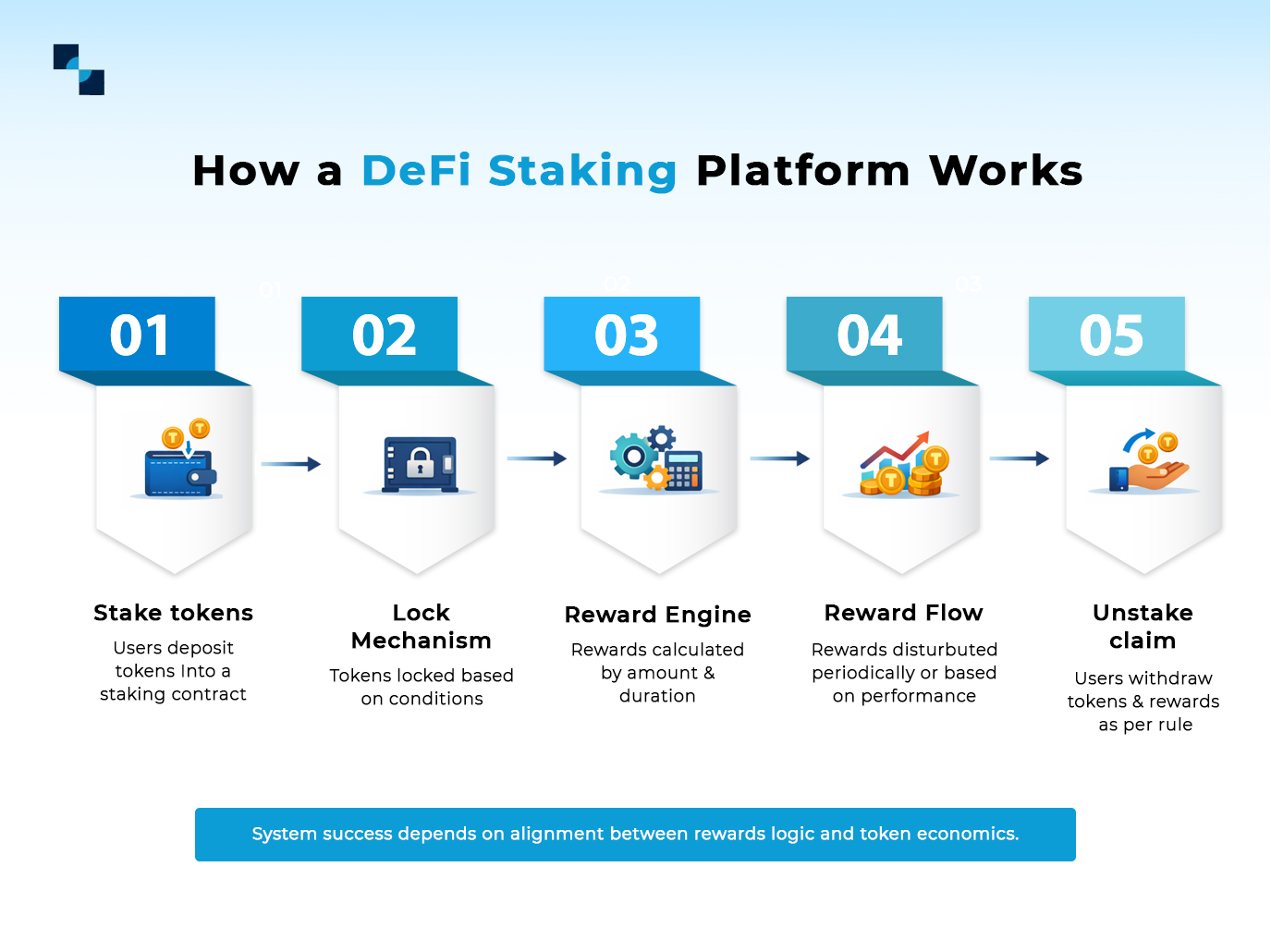
The effectiveness of a staking platform depends on how well its reward distribution aligns with token economics and user incentives.
Which Staking Model Should You Choose
Selecting the right staking model depends on your project goals, token structure, and user expectations. Each model serves a different purpose and comes with its own trade-offs.
| Model | Description | Risk Level | Suitable For |
|---|---|---|---|
| 1. Fixed Reward | Predefined returns | High sustainability risk | Early-stage projects |
| 2. Dynamic Reward | Based on protocol performance | Moderate | Growing ecosystems |
| 3. Liquid Staking | Tokenized staked assets | Smart contract exposure | Advanced users |
| 4. Validator Based | Network participation model | Complex setup | Layer 1 networks |
The right model depends on how you want users to interact with your platform and how rewards are structured within your ecosystem.
Step-by-Step: How to Build a DeFi Staking Platform
Step 1: Define Objectives
- Retention?
- Yield generation?
- Governance?
Step 2: Design Tokenomics
- Emission rate
- Reward source
- Locking duration
Step 3: Choose Blockchain
- Ethereum (security)
- Solana (speed)
- BNB Chain (cost efficiency)
Step 4: Develop Smart Contracts
- Staking logic
- Reward distribution
- Emergency controls
Step 5: Wallet Integration
- MetaMask
- WalletConnect
Step 6: UI/UX Development
- Clean dashboards
- Real-time rewards
Step 7: Security Audits
- Third-party audits
- Bug bounties
Step 8: Launch & Monitor
- Performance tracking
- Reward optimization
A structured approach to Defi staking development reduces both risk and time-to-market.
Get a tailored architecture and cost estimate based on your token model and business goals.
How to Handle Regulatory and Compliance Risks in Staking Platforms?
- Assess regulatory classification: Determine whether your staking model could be treated as a financial or investment product in target jurisdictions.
- Evaluate jurisdiction-specific requirements: Regulations vary by region, so identify where your users are located and which compliance standards apply.
- Implement KYC and AML where required: Ensure user verification and transaction monitoring align with regional compliance expectations.
- Design responsible reward models: Avoid fixed or guaranteed returns that may trigger regulatory scrutiny; prefer performance-linked or utility-driven rewards.
- Maintain transparency and documentation: Clearly define reward logic, smart contract behavior, and risk disclosures for users and regulators.
- Conduct regular audits: Independent smart contract audits improve trust and reduce operational risk.
- Align custody structure with regulations: Decide between custodial and non-custodial models based on compliance and user control requirements.
- Consult legal and compliance experts early: Proactive guidance helps avoid redesigns, delays, and potential regulatory issues.
How Much Does a DeFi Staking Platform Cost?
The effort required to build a DeFi staking platform depends on the scope, design complexity, and level of customization involved. Key factors include the type of staking model you choose, such as fixed, dynamic, liquid, or validator-based systems, as each requires a different level of logic and infrastructure. The choice of blockchain network also influences development, given variations in performance, tooling, and ecosystem compatibility.
Smart contract complexity is another major factor, especially when incorporating advanced reward logic, locking conditions, or multi-token support. User interface expectations, including dashboards and real-time analytics, further shape the development effort. In addition, security requirements, such as audits and risk controls, and integrations, such as wallets or cross-chain functionality, can significantly impact the overall build process. A well-defined architecture helps streamline development and ensures efficient execution.
Common Mistakes to Avoid
Designing a staking platform without proper planning can weaken both user participation and token performance.
- Setting high reward rates without economic backing.
- Ignoring emission controls results in an excessive token supply.
- Skipping smart contract audits and security validation.
- Creating complex user flows that discourage participation.
- Overlooking liquidity planning alongside staking mechanisms.
Future Outlook for DeFi Staking
Staking is evolving toward more adaptive and performance-driven models as the ecosystem matures. Reward systems are increasingly optimized with data-driven, AI-based mechanisms that adjust incentives based on participation, demand, and protocol performance. Cross-chain staking is expanding access to liquidity by enabling users to participate across multiple networks without fragmentation. At the same time, revenue-linked reward structures are replacing purely emission-based models, creating more balanced and sustainable systems. With growing institutional interest, there is also a stronger focus on security, compliance, and infrastructure reliability, shaping a more mature and scalable future for staking platforms.
Final Takeaway
If you are building or scaling a token ecosystem, staking is not optional. It is the system that determines how users participate, how rewards are distributed, and how your token behaves under real market conditions. The real question is not whether you need staking. It is whether your staking model is designed to sustain participation, control supply, and align incentives with actual value creation.
This guide gives you the clarity to move from idea to execution with confidence. From architecture to token economics, you now have a structured path to build a staking platform that performs as expected. For teams looking to move forward without trial and error, Antier provides the expertise to design and deliver staking platforms that are secure, scalable, and aligned with your ecosystem goals.
Frequently Asked Questions
01. Why do most token launches fail?
Most token launches fail not due to poor marketing, but because they lack mechanisms to retain capital after the initial hype fades, leading to decreased engagement and value.
02. What is a DeFi staking platform?
A DeFi staking platform is a blockchain-based system where users commit tokens to earn rewards based on predefined rules, encouraging holding behavior, reducing circulating supply, and strengthening ecosystem participation.
03. Why is staking critical for token success?
Staking is critical for token success because it introduces structured incentives that enhance user engagement, control token supply, and promote consistent participation, ultimately supporting sustainable growth of the ecosystem.