




✨ AI Summary
- In a world where banks have long held a monopoly over financial services, crypto exchanges are now challenging this status quo.
- Platforms like Coinbase and Crypto.com are expanding beyond trading to offer a range of financial services, aiming to become all-in-one financial hubs.
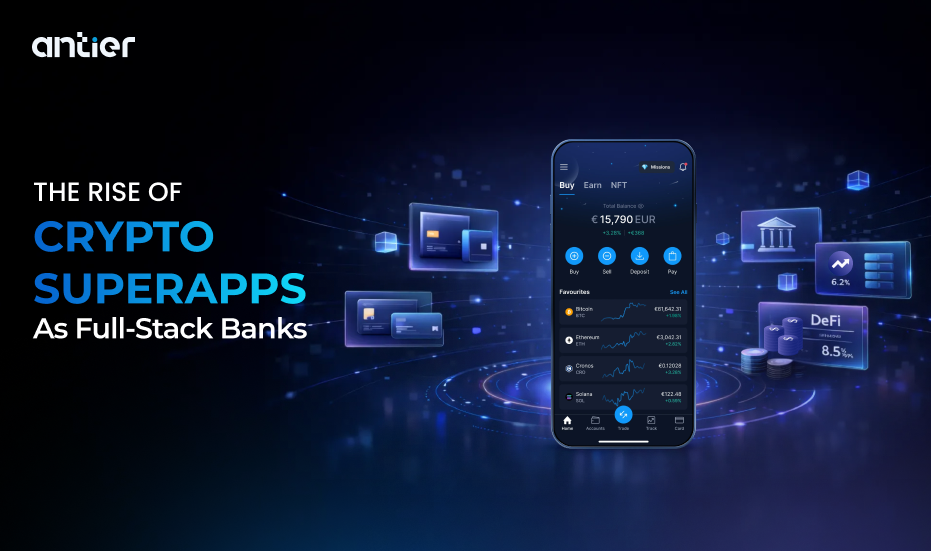
- These "crypto superapps" combine trading, payments, lending, staking, and more in a single platform, offering users a seamless financial experience.
- By leveraging innovative technologies like smart contracts and decentralized identities, these superapps are revolutionizing the traditional banking model.
- Unlike traditional banks with fragmented services and legacy infrastructure, crypto exchange superapps provide a unified, programmable financial ecosystem that allows for fluid movement of capital and assets.
For decades, banks operated as vertically integrated monopolies over money. If anyone wanted to store value, move funds, earn yield, or access credit, they had to go through a licensed intermediary with branch networks, correspondent banking relationships, and legacy core infrastructure.
Crypto exchanges, originally built around order books, matching engines, and custody for trading digital assets, are now challenging these incumbents. Over the past few years, they have been accumulating financial primitives, expanding beyond trading into payments, lending, staking, remittances, etc.
Coinbase, a leading crypto exchange software platform, has openly announced ambitious plans to reinvent the global financial landscape. In the words of Brian Armstrong, its CEO:
“Ultimately, we want to be a bank replacement for people.”
At the core of their strategy sits “crypto superapp development”, a cumulative nomenclature for the launch of an umbrella of financial services. Their ultimate goal is to build an “open financial system for the world,” and Coinbase isn’t alone in the pursuit. Similar to Coibase, Crypto.com has been aggressively bundling trading, payments, cards, and yield products into a unified ecosystem to compete head-on with retail banks.
Top Crypto Exchange Platforms Building Their Superapps
| Brand | Latest Strategic Move | Date | The Pivot (Why it’s a Super App) |
|---|---|---|---|
| Coinbase | The “Everything Exchange” | Jan 2026 | Exchange → All-in-One Wealth Hub: Merged Crypto with Stocks, Commodities, & Prediction Markets. Repositioned Base as the underlying OS for identity and payments. |
| OKX | The “On-Chain Portal” | Jan 2026 | Exchange → Web3 Gateway: Fully unified their CEX and non-custodial Wallet. Users now manage CeFi trading, DeFi yields, and NFT marketplaces in one seamless interface. |
| Crypto.com | The “Banking Level Up” | Dec 2025 | Exchange → Digital Bank: Bundled High-Yield Checking, Stock Trading, and Credit Cards into a single subscription, effectively replacing traditional retail bank apps. |
| Jupiter | The Solana “Front Door” | Mid 2025 | Aggregator → OS: Consolidated every Solana primitive (Swaps, Perps, Bridge, Launchpad) into one interface, aiming to bypass external wallets entirely. |
| Binance | The “Mini-Program Platform” | Early 2025 | Exchange → Lifestyle App: Expanded their “Marketplace” to include travel booking, ride-hailing, and gaming, all powered by Binance Pay. |
| Farcaster | The “Wallet-First” Pivot | Dec 2025 | Social → Fintech: Shifted to a Venmo-for-Crypto” model where the Wallet is the core product, and the Social Feed supports the transactions. |
What are Crypto Exchange Superapp?
A crypto exchange superapp is a unified financial platform combining trading, payments, remittances, custody, lending, staking, and other everyday financial services. It does not operate as a standalone exchange with bolt-on features, but as a consolidated financial operating system where capital and identity move across services without leaving the platform.
In practical terms, the same funds can:
- Trade spot or derivatives
- Earn yield
- Collateralize loans
- Payments and remittances
- Power debit card transactions
This way, crypto exchange software acts as a financial rail, which, unlike any single-purpose trading engine, is difficult to replace.
Core Characteristics of Crypto Exchange Superapp Platform Architecture
1. Identity & Access Layer
- Single Sign-On (SSO)
One session unified authentication across trading, payments, lending, custody, and other modules.
- Self-Custodial Wallets in Centralized Ecosystems:
Non-custodial wallets in centralized exchanges act as digital passports across ecosystems.
- Decentralized Identity (DID)
Blockchain-based identity frameworks allow users to control credentials and selectively disclose data.
- Enhanced Security Protocols (MFA + Biometrics)
Layered authentication to protect high-value accounts and mitigate custodial risks.
2. Wallet & Asset Infrastructure
- Multi-Currency Support
Consolidated custody of crypto, NFTs, stablecoins, tokenized assets, and fiat representations in a single wallet.
- Cross-Chain Compatibility
Bridges and interoperability layers enabling asset movement across blockchains without exiting the ecosystem.
- Real-Time Balance Synchronization
Instant ledger updates reflecting trading, staking, payments, and lending activity.
- Programmable Wallets:
Wallets whose funds can be governed by smart-contract logic enable automated payments, collateral management, yield routing, and policy-based spending within a single account.
- Payments Infrastructure:
With on/off ramps and stablecoin rails integrated in crypto exchange development, exchanges can power payments and cross-border transfers.
3. Capital & Financial Logic Layer
- Smart Contracts
Automated execution of lending, staking, collateral management, and settlement logic across crypto exchange software.
- Customizable Financial Products
Composable financial primitives allowing structured products, automated yield strategies, or synthetic exposure.
- Interoperability with DeFi Protocols
Native integrations enabling access to external liquidity pools, lending markets, or derivatives platforms.
4. Developer & Ecosystem Layer
- Open API Architecture
Modular APIs allow third-party integrations without disrupting core infrastructure.
- Extension Marketplace
A plug-in economy for analytics tools, trading bots, financial modules, or payment services.
- Community-Driven Development
Governance and developer participation to evolve the superapp beyond a closed product model.
Core Functional Capabilities of Crypto Exchange Superapp Platform
- Spot & Derivatives Trading
- Lending & Borrowing Markets
- Staking & Yield Products
- Stablecoin-Based Payments
- Debit / Prepaid Card Integration
- Cross-Border Remittances
- Store-of-Value Infrastructure
- Fiat-To-Crypto Payment Rails
- Liquidity Routing and Internal Transfers
- Tokenization Infrastructure
- Collateralized Credit Lines
- Treasury and Cash Management Tools
- On-Chain Wealth Products
- Recurring Payments and Subscriptions
- Merchant Payments
Antier’s white label cryptocurrency exchange has top-notch features, enabling businesses to build a crypto exchange superapp with 2X cost and time savings compared to custom builds.
Why are Traditional Banks Structurally Vulnerable?
Best Crypto exchange superapp platforms don’t merely add financial services to their existing financial services stack, but they consolidate them into a single programmable infrastructure. Traditional banks, by contrast, remain bound to institutional, technological, and regulatory structures that fragment capital and slow financial operations.
- Legacy Infrastructure Constraints
Many global banking institutions still operate on core platforms designed decades ago for batch processing, jurisdictional segregation, and intermediary settlement. They were not built for real-time global finance, as a result:
- Transaction finality depends on clearing networks rather than direct settlement.
- Cross-border transfers require correspondent banking layers.
- Product systems (cards, loans, deposits, brokerage) run on separate ledgers.
- Real-time capital mobility across services is limited.
Even modern digital banking interfaces typically sit above this legacy core rather than replacing it. As cryptocurrency exchange software evolves into superapps, it settles transactions directly on-chain and maintains unified ledgers, enabling instant finality and native global transfers without correspondent banking.
- Fragmented Financial Services
Banks provide a wide range of financial services, but institutional silos plague every layer and service. Fund deposits, credit, payments, and investments are managed as distinct balance environments with separate risk and accounting structures, leading to
- Multiple accounts for different financial functions
- Delayed transfers between internal products
- Capital trapped within service boundaries
- Limited reuse of collateral across services
The user experiences one brand, but the underlying financial state is partitioned. Capital cannot move fluidly across functions without explicit transfers or approvals. Modern-day crypto exchange software or multi-service crypto exchange apps operate on a single collateral and balance environment. This allows the same capital to move fluidly across trading, lending, payments, and investing without account fragmentation.
- Structural Cost and Compliance Burden
Banking models depend on regulated intermediaries, physical distribution, and jurisdiction-specific licensing. These requirements introduce fixed costs and operational friction that digital-native financial platforms do not carry in the same form.
Key constraints include:
- Branch and compliance infrastructure
- Capital reserve requirements tied to deposits and lending
- Jurisdictional licensing and reporting obligations
- Multi-party transaction chains (issuer, acquirer, networks, correspondent banks)
These structures are essential for regulated banking stability, but they also limit product agility, geographic expansion speed, and service integration.
Best crypto exchange superapp platforms replace intermediary-heavy transaction chains with programmable settlement and API-native distribution, reducing operational layers while expanding service reach digitally.
TL, DR: Banks aggregate services, whereas superapps integrate them. This distinction explains why multi-service crypto exchange apps can replicate core banking functions without inheriting the same structural limitations.
How Crypto Exchange Superapp Platforms Differ From Other Financial Models
| Dimension | Traditional Crypto Exchanges | Fintech Neobanks | Conventional Banks | Crypto Exchange Superapps |
|---|---|---|---|---|
| Primary Scope | Asset trading | Digital banking UX | Full-service banking | Unified financial platform |
| Service Integration | Siloed products (trading, staking separately) | Integrated UI, fragmented backend | Departmental silos (loans, deposits, brokerage) | Fully unified services |
| Settlement Layer | Exchange ledger | Bank rails | Bank rails & clearing networks | On-chain settlement |
| Asset Types | Crypto only | Fiat-centric | Fiat & securities | Crypto + fiat + tokenized RWAs |
| Payments | Limited | Domestic & card | Domestic & international | Global stablecoin rails |
| Yield Model | Staking / promos | Savings interest | Deposits & lending margin | On-chain yield + lending + staking |
| Liquidity Mobility | Transfers between products | Account transfers | Inter-account transfers | Single collateral pool |
| Operating Hours | 24/7 trading | Banking hours + cards | Banking hours | 24/7 all services |
| Programmability | Low | Low | None | Smart contracts & composability |
| Cross-Border | Exchange transfers | SWIFT/partners | SWIFT/correspondent banks | Native global transfers |
| User Custody Model | Custodial | Custodial | Custodial | Custodial + self-custody hybrid |
| Financial Architecture | Trading platform | Digital bank frontend | Legacy bank stack | Financial operating system |
The Superapp Model and The Future of Banking
Multi-service crypto exchange software apps are not simply replicating banks in digital form. They are reconstructing banking as a modular, programmable financial stack where custody, payments, credit, and investment operate on the same capital base and settlement layer. They scale faster than traditional banks because they expand from a unified digital infrastructure rather than institutional silos. Built on programmable settlement, API-native architecture, and borderless asset rails, they can extend financial services globally without the physical, regulatory, and intermediary layers that constrain banking expansion.
This structural advantage of modern-day crypto exchange software development compounds over time:
- Borderless by design: Services launch globally wherever digital asset access exists, not where banking licenses and branches are established.
- API-first evolution: New financial modules integrate into the same account and liquidity environment instead of creating new product silos.
- Composable finance: Trading, payments, lending, and yield interoperate on shared collateral rather than separate balance sheets.
- Rapid deployment cycles: Financial features ship as crypto exchange software integrations rather than institutional product launches.
If this model continues to mature, the banking functions will detach from the banking institutions, causing
- Payments to settle directly on stablecoin rails rather than correspondent networks
- Savings and yield to migrate to programmable asset vaults
- Credit to emerge from collateralized on-chain liquidity pools
- Capital markets to operate continuously on digital settlement layers
This way, the financial services remain, but their institutional container changes.
Antier, a leading crypto exchange software development company, enables enterprises to launch fully integrated crypto exchange superapp platforms that unify trading, payments, custody, and on-chain finance into a single programmable financial platform.
Frequently Asked Questions
01. What are crypto superapps and how do they relate to traditional banking?
Crypto superapps are platforms that integrate various financial services such as trading, payments, lending, and staking into a single application, challenging traditional banks that have historically monopolized these services.
02. What is Coinbase's vision for the future of finance?
Coinbase aims to reinvent the global financial landscape by becoming a bank replacement, focusing on developing a comprehensive "crypto superapp" that offers a wide range of financial services under one umbrella.
03. How are other crypto exchanges like Crypto.com and OKX adapting to compete with banks?
Other crypto exchanges are evolving by bundling services such as high-yield checking, stock trading, and DeFi functionalities into unified platforms, effectively positioning themselves as alternatives to traditional retail banking apps.