




✨ AI Summary
- Bitcoin's evolution from a static store of value to a dynamic DeFi powerhouse is revolutionizing the landscape for investors and enterprises alike.
- With a surge in demand for Bitcoin-native DeFi yield and credit structures, Richard Green highlights the shift towards utilizing Bitcoin as an asset that adds yield.
- The potential for unlocking liquidity pools and tapping into a multi-billion-dollar market is enticing for those looking to leverage Bitcoin's security and Ethereum's programmability on Layer 2 platforms.
- Building a BTC L2 DeFi lending platform in 2026 offers numerous benefits, from security and scalability to AI-driven optimizations and institutional appeal.
- The blog post delves into the latest trends, challenges, and steps involved in developing a successful BTC L2 DeFi lending platform, emphasizing the vast potential for growth and revenue streams in this evolving ecosystem.
“People holding Bitcoin, whether on the balance sheet or as investors, increasingly see it as a pot just sitting there. They still want it to be a utilized asset. It can’t just sit there doing nothing; it needs to be adding yield.”
Richard Green (Director of Rootstock Institutional)
Bitcoin’s reputation has evolved significantly from its value preservation narrative to a programmable infrastructure powering yield for holders without leaving the network. This indicates a surge in demand for Bitcoin-native DeFi yield and credit structures. And it is evident from Green’s statement:
“We’re seeing demand for BTC-backed stablecoins and credit structures that let miners, remittance firms, and treasuries unlock liquidity while staying in Bitcoin.
As the crypto holding “digital gold” stature steps into the DeFi with maturing Bitcoin L2s and their ecosystems, lending is a use case gaining institutional traction.
If you’re an investor, enterprise, or dApp owner, a BTC L2 DeFi lending platform development unlocks your chance to multi-billion dollar liquidity pools built on the most secure blockchain ever created.
BTC DeFi Lending Market Insights
- Explosive Growth Potential: Bitcoin DeFi TVL surged 2,700% from $307 million in early 2024 to $8.6 billion by Q2 2025.
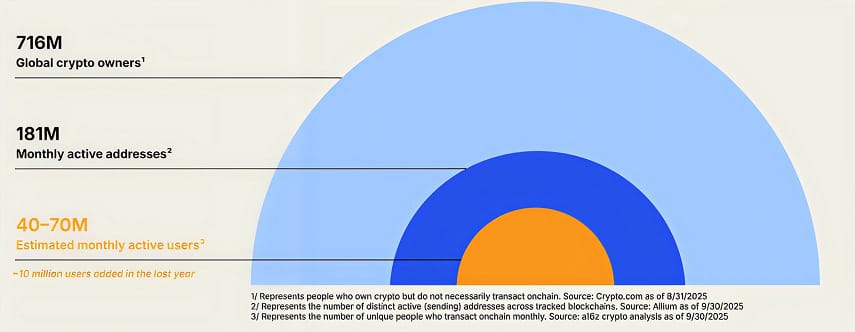
- Institutional Appeal: As of 2025 H1, 354 million people owned Bitcoin (4.1% YoY increase from 340 million), representing 50.1% of global crypto owners, which stood at 709 million by mid-2025. Bitcoin-native DeFi lending platforms, if done strategically, have the potential to unlock hundreds of billions in BTC liquidity for lending and tokenization.
- Lending Market Cap: The total value locked in DeFi reached a high of $169 billion, and TVL in lending protocols reached $89.9 billion in Oct 2025. Yet BTC-based lending protocols accounted for less than 5 percent of TVL in lending protocols, despite Bitcoin representing over 50% of global crypto market capitalization, presenting a huge opportunity for builders.
- BTC DeFi Potential & Challenges: BTC DeFi lending platform development can typically offer annual yields of approximately 5-10%, with some exceptional program integrations stretching it to 15%. Bridge security and evolving regulatory hurdles remain the most prominent challenges for institutional adoption and mainstream lending on BTC L2s.
- Emerging Trends: AI-driven yield optimization, trust-minimized bridges via BitVM, and modular architectures are accelerating BTC L2 adoption. Bitcoin’s current growth highly resembles Ethereum’s 2019 era.
Why Build A BTC L2 DeFi Lending Platform in 2026?
Bitcoin’s layer 2 solutions are transforming it from a static store of value into a dynamic DeFi development powerhouse, enabling lending and borrowing without compromising its legendary security. For investors, enterprises, and dApp owners, this means tapping an untapped market with phenomenal potential.
What are the Benefits of DeFi Lending Platform Development on Bitcoin Layer 2s?
- Security of Bitcoin, the most battle-tested base layer.
- Programmability of Ethereum, through EVM-compatible L2s like Rootstock and BOB.
- Scalability and lower fees, via modular rollups and trust-minimized bridges.
The ecosystem is new enough for first-movers to dominate niches, but mature enough that the plumbing (bridges, oracles, stablecoins) finally works. Early movers like Avalon Labs on Rootstock and Zesty protocol on Stacks experienced exponential growth within a few months of launch. Arkade, a high-potential Bitcoin Layer 2, launched quite recently. We can expect more lending protocols to emerge on such protocols.
Build Your BTC DeFi Lending Platform With Antier
What are the Latest Trends in BTC L2 DeFi Lending Platform Development?
The BTC L2 ecosystem is converging on hybrid models that combine the EVM’s versatility with Bitcoin’s trustlessness and security. Here’s a deeper dive into key trends defining BTC L2 DeFi Lending:
1. RWA-Backed Borrowing
Following the introduction of the Genius Act and BlackRock’s BSTBL fund, it is likely that tokenized real estate will reach $4 trillion by 2035. BTC L2s like Mintlayer and Liquid network are enabling secure tokenization and issuance, making tokenized assets available for lending collateral and reducing counterparty risks for institutions.
2. AI-Powered Protocols:
DeFi lending platforms are integrating AI agents for automated rebalancing in lending vaults, as seen in Antix-inspired models on Stacks. AI can further enhance risk assessment and scoring, decision making, predictive analysis, fraud detection, real-time loan and market monitoring, customer interactions, and various other crucial functions in DeFi lending platform development. AI-based DeFi models on Stacks predict volatility and auto-adjust collateral ratios, boosting efficiency by up to 30%.
3. Trust-Minimized Bridges:
Security remains the biggest DeFi liability to date. Solutions like BitVM, Portal Network, and zk-proofs reduce hack risks, powering cross-chain liquidity for multi-asset loans.
4. Institutional Inflows:
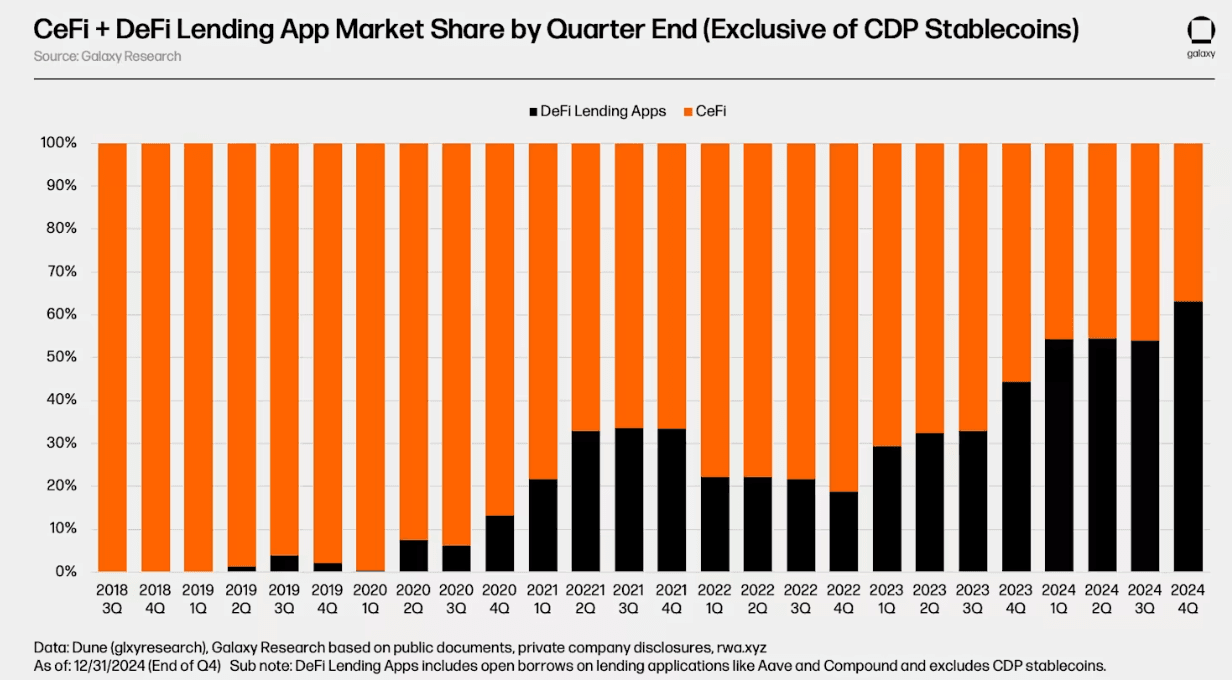
DeFi lending now dominates CeFi at 69% market share, driven by BTC ETFs, and enterprise migrations to L2s like Rootstock and Stacks. It is the first time that decentralized liquidity outpaced centralized models. Institutions are migrating from CeFi yield desks to on-chain BTC L2 protocols for DeFi lending platform development.
5. Overcollateralized BTC Loans:
Overcollateralized Bitcoin loans, where borrowers deposit more BTC than the loan value (typically 150-200%), emerged as a primary safeguard against defaults. Crypto.com’s October 2025 Morpho-Cronos tie-up introduced overcollateralized stablecoin credit lines against wrapped BTC (up to 8% APY, $150 M TVL surge). With BitVM bridges and native BTC L2 collateral ports, such models could eliminate wrappers, boost cross-chain liquidity by ~30%, and deliver RWA-fused, compliant yields above 12%, mirroring Coinbase’s DeFi pivot but anchored in Bitcoin’s core security.
How to Build Your BTC L2 DeFi Lending Platform in 2026?
Here’s a high-level funnel for launching your platform, tailored for enterprises scaling from existing dApps:
Phase 1: Strategic Planning and Architecture (1-2 Months)
- Market Research: Benchmark against Zest (Stacks) or Sovryn (Rootstock) for gaps like AI-optimized rates. You can also target institutional needs with KYC-integrated KYC lines.
- Bitcoin Layer 2 Selection: You can choose from the best BTC DeFi development chains:
- Rootstock (powering Avalon Labs) for EVM compatibility and Solidity, making it easier for migration.
- Stacks (home to Zest and GraniteBTC) for its PoX consensus and language clarity ensuring secure contracts.
- Merlin/Hemi: AI-yield focus with 10x throughput via Nakamoto upgrades.
- BOB or Build on Bitcoin: Hybrid L2 with $240M TVL, integrating Uniswap/Aave for BTC yields.
- Other Tech Stack Considerations You can also include chainlink oracles, BitVM bridges and other essentials suggested by your DeFi lending platform development company.
- Business Modelling: At this phase, you define tokenomics (e.g, governance tokens for voting on collateral types) and liquidity mining mechanisms.
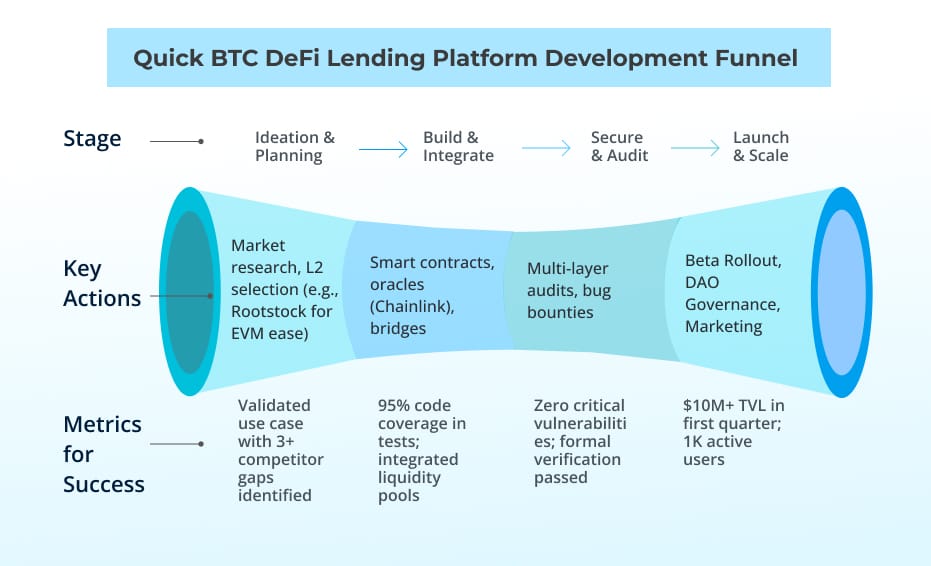
Phase 2: Core Development:
- Smart Contract Development: Collaborate with your DeFi lending platform development company to code modular lending logics that govern deposits, borrows, liquidations, etc. You can use overcollateralization with competitive yet dynamic rates that change as per supply/demand algorithms.
- Integrations: At this phase, you add multi-oracle feeds for BTC pricing and implement routers for cross-L2 liquidity (e.g., BTC to sBTC swaps).
- UI/UX for Enterprises: Join forces with your DeFi lending platform development company to build dashboards for yield tracking, with fiat on-ramps (for crypto and RWA) for investor accessibility.
Phase 3: Security and Compliance
- Audits: Engage with your DeFi lending platform development team to comprehensively audit the smart contracts and bridge integrations. They can also help you secure Certik or Trail of Bits certifications. This step also entails formal verification for liquidation math and fuzz testing for edge cases.
- Regulatory Scoping: Embed AML/KYT modules to attain compliance in most states. You can also prepare for GENIUS Act compliance on RWAs and securities by collaborating with legal experts at your DeFi lending platform development company. They can help you launch in crypto-friendly jurisdictions first and expand later by helping you secure more licenses from your desired jurisdictions.
- Bug Bounties: You must allocate atleaset $50k for community hunts that help scout oracle manipulations, bridge exploits, etc.
Phase 4: Testing and Infrastructure:
- Node Setup: Your DeFi lending platform development services provider deploys redundant nodes synced to Bitcoin via merged mining. They further monitor with Promethus for 99.9% uptime.
- Stress Testing: This is an essential part of testing where the tech provider simulates 10k concurrent loans and optimizes gas for lendings to $0.01 per trade.
- Off-Chain Indexing: Using the graphs, the DeFi development company can help you maintain queries and lending histories.
Phase 5: Launch and Iteration
- Phased Rollout: You must launch in phases. The first phase should be Beta with whitelisted enterprises and later you can plan full launch with DAO or set the pace as per your strategy.
- Growth Tactics: Partner with custodians and run yield farms to keep the platform alive. You can track KPIs, TVLs and borrow volume for liquidity while offering loans at competitive rates.
- Sustain Momentum: Quarterly updates may include AI agents for auto-liquidations or other AI-powered DeFi lending platform development enhancements.
DeFi Lending Platform Development: Costs, Timelines, ROI, and Challenges
DeFi lending platform development cost and timeline: Building a BTC DeFi lending platform from scratch may cost anywhere from $250k to $500k, depending on the project complexity and technologies used. And it typically takes around 12-14 weeks for a MVP and 10-12 months for a full-fledged launch.
Major BTC L2 DeFi lending platform development cost components include:
- Smart Contracts and Audits (includes 2-3 audit rounds)
- Bridge/Oracle Integrations (may include zk proofs integrations for security)
- Infrastructure and Testing (nodes, CI/CD pipelines)
- Compliance and Marketing (KYC tools, liquidity incentives)
But what are the revenue streams associated with DeFi lending platforms?
Those who are planning to build a DeFi lending infrastructure on BTC L2s can choose to implement the following revenue streams:
- Interest Rate Spread:
The core business model. Platforms earn from the difference between lending and borrowing rates, typically 3-8%, across overcollateralized BTC loans. Higher efficiency in rate algorithms and liquidity sourcing widens this margin. - Liquidation & Penalty Fees:
When borrowers fail to maintain collateral ratios (usually 150-200%), the platform executes liquidations and earns a fixed penalty fee (often 2-5%) per event. This reinforces risk control while adding steady revenue. - Origination & Service Fees:
A small fee (0.5-1%) charged when users initiate loans or redeem collateral. For institutional borrowers, these can scale into recurring service revenues tied to managed credit lines or RWA-backed loan portfolios. - Governance & Utility Token Economics:
Platforms that issue native governance tokens can capture platform fees, staking rewards, and DAO treasury inflows, creating circular revenue through protocol-owned liquidity and transaction gas. - Cross-Chain Liquidity & Bridge Fees:
As BTC L2 lending integrates BitVM or Portal Network bridges, platforms can charge micro-fees for cross-chain transfers, collateral swaps, or synthetic asset minting, adding 1–2% yield margin from transactional volume. - Institutional Credit Delegation:
Enterprises or verified lenders delegate funds to the protocol’s liquidity pool. The platform earns management and verification fees (usually 4-6%) while offering institutions compliant yield exposure without custody risk.
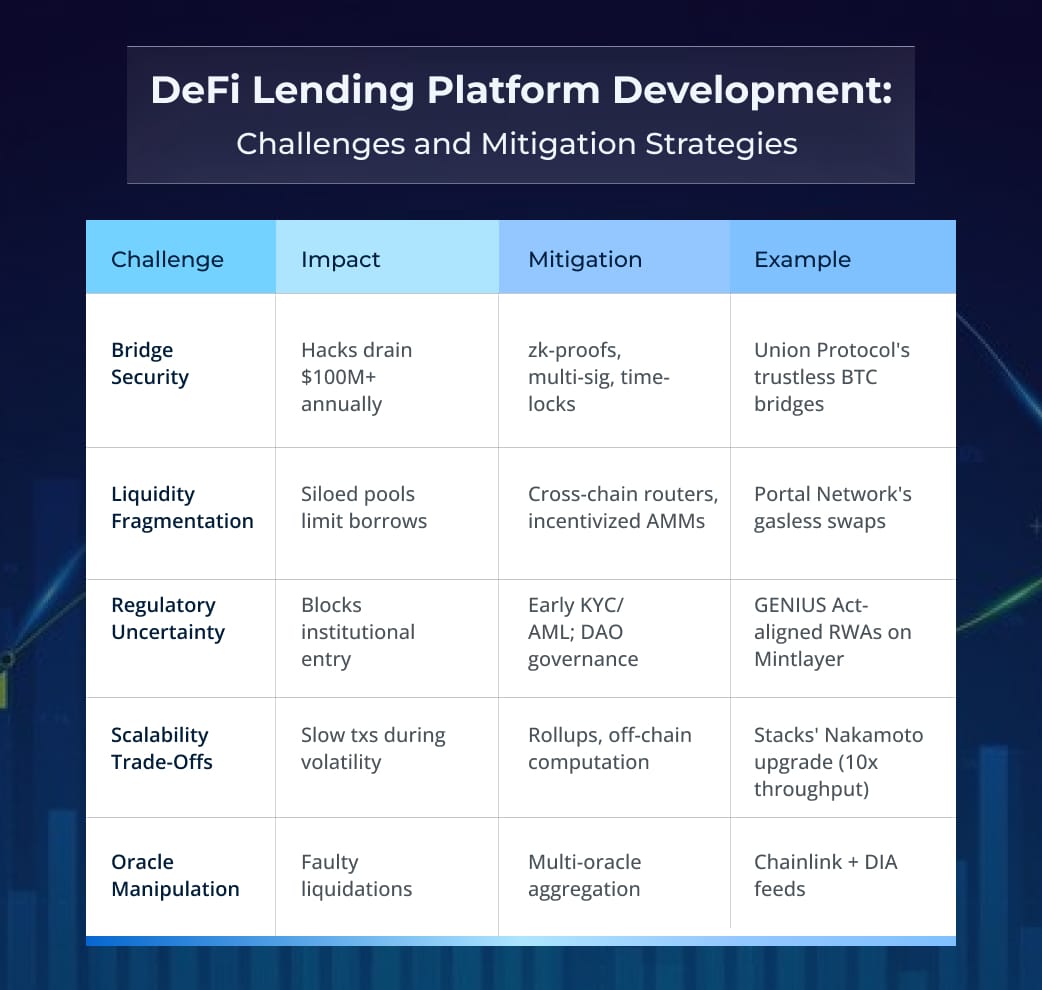
Earning this revenue isn’t a cakewalk as BTC DeFi lending isn’t without hurdles. Major risks that inflict the DeFi lending platform development on BTC L2s include centralization risks, liquidity silos, etc. Proactive designs can turn them into edges.
Seize the BTC L2 Opportunity
A few months ago Bitcoin was just a high valued digital asset with zero-to-minimal programability. With BTC L2 Era, it has been undergoing a renaissance. For investors eyeing 10-15% annualized yields, enterprises seeking compliant RWA lending infrastructures, existing tradFi instituions or dApp owners expanding into DeFi lending, BTC L2s offer first-mover white space. Unlike Ethereum’s mature (but congested) ecosystem, BTC L2 is in its “Ethereum 2019” phase: volatile, underdeveloped, and ripe for 300x upside if even 1-2% more BTC supply enters DeFi.
BTC L2 DeFi lending protocols can enable overcollateralized loans, flash borrowing, AI-enhanced rates optimization, and whatnot, all on Bitcoin’s secure rails. If you’re ready to migrate to or launch into a $2 trillion velocity engine, partner with Antier, a global blockchain leader excelling in DeFi lending platform development and enterprise-grade DeFi implementations. With more than 700 developers and subject matter experts with 20+ years of industry experience, they can help you in architecture design, smart contracts audits, compliance integrations and post-launch marketing. Antier brings the technical depth and industry insight to help you launch confidently into the Bitcoin DeFi era.
Connect and go grab your first $50M TVL ASAP.
Frequently Asked Questions
01. What is the current perception of Bitcoin among investors and enterprises?
Investors and enterprises increasingly view Bitcoin as a utilized asset that should generate yield rather than just sitting idle, leading to a growing interest in Bitcoin-native DeFi yield and credit structures.
02. How has the Bitcoin DeFi lending market evolved recently?
The Bitcoin DeFi Total Value Locked (TVL) surged 2,700% from $307 million in early 2024 to $8.6 billion by Q2 2025, indicating explosive growth potential and increasing institutional interest.
03. What are the potential yields for BTC DeFi lending platforms?
BTC DeFi lending platforms typically offer annual yields of approximately 5-10%, with some exceptional integrations potentially reaching up to 15%.