



✨ AI Summary
- NFT gaming has evolved from a niche experiment to a key component of modern digital economies.
- The blog explores the rising importance of NFT-powered ecosystems in creating immersive gaming experiences driven by value.
- With blockchain gaming infrastructure advancing, developers, publishers, and investors are recognizing the potential for sustainable interest in NFT games.
- The post highlights the significance of 2025 in NFT gaming, showcasing popular titles like Axie Infinity, Gods Unchained, Decentraland, The Sandbox, and Alien Worlds.
- These games offer real asset ownership, tradable value, and engaging gameplay mechanics, attracting a growing player base and fostering vibrant digital economies.
NFT gaming is no longer a niche – it is becoming an important part of modern digital economies. What began as a niche experiment in entertainment is evolving into a significant vertical within the business of games, where gameplay, asset ownership, and monetization models combine together to create exciting, immersive experiences driven by value. With the infrastructure surrounding blockchain gaming maturing, developers, publishers, and investors are starting to examine the real potential of NFT-powered ecosystems to sustain long-term interest. This shift is represented by the connected strategic role of an NFT game development company in creating games that are not just for fun – but built for scalability, interoperability, and relevance to the market.
Why 2025 Is the Year to Play, Invest, or Build in NFT Gaming
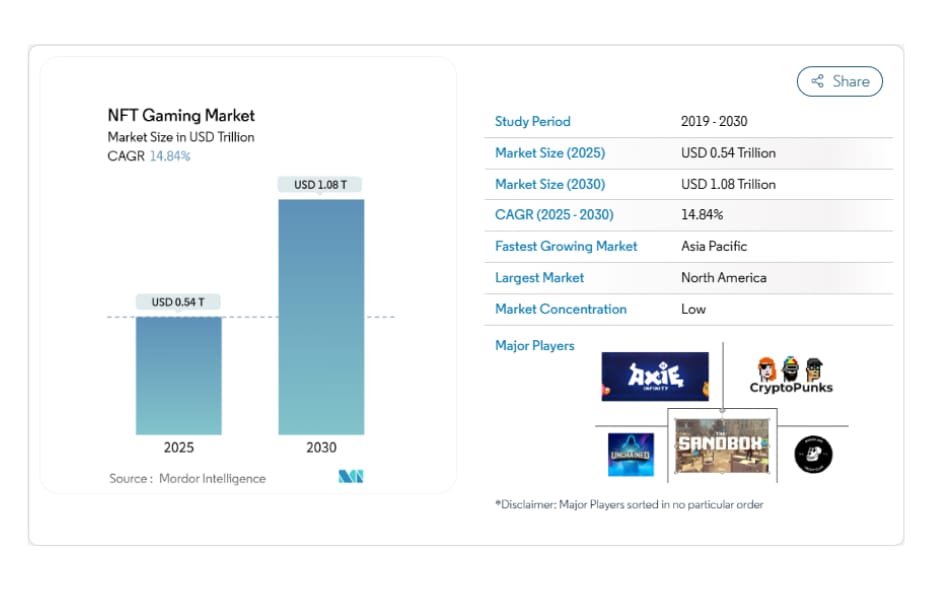
The ecosystem is coalescing. Scalable blockchain networks, gas-optimized smart contracts, and seamless wallets are lowering barriers and opening sophisticated revenue avenues for studios while making play for gamers less complicated. For gamers, 2025 represents more than just play – it introduces real asset ownership, tradable value, and progression through communities. For investors, the metrics are more defined: greater player retention, activity in marketplaces, and utility of tokens. And for the visionaries creating their own titles, this is the moment to partner with an NFT game development company that understands not just the mechanics of games but the architecture of the economy.
https://www.mordorintelligence.com/industry-reports/global-nft-gaming-market
Most Popular NFT games of 2025
2025 has ushered in a new era of mainstream recognition for NFT games. In just a few years, we have witnessed unparalleled adoption both in terms of player numbers and investment flows. Where, some time ago, NFT titles were appealing to only the early anime and Web3 enthusiasts, NFT games have grown into a well-loved medium for traditional gamers thanks to better mechanics, asset ownership, and the earning potential in the real world. NFT games are now not just a set of experimental mechanics or discovered by niche communities of players; they are attracting millions of active users, an established and often bountiful secondary market for digital assets, all with a vibrant digital economy.
The most played NFT titles this year have successfully married innovative storytelling, competitive gameplay, and on-chain utility that create ecosystems for players to become more than simply a participants in their game; they become stakeholders in their success. Growing player adoption mirrors a deeper shift in the profession’s ecosystem and objective: gaming value is becoming increasingly measured not only by installation downloads or daily active users, but by the level of success in delivering actual, ownable value as they leverage NFT game development.
1. Axie Infinity
Axie Infinity continues to exemplify the best of the Web3 gaming ecosystem in 2025 by fine-tuning its core gameplay and token utility. The battle-based premise allows players to breed, train, and battle their fantasy creatures called Axies, and is represented by an NFT that is unique to that specific NFT. The speed and low fees of the Ronin blockchain helped Axie create a player economy that was accessible and steady in terms of growth. Based on the model of two tokens (AXS and SLP), a season of tournaments, and staking capabilities, Axie was able to build a long-term value-based ecosystem. Although Axie Infinity is the first case study in NFT game development, it continues to inspire studios that want to build reward-based economies centered around collectibles.
- Dual-token economy (AXS & SLP) with real earning potential
- Runs on the custom-built Ronin chain for performance
- NFT breeding, battling, and marketplace infrastructure
- Global guild networks and player-owned economies
- Foundation model for scalable NFT game development
2. Gods Unchained
Gods Unchained is a TCG that leverages blockchain technology to elevate competitive players by combining traditional deck-building mechanics with verifiable NFT ownership and unique possibilities. The game is built on Immutable X, blockchain technology that allows gas-free minting and instant trades so that users fully own their in-game assets. Each of the cards is an NFT, meaning that they can be traded across external marketplaces, giving players ownership and financial freedom over their cards. For NFT game development companies looking to combine skill-based mechanics with monetizing assets in a well-received product, Gods Unchained provides a copybook on how to find a balance between competitive fairness and the benefits of blockchain rewards.
- Free-to-play TCG with NFT card ownership
- Built on Immutable X for zero gas fees
- Rewards skill-based progression and competition
- Strong secondary market for card trading
- Smart model for a competitive NFT game development company
3. Decentraland
Decentraland remains a case study in open-world metaverse paradigms, allowing users to purchase, own, and build a virtual land parcel in NFTs. Each virtual land parcel is programmable, tradable, and supplemented with monetary opportunities through events, games, or digital storefronts. Functioning as a decentralized application (dApp) under a DAO using the MANA token, Decentraland allows its community to continue defining the future of the platform. It is an example of how immersive and persistent environments can be structured using modular NFT game development approaches to decentralize ownership and user-driven development.
- No-code creation tools for NFT-based experiences
- Fully tradable LAND and asset economy
- Integrated NFT marketplace and staking model
- Brand partnerships with global IPs
- Creator-focused path for any NFT game development company
4. The Sandbox
The Sandbox has also established its merit as a creator-first metaverse that allows users to create, monetize, and trade voxel-based experiences. With game creation tools like Game Maker and VoxEdit, assets like NFT assets and interactive games can be created by a creator without coding expertise. The entire ecosystem is driven by the SAND token, allowing for land purchases, staking, and creator rewards. For any NFT game development company exploring UGC and brand engagement possibilities, The Sandbox demonstrates the benefits of modular world-building paired with ownership of assets.
- No-code creation tools for NFT-based experiences
- Fully tradable LAND and asset economy
- Integrated NFT marketplace and staking model
- Brand partnerships with global IPs
- Creator-focused path for any NFT game development company
5. Alien Worlds
Alien Worlds brings together GameFi mechanics and DAO governance to create a multi-planet exploration and mining ecosystem. Players use NFT tools and avatars to mine Trilium (TLM), take part in planetary elections, and contribute to decentralized models of strategy-building. With an operation across both WAX and BNB Smart Chain, this game creates true cross-chain asset management. As the combination of DeFi, governance, and games, this is an ideal case study on how NFT game development can transition, past just entertainment, and become a fully functioning economic ecosystem.
- Multi-chain gameplay with NFTs on WAX and BNB
- Idle mining, staking, and strategic gameplay loops
- DAO-driven planetary governance
- Rich DeFi integration and tokenized assets
- Expansive use case for layered NFT game development
Ready to Launch? We’re Your NFT Game Development Partner
At Antier, we do not only build games – we build digital economies that empower gamers, tap into communities, and generate long-term player investment. Being a full-service NFT game development company, we have talented blockchain engineers, well-versed game designers, and tokenomics specialists to create scalable, secure, and future-ready experiences in the gaming industry. Whether you want to launch a competitive NFT title, design interoperable assets, or create a metaverse ecosystem from scratch, our NFT game development capabilities can bring your vision to life. Connect with us to bring your idea into reality together; it might be the next benchmark in the gaming space.