



✨ AI Summary
- The blog post highlights the launch of India's first blockchain-based real estate tokenization platform, combining fractional ownership, AI valuations, and AR/VR visualization.
- It discusses why India is a strategic market for real estate tokenization, citing market growth, infrastructure readiness, investor demand for transparency, and regulatory openness.
- The post delves into the potential unlocked for businesses through tokenization, targeting different investor segments like retail, NRI, institutional, and developers.
- It also provides insights on the technology stack, revenue generation models, practical launch strategies, regulatory compliance, and competitive advantages.
- The platform aims to offer access, transparency, and liquidity to investors, positioning businesses as technology-driven and transparent real estate enterprises.
India has just witnessed the launch of its first home-grown blockchain-based real estate tokenization platform by combining fractional ownership, AI-led valuations, and AR/VR-powered property visualization. This milestone compresses every competitor’s roadmap and opens a new category for real estate and PropTech enterprises. Early entrants can now own investor funnels, proprietary data ecosystems, and recurring fee models through tokenization platforms white-labeled across assets and regions. As India’s policy framework evolves, it will unlock new opportunities for the tokenization platform owners. This guide explores why the Indian proptech industry is set to deploy real estate tokenization platforms, and investors and assets matter the most.
Why Is India the Strategic Market for the Real‐Estate Tokenization?
1. Market size & growth
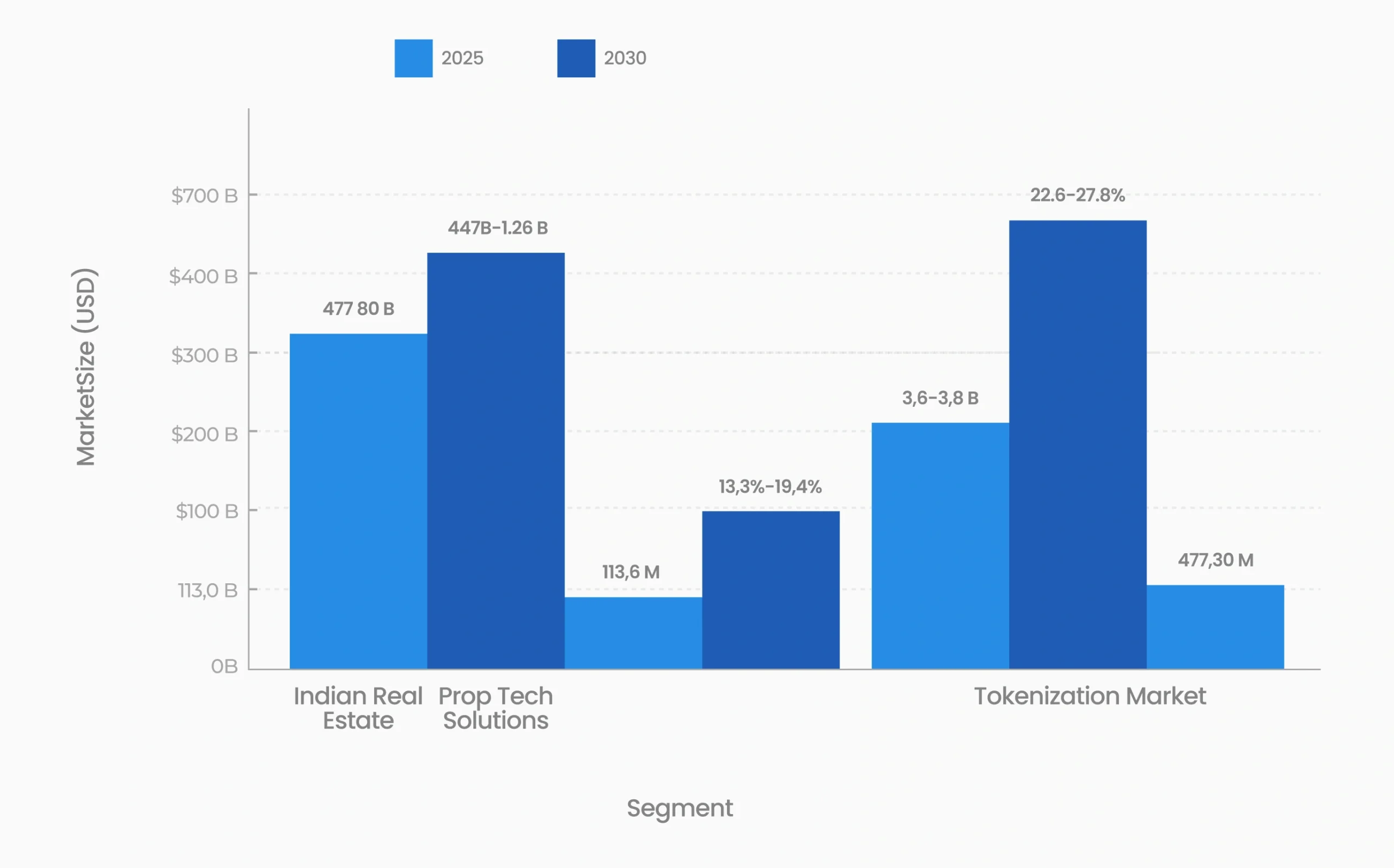
The Indian PropTech market was valued at approximately US $1.2 billion in 2024 and is projected to reach around US $3.6 – 3.8 billion by 2030, registering a CAGR between 13.3% and 19.4% depending on the segment definition.
At the same time, average transaction sizes across real estate investments are shrinking as investors diversify into smaller, fractional exposures. This shift is fueling demand for digitally fractionalized property ownership.
While India’s real estate tokenization market remains nascent (currently valued at under US $150 million), early adoption signals are promising, driven by improving regulatory clarity, PropTech maturity, and rising investor appetite for blockchain-enabled real estate.
2. Market is Infrastructure-Ready
Land record digitization under DILRMP, blockchain sandboxes at GIFT City, and aAI-enabled valuation systems have reduced the friction that previously made tokenization impossible. The infrastructure is catching up with the idea.
3. Investors Are Actively Searching for Transparency
Domestic investors want data-backed returns; NRIs want accountability without paperwork; institutions want verifiable audit trails. Tokenization answers all three demands simultaneously.
4. Regulators Are Signaling Openness
IFSCA’s real-world-asset sandbox, SEBI’s SM REIT framework, and the government’s stated interest in blockchain for recordkeeping collectively indicate a direction, not resistance. The environment is not lawless — it’s formative.
Launch Real-Estate Tokenization Platform with on-chain KYC, Custody, and Liquidity modules tailored for Indian Regulations
What Real-Estate Tokenization Can Unlock for Businesses in India?
With Tokenization, business owners can convert their real estate companies into financial platforms. By fractionalizing ownership through blockchain, Indian developers, PropTech firms, and asset managers can turn static assets into dynamic, income-generating products with built-in liquidity and data intelligence.
Each token, tied to an SPV and verified on-chain, becomes a compliant financial instrument that is fully transparent, divisible, and programmable. Smart contracts automate yield distribution, voting rights, and exits, eliminating manual friction.
For enterprises, this model creates three tangible advantages:
- New capital access: attract retail, NRI, and institutional investors without traditional fundraising bottlenecks.
- Recurring digital revenue: earn issuance, management, and secondary-trade fees long after construction is complete.
- Data-driven advantage: every transaction builds a proprietary dataset on investor behavior, asset performance, and market liquidity.
Who Proptech and Real-Estate Firms Can Target With Tokenization Platform (and Why They’ll Buy)
Every platform needs a clear demand side. India’s investor ecosystem is fragmented, but tokenization appeals across segments when positioned correctly.
1. The Digitally Native Retail Investor
These are India’s new-age wealth builders already investing through UPI, digital gold, and mutual-fund apps. They seek verified, low-barrier entry into real estate with ticket sizes starting at ₹1 lakh. Transparent ownership, instant onboarding, and credible on-chain verification drive their trust.
Why they buy: Real-estate exposure with entry tickets starting at ₹1 lakh; on-chain verification replaces brokerage dependence.
What they need from the platform: Simplified onboarding, mobile dashboards, periodic performance updates, and confidence that the tokens actually map to a real asset.
2. The NRI Investor Segment
The NRI People send over USD 120 billion annually to India but face barriers in property purchase and management. Tokenized real estate eliminates those barriers and enables these investors to participate in India’s property market securely and efficiently.
Why they buy: Seamless entry via IFSC or NRI accounts, digital proof of ownership, and virtual asset monitoring.
Platform expectation: Automated compliance, 24×7 accessibility, secure remittance rails, and clear repatriation mechanics.
3. The Institutional and Family-Office Investor
Institutional and family-office investors prioritize governance, compliance, and liquidity over sentiment. They allocate capital only to ring-fenced, audited SPVs with transparent cash flows. Tokenized assets appeal by offering verifiable ownership, automated reporting, predictable yields, and efficient exits aligned with institutional-grade investment standards.
Why they buy: Tokenized SPVs create smaller, diversified exposures with transparent reporting and optional liquidity windows.
Platform expectation: Institutional dashboards, ESG scoring, audited valuations, and secondary-market mechanisms.
4. The Developer and Asset-Owner Network
Many mid-sized developers lack digital distribution infrastructure
Why they join: Access to a new capital-raising channel and a broader investor pool
Platform expectation: White-label issuance modules, legal-document automation, and compliance support.
A tokenization platform designed around these four personas builds a demand engine that sustains itself.
Where to Launch a Real-Estate Tokenization Platform in India: India-Specific Location Strategy
Following are some Shortlisted cities to target with the Real-Estate Tokenization Platform in India based on three filters—(A) title/record readiness, (B) market depth, (C) story investors understand.
- Ahmedabad–Gandhinagar (Gujarat) / GIFT City sphere: administrative receptivity, IFSC framework, strong infrastructure narrative. Ideal for pilot showcases and cross-border investor communication.
- Peripheral Bengaluru: north and east belts with infra catalysts. Title diligence still matters, but demand depth is proven.
- Hyderabad growth corridors: logistics, IT spillovers, and steady absorption.
- Pune (west/north): manufacturing + IT blend; good investor familiarity.
- Select Tier-II nodes with digitization progress (e.g., Karnataka’s paperless drive is a confidence signal to investors who worry about records).
GIFT City has emerged as India’s regulatory sandbox hub for tokenized RWAs, with IFSCA issuing a consultation paper and observers noting conditional approvals for tokenization platforms. For real estate players, that’s a credible venue to structure pilots and learn transfer, disclosure, and custody mechanics under a supervisor’s lens.
How Enterprises Can Build a Compliant Real Estate Tokenization Platform: The Technology Stack That Makes It Work
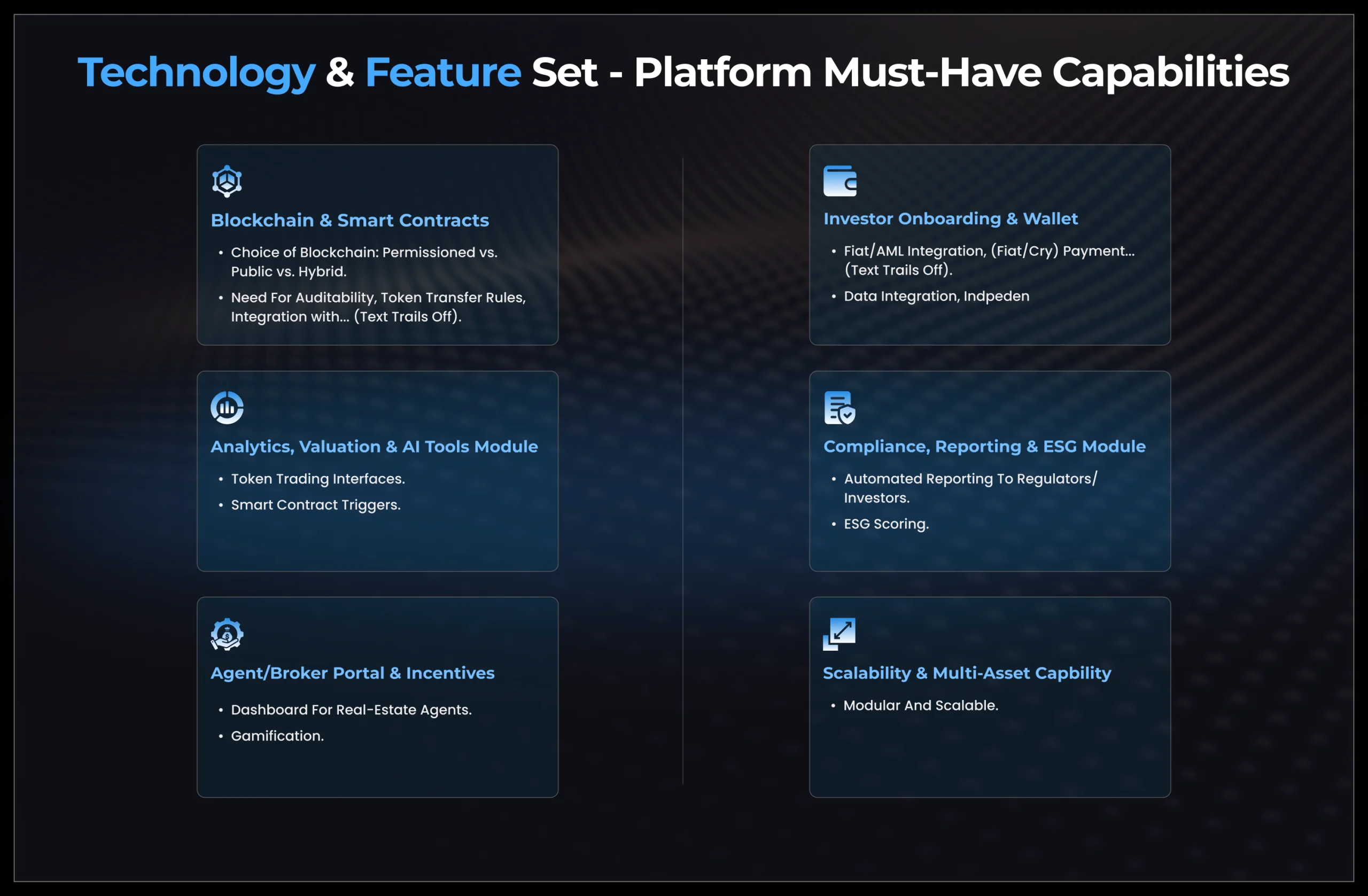
| Component | Purpose | Implementation Insight |
|---|---|---|
| Blockchain Ledger | Immutable ownership registry | Permissioned network hosted across multiple data centers for redundancy. |
| Smart Contracts | Business logic automation | Modular templates; parameterized for each SPV |
| Identity Engine | Investor Verification | Multi-Party Computation wallets or regulated custodians. |
| AI Valuation Models | Data-driven pricing | Machine-learning algorithms using micro-market data, transaction comps, and satellite imagery. |
| AR/VR Visualization | Investor confidence | Drone capture, BIM models, and 3D rendering embedded in dashboards. |
| Agent Ecosystem Module | Distribution scalability | CRM-grade lead management, digital visiting cards, and commission automation. |
| Compliance Engine | Regulatory Comfort | On-chain audit logs, ESG tagging, and real-time suspicious-activity monitoring. |
The Economics: How Businesses Can Generate Revenue from Real Estate Tokenization Platforms?
- Issuance Fees: A percentage of funds raised for each asset tokenized (1–3 %).
- Management Fees: Annual maintenance covering compliance, reporting, and investor servicing (0.5–1 %).
- Secondary-Market Commissions: A spread on token transfers or redemptions (0.25–0.75 %).
- White-Label Licensing: Technology offered as SaaS to other developers.
- Data and Analytics Subscriptions: Aggregated insights for lenders, funds, or market analysts.
Beyond direct revenue, a functioning tokenization platform becomes a data asset, holding pricing, liquidity, and investor-behaviour patterns invaluable for future product design.
Business Models That Actually Make Money
1. Model A: Single-Sponsor Platform
You tokenize your own pipeline, plots, redevelopment land, strata in income assets. Revenue levers:
- 1.0–2.5% primary issuance fee
- 25–100 bps annual admin
- 25–75 bps secondary transfer fee
- Performance carry on realized gains (if disclosed)
2. Model B: Marketplace / White-Label
Other developers list assets on your tokenization platform. Revenue levers:
- Set up + compliance package per asset (legal kit, KYC stack, data room)
- Monthly SaaS for dashboards + custody
- Marketing + AR/VR production fees
- Data products (comps, rent indices, heatmaps)
3. Model C: SM-REIT Bridge
For stabilized assets, graduate tokenized SPVs into SM REIT-like structures to reduce the cost of capital. Use the token market for early rounds, consolidate later into REIT vehicles when scale/tenancy profile justifies.
Where to Start: Practical Launch Strategy
- Pilot with Two Assets: one land parcel and one pre-leased property. This demonstrates both appreciation and yield models.
- Deploy Under Controlled Jurisdiction: Gujarat (IFSCA sandbox) or any state with digitized land records for easier verification.
- Limit Early Investors: 100–200 verified participants; collect operational feedback before scale.
- Publish a Transparency Report: subscription data, valuation updates, and audit summaries.
- Expand to Tier-II Cities: replicate the model where land is affordable and documentation is clear.
Activate Agent Network: incentivize verified brokers to onboard investors through performance dashboards. - Launch Secondary Window: after 6–9 months, open the internal trading module to demonstrate liquidity.
How Businesses Owning Real Estate Tokenization Platforms Can Operate Within India’s Regulatory Framework
India does not yet have a dedicated tokenization law, but existing statutes provide a workable and compliant pathway if structured correctly.
- SPV-Centric Structure (Companies Act, 2013): Tokens must represent lawful ownership or equity within a registered SPV holding the property. Shareholder agreements and offering documents define investor rights, lock-ins, and exit options.
- Private-Placement Route (SEBI Compliance): Issuances conducted privately avoid classification as public securities. Avoid unregistered “electronic trading platforms” that fall outside SEBI’s approval perimeter.
- KYC and AML (RBI & PMLA Standards): All investors and wallets must undergo complete verification. Platforms should follow FATF-aligned identity controls and maintain transaction records for audits.
- NRI Participation (FEMA Alignment): Use IFSC escrow channels for cross-border flows. Align with banking partners to ensure compliant remittance, investment, and repatriation procedures.
- IFSCA and GIFT City Regulatory Sandbox: The IFSCA permits tokenized real-world asset pilots within its sandbox, providing guardrails on custody, investor classification, and disclosure norms. This is India’s most structured environment for early tokenization projects.
- Taxation and Disclosure Hygiene: Offer documents must clarify:
- Stamp duty at acquisition
- Capital-gains treatment on token transfers
- GST on service or management fees
- TDS applicability on income distributions
Additionally, maintain transparent disclosures covering valuation methodology, encumbrance checks, zoning, insurance, and ESG scoring.
What Could Go Wrong, and How Leading Platforms Prevent It
- Title Verification: Partner with legal and data providers; publish encumbrance-free certificates for every tokenized asset.
- Cybersecurity: Implement MPC custody, multi-layer access controls, and independent audits.
- Regulatory Alignment: Avoid unregulated public trading; structure secondary transfers within permissioned networks.
Valuation Transparency: Disclose methodology, frequency, and auditors to prevent disputes.
- Dispute Resolution: Predefined arbitration clauses within SPV documentation to avoid ambiguity.
A disciplined governance framework is what separates compliant platforms from short-lived tokenization experiments.
Get a Custom Tokenization Platform with Legal Architecture, White-label Modules, and Cross-chain Asset Support
The Competitive Advantage for Businesses That Build Early
- First-Mover Credibility – Early entrants define standards that regulators later adopt.
- Data Ownership – Every transaction, valuation, and transfer builds proprietary market intelligence.
- Recurring Revenue – Platform economics extend beyond project margins.
- Institutional Partnerships – Banks and funds prefer partnering with established digital infrastructure, not latecomers.
- Brand Elevation – Positioning as a technology-driven, transparent real-estate enterprise enhances valuation and investor trust.
Once a marketplace reaches scale, replication becomes almost impossible; investors stay where liquidity already exists.
Takeaway
For businesses in real estate developments or managing property portfolios in India, launching a tokenization platform would be a strategic upgrade. It will move them from “selling one asset at a time” to an “owning the investment platform” approach, which brings capital, investors, and data to your business.
The technology is available, the regulatory winds are shifting, and investors (domestic + NRI) are ready for a product that delivers access, transparency, and liquidity. All it needs is to take a step ahead and start with the Real Estate Tokenization Platform Development process to capture early advantage and become the standard-setter for tokenized real estate in India.
Partner with Antier: Build India’s Next Generation Tokenization Platform
Antier stands as the world’s leading Real Estate Tokenization platform development company, delivering end-to-end infrastructure, from blockchain and smart contract architecture to integrated wallets, KYC modules, and compliant exchange systems for secondary liquidity. The firm’s expertise spans token issuance engines, investor onboarding portals, and custom regulatory alignment under Indian and IFSC standards.
Partner with experts at Antier to build a market-ready, full-stack ecosystem that includes wallet management, exchange integration, and a tokenization engine designed for long-term scalability and institutional adoption.