




AI Summary
- Discover the future of payments with AI Stablecoin Payment Systems!
- Uncover how Google's Agent Payments Protocol (AP2) is revolutionizing the landscape by enabling AI agents to conduct transactions autonomously using stablecoins.
- Dive into the benefits of AI-stablecoin platforms, such as speed, efficiency, and programmability, and explore the opportunities and challenges involved in building these systems.
- Learn how to define payment objectives, select suitable stablecoins, design AI transaction workflows, ensure security and compliance, and optimize system performance.
- See how different regions are embracing AI stablecoin payments and find out how to adapt your strategy for global adoption.
In recent months, the payments world has quietly begun to shift. AI agents have evolved from simple assistants into drivers of commercial activity. And stablecoins? They’re stepping out of cryptocurrency hype and into the backbone of this new landscape. Put them together, and you get something powerful: AI Stablecoin Payment Systems.
But Google’s latest announcement, Agent Payments Protocol (AP2), is doing more than confirming a trend. It’s a signal that the future many were speculating about is becoming real. For high-value businesses, banks, fintechs, and global brands, this shift isn’t just interesting; it’s strategic. In this post, we’ll define what an AI-stablecoin payment platform is, explore why it matters, analyze Google’s move as a turning point, consider the opportunities and challenges, and outline what implementing such systems entails.
Google’s AP2 Move: A Catalyst for Mainstream Adoption
In September 2025, Google made waves by launching an open-source payments protocol that enables AI applications to send and receive payments, including those made via stablecoins.
Here’s what’s exciting:
- They have teamed up with Coinbase, the Ethereum Foundation, American Express, Salesforce, and Etsy to build powerful stablecoin rails.
- The protocol handles both traditional payments and fiat-backed stablecoins, giving flexibility like never before.
- AI agents can now go beyond just sharing data; they can execute transactions autonomously.
- Over 60 organizations are on board to make sure it is secure, compliant, and fully interoperable.
This is not just a tech announcement. It creates huge opportunities and sets the stage for other banks, fintechs, and institutions to start building their own AI-driven stablecoin platforms.
But before we get ahead of ourselves, let’s first understand what an AI stablecoin payment system actually is and why it has become the focus of so much attention.
What Is an AI Stablecoin Payment System?
An AI stablecoin payment system merges advanced artificial intelligence with blockchain-based stablecoins, creating a seamless framework for autonomous, real-time financial transactions. At its core, it combines:
- AI-powered agents or applications that can independently initiate, approve, or settle payments.
- Stablecoin rails through which these transactions occur, either on-chain or via interoperable systems.
- Programmable, real-time payment workflows, including micropayments, conditional settlements, and automated revenue sharing.
With an AI stablecoin payment system, machines and agents do far more than just process information; they act, transact, and settle payments autonomously, collaborating with minimal human intervention. For instance:
- An AI agent could automatically pay an API provider as it consumes microservices.
- AI systems can distribute payments between developers, designers, or content creators based on usage metrics.
- In eCommerce, AI-powered stablecoin payments enable virtual shopping assistants to assemble a cart and execute transactions autonomously according to user preferences.
Key advantages of an AI custom stablecoin payment solution include:
Speed & efficiency: Instant or near-instant settlements with minimal intermediaries.
Lower cost: Reduced friction in cross-border payments and microtransactions.
Programmability: Custom rules, triggers, and conditional logic seamlessly integrated into payment flows.
Transparency & auditability: Especially when built on blockchain or other transparent systems, providing verifiable and secure transaction records.
Opportunities & Challenges in Building an AI Stablecoin Payment Platform
Building an AI stablecoin payment platform offers enterprises a unique opportunity to modernize payment infrastructure, improve efficiency, and enhance customer experience. At the same time, it comes with challenges that need careful planning and execution.
Below is a clear overview of the key opportunities and challenges organizations face when adopting or building an AI-powered stablecoin payment system:
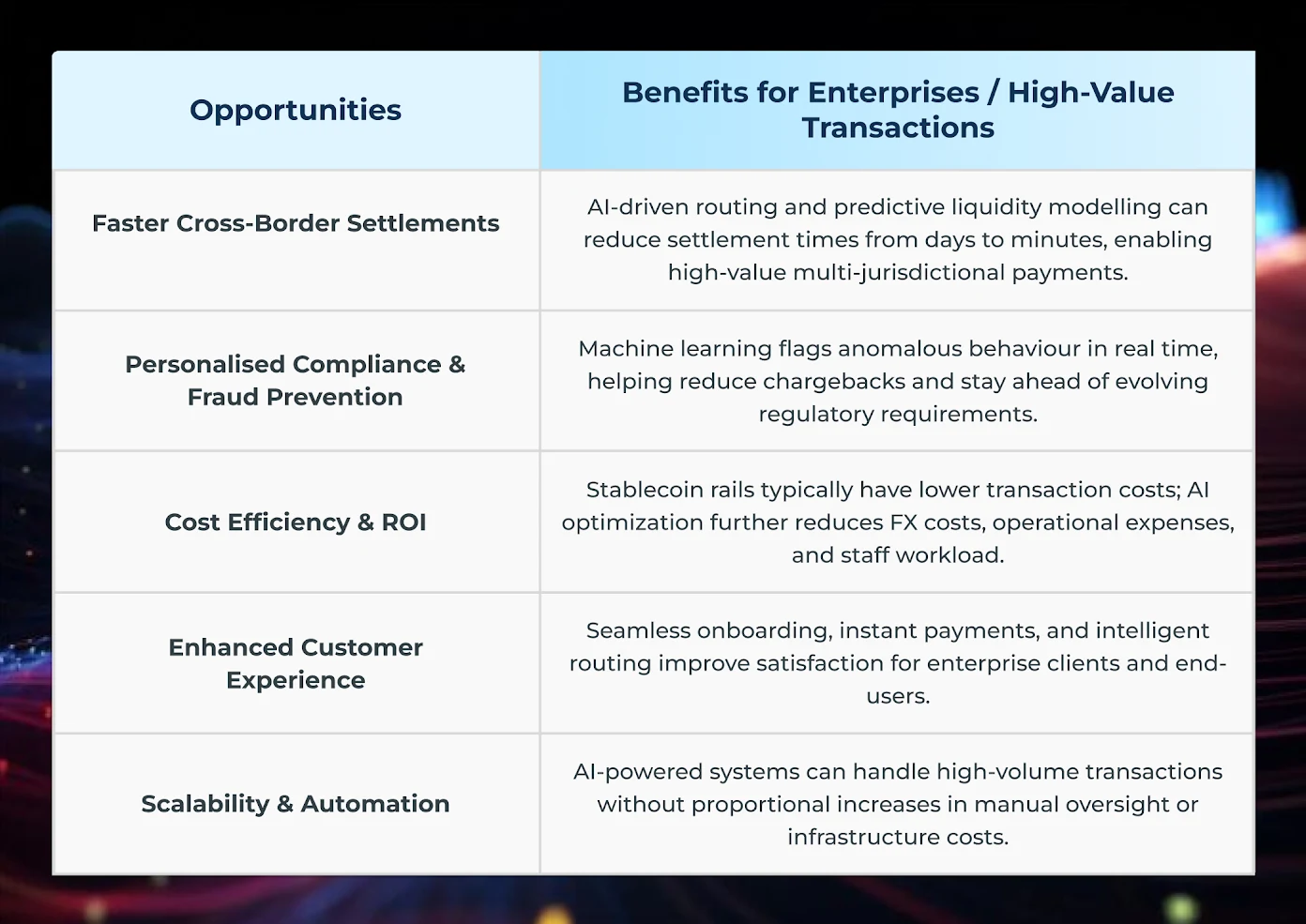

By understanding these opportunities and challenges, decision-makers can strategically evaluate the value of a custom AI stablecoin payment platform, mitigate risks, and plan for scalable, compliant, and efficient implementations.
Enterprises that successfully navigate these considerations will not only improve transaction efficiency but also position themselves as leaders in next-generation payment solutions.
Build AI Stablecoin Payment System: A Complete Guide for Banks & Fintechs
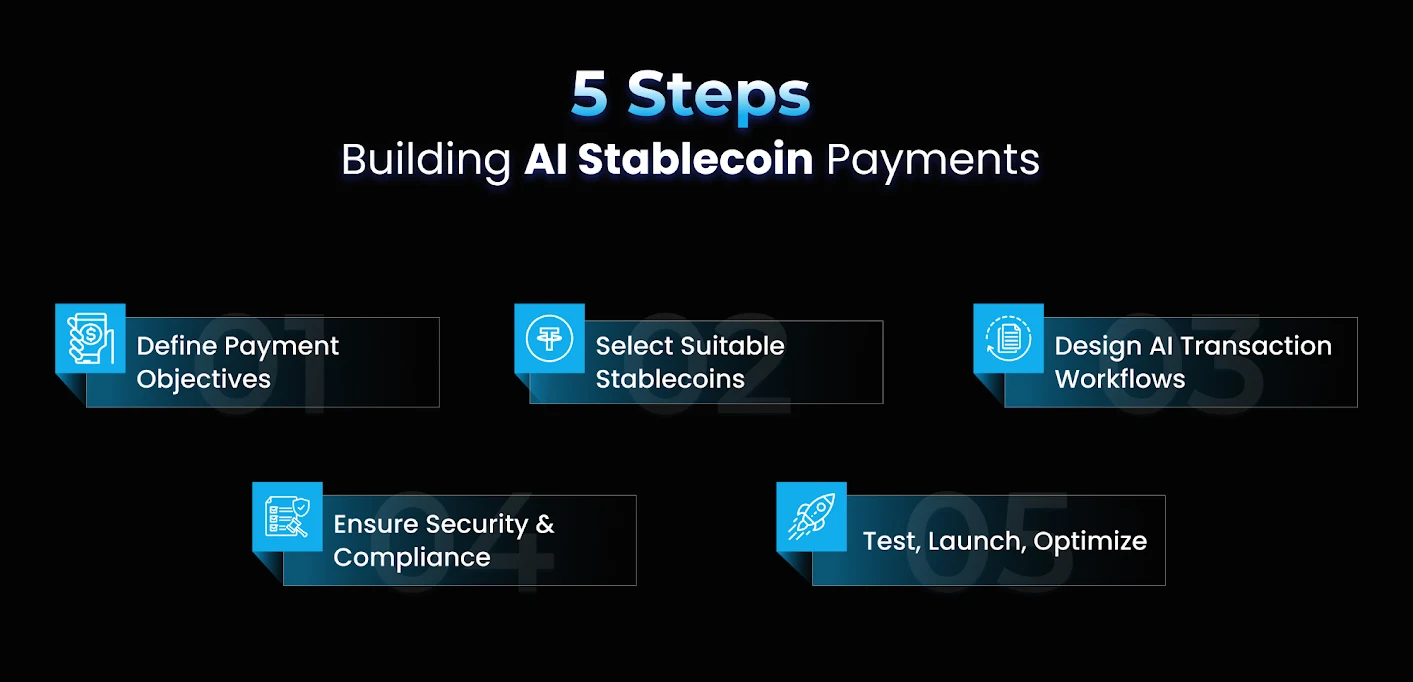
- Define Payment Objectives
Before building an AI stablecoin payment system, clearly outline your goals. Identify the type of transactions, volume, settlement speed, and regulatory requirements. Knowing whether your focus is on cross-border payments, micropayments, or automated vendor settlements helps design the system efficiently.
- Select Suitable Stablecoins
Choose stablecoins that align with your bank or fintech’s risk profile, regulatory compliance, and ESG standards. Fiat-backed stablecoins with transparency, audited reserves, and blockchain compatibility ensure safe and trusted AI-powered stablecoin payments.
- Design AI Transaction Workflows
Develop programmable, autonomous workflows for your AI agents. Define triggers, conditional payments, revenue-sharing mechanisms, and real-time micropayments. Properly designed workflows ensure speed, efficiency, and minimal human intervention in stablecoin rails.
- Ensure Security & Compliance
Integrate strong encryption, multi-factor authentication, and blockchain audit trails. Stay compliant with local and international regulations on digital payments, AML, and KYC requirements. Security builds trust with both users and investors.
- Test, Launch, Optimize
Run pilots with controlled transaction volumes to test scalability, efficiency, and reliability. Monitor AI decision-making, transaction speeds, and cost metrics. Continuously optimize to improve performance, compliance, and user experience in your AI stablecoin payment system.
How Location Impacts AI Stablecoin Payment System Adoption?
Although AI stablecoin payment systems are gaining global attention, geography continues to influence adoption rates:
- United States: Clearer regulation under the GENIUS Act is increasing enterprise confidence.
- Europe: MiCAR and e-money token regulations provide stricter yet more transparent frameworks for adoption.
- Middle East: Countries such as the UAE are leading with dirham-pegged stablecoins for cross-border commerce.
- Asia and Emerging Markets: Strong demand for remittances makes a stablecoin remittance platform highly relevant, although licensing and foreign exchange rules vary across countries.
Adapting your strategy to the specific regulatory and market environment of each region is essential for compliance and maintaining a competitive advantage.
Conclusion
We’re standing at an inflection point. The integration of AI and stablecoins, once theoretical, is now getting the infrastructure and validation it needs. Google’s AP2 protocol is not just another announcement. It is a sign that agent-driven, stablecoin-powered commerce is becoming part of mainstream payments architecture. If your organization is managing large payments, operating internationally, or looking for efficiency, security, and innovation, now is the time to consider: what role will AI stablecoin payments play in your systems over the next 12 to 24 months?
Take Action:
- Partner with Antier, a leading stablecoin remittance platform development company, to assess your existing payment flows and design custom AI-powered stablecoin solutions.
- Consider piloting stablecoin payment agents in low-risk environments.
- Evaluate which stablecoin protocols, custody providers, and compliance partners match your geography and risk profile.
If you are exploring how to integrate AI stablecoin payments into your business or want a guided roadmap tailored to your region or industry, we can help you plan, build, and launch. Just reach out, and together we can map out the path that works best for you.
Frequently Asked Questions
01. Why choose a custom AI stablecoin payment solution?
Custom AI solutions let businesses tailor payment flows, select preferred stablecoins, and meet regional regulations for better efficiency and lower costs.
02. How does an AI stablecoin payment platform improve cross-border payments?
An AI stablecoin payment platform automates routing, reduces fees, and accelerates settlement, making cross-border transactions faster and more cost-effective.
03. How can a business build a secure AI stablecoin payment system?
Use regulated stablecoins, AI-driven monitoring, audited smart contracts, and institutional custody while integrating compliance checks into your workflows.