




✨ AI Summary
- Real-World Asset Tokenization is revolutionizing global capital markets, with key players like big firms leading the charge.
- As this technology evolves over the next few years, jurisdictions that establish legal recognition, synchronization between on-chain and off-chain events, and regulated settlement rails will dominate the institutional Total Value Tokenization (TVT) landscape.
- By tokenizing real-world assets, businesses can expand their traditional models and tap into new revenue streams and investor pools.
- Implementing a customized asset tokenization platform allows for fractional ownership, expanded capital access, and programmable finance through smart contracts.
- Building a platform requires careful consideration of legal compliance, liquidity engineering, privacy needs, and modular compliance for global operations.
With numerous successful projects, the Real-World Asset Tokenization is positioning itself as the next foundation for global capital markets. Big firms implementing tokenization architecture are constructing platforms for structural re-design of asset ownership, custody, and liquidity. Over the next 3–7 years, RWA tokenization will move from niche pilots to mainstream institutional infrastructure in jurisdictions that get three things right:
- Legal recognition of ledger records and smart contracts.
- Infrastructure for synchronization between on-chain events and off-chain legal triggers
- Regulated settlement rails (including compliant stablecoins / CBDCs)
Jurisdictions and firms that standardize these primitives will host the majority of institutional TVT. But, for newcomers, grasping the infrastructure requirements and the market mechanics is essential.
This guide offers expert insights for businesses advancing with Real-World Asset Tokenization platforms, helping them transform liquidity into lasting market credibility.
Why build a Real-World Asset Tokenization platform?
The Real-World Asset tokenization platform helps to expand the traditional business model by bringing it on-chain. Countries like the USA, Hong Kong, and China have already set the standard to move from pilot programs into real markets.
- The GENIUS Act in the U.S. has created a framework for stablecoins- a critical settlement layer for tokenized assets.
- Dubai’s VARA Rulebook provides legal clarity on issuing and trading tokenized assets.
- The EU’s DLT Pilot Regime and Hong Kong Policy Statement 2.0 show governments formally supporting tokenization as part of their capital market evolution.
This helps to combine legal enforceability, custody, compliance, and liquidity into an infrastructure that turns static assets into dynamic, investable products. For banks, REITs, gold custodians, and fintechs, this is a structural opportunity to expand capital access, monetize balance sheets, and position competitively in the next wave of finance.
Implement Customized Asset Tokenization Platform!
What Real-World Asset Tokenization Platform Delivers
- Fractional Ownership and Expanded Capital Access
Large assets, such as a $500M office tower, a 1-ton gold reserve, and a $200M bond issuance, are traditionally illiquid and reserved for a small pool of investors. Tokenizing Real-World Assets fractionalizes ownership, enabling wider participation without compromising legal enforceability.
- Liquidity in Illiquid Markets
Real estate or infrastructure projects often tie up capital for decades. A Real-World Asset Tokenization Platform Development Company can build systems where secondary markets provide controlled liquidity, giving investors the ability to exit without destabilizing the underlying asset.
- Programmable Finance
With Smart contracts automating core functions, businesses can rent distributions, royalty payments, and coupon schedules, reducing intermediaries and errors. This programmability appeals to institutions looking to cut operational costs.
- Transparency and Trust
Immutable blockchain records provide auditability. Combined with verified off-chain documents (titles, vault certificates, legal agreements), they establish a golden record that regulators and investors can trust.
Why Firms Should Invest in Building Platforms
For institutional firms, the “why” behind tokenization is both strategic and operational:
- New revenue streams: Issuance fees, custody fees, secondary trading spreads.
- Balance sheet optimization: Liquidity access for illiquid portfolios.
- Investor expansion: Access to broader investor pools.
- Competitive positioning: Early movers set the standards and attract market trust.
A bank or REIT building a platform can position itself as a market operator — a far stronger role in the financial ecosystem.
Who should build the Real-World Asset Tokenization Platform
Build a Real-World Asset Tokenization Platform if:
- Own or control high-value assets (real estate portfolios, vaults of precious metals, private credit receivables, royalties). You need the asset flow and credibility to back tokens.
- Have compliance and legal resources or are willing to retain top-tier counsel across the jurisdictions you’ll service.
- Can commit to custody arrangements (insured vaults, trustee structures) and external audits.
- Want to compete for a new investor base and recurring platform economics (issuance fees, ongoing custody/management fees, secondary market fees).
Tips To Launch a Successful Real-World Asset Tokenization Platform: A Practical Lens
- Synchronization Between On-Chain and Off-Chain Events
Forbes highlighted the bottleneck: tokenizing a bond is straightforward, but ensuring that coupon payments, lien registrations, or collateral releases happen correctly across both digital and legal systems is the missing piece. Without synchronization, tokenized markets fracture into multiple “truths.”
- Liquidity Must Be Engineered
Specialists stress that liquidity will not magically appear. Platforms must secure anchor investors, design redemption facilities, and contract market makers to guarantee trading depth. Without these, tokens risk being static instruments.
- Privacy as an Institutional Requirement
Public blockchains thrive on transparency, but institutions need selective disclosure. Tokenization platforms of the future will adopt zero-knowledge proofs and verifiable credentials to satisfy AML and data privacy simultaneously.
- Modular Compliance for Global Operations
Every jurisdiction has unique requirements. A future-ready platform must provide compliance modules that can be switched on per region, from MiCA reporting in the EU to securities law compliance in the U.S.
Core Components for Real-World Asset Tokenization Platform Development
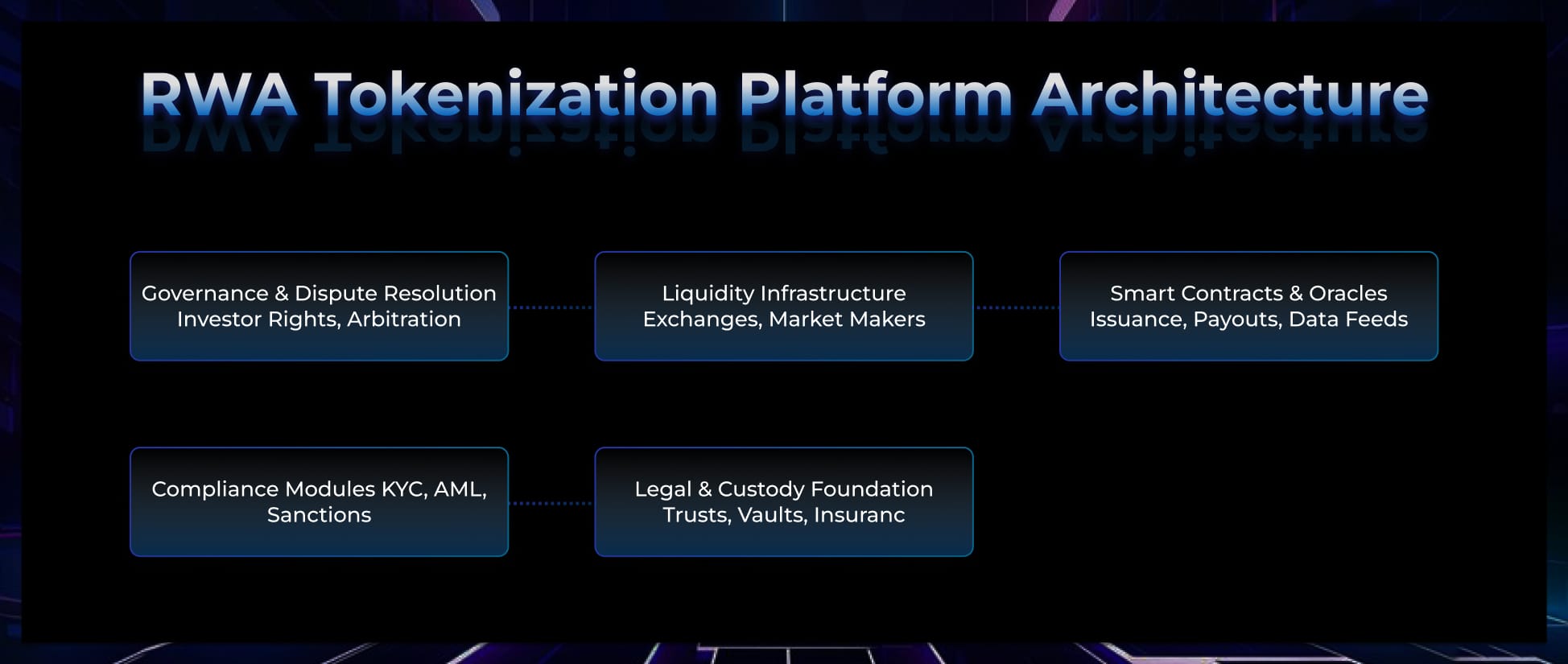
- Legal & Trust Layer — trustee/escrow agreements, title insurance, custodial certificates.
- Issuer Portal — asset onboarding, golden record capture, document notarization.
- Compliance Engine — KYC, sanctions screening, jurisdictional rule engine, on-chain whitelist management.
- Issuance Smart Contracts — immutable records + transfer request pattern (on-chain request, off-chain approval).
- Oracle & Event Sync Layer — multi-source oracles for valuations, payment events, custody audits, and timestamps.
- Custody & Insurance — insured vaults, reconciliation procedures, audit cadence.
- Investor UI & Custodial Wallets — institutional dashboards, reporting, tax docs.
- Secondary Market Infrastructure — regulated exchange partnerships or a permissioned order book with market-maker support.
- Governance & Dispute Resolution — contractually defined processes, governing law, and insolvency waterfall.
Blockstream, EchoX, and other infrastructure players are already proving that Bitcoin Layer-2 and institutional rails can host parts of this stack, but the choice of rail is a tactical decision tied to your risk model and liquidity targets.
Token design recommendation (practical sketch)
Experts favor a compliance-first token model: issuance controlled by a trustee, transfer requests on-chain, and approvals handled by an off-chain compliance engine. That pattern gives auditable on-chain logs while ensuring that transfers only finalize when legal conditions are verified.
Key elements:
- Token metadata contains hashed off-chain legal docs and custodian attestations.
- Transfer request events are emitted on-chain; an off-chain engine validates and executes transfers.
- Time-stamped oracle triggers reconcile payments and distributions.
This pattern prevents unauthorized transfers (sanctions, KYC failures) while preserving audit trails.
Liquidity Strategy
Market makers, exchange listings, and redemption mechanics are the real levers. Design for three-phase liquidity engines:
- Anchor institutional buyers — secure 2–3 institutional anchors for each launch to provide depth.
- Market maker agreements — contract regulated market makers with minimum quoting obligations for a defined period.
- Secondary market access — list on regulated tokenized securities venues or interoperate via licensed broker-dealers. Allow controlled wrapped liquidity only when legal reciprocity exists.
Ensure Every Layer of Your RWA Platform Meets Institutional Standards
Future signals you must watch (and how they change product ops)
- Statutory acceptance of ledger evidence — when courts accept ledger records as proof, dispute resolution and title transfer will be simplified. Jurisdictions that adopt this early will become tokenization hubs. Regulated settlement rails (stablecoins / CBDCs) — the GENIUS Act and similar laws make compliant stable settlement plausible; platforms must support regulated settlement assets.
- Institutional infrastructure partnerships — custody providers, trustee networks, and blockchain infra providers are consolidating around consortia. Partner early.
What Success Looks Like – Metrics That Matter to the Board
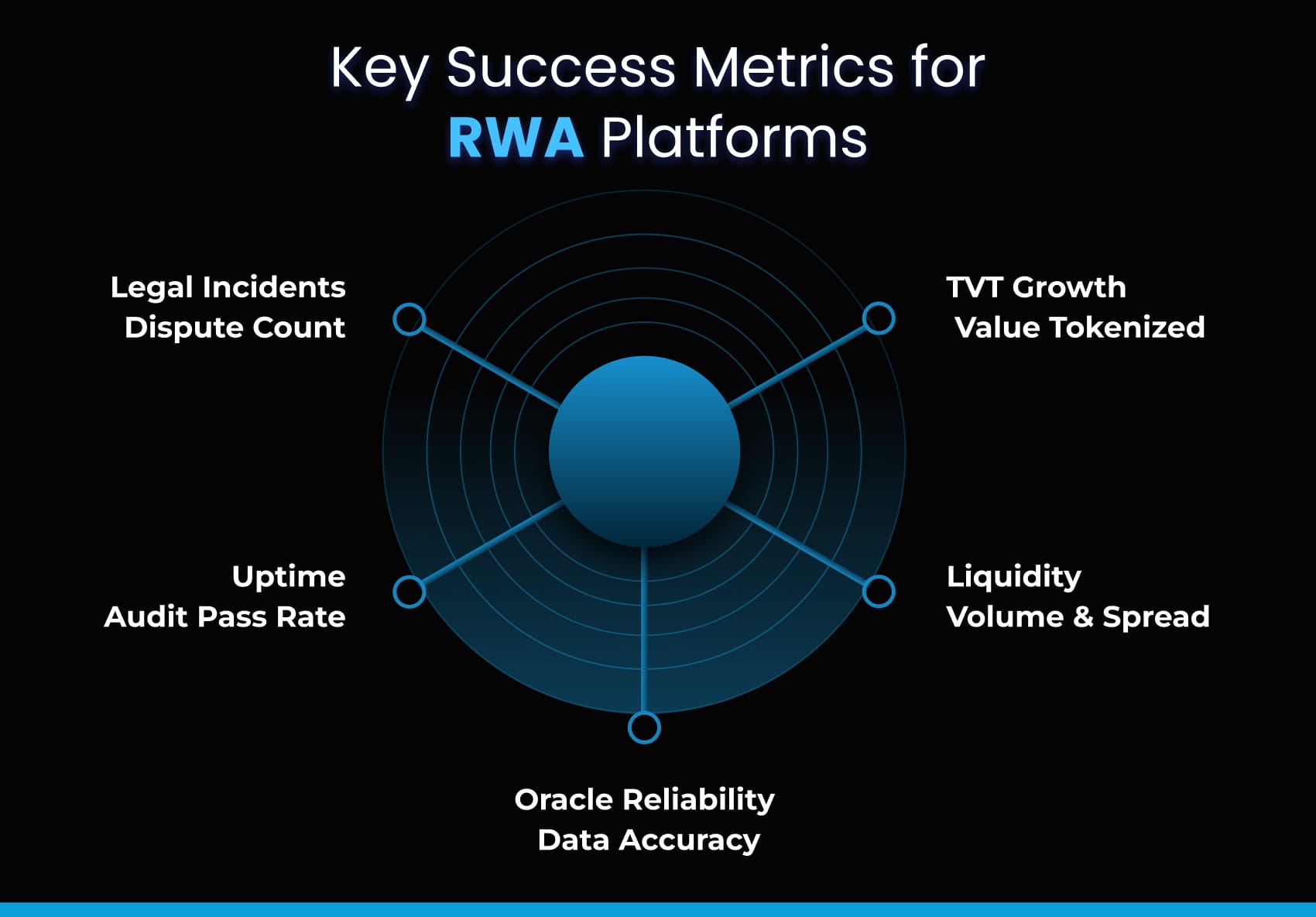
For any institution pursuing a Real-World Asset Tokenization platform, measurable outcomes are non-negotiable. Boards and investors will expect clear performance indicators, tracked consistently and reported with transparency. The most critical metrics include:
- Total Value Tokenized (TVT) and its growth trajectory over time.
- Active institutional participants, including anchor buyers and market makers, provide depth.
- Secondary market liquidity measures, such as daily trading volume and bid-ask spreads.
- Oracle reliability, monitored by tracking discrepancies across data feeds.
- Legal and compliance incidents, including disputes over title or enforcement actions.
- Operational resilience, measured through uptime percentages and external audit pass rates.
These metrics, reviewed monthly and summarized in board reporting, determine whether the platform inspires confidence or attracts skepticism. Markets punish ambiguity but reward measurable traction.
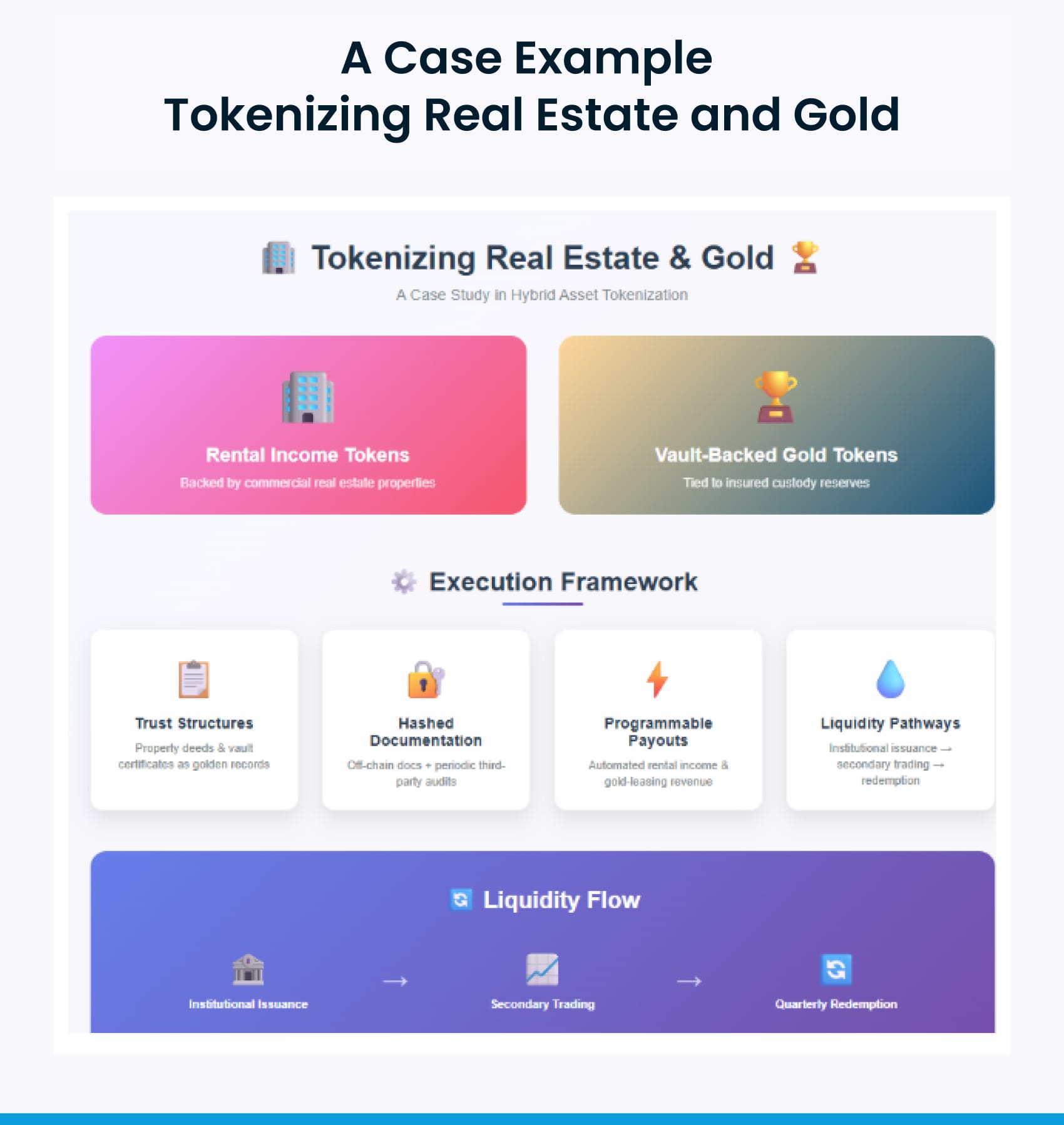
Consider a combined real estate investment trust (REIT) and bullion custodian. Such an operator could issue two classes of tokens:
- Rental income tokens, backed by commercial real estate.
- Vault-backed gold tokens, tied to reserves in insured custody.
Execution would rely on:
- Trust structures to formalize legal rights, with property deeds and vault certificates treated as golden records.
- Hashed off-chain documentation, coupled with periodic third-party audits for verification.
- Programmable payouts, automating distributions of rental income or gold-leasing revenue.
- Liquidity pathways, beginning with institutional issuance, extending to trading on permissioned secondary venues, and offering quarterly redemption windows.
This hybrid model illustrates how asset-heavy operators can unlock liquidity while maintaining legal and operational control.
Launch a Compliant and Scalable Asset Tokenization Platform
Expert Recommendations for Successful Platform Launch
- Adopt permissioned issuance before considering permissionless liquidity: Institutional investors demand legal certainty and compliance-first design. Control should not be sacrificed for hypothetical liquidity.
- Prioritize legal architecture over technical experimentation: Smart contracts can be revised or upgraded; title disputes and flawed legal sequencing cannot. The enforceability of claims determines whether a token is a saleable asset or a liability in waiting.
These lessons are the outcome of real-world pilots and regulatory engagements, echoed in industry research and commentary.
Takeaway
The success of the tokenization platform belongs to those who excel in three areas:
- Legal enforceability — tokens that represent rights courts will uphold.
- Trusted custody — physical and legal safeguards investors can rely on.
- Engineered liquidity — secondary markets designed to function, not just promised.
This is the only path to sustainable adoption without regulatory backlash or reputational damage. Companies planning to build Asset Tokenization Infrastructure need legal compliance, invest in synchronization layers, and partner with experienced custody providers.
If done correctly, the Real-World Asset Tokenization platform will unlock the profit center and secure a durable role in the financial system of tomorrow.
Frequently Asked Questions
01. What is Real-World Asset Tokenization?
Real-World Asset Tokenization is the process of converting physical assets into digital tokens on a blockchain, allowing for fractional ownership, increased liquidity, and broader market participation.
02. Why is tokenization important for capital markets?
Tokenization is important for capital markets as it enables structural redesign of asset ownership, custody, and liquidity, facilitating legal enforceability and compliance while expanding access to capital.
03. What are the key requirements for successful Real-World Asset Tokenization?
Successful Real-World Asset Tokenization requires legal recognition of ledger records and smart contracts, infrastructure for synchronization between on-chain and off-chain events, and regulated settlement rails, including compliant stablecoins or CBDCs.