



✨ AI Summary
- Luxury asset tokenization in 2025 is reshaping the concept of luxury by emphasizing access, transparency, and digital trust over scarcity and heritage.
- The global tokenized asset market has seen significant growth, with luxury assets becoming an attractive option for institutional diversification.
- Tokenized luxury projects are predicted to represent a substantial portion of tokenized inflows by 2035, signaling a shift towards luxury assets being viewed as measurable investment-grade instruments rather than just lifestyle trophies.
- However, challenges such as valuation inconsistencies, fraud, and redemption complexity remain significant hurdles that must be addressed to maintain investor confidence.
- Implementing a comprehensive architecture for institutional-grade tokenized luxury platforms is crucial, encompassing legal structuring, token and smart contract layers, custody and provenance, valuation and oracle layers, liquidity and secondary market layers, redemption and exit layers, as well as governance, reporting, and operations.
2025 is redefining luxury and not solely by scarcity or heritage, but by access, transparency, and digital trust. Luxury asset tokenization is becoming a rigorous infrastructure sector, bridging rare assets with global capital.
When a collector or asset owner asks, “Can my vintage car or limited-edition watch behave like an alternative investment?” The answer lies in luxury asset tokenization.
This article pulls from current data, real projects, and architectural insight to guide builders, investors, and brands on building tokenized luxury platforms worthy of generating higher ROI.
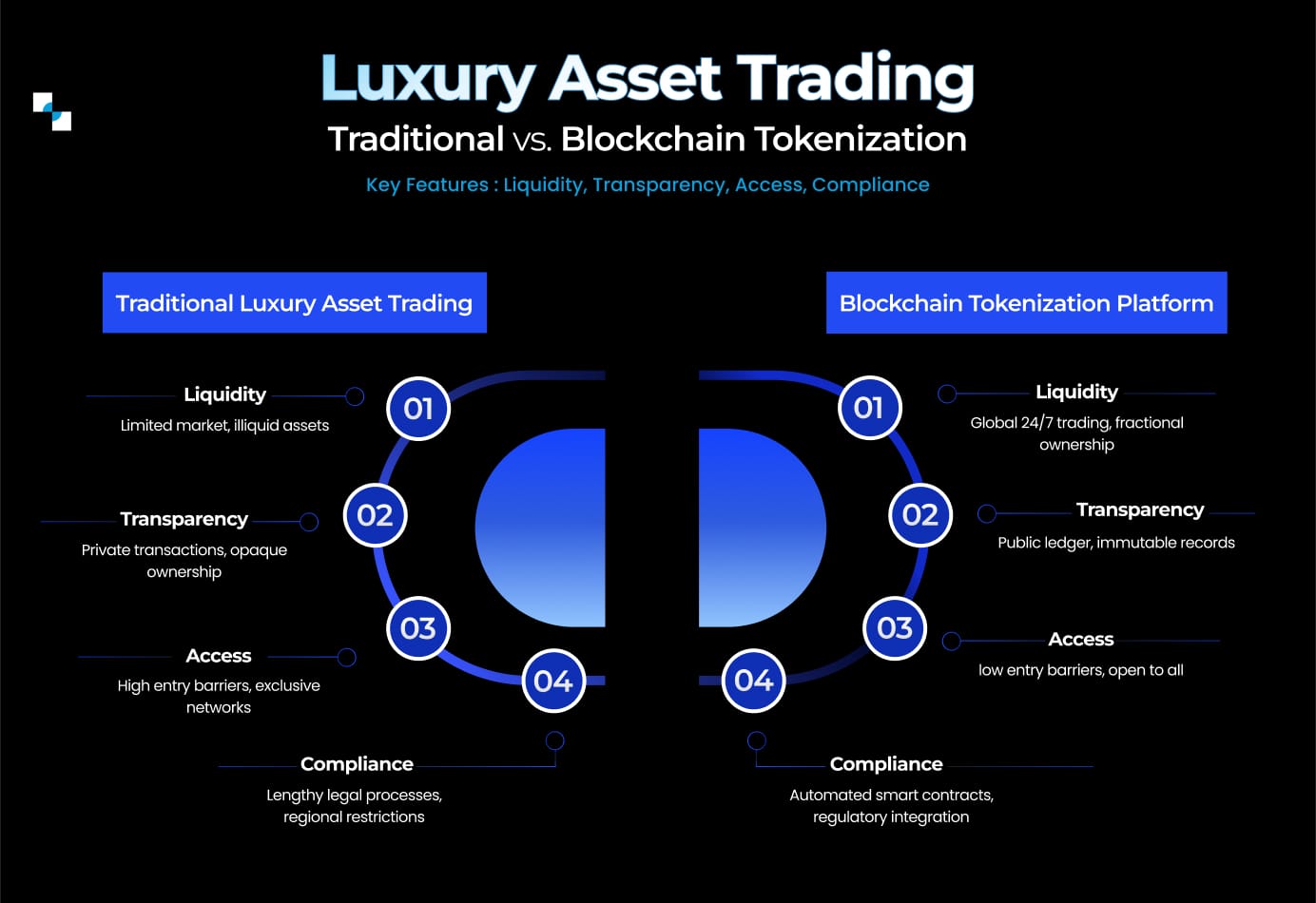
Market Signals: How Blockchain is changing Luxury Ownership?
The global tokenized asset market surpassed USD 2.9 trillion in 2024, with projections to reach USD 13–16 trillion by 2030. While much of this growth comes from tokenized real estate and debt, the luxury segment is emerging as one of the most attractive categories for institutional diversification. Scarcity, stable valuation, and brand equity make luxury goods ideal candidates for fractionalization.
A 2025 Deloitte analysis predicts that Tokenized Luxury projects could represent nearly 20% of all tokenized inflows by 2035. This clearly signifies that luxury assets are transitioning from lifestyle trophies to measurable investment-grade instruments.
For investors, this means:
- Entry into previously inaccessible asset classes.
- Portfolio diversification beyond equities and bonds.
- Exposure to assets with historically strong performance during inflationary cycles.
For businesses and asset issuers, this means:
- New liquidity channels for illiquid holdings.
- Fractional fundraising models with global investor reach.
- Operational efficiency, replacing manual investor management with automated smart contracts.
Launch Investor-ready Tokenization Infrastructure for Fractional Luxury Ownership!
The Promise and Pitfalls of Tokenized Luxury
The Promise: Fractional Ownership and Liquidity
The core appeal of fractional ownership of luxury assets lies in accessibility and liquidity.
Rather than requiring a single buyer to invest USD 1 million in a rare collectible, fractional luxury ownership enables hundreds of investors to collectively participate, each owning verifiable shares via digital tokens.
This unlocks liquidity in historically illiquid markets while preserving provenance and authenticity through blockchain-based audit trails. Tokens can be traded across permissioned marketplaces, allowing secondary transactions with full compliance and traceability.
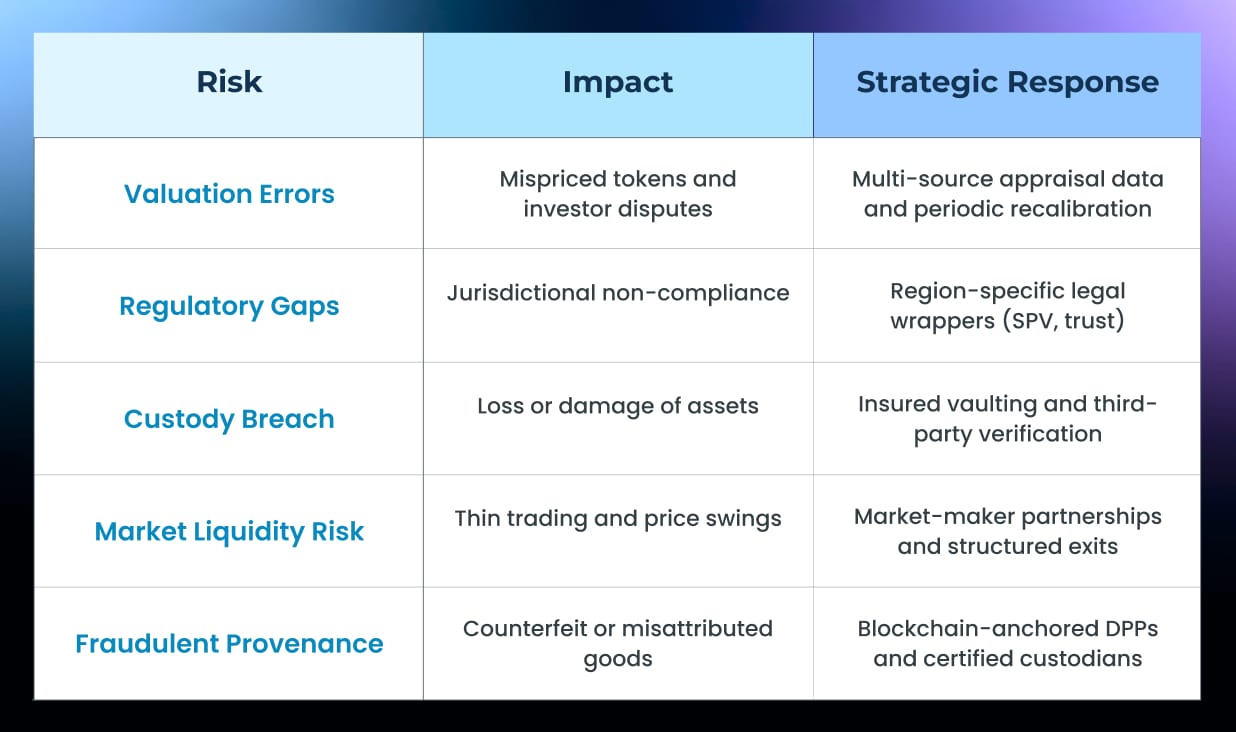
The Pitfalls: Valuation, Fraud, and Redemption Complexity
The challenges, however, remain significant.
- Valuation inconsistencies can lead to disputes and investor distrust.
- Counterfeiting continues to pose a material threat in luxury categories such as watches, jewelry, and collectibles.
- Redemption logistics, including cross-border shipping, verification, and insurance, can introduce operational friction.
- Limited secondary market depth can reduce liquidity and increase price volatility.
A tokenized luxury platform that does not address these challenges through structural safeguards risks eroding investor confidence. Sustainable models must be designed around control, auditability, and risk management.
Architecture of Institutional-Grade Tokenized Luxury Platforms
Institutional adoption begins with architecture. Below is a framework reflecting how a credible RWA tokenization development service structures luxury platforms for compliance, security, and market readiness.
1. Legal and Structuring Layer
- Establish an SPV (Special Purpose Vehicle) or regulated trust to hold physical assets.
- Tokens represent rights (ownership, revenue share, redemption) in the SPV, not direct ownership of the item.
- Define governance, transfer restrictions, lockups, and rights transparently in offering documents.
2. Token and Smart Contract Layer
- Employ transfer-restricted token standards such as ERC-3643 or ERC-1400 for securities-grade functionality.
- Use ERC-721/1155 for membership privileges or collectible utilities.
- Encode investor accreditation, KYC, and jurisdictional checks directly into smart contracts.
- Include upgradability and emergency controls to meet compliance requirements.
3. Custody and Provenance Layer
- Partner with insured vaults and regulated custodians to safeguard physical assets.
- Implement Digital Product Passports (DPPs) containing inspection data, serial numbers, and provenance.
- Attach NFC or tamper-proof QR identifiers linked to on-chain records.
- Conduct scheduled re-inspections to preserve asset integrity.
4. Valuation and Oracle Layer
- Use a blend of independent appraisals, auction benchmarks, and internal trading data.
- Integrate Oracle services with circuit breakers and validation lags to avoid manipulation.
- Maintain transparent price histories and metadata for investor confidence.
5. Liquidity and Secondary Market Layer
- Begin with permissioned secondary trading through whitelisted participants.
- Integrate later with regulated venues such as ATS/MTF for broader liquidity.
- Use on-chain compliance gates to ensure that transfers meet KYC and eligibility rules.
- Deploy market surveillance logic to prevent wash trading and fraud.
6. Redemption and Exit Layer
- Define redemption processes involving verified identities, insured logistics, and escrow control.
- Enable cash-out or buyback options where physical delivery is impractical.
- Maintain full on-chain logs to ensure accountability and prevent “phantom redemptions.”
7. Governance, Reporting, and Operations
- Provide investor dashboards, holding reports, and automated distributions.
- Maintain role-based admin controls, audit logs, and exportable compliance reports.
- Design systems that align with auditor and regulator expectations.
When implemented cohesively, these layers convert tokenized luxury platforms from conceptual projects into institutional-grade financial infrastructure.
Use Cases: Luxury Assets Already Tokenized
- Luxury Real Estate and Branded Residences
Fractionalized ownership models for high-end villas, resorts, and branded residences are attracting global investors. Tokens represent equity, income rights, or usage entitlements, bridging physical real estate with digital liquidity.
- Fine Art and Collectibles
Art tokenization platforms enable co-ownership of high value works stored in secure galleries or museums. Provenance, valuation, and transfer histories are embedded into DPPs, preserving authenticity and regulatory compliance.
- Classic Cars and Exotic Vehicles
High-performance and collectible vehicles are increasingly being fractionalized. Tokenization frameworks include usage tracking, rental income sharing, and dynamic valuation based on condition or demand.
- Premium Watches and Jewelry
Compact, high-value items like watches and jewelry are ideal for the tokenization of luxury goods due to ease of custody and clear provenance. NFC chips and on-chain authenticity certificates ensure tamper-proof ownership trails.
These examples illustrate that tokenized collectibles and luxury items are functioning, regulated, and evolving markets.
Investor and Business Benefits: Beyond Novelty
- Liquidity Access: Ability to trade luxury exposure instead of waiting years for resale.
- Diversification: New asset categories are insulated from traditional market cycles.
- Regulated Transparency: On-chain records ensure verifiable ownership and reduced fraud.
- Yield Generation: Some models integrate revenue from asset utilization, e.g., car rentals or brand exhibitions.
For Businesses and Asset Owners
- Capital Efficiency: Tokenization converts static holdings into working capital.
- Global Investor Base: Fractional structures attract investors across borders.
- Reduced Administrative Overhead: Smart contracts automate investor communication and distributions.
- Brand Longevity: Ownership becomes continuous engagement- a strategic move from selling products to curating digital communities.
This enables democratization of access, monetizes exclusivity, and builds new liquidity economies around luxury.
Tokenized Luxury Trends to Capture in 2025
- Digital Product Passports (DPPs) Mandated by Regulation: ESG and authenticity tracking now demand on-chain traceability.
- Institutional Custody Expansion: Traditional custodians entering tokenized luxury markets enhance investor confidence.
- Cross-Chain Liquidity Hubs: Interoperable marketplaces across Ethereum, Polygon, and Avalanche will enable cross-border trade of tokenized collectibles and luxury items.
- Collateralized DeFi Models: Luxury assets are entering decentralized finance as collateral for yield-bearing loans, linking Web3 credit markets to real-world prestige.
- Phygital Experiences: Luxury brands are merging physical ownership with digital exclusivity, loyalty access, token-gated memberships, and curated experiences for holders.
Each Tokenized luxury trend 2025 points to a singular direction of financial and cultural evolution.
How To Deal with the Market Challenges?
The following are some mitigation strategies that can help in launching a successful Luxury Asset Tokenization Platform.
The Future of Luxury Tokenization
- Institutional Adoption Will Accelerate: Luxury assets will move from exclusive ownership to regulated investment markets. As institutions recognize their potential for stable returns, tokenized luxury will be positioned as a legitimate, yield-generating asset class.
- Regulatory Frameworks Will Strengthen: Clear policies from Dubai’s VARA, Singapore’s MAS, and the EU’s MiCA will standardize tokenized asset operations, giving investors legal confidence and enabling global cross-border participation.
- Luxury Holdings Will Become Productive Capital: Businesses and family offices will unlock liquidity from high-value inventories. Tokenization will allow them to raise funds, diversify portfolios, and engage global investors without selling the underlying asset.
- Investors Will Access New Alternative Markets: Fractional luxury ownership will open doors for diversified portfolios that blend financial performance with cultural value, offering transparency, liquidity, and verified provenance.
- Technology and Trust Will Converge: Platforms will combine insured custody, on-chain governance, and automated compliance, transforming luxury assets into programmable, tradable, and secure financial products.
Design a secure RWA Tokenization Ecosystem Tailored to Your Asset Class
Takeaway
To anyone building or investing in the next generation of luxury platforms, the path forward is not about flashy drops or hype. It’s about durability, compliance, and architecture that earns trust. The value accrues to those who build with rigor, transparency, and respect for both assets and investors.
If you want to engage in this space, bet on infrastructure that reads like a financial ledger. Because in tokenized luxury, credibility is everything.
At Antier, we design and deliver institutional-grade tokenization platforms for luxury assets that integrate compliance, smart contracts, provenance, and liquidity into one unified ecosystem. From fractional luxury ownership to tokenized collectibles and luxury items, our RWA Tokenization Development Company built frameworks for the next phase of global capital markets.
Partner with our blockchain experts to turn luxury into a regulated digital asset class with compliant and scalable infrastructure.
Frequently Asked Questions
01. What is luxury asset tokenization?
Luxury asset tokenization is the process of converting luxury assets, like vintage cars or limited-edition watches, into digital tokens that can be traded, allowing for fractional ownership and increased liquidity.
02. How is blockchain changing luxury ownership?
Blockchain is transforming luxury ownership by enabling fractional ownership, enhancing liquidity, and providing transparency and traceability through blockchain-based audit trails, making luxury assets more accessible to a broader range of investors.
03. What are the benefits of tokenized luxury assets for investors?
Tokenized luxury assets offer investors access to previously inaccessible asset classes, portfolio diversification beyond traditional equities and bonds, and exposure to assets that historically perform well during inflationary periods.