



AI Summary
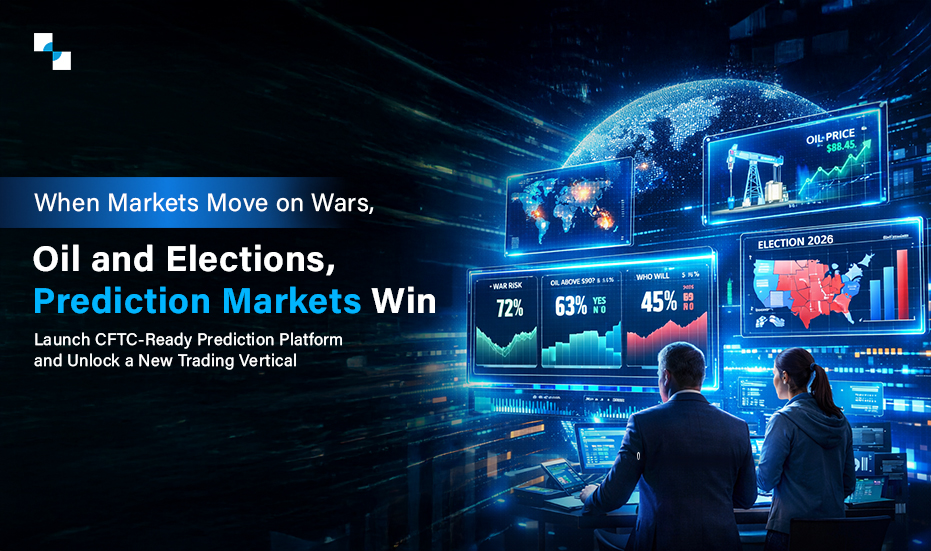
- In a rapidly evolving financial landscape, prediction markets are revolutionizing trading by allowing investors to directly trade on real-world events like wars, elections, and oil shocks.
- These markets, where participants buy and sell event contracts tied to outcomes, provide a new layer of financial trading where uncertainty itself becomes the asset being traded.
- With the demand for prediction markets on the rise, industry data suggests significant growth potential, with trading volumes already quadrupling in recent years.
- Prediction markets offer traders exposure beyond traditional assets, aggregate crowd intelligence for pricing, and provide a dynamic probability signal reflecting collective sentiment on future events.
- As exchanges adapt to this trend by integrating event-based trading into their platforms, prediction markets are poised to become a key revenue engine and a valuable tool for traders seeking profits in uncertain times.
Financial markets have always been sensitive to global events. Wars disrupt supply chains, central bank decisions move liquidity, elections reshape policy direction, and oil stocks ripple across currencies, equities, and commodities. In the past, traders positioned themselves around these events indirectly by buying energy stocks during geopolitical tension or adjusting portfolios ahead of elections.
But traders no longer wait for assets to react. Increasingly, they trade the event itself.
When oil supply becomes uncertain, a major election approaches, or central banks signal policy shifts, traders want exposure to the event, not just the assets influenced by it. This is where prediction marketplaces jump in, where participants trade event contracts tied to real-world outcomes. Markets form around questions, for example:
“Will oil cross $120 this year?” or “Will candidate A win the election?”
Traders then buy or sell YES or NO contracts on that outcome. A YES contract pays off if the event happens, while a NO contract pays out if the event doesn’t happen. As traders buy and sell these contracts, the prices move up or down, reflecting the market’s collective view of how likely the event is to occur.
As geopolitical conflicts, energy market instabilities, and election cycles cause global disruptions, prediction markets are emerging as a new layer of financial trading, where uncertainty itself becomes the asset being traded.
How Prediction Markets Turn Wars, Elections, and Oil Shocks into Tradable Opportunities?
Once a prediction market is created, traders can take positions based on how they interpret real-world developments. Unlike traditional markets where traders speculate on assets such as oil futures, currencies, or equities, prediction markets allow participants to trade directly on the outcomes of major events.
This structure enables markets to form around events that have always influenced financial systems but were not directly tradable.
For example:
| Event Market | Example Contract |
| Geopolitics | Will a ceasefire occur before a certain date? |
| Elections | Will a candidate win the presidency? |
| Energy markets | Will oil exceed $120 per barrel? |
| Monetary policy | Will the Federal Reserve cut rates this quarter? |
As new information emerges, the contracts get settled autonomously, and participants who predicted correctly receive payouts, while opposing positions expire. Through this process, prediction markets transform breaking news, geopolitical developments, and economic signals into structured trading opportunities.
Industry data suggests that demand for these markets is expanding rapidly. U.S. Bank Citizens also predicted that prediction markets, running at $3 billion, up from $2 billion in December 2025, may even reach $10 billion by 2030. Reports from Certik, a blockchain analytics and security firm, also indicate that prediction market trading volumes have quadrupled in 2025, climbing from $15.8 billion in 2024 to about $63.5 billion in 2025.
Why Prediction Markets Are Growing Alongside Financial Markets
- Information Moves Markets Faster Than Ever
Geopolitical developments break in real time, social media amplifies narratives instantly, and outcome-based data is analyzed and distributed within seconds. Pricing in traditional markets can’t react as efficiently to the new information or developments, but prediction marketplaces are designed to be more responsive to real-world events.
- Traders Want Exposure Beyond Traditional Assets
Conventional trading instruments limit exposure to equities, ETFs, commodities, and derivatives. However, many market-moving factors, such as elections, policy decisions, or geopolitical outcomes, are not directly tradable. Prediction markets fill this gap by allowing traders to take positions on events themselves, creating an entirely new category of financial exposure alongside spot, derivatives, and options markets.
- Crowd Intelligence as a Pricing Mechanism
Prediction markets aggregate the views of thousands of participants. Traders commit capital based on conviction, and incorrect assumptions are penalized financially, whereas those who predicted correctly are incentivized. Market prices adjust continuously as the social sentiments and event dynamics change. This results in a dynamic probability signal that often reflects collective sentiment more efficiently than static forecasts or opinion-based analysis.
- Convergence of Trading and Information Markets
Prediction markets are increasingly functioning as information exchanges, where prices reflect not just the speculation but consensus expectations about future events. Unlike traditional financial markets, where information is an input, prediction markets treat information as the asset being priced.
Platforms such as Kalshi and Polymarket illustrate how event-based trading is gaining traction across both regulated and decentralized environments.
Turn Global Volatility Into a New Trading Vertical With Antier
Why Exchanges Are Adding Event-Based Trading?
As prediction markets gain traction, cryptocurrency exchange software solutions are preparing to accommodate the rush of outcome-based traders by integrating event-based trading into their core offering. This reflects a structural shift in platform design where exchanges become purely asset-driven to models that price real-world events.
Traditionally, exchanges have operated across these primary layers: spot, markets, derivatives and options. Prediction marketplaces introduce a fourth layer, known as event contracts, where traders take positions on real-world events and macroeconomic decisions. This doesn’t add a feature but expands the ecosystem into highly popular markets.
What this enables for exchanges:
Prediction markets are now being integrated into next-generation crypto exchange software architectures, where asset trading, derivatives, and event-based markets exist within a single platform.
- New categories of tradable markets: By integrating prediction platforms or YES/NO event tap trading models, platforms can list contracts tied to elections, policy decisions, and global events. These areas that influence markets were not directly tradable before.
- Higher trading frequency: Event-driven markets react continuously to news, data releases, and global developments, creating more consistent trading activity.
- Expansion beyond traditional assets: Exchanges move beyond crypto, equities, and commodities into event-driven markets, where outcomes are traded, not assets.
- Access to new user segments: Event trading attracts users who follow politics, economics, and global events. This attracts a whole new target audience and also enhances engagement for traders.
- Additional revenue streams: Adding more markets means more trading activity, leading to increased fee generation and deeper liquidity pools.
Regulatory Frameworks: CFTC and Event Contracts
Prediction markets in the United States operate within the event contracts framework, which fall under the CFTC jurisdiction. These contracts are treated as a form of derivatives, where payouts depend on the outcome of a specific real-world event. However, the regulatory landscape is still evolving.
Recent guidance from the CFTC signals a more active approach toward overseeing prediction markets, particularly as trading volumes and platform participation continue to grow. The regulator has emphasized the need for clear standards around market integrity, manipulation risks, and contract design, while also indicating openness to innovation in event-based trading.
At a higher level, prediction market platforms operate under these two distinct models:
| Platform Type | Example | Structure |
| Regulated event markets | Kalshi | Licensed as a Designated Contract Market (DCM), compliant with CFTC rules |
| Decentralized prediction markets | Polymarket | Blockchain-based, often operating outside direct U.S. regulatory oversight |
The distinction is clear. Regulated platforms must, therefore, comply with strict requirements related to:
- market surveillance and manipulation prevention
- contract design and public interest considerations
- reporting, clearing, and settlement standards
At the same time, decentralized platforms operate with greater flexibility but face legal uncertainty and jurisdictional challenges, particularly when serving U.S. users.
But compliance becomes essential as it becomes a key differentiator since regulated environments:
- Attract institutional participation
- Ensures that platforms operate within established legal frameworks, rather than living in a risky grey
- Are better positioned to scale as governments introduce clearer rules for event-based trading
Recent developments suggest that the CFTC is working toward a more defined regulatory structure rather than restricting the market entirely. Ongoing rulemaking discussions and industry consultations indicate a shift toward balancing innovation with oversight, which could accelerate the expansion of compliant prediction market platforms in the coming years.
Markets Are Uncertain. Profits Don’t Have to Be. Build Your New Revenue Engine Today
Prediction marketplaces are emerging as a new essential layer in crypto exchange infrastructure. Despite being a part of the ecosystem, they are booming, becoming a prominent standalone application.
For entrepreneurs and fintech platforms, this presents a clear opportunity:
- build standalone prediction market platforms
- integrate event trading into existing exchanges
- develop data-driven analytics products around market probabilities
With regulatory clarity improving, particularly around frameworks like CFTC-regulated event contracts, the foundation for scalable, compliant prediction markets is becoming stronger.
Antier enables businesses to build scalable, compliant prediction market platforms from standalone solutions to exchange-integrated event trading systems.
Start Building a CFTC-ready prediction market platform with Antier Today
Frequently Asked Questions
01. What are prediction markets?
Prediction markets are platforms where participants trade event contracts tied to real-world outcomes, allowing traders to speculate on the likelihood of specific events occurring, such as elections or oil price changes.
02. How do prediction markets differ from traditional financial markets?
Unlike traditional markets that focus on trading assets like stocks or commodities, prediction markets allow traders to directly bet on the outcomes of significant events, making uncertainty itself a tradable asset.
03. What types of events can be traded in prediction markets?
Prediction markets can be used to trade on a variety of events, including geopolitical developments, election outcomes, energy prices, and monetary policy decisions.