



AI Summary
- Decentralized exchanges (DEXs) have transformed into a vital layer of the crypto economy, offering platforms like UniSwap and Curve Finance that process trillions in trades without centralized control.
- DAO-governed DEXs empower users and token holders to make key decisions through blockchain-based voting systems, marking a shift towards community-driven governance.
- The intersection of decentralized governance and regulatory frameworks, exemplified by DerivaDEX, signals a new era where traders have a say in protocol evolution.
- The governance structure involves token distribution among stakeholders, delegation systems, proposal lifecycles, and various governance models.
- Technical aspects of a DAO-governed DEX include layers for trading, governance, treasury management, and incentive design.
Once considered as an experimental attempt to eliminate centralized control from digital asset markets, decentralized exchanges (DEXs) have evolved into a critical infrastructure layer for the crypto economy. Platforms such as UniSwap, Curve Finance, and Balancer now process trillions in trading while operating without centralized custodians or intermediaries.
At the same time, decentralized exchange software solutions have transcended beyond their previous generation. Early DEX platforms decentralized the trade execution but left control over protocol updates, fee adjustments, and treasury management in the hands of small core teams. DAO-based governance models helped unshackle these protocols from centralized control, shifting decision-making authority towards users, token holders, and liquidity providers.
Governance rules are embedded in smart contracts and executed transparently through blockchain-based voting systems, allowing communities to participate in shaping the protocol’s direction.
The governance shift is now beginning to intersect with regulatory frameworks. DerivaDEX launched a Bermuda Monetary Authority (BMA)-aligned DAO-driven decentralized exchange software, marking a rare case where a decentralized web3 infrastructure operates within a recognized regulatory framework. The development signals a turning point for DEXs where traders are not just market participants but stakeholders with voting rights over protocol evolution. Similarly, DAOs are emerging as a viable governance layer for managing digital financial infrastructure at scale.
What Is a DAO-Governed DEX?
A DAO-governed decentralized exchange software is a trading platform where all the key platform decisions are controlled by a decentralized autonomous organization rather than a corporate entity. They combine trading infrastructure with governance systems that enable communities to control the protocol parameters.
| Feature | DAO-Governed DEX | Developer-Controlled DEX |
| Protocol upgrades | Community voting | Core team decisions |
| Treasury control | DAO governance | Team controlled |
| Token holder influence | High | Limited |
| Transparency | On-chain governance | Partial transparency |
In this model:
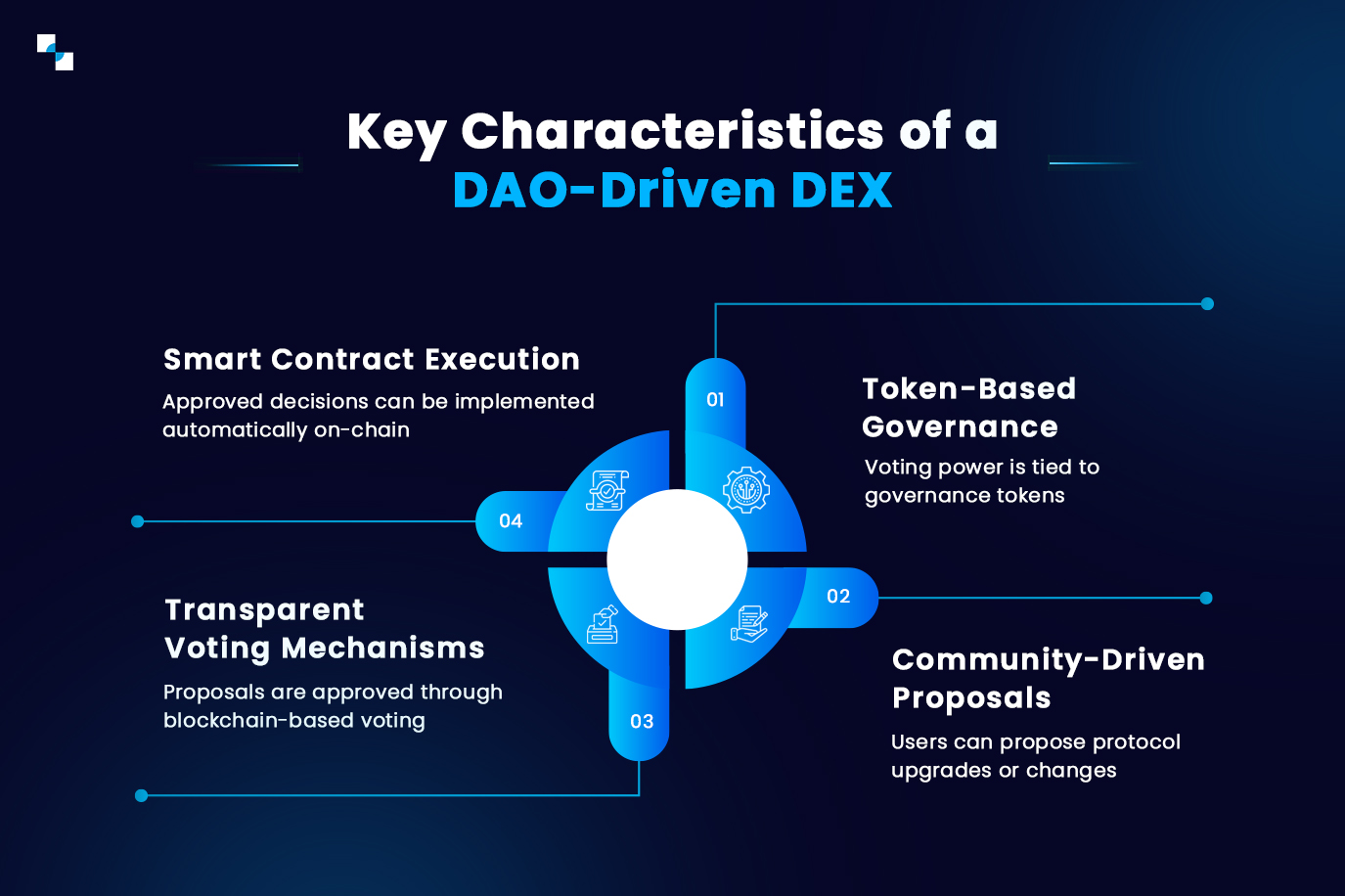
- Governance authority is distributed among token holders, users, and liquidity providers, who participate in blockchain-based voting mechanisms.
- They use their governance tokens to propose, vote on, and implement protocol changes such as upgrades related to trading parameters, fee adjustments, protocol upgrades, liquidity incentives, or treasury allocations
- Once approved, the outcomes are executed automatically on-chain or implemented through governance-controlled contracts.
- The voting powers, execution mechanism, and everything else are controlled by the rules embedded into smart contracts, rather than centralized management.
How DAO Governance Works in Decentralized Exchange Software?
Governance Token Model
Governance tokens form the foundation of DAO decision-making in decentralized crypto exchange software. They represent the voting power within the protocol and allow participants to influence governance outcomes.
Voting Power
In several leading decentralized exchanges such as Uniswap and Balancer, governance tokens grant holders the ability to vote on protocol proposals. In such DAO-implemented DEXs, voting weight is proportional to the number of tokens held or delegated.
Token Distribution Models
Distribution of governance tokens relates to distribution of power, which plays a critical role in maintaining fairness in decentralized control systems. Decentralized exchange development projects often design token allocation strategies carefully so the power and incentives are strategically allocated among different ecosystem stakeholders.
Let’s have a look at how governance tokens are distributed in DAO-governed DEX models…
| Stakeholder Group | Role in the Protocol | Why They Receive Governance Tokens |
| Users & Liquidity Providers | Supply assets to liquidity pools and enable trading activity | Incentivizes liquidity provision and rewards users who help maintain market depth and trading volume |
| Core Developers & Early Contributors | Design, build, and maintain the protocol’s infrastructure | Compensates the teams and contributors responsible for developing the exchange and maintaining its technical architecture |
| Ecosystem Builders & Partners | Develop integrations, tools, and services around the protocol | Encourages third-party development such as analytics tools, trading interfaces, integrations, and DeFi applications |
| DAO Treasury | Holds tokens controlled by governance voting | Provides financial resources for long-term protocol growth, grants, marketing initiatives, and ecosystem expansion |
| Community Incentive Programs | Reward active users and governance participants | Encourages participation in governance voting, community initiatives, and long-term ecosystem engagement |
A balanced token distribution strategy helps prevent governance concentration while ensuring that protocol control remains distributed across key ecosystem participants.
Delegation Systems
Many token holders prefer to delegate their voting rights to experienced participants rather than voting on every proposal themselves. For this reason, decentralized exchange software development involves implementing delegation systems that allow:
- governance representatives to vote on behalf of token holders
- increased participation in governance decisions
- more informed voting outcomes
Proposal Lifecycle
DAO governance in DEXs typically follows a structured proposal lifecycle that ensures protocol changes are reviewed, debated, and approved transparently.
Community Discussion
Governance proposals often begin with informal discussions in the community forums or governance channels. This ensures that participants evaluate the proposal and gather feedback before formal submission.
Proposal Submission
Once the proposal gains community support, it can be formally submitted to the DAO governance system. Many protocols even require a minimum number of governance tokens for submission, preventing spam or low-quality submissions.
Voting Period
Token holders use their governance tokens to participate in voting. The voting process usually lasts several days and requires predefined quorum thresholds to validate the outcome. Many decentralized crypto exchange software also conduct off-chain voting using Snapshot-like governance platforms and record results transparently.
Execution
If the proposal receives sufficient support, it proceeds to execution. Depending on the governance model, implementation may occur autonomously through smart contracts or through governance-controlled administrative actions.
Governance Execution
The final stage of governance determines how approved proposals are implemented within the protocol. The primary execution models used in DAO-driven decentralized crypto exchange software development include:
| Model | Description |
| Off-chain voting and manual implementation | Community members vote off-chain, and approved decisions are implemented manually by protocol administrators or governance multisig wallets. |
| On-chain governance and autonomous implementation | Voting occurs directly on-chain, and approved proposals trigger smart contract functions that automatically implement protocol changes. |
On-chain governance models increase transparency and reduce reliance on trusted intermediaries. However, many protocols initially adopt hybrid approaches that combine off-chain voting with controlled execution mechanisms and later transition to fully automated governance.
Core Architecture of a DAO-Governed DEX Development
Governance determines how protocol decisions are made, but the underlying technical architecture determines how DAO-driven DEXs function. The architecture consists of several interwebbed layers responsible for trading operations, governance management , treasury administration, and incentive mechanisms.
1. Smart Contract Trading layer
The trading layer is responsible for executing transactions and managing liquidity across the crypto exchange software. Smart contracts deployed on blockchain networks automate all the operations across the trading layer
Core components of the trading layer include:
- Liquidity Pools- Liquidity pools hold the token reserves that enable users to swap assets without relying on centralized order matching systems. These reserves are run by liquidity providers who deposit assets in these pools in exchange for trading fee or reward incentives.
- Swap Contracts:- Swap contracts process trades by calculating asset prices, updating pool balances, and executing transactions based on predefined pricing algorithms.
- Trade Settlement –Trade Settlement occurs on-chain, ensuring that execution and balance updates remain transparent and verifiable.
- Fee Logic –As said earlier, smart contracts determine how trading fees are calculated among key stakeholders,
- Trading Models- DAO-governed decentralized exchange software development may implement different trading models depending on their architecture.
| Model | Description |
| AMM | Automated Market Maker systems use liquidity pools and pricing algorithms to facilitate trades. |
| Order-book DEX | Orders are matched between buyers and sellers through decentralized order book mechanisms. |
| Hybrid model | Combines AMM liquidity with order-book execution to improve capital efficiency and price discovery. |
2. Governance Layer
The governance layer manages how DAO decisions are submitted, voted on, and executed within the protocol, ensuring transparency and action enforceability within the blockchain environment.
Core Components of Governance Layer Include
- Proposal Contracts- Proposal contracts allow governance participants to submit proposals that request changes to protocol parameters or treasury allocations.
- Voting Contracts- Voting contracts manage the voting process by recording votes, calculating token-weighted outcomes, and enforcing quorum thresholds.
- Execution Contracts- Execution contracts implement approved governance decisions by triggering decided transformations in protocol parameters, treasury transfers, or smart contract upgrades.
3. DAO Treasury Infrastructure
The DAO treasury acts as the financial backbone of the decentralized exchange software ecosystem, storing funds generated from trading fees, token allocations and ecosystem contributions. These treasuries are governed by token holders who decide how these resources are allocated.
Common treasury uses include:
- Liquidity incentive programs
- Developer grants and ecosystem funding
- Marketing and community growth initiatives
- Infrastructure development
4. Tokenomics and Incentive Design
Tokenomics plays a critical role in maintaining participation within DAO-driven exchanges. With a strategic and lucrative incentive structure, decentralized cryptocurrency exchange software can encourage users to contribute liquidity, participate in governance and support long-term ecosystem growth.
Key elements of tokenomic design include:
- Token Allocation- Governance tokens are distributed among community members, early contributors, ecosystem funds, and liquidity providers.
- Staking Incentives- Token holders may stake their governance tokens to participate in governance processes or earn additional protocol rewards.
- Liquidity Mining- Liquidity mining programs reward users who provide liquidity to trading pools, helping the DEXs maintain sufficient market depth.
- Governance Participation Rewards- Some protocols introduce incentives for active governance participation, encouraging token holders to vote on proposals and contribute to protocol decision-making.
Common Governance Models Used in DEX Development in 2026
| Governance Model | How It Works | Advantages | Example Protocols |
| Token-Weighted | 1 Token = 1 Vote. Proportional to holdings. | Simple, aligns power with financial stake. | Uniswap, Balancer |
| Delegated | Holders assign voting power to “experts” or “delegates.” | Reduces voter fatigue; ensures informed decisions. | Uniswap, Aave |
| Quadratic | The cost of additional votes increases exponentially ($V \propto \sqrt{Tokens}$). | Reduces “Whale” dominance; favors community consensus. | Gitcoin, Snapshot (optional) |
| Vote-Escrow (ve) | Power is based on Token Amount × Time Locked. | Rewards long-term commitment; prevents “pump-and-vote” attacks. | Curve (veCRV), Aerodrome |
| Optimistic Gov | Proposals pass automatically unless someone “vetoes” or challenges them. | Fast execution removes the need for 100% voter turnout for routine tasks. | Synthetix, Lido (Dual Gov) |
| Reputation-Based | Voting power is earned through activity (liquidity provision, code, etc.) and is often non-transferable. | Meritocratic; impossible to “buy” the vote on the open market. | Colony, Status (Karma) |
Also Read>>> Humanitarian DAO Development Guide For NGOs and Impact Investors
Why Build DAO-Driven Decentralized Crypto Exchange Software?
There are several benefits of DAO-driven DEX development. Let’s shed light on some of them:
Community Ownership:
Users and LPs participate in the governance through tokens, allowing them to influence the platforms they use. No centralized party controls user funds and no DEX operator takes the end decisions for the platform.
Transparent Decision-Making
Governance proposals and voting outcomes are publicly visible, ensuring that changes in protocol and the decentralized exchange software occur through transparent, and verifiable processes.
Incentive Alignment
Token holders benefit from the protocols through growth governance rewards, liquidity incentives, or ecosystem participation.
Ecosystem Expansion
In DAO-governed decentralized crypto exchange software, protocol revenue flows into a treasury governed by token holders. Instead of being controlled by a core team, these funds are allocated through governance proposals toward liquidity incentives, developer grants, integrations, and other initiatives that directly strengthen the platform’s ecosystem.
Governance Risks and Challenges Associated With DAO-Driven Decentralized Crypto Exchange Software Development
While DAO governance improves decentralization and transparency, it also introduces several operational challenges that must be addressed during DAO-based DEX development.
Low Voter Participation
Many governance proposals receive limited participation from token holders, causing the small group of active participants to influence protocol decisions.
Governance Concentration
Large token holders may accumulate significant voting power, allowing them to influence proposals in ways that may not align with broader community interests.
Governance Attacks
In some cases, malicious actors may attempt to acquire large quantities of governance tokens to push proposals that benefit them financially.
Slower Decision Making
Governance decisions require community discussion and voting periods, protocol upgrades, delaying protocol upgrades and trading parameter changes.
Top DAO-Driven DEX Case Studies Compared 2026
| Protocol | Governance Model | How It Works | Key Evolutionary Impact |
| Uniswap | Delegated | Holders delegate votes to experts/orgs. | Professionalized governance via the Uniswap Foundation. |
| Curve | Vote-Escrow (ve) | Power = Amount × Time Locked. | Created “Bribe Markets” for liquidity control. |
| Aerodrome | ve(3,3) | 100% of fees go to voters. | Perfectly aligns voter profit with protocol volume. |
| PancakeSwap | Multi-Chain | Unified veCAKE across multiple L1s/L2s. | Unified brand/tokenomics across fragmented chains. |
| DerivaDEX | Regulated DAO | Operates with a formal Bermuda License. | Pioneered “Institutional DeFi” for regulated trading. |
| SushiSwap | Council / Studio | Small, elected Council for fast execution. | Shifted from “Pure DAO” to “Executive Speed.” |
| Jupiter | Active Aggregator | Community votes on ecosystem launchpads. | High-engagement model focused on utility/growth. |
Also Read>>> Institutional-Grade DEX Development Guide 2026
Key Technical Considerations For DAO-Governed Decentralized Exchange Development
DAO-governed DeFi exchange development requires careful design of governance frameworks, smart contracts and token distribution models.
1. Smart Contract Security
Governance and trading smart contracts must undergo rigorous audits to prevent exploits that could compromise protocol control or treasury funds.
2. Governance Framework Design
Clear parameters such as proposal thresholds, quorum requirements, and voting durations must be defined to ensure fair governance participation.
3. Token Distribution Strategy
Governance tokens should be distributed strategically to avoid excessive concentration of voting power among a small group of holders.
4. Cross-Chain Governance
Governance systems must support coordination across multiple blockchains as DEX protocols expand to multi-chain ecosystems.
Hire Antier For DAO-Governance DEX Development Services
Building a DAO-governed decentralized cryptocurrency exchange software requires expertise across trading infrastructure, governance frameworks, tokenomics, and smart contract security. As decentralized exchanges evolve into community-governed financial systems, businesses must design governance mechanisms as carefully as the trading architecture itself.
Antier supports organizations looking to launch DAO-governed exchange platforms by providing end-to-end DeFi exchange development services.
Key capabilities include:
Decentralized Exchange Development
Design and deployment of scalable DEX platforms with automated trading infrastructure, liquidity management systems, and on-chain settlement.
DAO Governance Frameworks
Implementation of governance modules that allow token holders to propose, vote on, and execute protocol decisions.
Tokenomics Design
Creation of governance token models and incentive structures that promote decentralized participation and long-term ecosystem growth.
Smart Contract Engineering
Development of secure smart contracts that manage trading logic, governance execution, and treasury operations.
Security Audits
Comprehensive smart contract audits and testing to protect protocol assets and governance mechanisms.
As governance becomes a core layer of decentralized trading infrastructure, businesses entering the DeFi ecosystem must ensure that their platforms combine robust trading systems with transparent community governance. Partnering with an experienced DeFi exchange development company like Antier enables organizations to launch DAO-governed DEXs that are secure, scalable, and aligned with the interests of their user communities.
Frequently Asked Questions
01. What is a DAO-governed decentralized exchange (DEX)?
A DAO-governed DEX is a trading platform where key decisions are made by a decentralized autonomous organization, allowing communities to control protocol parameters through blockchain-based voting.
02. How does governance work in a DAO-governed DEX?
Governance in a DAO-governed DEX is executed through community voting, where token holders, users, and liquidity providers use governance tokens to propose and vote on protocol changes.
03. What are the advantages of a DAO-governed DEX compared to a developer-controlled DEX?
A DAO-governed DEX offers higher transparency, community control over protocol upgrades and treasury management, and greater influence for token holders, unlike a developer-controlled DEX where decisions are made by a core team.