




✨ AI Summary
- Solana's rise in the DeFi space is undeniable, with its DEXs outperforming Ethereum and other major blockchains in trading volumes.
- The recent Alpenglow upgrade has revolutionized Solana's network, introducing faster finality times and increased block capacity.
- This upgrade paves the way for more sophisticated DEX development, offering traders smoother high-frequency trading experiences and entrepreneurs the opportunity to build professional decentralized trading desks.
- Various Solana DEX projects like Titan, Pyra, Ranger Finance, Byreal, MageDEX, and platforms like PumpSwap are driving innovation in liquidity, leverage, and community engagement.
- While Solana DEXs face challenges like rug pulls and wash trading, developers are focusing on implementing better security measures to protect users.
Solana’s soaring, and so are Solana DeFi and opportunities within the ecosystem. For the past 10 months straight, Solana DEXs have left Ethereum and other major blockchains in the dust in terms of trading volumes, beating them at their own game.
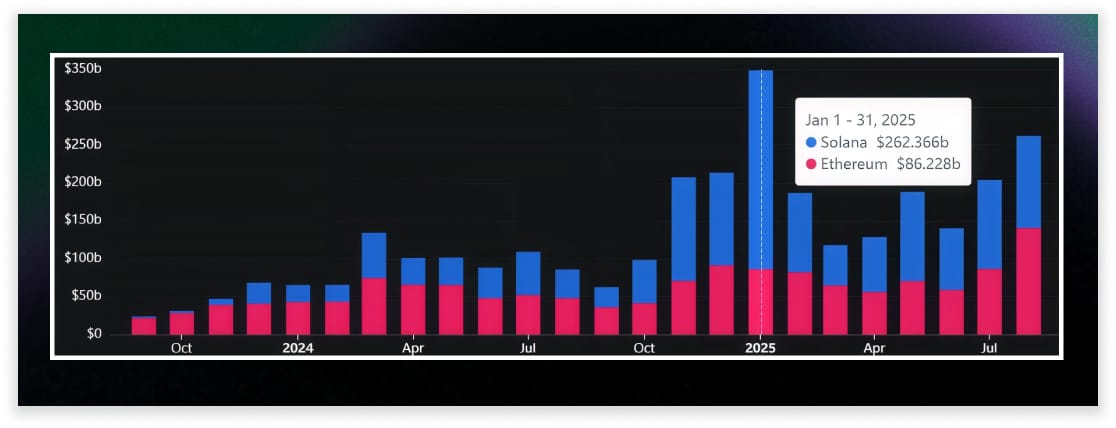
Source: DeFiLama
Past two quarters, Solana literally dominated the charts, with its cumulative trading volume hitting $1.46 trillion and TVL surpassing $13.23 trillion to date. On September days, the daily trading volumes on Solana DEXs have been surpassing $4.4 billion, cementing its lead in the liquidity race. And it’s not just the raw hype. Several major Solana DEXs like PumpSwap, Jupiter, HumidiFi, Raydium, etc. have recently reported record or near-record revenues. 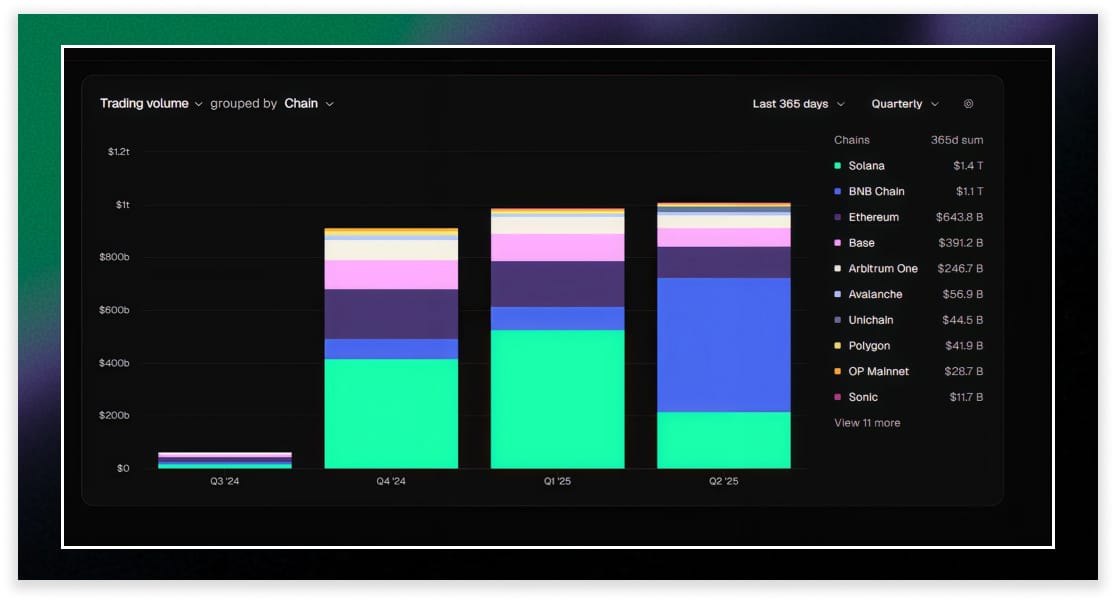
Source: Token Terminal
What Does the Alpenglow Upgrade Mean for Solana DEX Development?
Solana’s network just got its biggest upgrade since launch. So, what’s the Alpenglow afterglow for decentralized exchanges?
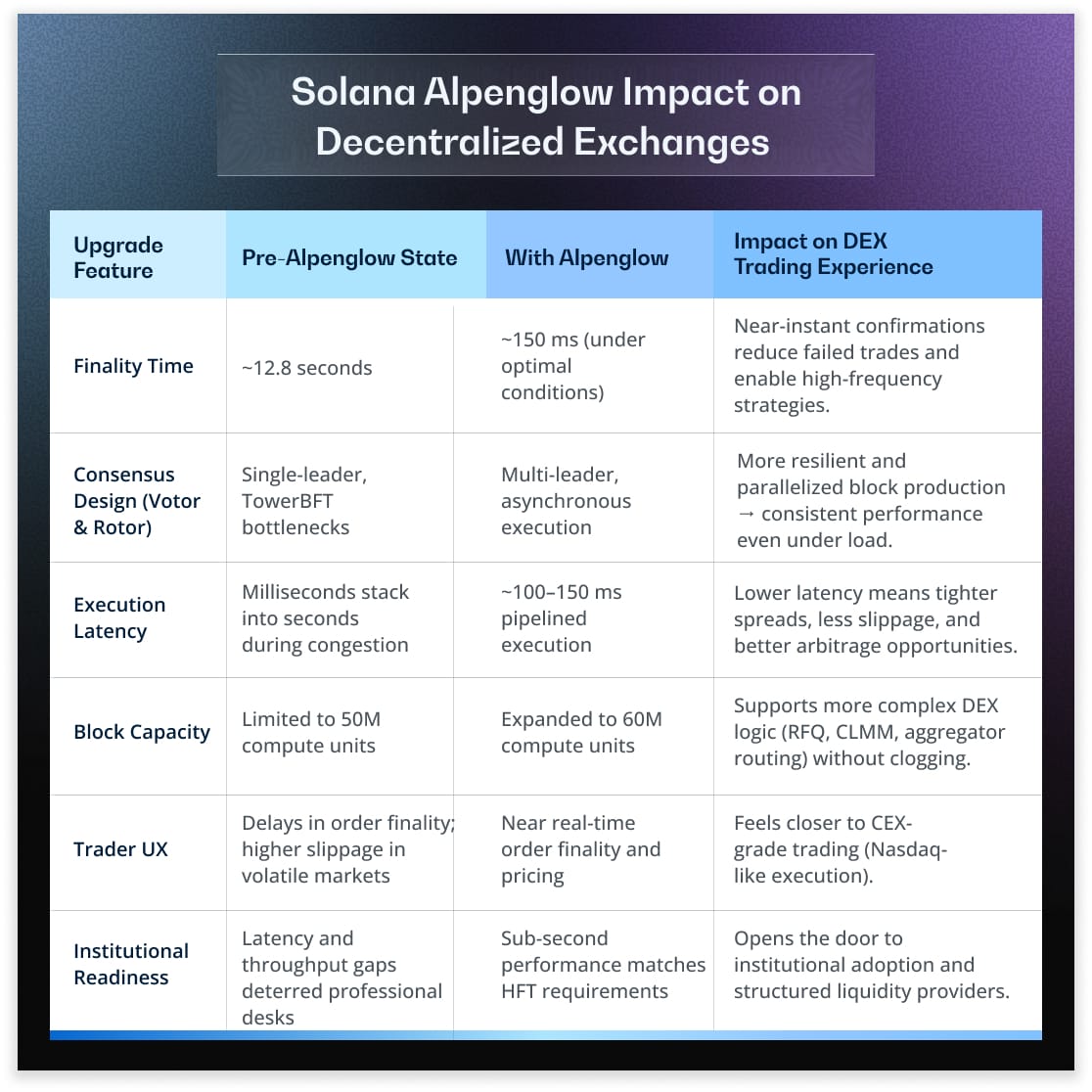
Alpenglow, approved by over 98% of validators, rewires consensus by introducing multi-leader finality (Votor & Rotor) and asynchronous execution, slashing finality times from ~12.8 seconds to near 150 milliseconds. For any existing or emerging decentralized exchange software, this is a structural shift.
Faster blocks introduced by Alpenglow mean tighter spreads, lower slippage, and execution speeds that start looking like Nasdaq and not DeFi. Layer in the memecoin-driven liquidity boom and the growth of specialized liquidity pools routed through Jupiter for more efficient execution. Together, they now account for more than a quarter of Solana’s DEX activity, marking a structural shift toward sustainable liquidity that is attracting both retail and institutional participants.
And it’s not just about speed. The Alpenglow upgrade increases block capacity from 50M to 60M compute units. So, now Solana can support more complex DEX development logics, from RFQ routing to concentrated liquidity models, without any network congestion. For traders, this translates into a smoother high-frequency trading experience that could mean near real-time order confirmations, tighter spreads, and reduced slippage.
For entrepreneurs, the combination of sub-second finality and higher throughput finally matches the execution standards of traditional finance, making Solana a serious venue for building a professional decentralized trading desk.
Solana Alpenglow Impact on Decentralized Exchanges
Also Read>>> How to Build an Institutional-Grade DEX in 2026: Lessons from aPriori’s $20M On-Chain Bet
Which Solana DEX Models Are Defining 2025?
Solana’s liquidity is soaring, and it is not all about the trading volumes. Decentralized crypto exchange software solutions on Solana have paved the way in terms of how trades are routed, priced, and secured.
A new crop of decentralized exchange development models is shaping the market, each addressing varied pain points ranging from liquidity fragmentation to execution fairness.
- Titan
Titan, the DEX of DEXs meta-aggregator, scans across multiple DEXs and aggregators to secure the best execution path. Instead of challenging the Solana DEX Jupiter, it complements it, giving traders meta-level routing that reduces slippage and expands access to hidden liquidity.
- Pyra
Pyra rethinks leverage with a credit without a liquidation mechanism. Instead of the brutal margin calls DeFi is infamous for, it offers smart liquidation protection and even links to payment rails like Visa cards. By letting users tap credit lines without selling their core assets, Pyra is blurring the lines between trading, lending, and real-world finance.
- Ranger Finance
While most Solana DEX aggregators focus on swaps, Ranger is built for perpetual contracts. It routes trades across perps DEXs on Solana to minimize slippage, a crucial feature as derivatives, including perpetuals, futures, and options, dominated trading activity in 2025, making up to two-thirds of trading volume. This puts Ranger in direct competition with centralized exchanges offering similar efficiency.
- Byreal
Byreal, a Solana DEX development project incubated by Bybit, brings a hybrid of Request-for-Quote (RFQ) and Concentrated Liquidity Market Maker (CLMM) models. Its mission is to import CEX-grade liquidity into DeFi. Its “Reset Launch” mechanics also aim to curb bot exploitation in token launches. This bot-protection feature is being closely watched by developers and entrepreneurs planning Solana decentralized exchange development.
- MageDEX
MageDEX is a Solana-native DEX, designed with a community-first approach at its core. With 95% of swap revenue shared with stakers, near-zero fees, and instant execution, it has become a magnet for traders frustrated with EVM DEX costs. Its incentive model doubles as a community growth engine, giving it stickiness beyond just low fees.
- Pump.fun & PumpSwap
Platforms like Pump.fun and its trading layer, PumpSwap, have become the entry point for Solana’s memecoin wave, with liquidity at the launch approach. By automating liquidity pool creation and early routing, they address one of the hardest problems in DeFi: how to bootstrap tradable markets from day one. Despite being criticized as “degen casinos,” their impact is undeniable. PumpSwap alone has captured more than 70% of Solana’s DEX activity during peak memecoin weeks, proving that liquidity innovation often starts at the fringes before it scales into mainstream DeFi.
Together, these Solana decentralized exchange development projects strengthen Solana’s ecosystem by addressing DeFi’s grave issues, including liquidity, aggregation, credit, and community-first economics. By emphasizing speed, fairness, and long-term sustainability, they indicate the trajectory of future DEX development beyond the memecoin spikes.
Also Read>>> How do you launch your DEX Aggregator like Jupiter?
Are Solana DEXs Secure Against Rug Pulls and Wash Trading?
For all the speed and liquidity, Solana DEXs are not immune to the darker side of DeFi. In fact, their very efficiency can make them honey pots for malicious actors.
- Rug Pull Pools in the Thousands
A recent dataset called SolRPDS analyzed over 3.7 billion Solana transactions and flagged more than 62,000 suspicious liquidity pools from 2021-2024. Roughly 22,000 of these showed rug-pull behavior, pools where liquidity is suddenly drained, leaving traders with worthless tokens.
Takeaway For Developers and Entrepreneurs: Collaborate with your Solana decentralized exchange development company to implement better listing filters and automated fraud detection as they’re no longer optional but table stakes.
- Wash Trading in Memecoin Markets
Memecoins might be driving record DEX volumes, but not all of it is organic. Analysts have traced significant wash trading activity, where insiders trade with themselves to inflate volume or manipulate prices.
Takeaway For Decentralized Exchange Software Developers and Entrepreneurs:
Wash trading distorts signals for traders and erodes trust in decentralized crypto exchange software platforms. DEXs must integrate transparent analytics and verifiable volume metrics to keep credibility intact.
- Phishing and Transaction Exploits
Tools like SolPhishHunter emerged after researchers documented new phishing strategies exploiting Solana’s transaction mechanics. Losses are measurable, not hypothetical.
Solana DEX Development Takeaway: Entrepreneurs planning to launch their Solana DEXs must implement wallet-level education, better transaction previews, and stricter dApp permissions to combat these exploits.
Security won’t kill innovation, but help Solana DEXs sustain the momentum. Solana DEX Development projects that address rug pulls, fake volume, and phishing vectors head-on will earn the trust that raw speed and liquidity can’t buy.
Build Your Solana DEX With Antier
What Must Upcoming Solana DEXs Deliver?
Speed and liquidity alone won’t cut it anymore. Any DEX launching on Solana in 2025 must:
- Leverage Alpenglow’s Sub-Second Finality: Entrepreneurs must build AMMs and perp engines that take advantage of near-instant execution. (low-latency AMMs, atomic swaps, decentralized institutional trading desks, perps engines) Any early mover building these will define the UX metrics for upcoming Solana DEXs.
- Integrate with Legacy Pools: Private AMMs routed by Jupiter have already amassed trading volumes in the past two quarters. So, the next better isn’t about who has the deepest pool but who can design smarter routing and execution strategies that siphon volume from legacy pools like Raydium or Orca.
- Adopt Fair Launch & Security Safeguards: Rug pulls and wash trading aren’t going away. Collaborate with your decentralized exchange development company to bake anti-bot mechanics, reputation scoring, fraud detection, safe-launch mechanics, and protection against rug pulls into DEX designs.
- Design for Mobile and Retail Access: With Solana’s Seeker phone already shipping 150+ units, mobile native DEX experiences will matter. Builders who integrate wallets, gasless swaps, and lightweight UIs for the next billion mobile users will capture the widest market.
- Position for Institutional Capital: Collaborate with DEX development company to execute structured liquidity (RFQ/CLMM models) and RWA integration to enhance professional adoption.
Also Read>>> Cryptocurrency Exchange Development: Comparing Solana and Basechain
Build the Future of Solana DEXs with Antier
Solana’s DEX boom is not a passing wave. Those who internalize the lessons of Alpenglow, private AMMs, memecoin liquidity, and security risks will be building not for the hype of 2025 and beyond, but for the financial rails of the next decade.
Antier turns Solana’s momentum into your competitive advantage, building DEXs that scale from retail traders to institutional desks.
Antier’s Decentralized Exchange Development Services Include:
- Custom Solana DEX Development: RFQ, CLMM, perps engines, aggregator integration, and more.
- Liquidity Solutions: Design and deploy models that bootstrap sustainable liquidity from day one.
- Institutional-Grade Features: RWA tokenization, compliance frameworks, and execution fairness.
- Mobile-First DeFi Experiences: Wallet integration, gasless transactions, and UX tailored for Solana’s Seeker ecosystem.
- End-to-End Delivery: Antier has delivered 250+ successful exchange deployments worldwide.
If you’re ready to build on Solana’s momentum in 2025, Antier is your trusted DEX development partner.
Frequently Asked Questions
01. What is the Reset Launch feature in Byreal?
The Reset Launch is Byreal’s anti-bot protection mechanism for new token launches. Instead of letting automated bots capture liquidity and dump immediately, Reset Launch periodically clears early orders and reopens the pool. This levels the playing field for human traders, curbs predatory sniping, and ensures fairer price discovery for new assets. For investors, it reduces the chaos often associated with DeFi launches while still keeping the process on-chain.
02. What are RFQ and CLMM in a DEX?
RFQ (Request for Quote): An execution model where traders request a price from professional market makers before confirming a trade. This reduces slippage and provides tighter spreads, especially for large orders.
CLMM (Concentrated Liquidity Market Maker): A liquidity design where providers allocate funds to specific price ranges rather than across the entire spectrum. This makes capital more efficient and allows for deeper liquidity near active trading ranges.
Together, RFQ + CLMM blends the precision of centralized exchanges with the transparency of DeFi, which is why Byreal and other Solana DEXs are adopting it.
03. How can new tokens bootstrap tradable markets from day one?
Platforms like Pump.fun and PumpSwap have redefined token launches by automatically creating liquidity pools the moment a token is minted. Instead of relying on manual listings or third-party liquidity providers, PumpSwap ensures that a token can be bought and sold instantly, often within minutes of launch. This approach not only drives early trading activity but also addresses one of DeFi’s hardest challenges and which is how one can create immediate, liquid markets for brand-new assets. For Solana’s ecosystem, it has been a critical driver of both memecoin popularity and sustained DEX volumes.