



✨ AI Summary
- The blog post delves into the evolution of the gaming industry, emphasizing the rise of Play-to-Earn (P2E) games powered by blockchain technology.
- These games offer players the opportunity to earn digital tokens, NFTs, and tradeable assets, revolutionizing the traditional gaming model.
- However, mainstream adoption has been hindered by high onboarding friction, resource-heavy requirements, and fragmented player bases.
- Enter Telegram farms – lightweight gaming experiences within the Telegram app that simplify entry, enhance community growth, and offer gamified farming mechanics.
- These mini-apps eliminate technical barriers, promote daily engagement, and pave the way for a future Telegram-enabled economy.
The gaming industry has undergone an evolution based on demand from the players – arcades have led to home consoles, which led to online multiplayer games, which have subsequently pushed the envelope of gaming even further with blockchain technology that focuses on Play-to-Earn (P2E.)
Unlike traditional gaming models, where players are rewarded with something that has no intrinsic value to the real world other than entertainment and virtual progression, P2E games establish an entirely different world – a game where players can earn compensatory value in the form of digital tokens, NFTs, and tradeable assets. The intersection of gaming and finance has rapidly given rise to a massive new sector known as GameFi.
Although there is a lot of buzz around P2E and GameFi, mainstream user engagement has been quite small. Fragmented ecosystems, digital wallets and gas fees, and a confusing onboarding process have provided a barrier for casual gamers to enter the sector. Many blockchain-based gaming users were curious and went through the onboarding process, but they never fully realized the value of P2E gaming before disengaging due to the onboarding process feeling too dense and confusing.
This is exactly where Telegram farms come into play. By providing simple gameplay combined with the general usability of Telegram, these farming-style games are eliminating layers of friction that made P2E strong-arming to the average user. Leveraging Telegram-based mini-apps for instant accessibility and the scalability of the TON blockchain, they have introduced millions of players to Web3 gaming in a way that feels familiar and enjoyable, rather than intimidating.
Learn Why to Launch a Game on Telegram Apps Center.
The Challenge in P2E Models
The Play-to-Earn ecosystem, for all its promise, faced a few challenges that kept it from truly breaking into the mainstream.
1. High onboarding friction
Most blockchain games require players to jump through several hoops before they can start. Setting up a new crypto wallet and safeguarding private keys, buying (or bridging) tokens from an exchange, and accessing decentralized applications are all second nature to blockchain natives, but they create a significant burden for an average gamer. This high friction is a deterrent to first-time adoption and keeps P2E in a small user base.
2. Resource-heavy onboarding
Many of the early blockchain games were designed as complete experiences on the blockchain, with complicated mechanics in their design and implementations that put high demands on devices. Not only was this a demand on higher-end devices, but it also asked players to invest a fair amount of time and money to stay competitive. This would translate into a first impression that P2E was “pay-to-win”, which harkened back to the marketing narrative of player inclusivity.
3. Fragmented player base
As blockchain games often operate across multiple ecosystems, chains, and platforms, player communities remain scattered. A user playing a P2E game on Ethereum may not be able to interact with someone on Binance Smart Chain or Solana. This lack of cross-platform integration prevents network effects, reduces organic virality, and makes it harder for communities to scale.
These challenges combined to create an ecosystem that was exciting in theory but inaccessible in practice. P2E needed a bridge — a model that could simplify entry, unify communities, and sustain engagement.
Build Your Own Telegram Farm – Start Developing Today
What Are Telegram Farms & How Are They Solving It?
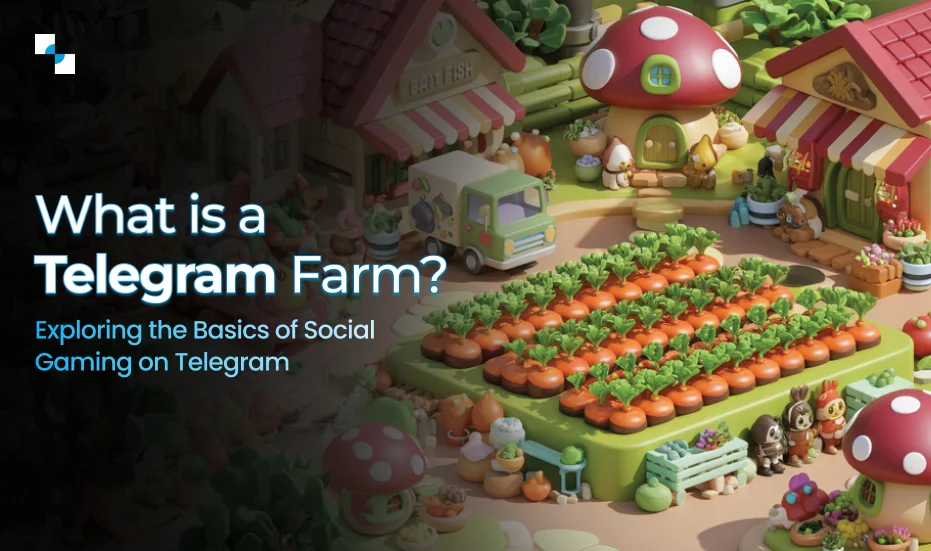
A Telegram farm is a blockchain-based, lightweight gaming experience you can access through and natively in Telegram, where you can earn tokens, digital assets, or crypto simply through actions taken in the app. In contrast to the traditional Play-to-Earn (P2E) games, the Telegram farms are explicitly built to be very easy to use with little to no setup, and immediate access to gaming.
Most Telegram farms are represented as mini-apps or mini-programs within the Telegram framework, and will utilize the TON blockchain to verify and account for in-game assets, meaning these Telegram farms are even closer to the realm of traditional applications and messaging services.
By combining similar social experiences with blockchain-backed incentives, they are changing the user experience with P2E.
1. Community-driven growth
Telegram has long been the platform of choice to expand a crypto community. It is the primary place for conversations, project updates, and minimalistic grassroots marketing. By simply integrating farming mechanics into the existing Telegram groups and channels, developers have an instant ecosystem to work off from. The viral referral mechanisms, group competitions, and farming activities guarantee growth with the community and naturally within the user base, while players bring in players in groups organically. Once again, the Telegram farms are fueled by the social experience that comes from the Telegram app, not the actual game.
Explore The Legal and Regulatory Landscape of Telegram Games
2. Easy onboarding
One of the biggest breakthroughs of Telegram farms is the obliteration of technical barriers to entry. The mini-apps-based experiences can guarantee that a user can simply start playing with a click of a button without the need for wallets, tokens, or any prior blockchain knowledge, and literally start to play right away across the board. It isn’t until a user engages more that they start to learn about the blockchain aspect, which happens when you start to learn about the TON blockchain for where they store and transfer in-game assets into the same channels. This creates the “Web2 first, Web3 later”, where casual players would like to learn about the game without being overwhelmed at the onset.
3. Gamified farming
Although Telegram Farms’ gameplay mechanics might seem unremarkable, they are effective in building daily engagement through Tap-to-earn actions, evolution of tokens, and reward levels to encourage players to return each day. Eventually, these repetitive behaviors become habits associated with reward loops. Players then began to understand deeper digital ownership through leveling up and unlocking assets tied to the blockchain and P2E ecosystems.
The combination of social virality, seamless onboarding, and habit-forming gameplay patterns is what makes Telegram Farms a true disruptor in the P2E category.
Role of Telegram-native economies in P2E growth
The trend surrounding Telegram farms indicates that they may one day serve as the framework for a future Telegram-enabled economy. With Telegram beginning to roll out in-app payment functionalities and integrating more deeply with the TON blockchain, the service is evolving from a mere messaging platform into a Web3 super-app.
As we look ahead, we can begin to see emerging opportunities.
- United farming ecosystems – The development of interconnected farming games around a single token economy is in the works. This reduces fragmentation, creates a stronger liquidity pool, and enhances engagement across multiple experiences for players.
- Messaging meets DeFi – The combination of Telegram farms with the opportunities within decentralized finance presents new opportunities. Players could stake their tokens earned from farming, lend them out, or earn yield all within the TON ecosystem, thereby turning simple gameplay into a gateway to more complex financial interactions.
- Interoperability across games – Assets earned in one of the Telegram-based mini-apps, could soon be usable across others. This would allow players to transfer characters, rewards, or upgrades from one game to another, creating a more immersive connected experience.
If these trends continue, Telegram will likely continue to solidify its position as the central hub for financially rewarding, light-weight, viral gaming experiences and push forward the next wave of mass adoption for blockchain gaming.
Experience seamless blockchain gaming with TON-powered Telegram mini-apps — start Telegram farm development today with Antier!
Frequently Asked Questions
01. What is Play-to-Earn (P2E) gaming?
Play-to-Earn (P2E) gaming is a model where players can earn real-world value through digital tokens, NFTs, and tradeable assets, unlike traditional gaming which only offers entertainment and virtual progression.
02. What challenges does the P2E ecosystem face in attracting mainstream users?
The P2E ecosystem faces challenges such as high onboarding friction, resource-heavy onboarding processes, and a confusing user experience, which deter casual gamers from fully engaging with blockchain-based games.
03. How do Telegram farms improve the P2E gaming experience?
Telegram farms simplify gameplay and leverage the familiar interface of Telegram, reducing onboarding friction and making it easier for new players to access Web3 gaming, thus enhancing user engagement.