




✨ AI Summary
- In a world where blockchain meets regulation, miners and validators are now under the legal microscope.
- This blog post delves into the evolving legal landscape surrounding these crucial blockchain actors, highlighting issues such as money transmission laws, tax ambiguity, data privacy conflicts, and environmental compliance challenges.
- As global laws struggle to keep pace with blockchain technology, the role of Blockchain Legal Advisors becomes essential for every project.
- These advisors help interpret complex regulations, design compliance frameworks, and anticipate policy changes, empowering projects to operate within clear legal boundaries.
- The post also outlines a practical roadmap for addressing blockchain legal issues, emphasizing the importance of auditing operations, partnering with legal consultants, and embedding compliance into organizational culture.
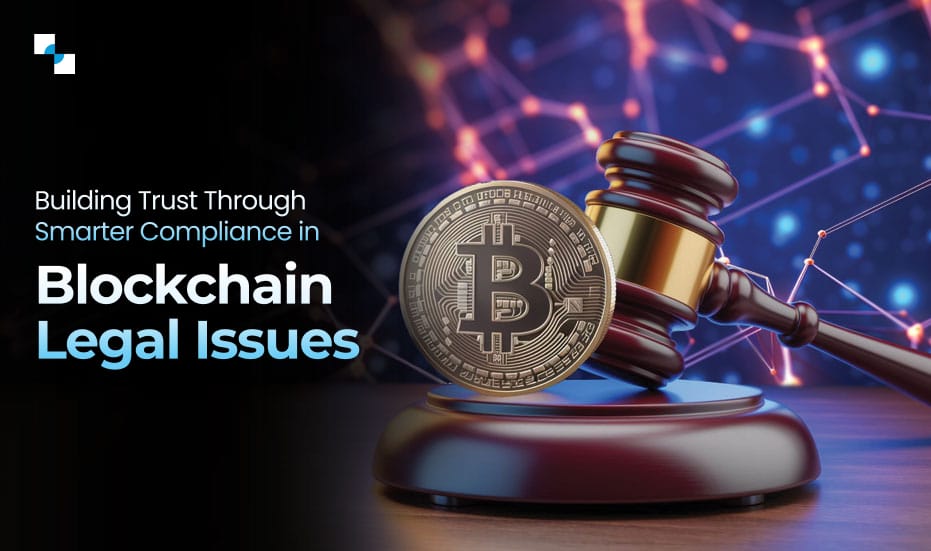
Every revolution eventually meets reality, and for blockchain, that reality is regulation. As the world begins to address growing blockchain legal issues, the spotlight that once shone on token issuers, exchanges, and DeFi protocols is now shifting to the quiet workhorses behind every chain – miners and validators. These actors don’t chase hype; they keep the system alive. They validate transactions, secure consensus, and hold the infrastructure together.
But now, they’re entering a space with new rules and growing legal attention. Governments, tax bodies, and regulators are finally asking: If the blockchain breaks the law, who’s responsible for keeping it running?
This blog explores the evolving legal issues with blockchain that are emerging around miners and validators, why these blockchain regulatory issues matter, and how a Web3 Legal Consulting Firm can transform compliance into a long-term strategic advantage.
The Silent Shift: From Tokens to Infrastructure-Level Compliance
In blockchain’s early days, legal battles revolved around cryptocurrency legal issues – ICO scams, token securities classifications, and exchange licensing. Everyone assumed that miners and validators were safe in the background, just “running the code.”
That assumption is dead.
Regulators such as the SEC, CFTC, and FATF have realized that blockchain’s integrity depends on the actors maintaining it. And those actors – miners, validators, and even node operators are now under the same legal microscope as exchanges and DeFi developers.
What was once a purely technical activity is now being interpreted through a legal lens. Are miners “money transmitters”? Are validators “service providers”? Should they be licensed financial entities?
These are no longer theoretical debates. They are active blockchain regulatory issues shaping the global compliance landscape.
The People Behind the Protocols: Who Miners and Validators Really Are
Before diving into law, let’s pause on the human side of this technology. Miners are the backbone of Proof-of-Work networks like Bitcoin, solving cryptographic puzzles to verify transactions. Validators, meanwhile, play the same role in Proof-of-Stake systems like Ethereum, Solana, and Cosmos, thus staking assets to maintain consensus and earn rewards.
For years, these roles operated in a legal gray zone, but as blockchain becomes an engine for real-world finance, the actions of miners and validators are starting to carry legal consequences.
Here’s why:
- They process global transactions involving real assets.
- They sometimes run servers across multiple jurisdictions.
- Their earnings, whether in tokens or fiat, raise taxation and reporting questions.
- Their data handling practices touch privacy laws like GDPR and CCPA.
The line between “just verifying blocks” and “performing regulated activity” is getting thinner. That’s where blockchain legal consultants come in to interpret what those lines mean before regulators draw them for you.
The Legal Minefield: Unresolved Regulatory and Compliance Gaps
Most blockchain infrastructure providers are navigating complex blockchain regulatory issues without even realizing it. Let’s look at some of the most pressing legal issues with blockchain that miners and validators are facing today:
a. Money Transmission Laws
Some governments consider transaction verification as a form of financial facilitation. If a miner or validator is viewed as “transmitting value,” they could be forced to obtain money transmitter licenses even if they never directly handle user funds.
b. Tax Ambiguity
Mining rewards are taxed differently across jurisdictions – income in the U.S., capital gains in the U.K., and hybrid models in Singapore. Without structured reporting, even compliant operators can end up breaching tax laws unintentionally.
c. Data & Privacy Conflicts
Validators often process encrypted data from multiple countries. But under laws like GDPR, “processing” itself can make you liable even if you can’t read the data. This is one of the least understood blockchain legal issues in existence.
d. Environmental Compliance
Energy-heavy operations are now linked to environmental regulations. Norway, Canada, and parts of the EU have already restricted mining operations over sustainability concerns.
Each of these risks exists because global law still hasn’t caught up with blockchain technology, and until it does, every miner or validator operates under uncertainty – a challenge explored in detail by Norton Rose Fulbright.
Why Blockchain Legal Advisors Are Now Essential for Every Project
For years, projects viewed legal professionals as a checkbox. “We’ll get a lawyer once we scale,” they’d say.
That mindset doesn’t work anymore.
Today, compliance is a core part of business strategy. A skilled Blockchain Legal Consultant or Blockchain Legal Advisor doesn’t just tell you what’s legal; they help design your operations so you can build freely within the rules.
Here’s what they do in practice:
- Interpret global frameworks (SEC, MiCA, VARA, FATF) and apply them to your project’s architecture.
- Design compliance frameworks for node operators, validator pools, and mining collectives.
- Draft operating agreements that define liability between validator nodes.
- Conduct legal audits to identify hidden risks before a regulator does.
Working with a Web3 Legal Consulting Firm isn’t about fear; it’s about foresight. It’s how projects move from “uncertain” to “institution-ready.”
Empowering Growth Through Legal Guidance
In today’s digital economy, clarity and compliance are just as vital as innovation. Working with an experienced Blockchain Legal Consultant ensures that your project is built on a foundation of trust, transparency, and long-term sustainability.
A professional Blockchain Legal Advisor helps your organization interpret complex blockchain regulatory issues, align with global standards, and anticipate policy changes before they affect your business.
When blockchain ventures operate within clear legal frameworks, they:
- Attract stronger partnerships.
- Earn deeper investor confidence.
- Gain faster market credibility.
Legal foresight isn’t a burden; it’s the engine that keeps innovation moving forward.
Global Legal Momentum: How 2025 is Redefining Blockchain Regulation
2025 is the year blockchain meets its legal reflection. Across the world, blockchain regulatory issues are solidifying into formal laws.
Here’s what’s happening now:
- Europe’s MiCA framework has become the benchmark for crypto regulation – setting licensing, disclosure, and AML standards.
- The U.S. is tightening IRS reporting obligations for mining and staking operations.
- Dubai’s VARA has emerged as a global pioneer, mandating compliance verification for tokenization, mining, and DeFi licensing.
- Singapore and Hong Kong are positioning themselves as compliant innovation hubs, actively encouraging partnerships with Web3 Legal Consulting Firms.
The tone of the industry is changing. Legal alignment isn’t just survival; it’s a competitive advantage. The companies that adapt now will define what “compliant decentralization” looks like for the next decade.
A Practical Roadmap for Navigating Blockchain Legal Issues
So, how can miners, validators, and infrastructure builders address evolving blockchain legal issues? Here’s a simple but powerful three-step roadmap.
1. Audit Your Operations
Map out where your nodes are located, how rewards are distributed, and what jurisdictions apply. Identify overlaps between blockchain regulatory issues and your daily operations.
2. Partner With a Blockchain Legal Consultant
Instead of reacting to rules, interpret them early. Let a blockchain legal advisor help build frameworks for taxation, KYC, and risk management that scale with your network.
3. Build Compliance Into Culture
Stop treating compliance as a roadblock. Treat it as infrastructure. When investors, regulators, and partners see that your system runs within the law, you don’t just gain trust; you gain leverage.
Schedule a call with our Web3 Legal Consulting Firm to know more
Conclusion:
Blockchain has entered its grown-up phase, and with maturity comes accountability. The invisible players of yesterday, miners and validators, are now at the center of tomorrow’s legal conversations.
Understanding blockchain legal issues isn’t about avoiding penalties; it’s about earning legitimacy in a world where law and technology finally intersect.
Those who embrace compliance early, guided by expert blockchain legal advisors and Web3 Legal Consulting Firms, won’t just survive; they’ll lead. This is because decentralization was never meant to escape regulation. It was meant to prove that transparency, security, and compliance can coexist and together, they’re what make the next era of blockchain unstoppable. Your blockchain project deserves clarity, not confusion.
Speak with an Antier – Blockchain Legal Consultant today and transform compliance into your strongest competitive advantage.