




AI Summary
- The blog post discusses the importance of account abstraction in cryptocurrency exchange software to improve user experience by addressing wallet friction issues.
- It highlights how traditional wallet structures create complexities for users, leading to inefficiencies in trading processes.
- Account abstraction shifts execution control to smart accounts, offering benefits such as simplified trading flows, reduced gas fees, and improved security.
- By integrating this technology, exchanges can streamline trade execution, reduce confirmation steps, and enhance user retention rates.
- The post also outlines the security considerations and potential risks associated with implementing account abstraction, emphasizing the need for robust security measures.
Cryptocurrency exchange software has spent the past decade optimizing liquidity, matching engines, and trading interfaces, yet the most critical bottleneck, the wallet layer, sits outside. Externally owned accounts (EOAs), controlled by a user’s private key, underpin most crypto wallets today but were never actually built for high-frequency trading or mainstream usability. Users need to manually manage seed phrases, approve tokens, hold native gas tokens, and sign multiple transactions before executing a single trade. End users gain exposure to low-level blockchain mechanics and a fragmented flow that TradFi platforms eliminated years ago.
Account abstraction changes this model by moving transaction logic, fee handling, and authorization rules into programmable smart accounts. Instead of users adapting to blockchain constraints, the cryptocurrency exchange software can define how accounts behave by sponsoring fees, batching actions, delegating permissions, and enabling flexible authentication. The result is a trading experience that approaches Web2 simplicity while preserving self-custody at the settlement layer.
How Does Wallet Friction Break Crypto Exchange UX?
As stated earlier, the constraint is not liquidity or matching speed but the execution control. When trading relies on EOA-based execution, cryptocurrency exchange software cannot abstract gas management, approval logic, or transaction sequencing. Every trade inherits the blockchain-level constraints.
Gas Fees as a Trading Blocker
Exchanges that don’t implement account abstraction require users to
- Maintain native tokens (e.g., ETH) for execution
- Monitor gas balances before trading
- Absorb gas price volatility
- Face failed transactions when balances are insufficient
This places a critical part of trade execution outside the control of the crypto exchange software.
Business impact:
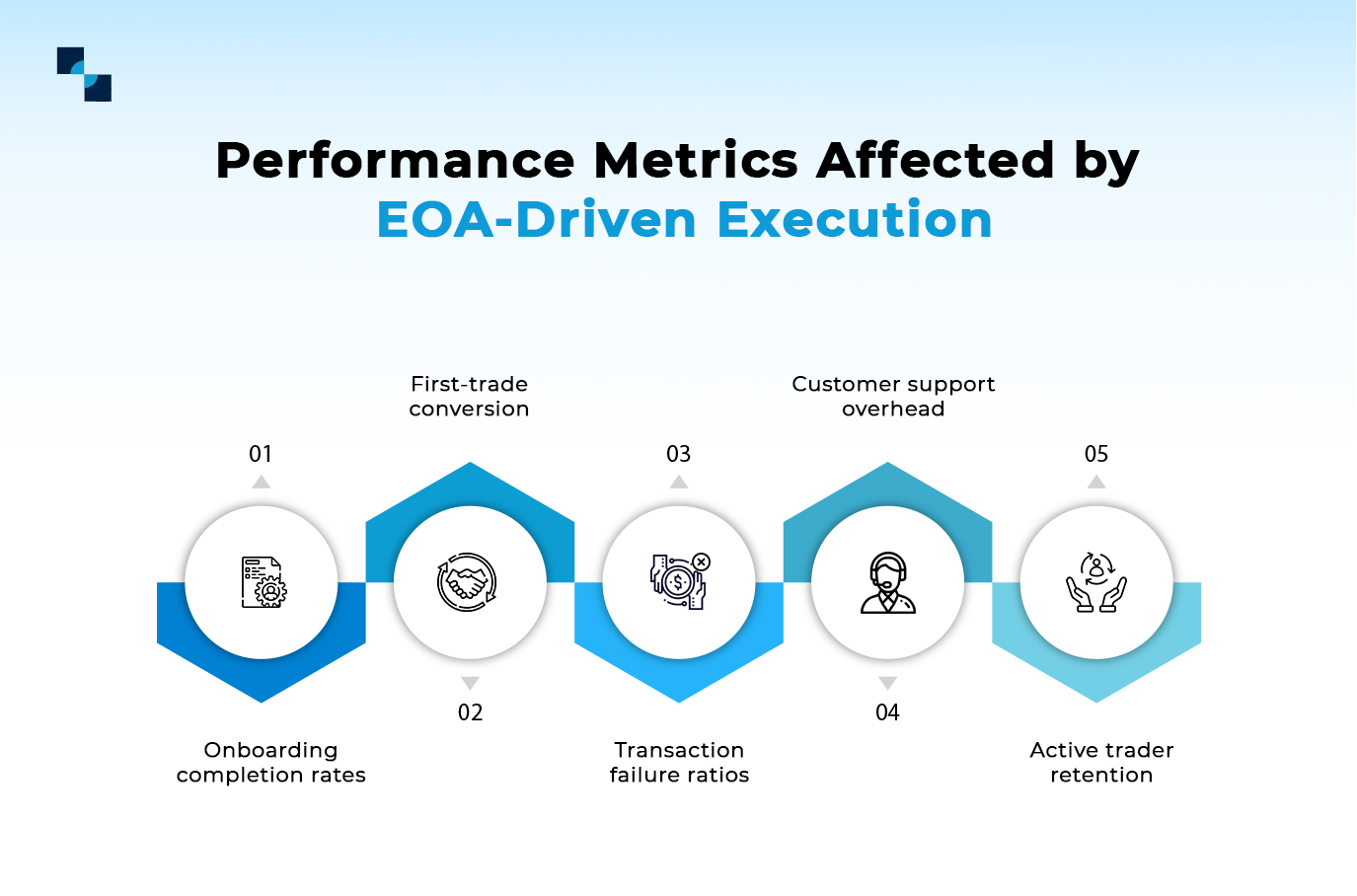
Gas dependency increases onboarding friction and introduces failure points during the first trade. Users who encounter gas-related errors early are less likely to complete activation, reducing onboarding completion and first-trade conversion rates. Users’ confidence in the cryptocurrency exchange software also declines.
Fragmented Trade Execution Model
EOA-based trading converts a single user intent into multiple independent blockchain actions. A simple trade may, therefore, involve:
- Token approval
- Trade submission
- Separate gas payments
- Waiting for on-chain confirmations
What appears as a single action in the UI becomes a sequence of protocol-level operations, increasing cognitive load and execution latency.
Business impact:
When wallet setup introduces additional steps before trading begins, abandonment increases. Each layer of required configuration, including gas funding, approvals, and transaction confirmation, raises entry friction for non-technical users. For active traders, it slows execution velocity and affects retention.
Approval Loops and Signature Fatigue
In an EOA-based model, validation occurs one transaction at a time.
- As said earlier, a single trade will involve a token approval, trade execution, and multiple gas payments. Each step will also demand a separate wallet confirmation.
- Even when approvals are reused, every trade still requires a manual signature and gas confirmation since execution cannot be batched. For users, this creates an interruption at the exact moment when speed matters most.
Business impact:
Repeated confirmations reduce execution continuity for high-frequency traders and degrade overall crypto exchange software platform stickiness. Over time, this leads to lowered active trader retention.
Private Key Responsibility in Crypto Trading Environment
EOAs expose users to complexity and operational risks, including:
- Key storage and recovery
- Irreversible loss exposure
- Manual confirmation for every action
This transaction model is structurally incompatible with high-frequency trading, automated strategies, and mobile-first interfaces.
Business impact:
Wallet setup complexity increases onboarding drop-off, and recovery anxiety reduces user confidence in cryptocurrency exchange software. Support tickets related to lost keys, pending transactions, and gas confusion ultimately increase operational overhead.
How Account Abstraction Restructures Crypto Exchange Software Architecture and UX ?
Account abstraction shifts execution control from user-managed execution to programmable smart accounts. Instead of relying on EOAs that execute one signed transaction at a time, crypto exchanges integrating account abstraction operate through smart accounts that embed rules, validation logic, and fee policies directly into the account layer. It is a structural redesign of how transactions are authorized, validated, and executed within cryptocurrency exchange software.
Smart Accounts Replace Static EOAs
Under traditional EOA architecture:
- Each user controls an EOA via a private key.
- The account can only validate signatures.
- Each transaction is confirmed independently
- It cannot enforce custom rules or automate multi-step logic.
Also, each intent requires token approval, trade execution, separate confirmations, and gas payments, with each step requiring separate validation.
With account abstraction implemented in cryptocurrency exchange development:
- Each user operates through a smart contract-based account.
- The account can define validation rules beyond a simple private key signature.
- Execution logic can bundle multiple actions into a single atomic transaction.
Instead of signing multiple blockchain transactions, the user signs only once. This allows cryptocurrency exchange software to define how accounts behave without taking custody of assets.
UX Outcome For Crypto Exchange Software:
A trade that previously required approval + execution + separate confirmations can execute as a single action after cryptocurrency exchange development implements account abstraction. This leads to:
- One-click trades
- Reduced signature fatigue
- Faster execution perception
- Lower slippage risk in volatile markets
Users experience intent-based trading instead of transaction-based signing.
User Operation Flow Enables Programmable Execution
In an EOA model:
- The user signs a transaction.
- The transaction is broadcast to the network.
- The user pays gas directly.
In an account abstraction based cryptocurrency exchange development:
- The user signs a User Operation which is an instruction object, not a direct transaction.
- A bundler aggregates multiple User Operations.
- The bundled transaction is submitted on-chain.
- A paymaster can sponsor or manage gas payment.
This way, the user no longer interacts with raw blockchain transactions. Execution becomes purely programmable and policy-driven.
UX Outcome For Crypto Exchange Software
By integrating account abstraction into crypto exchange development, trading platforms can therefore abstract gas fees. Users no longer need to hold native tokens or manually manage fee volatility. Trade execution becomes predictable for users.
Fee Handling Becomes Platform-Controlled
EOAs require users to:
- Hold native gas tokens
- Estimate and manage gas costs
- Accept failed transactions due to insufficient gas
Account abstraction enabled smart accounts in cryptocurrency exchange software allow:
- Sponsored gas
- Stable coin-denominated fee deduction
- Gas fee abstraction at the infrastructure layer
UX Outcome For Crypto Exchange Development:
Since the user-managed gas fee model is eliminated and platforms abstract gas volatility for the users entirely, it results in reduced onboarding friction, higher first-trade success, and simplified mobile trading flows.
Authorization Becomes Policy-Based, Not Key-Based
In an EOA model, a transaction is valid if the private key signs it. Authorization is binary as it is either full approval or rejection.
Smart accounts powered by account abstraction introduce conditional validation. An action can be executed only if predefined rules are satisfied, such as:
- Multi-signature authentication
- Spending limits
- Time-bound permissions
- Role-specific access (trade allowed, withdrawal restricted)
- Delegated bot or API permissions
- Device-scoped authentication
Validation shifts from “Who signed this?” to “Does this action satisfy defined policy constraints?”
UX Outcome For Crypto Exchange Software:
- Session-based trading without repeated confirmations
- Controlled automation for bots and APIs
- Flexible recovery without custodial compromise or requiring users to confirm every transaction manually
This enables high-frequency trading and mobile-first interaction without degrading security posture.
Structural UX Shift
Under EOA-based execution, users adapt to blockchain mechanics.
Under account abstraction based cryptocurrency exchange development, blockchain mechanics adapt to user intent. The exchange defines:
- Transaction sequencing
- Fee logic
- Authorization boundaries
- Execution batching
The user interacts with a trading interface where the platform manages the protocol complexity itself.
Top Account Abstraction Implementations 2025-2026
| Entity | Implementation Type | Key AA Features Delivered | Focus / Market Position |
|---|---|---|---|
| OKX Wallet | Smart Account (ERC-4337) | Gasless swaps (using USDT/USDC for fees), Social Recovery, One-click dApp interactions. | UX-first retail onboarding. |
| Coinbase | Coinbase Smart Wallet | Passkey-based login (no seed phrase), “Paymaster” gas sponsorship, Batch transactions. | Bridging CEX users to On-chain. |
| Binance | Binance Web3 Wallet | Hybrid MPC + AA, Secure Auto-Sign (SAS), Sponsored gas on opBNB/L2s. | “Keyless” security and speed. |
| Safe (Gnosis) | Safe Smart Account | Multi-sig governance, Spending/Velocity limits, Custom logic modules (Inheritance). | Institutional & Enterprise treasury. |
| Argent | Argent (ZkSync/Starknet) | Guardian-based Social Recovery, Daily spending limits, Session keys for Gaming. | Mobile-native L2 specialists. |
| Trust Wallet | Smart Accounts (Optional) | Transaction simulation (Security Scanner), Batching, Biometric-backed recovery. | High-security self-custody. |
| Visa | Visa Paymaster (Pilot) | Experimental deployment of contracts to allow auto-payments and ERC-20 gas fees. | Bridging TradFi and Web3. |
| Particle Network | Universal Accounts | “Chain abstraction” where one account works across all chains gaslessly using social login. | Developer-centric infrastructure. |
Security and Implementation Considerations Fpr Account Abstraction-Based Crypto Exchange Development
Account abstraction improves execution control, but it also shifts responsibility to smart account logic and platform infrastructure. The UX gains are meaningful only if risk boundaries are clearly defined and enforced during account abstraction-based cryptocurrency exchange development.
Below are the core security dimensions that cryptocurrency exchanges must address while implementing account abstraction:
1. Smart Account Contract Risk
Unlike EOAs, smart accounts are programmable contracts. That introduces:
- Contract-level vulnerabilities
- Logic flaws in validation rules
- Upgradeability risks
- Dependency risks from third-party libraries
If the account contract contains a flaw, the impact can span across all users using that implementation.
Mitigation Requirements:
- Independent smart contract audits
- Formal verification for validation logic
- Strict upgrade governance
- Minimal external dependency design
The wallet layer in crypto exchange software becomes protocol infrastructure. It must be treated accordingly.
2. Paymaster Abuse and Fee Sponsorship Risk
Gas sponsorship introduces a new attack surface that must be protected. Potential risks include:
- Spam UserOperations draining sponsored gas
- Transaction replay attempts
- Fee griefing attacks
- Exploitation of fee validation logic
If paymaster validation rules are weak, the cryptocurrency exchange software absorbs cost exposure.
Mitigation Requirements:
- Rate limiting per account
- Pre-execution validation checks
- Transaction simulation before sponsorship
- Spending caps per user or session
Fee abstraction should not mean unlimited liability. So, entrepreneurs must protect the paymaster and fee sponsorship contracts along with other vulnerabilities in crypto exchange software.
3. Session Key and Delegated Permission Controls
Session keys enable smoother trading but expand the authorization surface, exposing the cryptocurrency exchange to te following risks:
- Compromised session keys
- Overly broad permission scopes
- Infinite-duration trading access
- Delegated bot misuse
Without strict boundaries applied during account abstraction-based crypto exchange development, automation can bypass user safeguards.
Mitigation Requirements:
- Time-bound session keys
- Spending and frequency limits
- Explicit scope constraints
- Immediate revocation capability
Authorization must be granular, not binary.
4. Recovery Logic and Identity Boundaries
Flexible authentication improves UX, but recovery flows can introduce vulnerabilities if poorly designed. Primary risk areas include:
- Social recovery collusion
- Centralized override mechanisms
- Weak multi-signature thresholds
- Off-chain identity spoofing
If recovery mechanisms are easier to exploit than private keys, the security of crypto exchange software regresses.
Mitigation Requirements:
- Transparent recovery policy design
- On-chain enforcement of recovery thresholds
- No hidden administrative overrides
- Clear separation between the UX layer and the control layer
5. Operational and Infrastructure Dependencies
Account abstraction introduces additional components to crypto exchange development, including:
- Bundlers
- Paymasters
- Relayer infrastructure
- Transaction simulation systems
If these components fail or are centralized without redundancy, execution reliability degrades.
Mitigation Requirements:
- Redundant bundler architecture
- Failover infrastructure
- Clear monitoring and alerting systems
- On-chain transparency of execution rules
Execution control must not create invisible trust assumptions.
Where Account Abstraction Creates the Most UX Value for Crypto Exchange Software?
| Exchange Model | Execution Constraint Under EOAs | How Account Abstraction Changes It | UX & Business Impact |
|---|---|---|---|
| High-Frequency & Active Trading Platforms | Repeated confirmations slow execution. Manual gas handling interrupts strategy flow. | Policy-based execution replaces per-transaction confirmation. Session keys enable bounded automation. | Improved trading continuity, reduced friction, higher active trader retention. |
| Mobile-First & Consumer Exchanges | Multi-step wallet confirmations increase abandonment. Gas management confuses new users. | Gas abstraction and batched execution simplify flows into single actions. | Shorter onboarding, higher first-trade conversion, improved mobile usability. |
| Automation, Bots & API-Driven Strategies | Bots require repeated signatures or full private key exposure. | Delegated permissions enforce role-bound execution without exposing custody. | Safer automation, expanded advanced trading support, and reduced operational risk. |
| Social & Copy Trading Platforms | Approval delays and execution fragmentation create slippage during replication. | Bundled execution enables synchronized strategy settlement. | Fairer copy performance, reduced slippage, stronger platform credibility. |
Strategic Takeaway
Account abstraction shifts wallet behavior from static key validation to programmable execution logic. For crypto exchange development, this means:
- Control over transaction sequencing
- Control over fee abstraction
- Control over authorization boundaries
- Control over execution experience
Cryptocurrency exchanges are no longer fighting over liquidity depth or interface design but claiming the execution layer.
Exchanges that continue combating while they still rely on EOA mechanics inherit blockchain-level constraints, while those adopting account abstraction will design trading experiences around user intent.
Antier builds exchange infrastructures that integrate account abstraction at the protocol and execution layers, enabling gas abstraction, delegated trading logic, and policy-driven security within production-ready architectures.
Share your requirements with the best crypto exchange development company today!
Frequently Asked Questions
01. What is the main issue with traditional cryptocurrency wallets for high-frequency trading?
Traditional cryptocurrency wallets, which rely on externally owned accounts (EOAs), require users to manually manage seed phrases, approve tokens, and handle gas fees, creating a fragmented and cumbersome trading experience.
02. How does account abstraction improve the user experience in cryptocurrency trading?
Account abstraction simplifies the trading process by moving transaction logic and fee handling into programmable smart accounts, allowing exchanges to manage fees, batch actions, and enable flexible authentication, thus enhancing usability while maintaining self-custody.
03. What are the consequences of gas fee dependency in cryptocurrency exchanges?
Gas fee dependency increases onboarding friction and introduces failure points during trades, leading to potential errors, reduced user confidence, and lower conversion rates for first-time traders.