



✨ AI Summary
- Equity markets are on the brink of transformation with the rise of RWA Tokenization platform development services.
- This new model offers digitized, programmable infrastructure for real-time settlement and global access.
- Nasdaq and BlackRock have already embraced tokenized securities, showcasing the shift towards institutional adoption.
- Businesses looking to implement equity tokenization platforms must consider factors like settlement design, legal frameworks, compliance, custody, market infrastructure, and more.
- Challenges such as liquidity risks, jurisdictional differences, and cash flow issues need to be addressed.
Equity markets are approaching an inflection point. Despite $100+ trillion of capital passing through them, their infrastructure is creaking under the demands of speed, transparency, and global access. Meanwhile, RWA Tokenization platform development Services are introducing a new model- digitized, programmable infrastructure capable of real-time settlement, global access, and automated compliance…
This transformation is already visible. Nasdaq filed in 2025 to permit tokenized securities trading under its existing market structure. BlackRock’s BUIDL tokenized liquidity fund surpassed $1 billion in assets within twelve months of launch. Tokenized assets are now accepted as collateral by major exchanges. These developments confirm that tokenization has moved from experimentation to institutional adoption.
For businesses considering equity tokenization platform development, this guide provides a clear road they need for effortless implementation.
Enable 24/7 Stock Trading with Tokenized Equity Platforms!
Understanding Traditional Limitations: Why Legacy Equity Infrastructure Is Obsolete
The traditional market framework is no longer aligned with institutional needs due to:
- Delayed settlement: Even under T+1, capital remains locked, and reconciliation lags.
- Restricted access windows: Markets open only during fixed hours and time zones.
- Opaque intermediation: Custodians, clearing houses, and transfer agents introduce friction and risk.
- High friction for issuance and corporate actions: Manual processes, off-chain coordination, and regulatory lag slow everything.
These structural limitations create unnecessary cost, limit global participation, and constrain capital efficiency. RWA Tokenization platform development Services reset this compromised market architecture and introduced new, transparent ways to enhance liquidity.
Understanding On-Chain Equities
On-chain equities are shares or economic rights expressed as tokens on a ledger, subject to compliance and regulation. Two main models exist:
- Native ledger securities: jurisdictions (e.g., Switzerland, Germany) now accept ledger-based shares as valid under local corporate law. In these cases, the on-chain registry is the official record.
- Wrapped/Depositary model: a regulated entity (trust, depository) holds the underlying equity and issues a token “mirror” with legal backing. Transfers are permitted via smart contracts. This model is common in early U.S. deployments.
For businesses planning to launch an equity tokenization platform, understanding which model to use is central is crucial as it drives the legal, technical, and operations design in the development process.
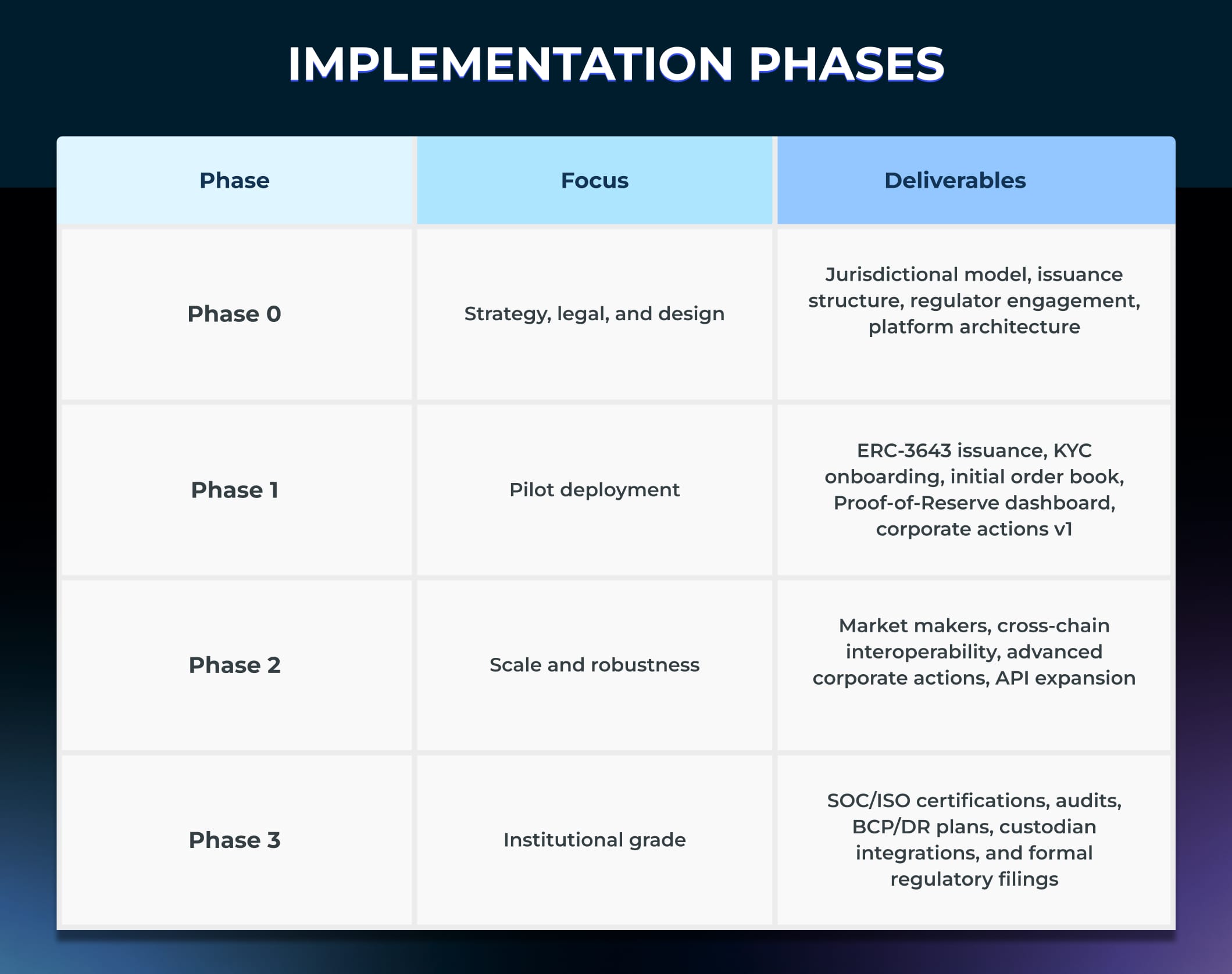
Steps To Build a Tokenized Equity Platform
To build a tokenized equity investment platform that won’t compromise in terms of regulations and trading, here’s what must be in place:
Architecture of a Tokenized Equity Platform
For businesses planning a tokenized equity investment platform, the following components are critical:
1. Settlement and Cash Flow Design
- Atomic delivery-versus-payment (DvP) is the standard: tokenized shares and cash move simultaneously. This requires on-chain settlement assets such as regulated stablecoins or wholesale CBDCs.
- Fallback mechanisms: Where atomic DvP is not legally permitted, platforms should provide T+0 or near-instant internal settlement while maintaining interoperability with legacy rails.
- U.S. equities: Some deployments will remain dependent on T+1 via DTC. Nasdaq’s filing assumes this model initially.
2. Legal and Corporate Framework
- Jurisdictions like Switzerland or Germany allow native ledger-based securities. These simplify compliance and reduce dependency on intermediaries.
- Where native frameworks do not exist, the depositary model provides a bridge. Custodians or trustees’ issue tokenized representations backed by underlying shares.
- Corporate action logic must be integrated. Smart contracts should automate dividends, splits, and voting. Investor agreements should specify rights and redemption processes in detail.
3. Identity, Compliance, and Transfer Control
- Token standards such as ERC-3643 or ERC-1400 enforce compliance on-chain. They restrict transfers to eligible, KYC-verified investors.
- Identity registries maintain attestation records, enabling revocation or revalidation when eligibility changes.
- Automated rejection of non-compliant transfers minimizes regulatory risk and manual intervention.
4. Custody and Proof of Backing
- For wrapped models, platforms must demonstrate verifiable 1:1 reserve. Proof-of-Reserve solutions such as Chainlink PoR can provide transparent attestations.
- For native securities, the blockchain registry serves as the official record, but registrar synchronization is essential for audit purposes.
- Licensed custodians should be integrated with disaster recovery and insurance safeguards.
5. Market Infrastructure and Liquidity
- Platforms must support both central limit order books (CLOBs) and RFQ models to cater to institutional and retail investors.
- Market makers are critical for providing liquidity and reducing spreads.
- Cross-venue interoperability should allow orders and transfers to flow across DLT platforms and exchanges.
- Cross-chain messaging (e.g., CCIP protocols) can manage lifecycle operations across multiple blockchains.
6. Oracles and Market Data
- Reliable oracles must provide real-time equity pricing, volatility metrics, and corporate data.
- Fallback mechanisms and sanity checks are essential to prevent manipulation or downtime.
- Every data feed should be auditable to maintain transparency with regulators and investors.
7. UX, APIs, and Developer Ecosystem
- APIs should support institutional clearing, risk systems, and reporting requirements.
- Investor onboarding must include KYC and wallet linking flows.
- Modular plug-ins for tax reporting, analytics, and compliance dashboards enhance platform adoption.
Challenges & Trade-offs: What Businesses Must Know
1. Liquidity Risks
Tokenization doesn’t guarantee liquidity. Many real-world assets see limited trading volume. Tokenization is robust, but tradability lags due to regulatory gating, valuation opacity, and small active investor bases. For this, businesses require Seedi liquidity, maker incentives, cross-asset pairing, and hybrid market structures.
2. Jurisdictional Discrepancies
What works in Switzerland might not be allowed in India, the U.S., or Singapore. Legal models may vary significantly. Organizations must have a legal map and jurisdiction fallback.
3. Cash Flow Risk
If the settlement isn’t atomic, users face mismatch risk. Stablecoin volatility or regulatory disallowance may complicate use. Having fallback rails and cash triggers is essential.
4. Corporate Actions Complexity
Stock splits, dividends, mergers—all need logic. Mishandling even one event can result in legal liability. Thus, building modular corporate action engines is critical.
Sanctions & Compliance Drift
Investor eligibility changes over time. The Asset Tokenization Platform must support mid-lifecycle revocation, revalidation, and enforce sanctions automatically.
Business Logic: How Value Accrues
The economic advantages of building a tokenized equity marketplace are significant:
- Issuance fees and trading spreads generate recurring revenue.
- Data analytics from order flow and usage patterns provide strategic insights.
- Liquidity aggregation positions the platform as a central market hub.
- Network effects compound: more issuers attract more investors, reinforcing liquidity.
- Distribution efficiency reduces issuance cost and expands access to global capital.
Early movers stand to become indispensable infrastructure providers. Late entrants risk marginalization.
RWA Tokenization Case Study: BUIDL and Nasdaq
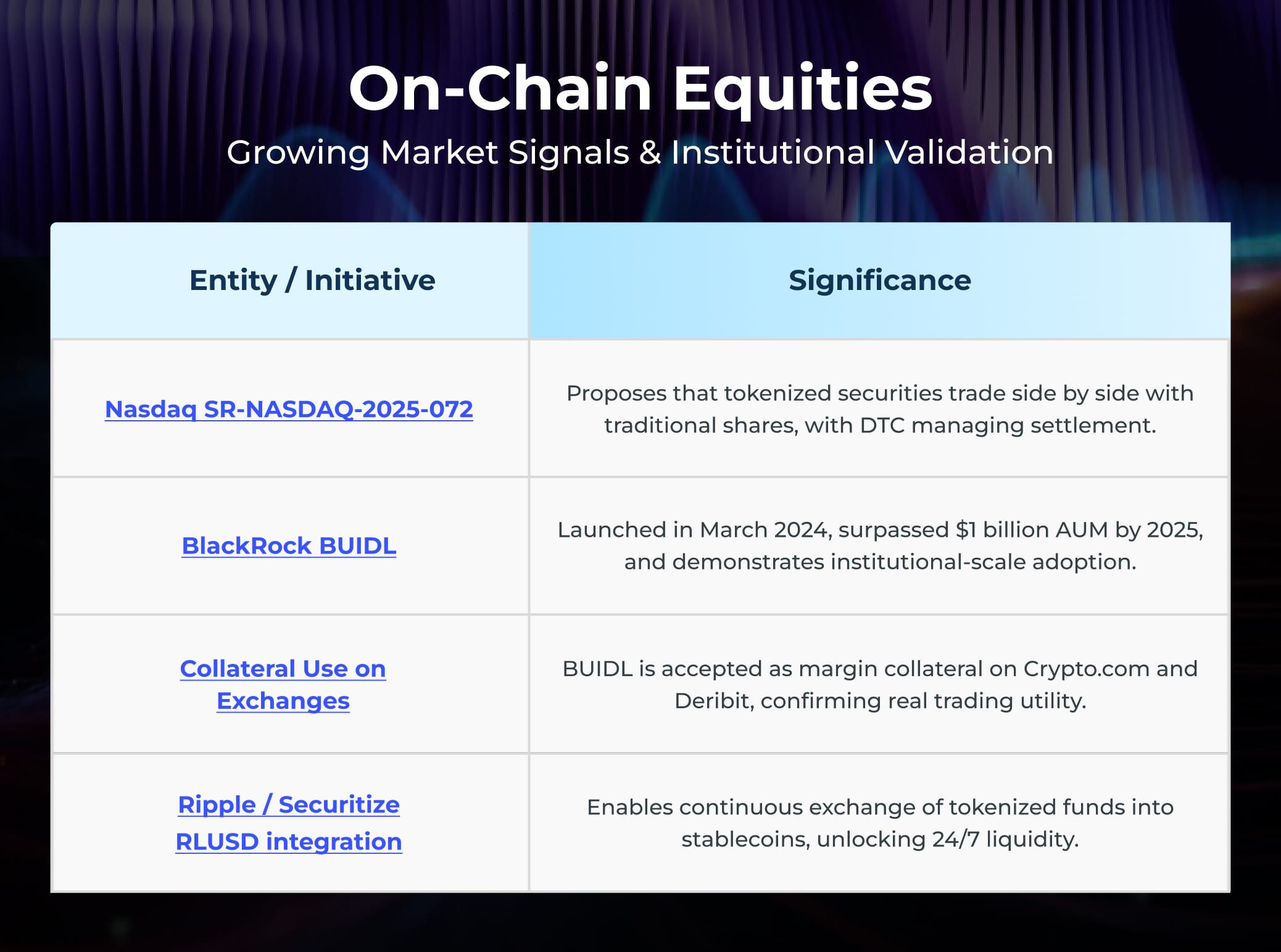
- BlackRock BUIDL: A tokenized money market fund operated on Ethereum, surpassing $1B AUM within a year. It is now accepted as collateral on global exchanges, demonstrating both scale and utility.
- Nasdaq SR-NASDAQ-2025-072: A rule filing to allow tokenized securities to trade alongside traditional equities with DTC settlement. This move demonstrates how incumbents are adapting tokenization into regulated frameworks.
These examples illustrate both demand from issuers and structural acceptance from exchanges.
Design your RWA Platform with Compliance and Scale Built In!
Metrics That Matter to Investors in Equity Tokenization
- Finality latency (P99 trade → settled)
- Atomic settlement ratio (percentage of trades atomic DvP)
- Corporate actions SLA (dividend/split completion time)
- Liquidity depth & spread (bid/ask behavior under load)
- Compliance blocks (number of rejected transfers due to KYC rules)
- Reserve variance (backing delta in wrapped model)
- Interoperability uptime (cross-chain lifecycle success rates)
Without these metrics, institutional investors and regulators will question platform credibility.
Takeaway
For businesses evaluating RWA tokenization platform development services, stock tokenization platforms, or a tokenized equity marketplace, they must
- Select the correct legal model.
- Define an issuance and trading roadmap.
- Embed compliance from inception.
Businesses that go for a tokenized equity platform will define standards, attract liquidity, establish long-term market dominance, and control investor trust and liquidity.
At Antier, we deliver end-to-end tokenized securities platform development. Our RWA Tokenization Platform Development Company combines technical expertise with regulatory alignment to launch scalable and compliant tokenized equity platforms that meet the demands of global investors and regulators alike.
Frequently Asked Questions
01. What are the main limitations of traditional equity market infrastructure?
Traditional equity market infrastructure faces limitations such as delayed settlement, restricted access windows, opaque intermediation, and high friction for issuance and corporate actions, which create unnecessary costs and constrain capital efficiency.
02. What is the significance of RWA Tokenization platform development?
RWA Tokenization platform development introduces a digitized, programmable infrastructure that enables real-time settlement, global access, and automated compliance, transforming the equity markets from experimentation to institutional adoption.
03. What are on-chain equities and their models?
On-chain equities are shares or economic rights represented as tokens on a ledger, with two main models: native ledger securities, which are recognized under local corporate law, and the wrapped/depository model, where a regulated entity issues a token mirror of the underlying equity.