



✨ AI Summary
- This blog post delves into the concept of tokenized treasury platforms and their rising dominance in the realm of institutional finance.
- Tokenized treasury platforms convert ownership of treasury assets into digital tokens, offering near-instant settlement, broader investor participation, and real-time on-chain updates.
- The post highlights Franklin Templeton's BENJI fund and BlackRock's BUIDL fund as examples of successful tokenized funds.
- It then breaks down the process of building an institutional-grade tokenized money market fund blockchain platform, covering areas such as blockchain selection, token structure, regulatory considerations, and yield distribution.
- The post emphasizes the importance of careful planning, regulatory groundwork, and precision engineering in developing such platforms.
Franklin Templeton’s BENJI fund has crossed $1.6 billion in AUM on-chain as of May 2026, (RWA.xyz, May 2026), making it one of the largest and most closely watched tokenized fund products in institutional finance today. BlackRock’s BUIDL fund has crossed $2.5 billion in AUM over the same period. These are not pilot experiments or proof-of-concept projects. They are live, scaled, regulated financial products running on public and permissioned blockchains, serving institutional investors across the United States and beyond.
Institutional RWA tokenization is no longer in the evaluation phase. Capital is moving. Infrastructure is being built. The window to establish early leadership in the tokenized treasury platform development space is open right now, and the founders who move with clarity will define the next decade of digital asset infrastructure.
So, what does it actually take to build something like this?
This blog breaks down the architecture, the compliance structure, the technology decisions, and the step-by-step build path for launching an institutional-grade tokenized money market fund blockchain platform. Whether you are a VP of digital assets, a fintech founder, or a decision-maker at a traditional asset management firm exploring tokenization, this guide is written for you.
What Is a Tokenized Treasury Platform?
A tokenized treasury platform is a blockchain-based infrastructure that converts ownership of real-world treasury assets, such as US Treasury bills, money market instruments, or government bonds, into digital tokens. These tokens represent fractional, transferable, programmable claims on the underlying assets and are issued, held, and redeemed entirely through smart contracts on a blockchain network.
The difference between this and traditional treasury management is structural, not cosmetic. Traditional treasury operations require T+1 or T+2 settlement cycles, restrict access to high minimum investments, distribute yield through manual and periodic processes, and rely entirely on off-chain records for ownership. Asset tokenization development services change all of this. Settlement becomes near instant. Ownership can be fractional, enabling broader investor participation. Yield distribution becomes programmable and automated through smart contract yield distribution. And all ownership records, transactions, and NAV updates are reflected on-chain in real time.
The global tokenized asset market has surpassed $20 billion in on-chain value as of May 2026, with tokenized government securities leading all asset classes.
Franklin Templeton’s BENJI fund and BlackRock’s BlackRock BUIDL fund are not outliers. They are proof that on-chain treasury management has cleared the institutional credibility bar. The technology works. The regulatory path exists. The investor appetite is real. What remains is execution.
The Franklin Templeton Model: What’s Under the Hood
Blockchain: Stellar
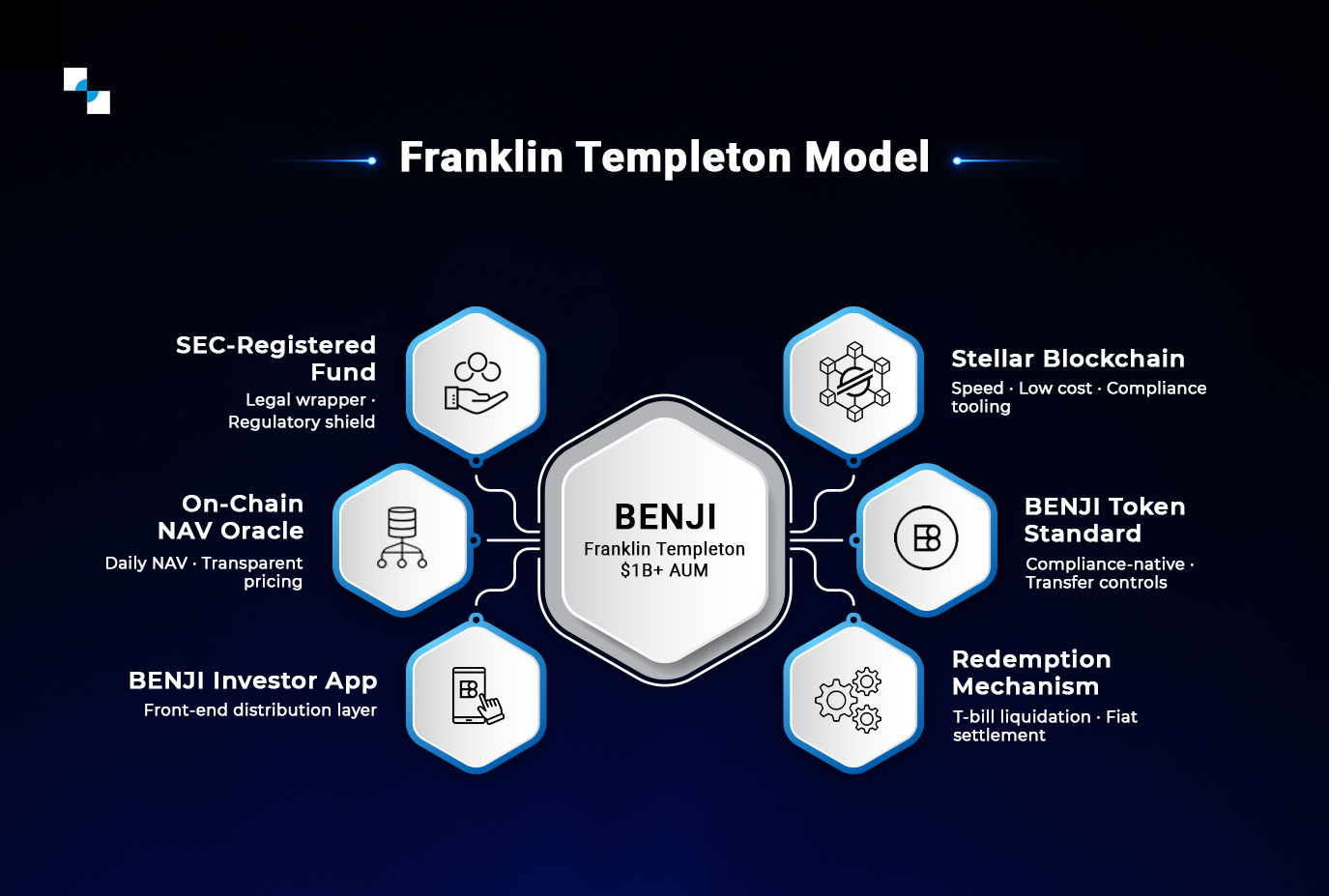
Franklin Templeton chose Stellar blockchain tokenization as the settlement layer for BENJI. The decision comes down to three factors: transaction speed (typically 3-5 seconds), very low transaction costs (fractions of a cent), and Stellar’s built-in compliance tooling, including native asset issuance controls, account flags for whitelisting, and freeze capabilities. For a regulated fund requiring compliant investor controls, Stellar offered these features at the protocol layer rather than requiring custom smart contract engineering.
Token Structure
BENJI tokens represent shares in the Franklin Templeton US Government Money Fund. Each token is backed by the fund’s net asset value, which is recalculated daily and reflected on chain. The token structure incorporates transfer restrictions at the protocol level, meaning tokens can only be transferred between wallets that have been approved through the fund’s KYC and accredited investor verification process.
Regulatory Wrapper
This is perhaps the most important architectural decision Franklin Templeton made. BENJI is an SEC-registered money market fund, not a crypto asset. The blockchain is used as the official transfer agent and book of record, a structure approved by the SEC. This means BENJI operates under existing securities law, with blockchain serving as infrastructure rather than as the regulatory vehicle itself. Investors are investing in a regulated fund. The token is the record of ownership.
NAV and Redemption
The fund’s NAV is calculated daily by the fund administrator and pushed on-chain through a permissioned on-chain NAV oracle. Investors can subscribe and redeem through the BENJI app, with the app serving as the front-end distribution layer. Redemption triggers the liquidation of underlying T-bill holdings, settlement of the fiat amount to the investor, and burning of the redeemed tokens. The entire process is logged on-chain, creating an immutable audit trail.
Core Components of Tokenized Treasury Platform Development
Building a tokenized money market fund blockchain platform requires six distinct components working in concert. Skipping or underbuilding any one of them creates gaps that become regulatory, operational, or investor-trust liabilities later.
1. Asset Layer
The asset layer is the foundation. It defines what backs your token: US Treasury bills, short-duration government bonds, money market instruments, or a combination. This layer also includes custodian integration. The underlying assets must sit with a regulated custodian, with a clear, auditable link between the off-chain asset holdings and the on-chain token supply. Without this link, your platform does not have a credible product. It has a token.
2. Tokenization Engine
The tokenization engine is the smart contract layer that governs the lifecycle of your token. This includes minting logic (tokens created when a verified investor subscribes and funds are confirmed), burning logic (tokens destroyed on redemption), and the token standard itself. For regulated products, the ERC-1400 security token standard or its successor ERC-3643 (T-REX) is recommended. These standards embed compliance controls directly into the token, including transfer restrictions, partition management, and operator controls. A basic ERC-20 is insufficient for institutional use because it has no native compliance hooks.
This layer forms the technical core of asset tokenization development services.
3. Yield Distribution Module
How yield reaches investors is both a technical and an investor experience decision. There are two primary models. In a rebasing model, the investor’s token balance automatically increases as yield accrues, keeping the token price stable at $1. In a transfer-based model, the token balance stays fixed, and yield is distributed as a separate claimable amount. The on-chain NAV oracle feeds daily or real-time pricing data into the system, which triggers automated yield calculations. Smart contract yield distribution removes the manual reconciliation process entirely, reducing operational cost and error risk.
4. Compliance and Identity Layer
This is the component most teams underestimate. Tokenized assets compliance must be built into the architecture at the wallet level, not applied as an afterthought. The compliance layer includes on-chain KYC/AML verification, whitelisted wallet architecture (only verified wallets can receive or transfer tokens), transfer restrictions enforced at the smart contract level, and hooks for Reg D, Reg S, or MiCA compliance depending on your target jurisdiction. Investors complete KYC through an off-chain provider such as Sumsub or Onfido, and once verified, their wallet address is added to the on-chain registry. Every token transfer checks this registry before executing.
5. Investor Portal and Front-End
The investor portal is the operational face of your platform. It must support onboarding and KYC completion, subscription and redemption workflows, real-time NAV display sourced from your oracle, transaction and yield history, a document vault for fund documents and tax statements, and an admin dashboard for the fund operator. The portal must be built to institutional standards, not crypto-native UX. Your investors are asset managers, family offices, and treasury desks. The experience must reflect that.
6. Blockchain Selection
For RWA tokenization platform development, blockchain selection is a business decision before it is a technical one. Ethereum offers the deepest institutional credibility and the richest DeFi ecosystem but carries higher transaction costs. Polygon provides EVM compatibility at significantly lower cost and is increasingly adopted by institutional platforms. Avalanche Evergreen subnets offer permissioned, compliance-native environments purpose-built for regulated financial products. Stellar, as discussed, offers native compliance tooling and very low cost. Solana offers speed and low cost with growing institutional adoption. The right chain depends on your investor base, regulatory jurisdiction, and liquidity strategy.
Planning a Tokenized Treasury or RWA Platform? Talk to us to Finalize your Architecture
Steps to Build a Tokenized Treasury Platform Like Franklin Templeton
Building a tokenized treasury platform is not a single technical decision — it is a sequence of deliberate, interdependent choices that span legal structure, blockchain architecture, compliance infrastructure, and investor experience. Franklin Templeton did not arrive at BENJI overnight. What looks like a seamless product today is the result of structured planning, regulatory groundwork, and precision engineering across every layer of the platform.
For founders and asset managers looking to replicate that outcome, the path forward follows a clear, stage-by-stage build process — and partnering with an experienced real-world asset tokenization development company from the outset is what separates platforms that launch cleanly from those that stall in technical or regulatory revision cycles.
- Define Your Product and Business Model Determine whether you are building a tokenized fund, a yield token product, or a treasury management platform. Answer three foundational questions: who is your investor, what asset backs the token, and which jurisdiction governs the product. These answers drive every subsequent decision.
- Establish Your Legal and Regulatory Wrapper Engage legal counsel with securities law expertise in your target jurisdiction before writing a line of code. In the US, your options include an SEC-registered fund (Franklin Templeton’s route), a Reg D or Reg S private placement exemption for a faster path to market, or an SPV structure. In Europe, MiCA provides the emerging framework. In the UAE, VARA and ADGM financial services regulations apply. Your legal structure determines your token classification, your investor eligibility rules, and your disclosure obligations.
- Select Your Blockchain and Token Standard Based on your regulatory and investor profile, select the settlement chain and the token standard. For US-regulated products targeting institutional investors, ERC-3643 on Ethereum or a permissioned Avalanche subnet are strong choices. For cost-sensitive or cross-border deployments, Stellar and Polygon offer compelling alternatives. Finalize the token standard before smart contract development begins.
- Build and Audit Your Smart Contracts Develop the four core contracts: the token contract with minting, burning, and transfer restriction logic; the NAV oracle contract for on-chain pricing; the yield distribution contract; and the investor registry contract for compliance enforcement. All contracts must undergo a third-party security audit by a recognized firm before mainnet deployment. This is non-negotiable for institutional credibility.
- Integrate KYC/AML and Custodian Infrastructure Connect your on-chain compliance layer to an off-chain KYC/AML provider. Build the investor onboarding flow that moves from identity verification to wallet whitelisting. Simultaneously, establish the custodial relationship for your underlying assets. The custodian and the smart contract must be connected through a reconciliation process that keeps on-chain token supply in sync with off-chain asset holdings.
- Launch the Investor Portal and Run Pre-Launch Testing Build and test the investor-facing portal. Conduct full integration testing of the subscription and redemption flows on testnet. Complete penetration testing on the portal. Run a limited soft launch with a closed investor group before opening to broader access. Ensure your disaster recovery plan includes a contract pause mechanism and an emergency redemption path.
How Antier Builds This for You
Understanding architecture is one thing. Executing it at institutional grade, on time, and with the compliance rigor that serious investors require is another. Antier Solutions is a globally recognized real-world asset tokenization development company with over nine years of blockchain development experience, a multi-chain delivery capability, and a track record of building regulated digital asset platforms for clients across the United States, United Kingdom, UAE, Singapore, and Europe.
Our asset tokenization development services cover the full build lifecycle. We architect and develop the smart contract layer, including the tokenization engine, NAV oracle, yield distribution module, and compliance registry. We integrate leading KYC/AML providers to build your on-chain identity and compliance infrastructure. We deliver a white-label investor portal built to institutional UX standards, ready for your branding and your investor base. We coordinate third-party smart contract audits and support your legal team with technical documentation for regulatory submissions. And we provide ongoing post-launch maintenance, upgrade management, and infrastructure monitoring.
If you are a VP of digital assets exploring a tokenized fund launch, a fintech founder building a tokenized treasury platform for asset managers, or a financial institution evaluating how to build a tokenized money market fund like Franklin Templeton, Antier brings both the technical depth and the institutional understanding to get it built right the first time.
The blueprint is proven. The regulatory path is clearing. The platforms that will lead the tokenized treasury market in 2027 and beyond are being built right now. The question is not whether to build. The question is who you build it with.
Conclusion
The Franklin Templeton BENJI fund and BlackRock BUIDL have done something more important than tokenize assets. They have demonstrated that institutional-grade, regulated, on-chain treasury infrastructure is not only possible but operational at scale. The market is responding. Total on-chain tokenized government securities now exceed $20 billion, and the trajectory points decisively upward (RWA.xyz, May 2026).
Tokenized treasury platform development requires deliberate decisions across legal structure, token architecture, compliance infrastructure, and investor experience. None of these decisions are trivial. All of them are executable with the right development partner. For founders and decision-makers who are ready to move from evaluation to execution, the path is clear.