




AI Summary
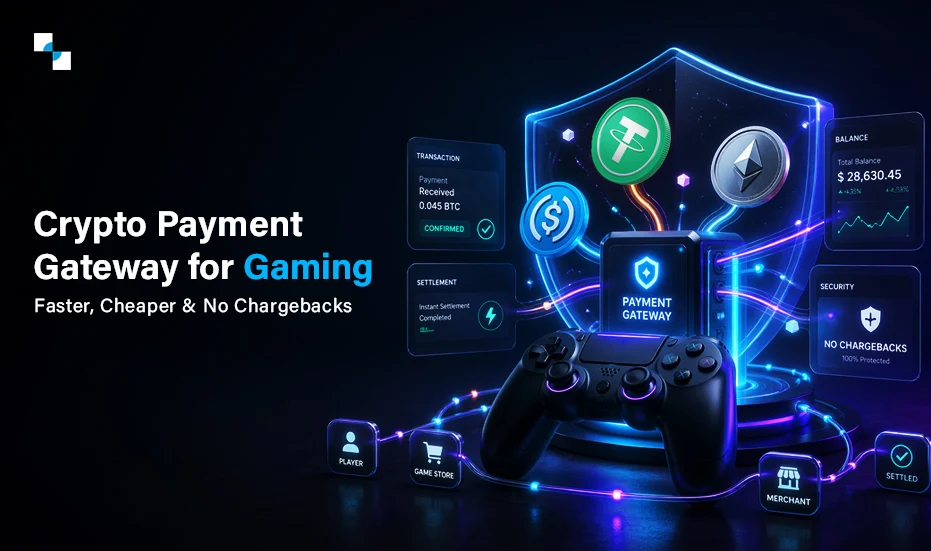
- The blog post highlights the increasing importance of crypto payment gateway solutions for gaming companies looking to scale and improve their revenue streams.
- As the gaming industry continues to expand globally, traditional payment methods are falling short due to high fees, slow processing times, and fraud risks.
- Crypto payment gateways offer a solution by enabling faster transactions, lower costs, and enhanced security measures.
- With the growing adoption of cryptocurrencies and stablecoins, these gateways provide a seamless payment experience for players worldwide.
- The post emphasizes the key features and benefits of implementing a gaming-focused crypto gateway, such as multi-wallet support, stablecoin acceptance, and real-time settlement options.
Gaming moves at the speed of impulse. A player is ready to buy, deposit, upgrade, or join a tournament in seconds, and the payment layer must move just as fast. When checkout slows down, fees stack up, or disputes begin to eat into revenue, the business is no longer dealing with a payment issue only. It is dealing with a growth issue. That is exactly why crypto payment gateway solutions are becoming a serious conversation for gaming companies that care about scale, global reach, and cleaner unit economics.
For gaming operators, publishers, marketplaces, and Web3-native platforms, the case is no longer speculative. The market is large, the payment pain is real, and the buyer base is already familiar with digital assets. What once looked like an alternative rail is now looking more like a strategic payment layer.
The Current Market Around Gaming, Crypto, and Crypto Payment Gateways
The gaming market is still expanding at scale. Newzoo estimates that the global games market will generate $187.7 billion in 2024, with 3.4 billion enthusiasts worldwide. It also projects the market to reach $213.3 billion by 2027, while mobile alone is expected to account for $92.6 billion in revenue in 2024. That is not a niche economy. That is a massive, international payments environment.
Crypto adoption is also wide enough now to matter commercially. Triple-A reported 562 million crypto owners in 2024, equal to 6.8% of the global population, up from 420 million in 2023. Chainalysis also notes that Central and Southern Asia and Oceania lead the world in crypto adoption, which matters for gaming businesses that sell into global and mobile-first markets.
Stablecoins are especially relevant for payments. Coinbase Institutional notes that stablecoins settled $10.8 trillion worth of transactions in 2023, with $2.3 trillion tied to organic activity such as payments and cross-border remittances. That gives the market a practical payments use case, not just a trading story.
Here are the key market signals in simple terms:
- Global games revenue: $187.7 billion in 2024, with 3.4 billion enthusiasts and a forecast of $213.3 billion by 2027.
- Mobile gaming scale: $92.6 billion expected from mobile in 2024, or 49% of global gaming revenue.
- Crypto ownership: 562 million people globally in 2024, up 34% year over year.
- Stablecoin payment volume: $10.8 trillion settled in 2023, with $2.3 trillion linked to organic use cases.
- Fraud pressure on merchants: Visa’s 2024 survey found that merchants estimated around 3% of e-commerce revenue is lost to payment fraud, and roughly 3% of accepted orders turn out to be fraudulent.
Payment Challenges in the Gaming Industry
The biggest problem with traditional payment rails is not that they do not work. It is that they create friction exactly where gaming businesses need fluidity. Card processing fees can compress margin, cross-border acceptance can become messy, and disputes can turn into a hidden tax on growth. Visa says chargeback disputes can cause extra fees, wasted time, operational strain, and even reputational damage.
Gaming also has a pattern that makes it more vulnerable than many other industries. It deals with low-ticket repeat purchases, high-volume transactions, global players, digital goods, subscription models, virtual items, and real-time demand. In that kind of model, even a small percentage of payment failure or fraud can become expensive very quickly. Visa’s fraud survey shows that 66% of merchants cite internal resource constraints as a major fraud-management challenge, while 57% struggle to stay up to date with new attacks and rule changes.
The result is familiar. Teams spend more time reconciling payments, fighting disputes, managing rejected orders, and handling settlement delays than they should. For gaming businesses with creators, partners, affiliates, or international payout flows, the operational drag only grows.
How Do Crypto Payment Gateway Solutions Solve the Core Problems?
- Slow payment processing: Crypto payment gateway development solutions speed up checkout by enabling faster transaction confirmation than many traditional payment rails.
- High transaction fees: They reduce reliance on multiple intermediaries, which helps lower overall payment processing costs for gaming businesses.
- Chargebacks and payment disputes: Once a crypto transaction is confirmed on the blockchain, it cannot be reversed in the same way as a card payment, which protects revenue.
- Cross-border payment friction: Crypto payments work across regions without the same banking restrictions, making global player access easier.
- Payment failures and declined cards: Crypto gateways provide an alternate payment path for users whose cards or banks block the transaction.
- Delayed settlement: Many cryptocurrency payment gateway models support faster settlement, helping gaming businesses improve cash flow and operational control.
- Limited access for unbanked users: Players only need a crypto wallet, which expands access for users who do not rely on traditional banking.
- Weak support for microtransactions: Crypto works well for frequent digital purchases, making it a strong fit for in-game items, top-ups, and rewards.
- Operational burden from reconciliation: Gateway dashboards, APIs, and automated tracking reduce manual payment handling and make accounting cleaner.
- Scalability issues for global gaming platforms: Crypto gateways give gaming companies a flexible payment layer that can scale across markets and user types.
Upgrade Your Gaming Payment Stack with Crypto Gateway Solutions
Features of a Crypto Payment Gateway Designed for the Gaming World
A gaming-grade crypto payment gateway solution should not feel like a generic payment button. It should behave like a revenue infrastructure layer. The strongest features are the ones that reduce friction for the player and reduce work for the business. BitPay’s product flow shows supported wallets, exchange rate display, countdown-based invoices, fiat settlement, omnichannel acceptance, and compliance support. Triple-A adds API documentation, next-day fiat settlement, instant confirmation, and wallet coverage.
The features that matter most are:
- Multi-wallet support so players can pay from common crypto wallets without extra setup.
- Stablecoin acceptance for players and operators who want less volatility.
- Exchange-rate lock and payment timer so the quoted amount stays predictable during checkout.
- Fiat settlement options so treasury teams can keep accounting simple.
- API-first integration for game stores, launchers, marketplaces, and backend systems.
- KYC, AML, and monitoring support for enterprise compliance expectations.
- Automated payout support for affiliates, creators, tournament winners, and vendor flows.
A well-featured solution for cross border payments can only be designed with the help of an experienced and certified team of experts from a world class blockchain development company. Always make sure that you hire a company that has white label crypto payment gateways modules so that you also have the option to customize solutions as per business needs in no time, rather building it from the scratch.
Technical Architecture of a Gaming-Focused Crypto Gateway Development
- Frontend Checkout & Payment Initiation
- This is where the user selects crypto and initiates the payment.
- It connects the game interface (store, wallet, or marketplace) with the payment gateway.
- The goal here is seamless UX so that payment does not interrupt gameplay flow.
- Invoice & Pricing Engine
- Generates a real-time payment request with exact crypto amount, wallet address, and expiry window.
- Locks exchange rates to prevent volatility during checkout.
- Ensures transaction clarity and reduces payment mismatches.
- Blockchain Interaction Layer
- Handles communication with blockchain networks to detect and validate transactions.
- Monitors confirmations and verifies that funds are successfully transferred.
- This layer replaces traditional banking rails with decentralized verification.
- Payment Validation & Confirmation Engine
- Confirms when a transaction meets required network confirmations.
- Prevents double-spending or incomplete transactions.
- Acts as the decision point before triggering any in-game action.
- Business Logic & Game Integration Layer
- Connects payment confirmation with in-game actions such as crediting assets, unlocking features, or activating subscriptions.
- Ensures real-time synchronization between payment and gameplay systems.
- This is where payments directly translate into user experience.
- Settlement & Treasury Management Layer
- Manages how received crypto is handled post-payment.
- Supports conversion to fiat, stablecoin routing, or wallet storage based on business needs.
- Helps gaming companies maintain predictable cash flow and accounting.
- API & Webhook Infrastructure
- Enables communication between the payment gateway and the gaming platform backend.
- Automates updates like payment success, failure, refunds, or status changes.
- Critical for scaling real-time operations in high-traffic gaming environments.
- Compliance & Risk Management Layer
- Integrates KYC, AML checks, and transaction monitoring systems.
- Ensures regulatory alignment across different jurisdictions.
- Important for enterprise-grade gaming platforms operating globally.
- Security & Custody Layer
- Protects wallet infrastructure, private keys, and transaction data.
- Implements encryption, access control, and secure key management.
- Ensures trust and prevents financial or reputational loss.
- Monitoring, Analytics & Reconciliation Layer
- Tracks transactions, settlement status, and payment performance.
- Helps businesses manage reconciliation and identify anomalies.
- Supports data-driven decision-making for revenue optimization.
Conclusion
Crypto payment gateways are no longer a side experiment for gaming businesses. They solve practical problems that directly affect revenue, player experience, and operational efficiency. Faster payments, lower processing costs, stronger fraud resistance, and borderless acceptance make them a serious infrastructure choice for any gaming brand that wants to grow without payment friction slowing it down.
Antier stands out as a reliable partner because it combines technical depth with real enterprise understanding. Its team brings blockchain expertise, certified professionals, and legal awareness into one delivery model, which matters when building secure and scalable payment systems. With white-label cryptocurrency payment gateway modules, custom development capability, and a strong grasp of AI and Web3 innovation, our team helps businesses launch faster, adapt smarter, and build solutions that fit their exact commercial goals. Get in touch with our professionals and share your business planning and vision.
Frequently Asked Questions
01. Why are crypto payment gateways important for gaming companies?
Crypto payment gateways are crucial for gaming companies because they enable fast transactions, reduce fees, and help avoid disputes, which are essential for scaling and maintaining revenue in a rapidly evolving market.
02. What is the projected revenue for the global gaming market in 2024?
The global gaming market is projected to generate $187.7 billion in 2024, with expectations to reach $213.3 billion by 2027.
03. How many people globally owned cryptocurrency in 2024?
In 2024, there were approximately 562 million cryptocurrency owners worldwide, representing about 6.8% of the global population.