




AI Summary
- Prediction markets have evolved into powerful liquidity systems for real-world uncertainty, attracting significant global trading volume and mainstream attention.
- They allow users to trade contracts tied to future events, turning opinions into measurable market signals.
- Gas-free prediction markets within white label crypto wallets eliminate user fees, improving usability and conversion rates.
- These markets benefit enterprises by enhancing user engagement, retention, and monetization opportunities.
- However, developing a gas-free prediction market requires careful consideration of factors like gas sponsorship, risk management, compliance, liquidity, and custody.
Prediction markets have moved well beyond curiosity status. Reuters reported that prediction markets logged $47 billion in global trading volume in 2025, and the space has been pulling in mainstream financial and media attention as event-based data becomes more useful for trading, reporting, and decision-making.
For investors and enterprises, that matters for one simple reason: prediction markets are not just “bets on outcomes.” They are liquidity systems for real-world uncertainty. When these markets are embedded inside white label crypto wallets, they become far more powerful because the wallet is already the user’s control point for custody, identity, and transaction flow. A crypto wallet protects private keys and lets users prove ownership of digital assets, which makes it a natural home for event trading, portfolio participation, and on-chain engagement.
Heard of Prediction Markets? How Is It’s Market?
Prediction markets let users buy and sell contracts tied to future events, with prices reflecting the crowd’s view of probability. The model is gaining traction because it turns opinions into measurable market signals. That is why major media and financial players are increasingly paying attention to prediction market data and why platforms like Polymarket publicly position themselves as large-scale markets for future events.
From a business lens, the market is attractive because it sits at the intersection of speculation, information, and engagement. Enterprises see value in this because prediction markets can improve user retention, create repeat interaction, and generate high-frequency participation around politics, sports, macro trends, crypto narratives, and cultural events. In other words, the product is not only financial; it is behavioral.
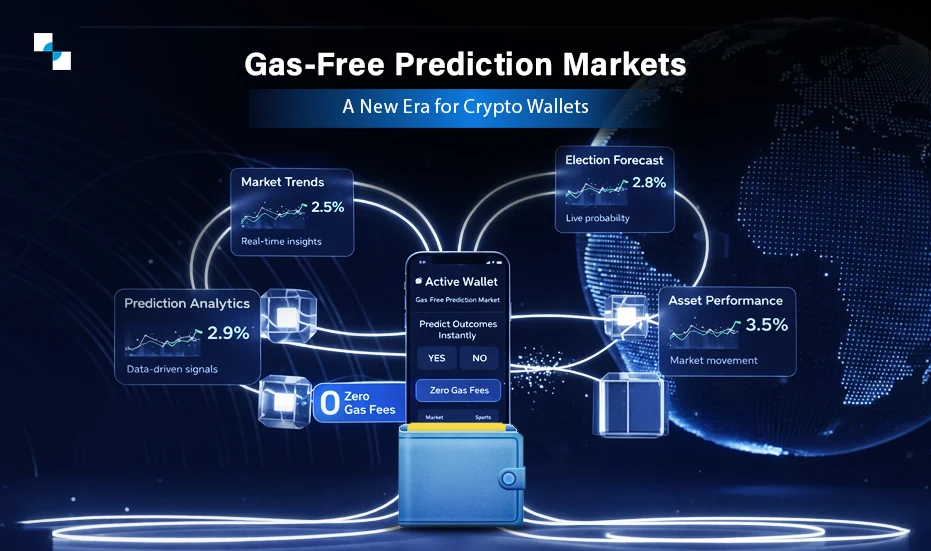
What Is a Gas-Free Prediction Market?
A gas-free prediction market is a trading experience where the user does not directly pay blockchain gas fees for each action. Instead, the wallet or platform sponsors the transaction, abstracts the gas layer, or otherwise hides the network friction from the user. Ethereum’s account abstraction roadmap explicitly supports programmable wallets and gasless transacting, while Ethereum’s documentation also explains sponsored gas as a transaction-covering model.
In a white label crypto wallet app, this matters because the user experience becomes much smoother. Users can enter, trade, and exit prediction positions without being interrupted by constant fee prompts. That small UX shift can produce a major commercial effect: lower abandonment, higher repeat usage, and broader accessibility for users who are new to Web3.
A gas-free prediction market usually relies on one or more of these models:
- Sponsored transactions paid by the platform
- Account abstraction and smart contract wallets
- Meta-transaction relays
- Fee reimbursement or hidden fee routing
- Token-based fee settlement inside the app logic
The common theme is simple: remove friction without removing control. Let us scroll through the complete blog to better understand the concept of a gas-free prediction market in a Web3 crypto wallet.
Benefits of Integrating Gas-Free Prediction Markets in White Label Crypto Wallets
For serious builders, the opportunity is not just technical elegance. It is product-market expansion.
- Gasless execution improves conversion. Every extra step in a financial product creates leakage. When users are forced to pause, calculate fees, or switch tokens just to place a market position, many simply drop off.
- It supports mass-market usability. Prediction markets often attract non-technical users who care more about the event than the blockchain mechanics. Gas-free design keeps the experience aligned with the user’s intent.
- This solution creates a stronger competitive moat for wallet operators. A white label blockchain wallet with prediction market support can become a high-engagement financial hub rather than a passive storage tool.
- It enables more scalable monetization. Platforms can earn through spreads, premium features, event creation fees, partner integrations, or ecosystem activity rather than relying only on standard wallet usage.
- It makes cross-chain and cross-segment expansion easier. Once the wallet becomes the interface for predictions, it can also become the gateway for analytics, rewards, governance, and other on-chain financial products.
Deploy The Most Seamless Web3 Wallet Solution Today!
What to Evaluate Before Gas-Free Prediction Crypto Wallet Development?
A gas-free prediction market sounds simple at the surface, but the architecture needs discipline.
The most important questions are:
- Who sponsors the gas? The platform, a relayer, a treasury model, or a third-party infrastructure layer?
- How is risk managed? Sponsored flows can be abused if limits, monitoring, and fraud controls are weak.
- How are outcomes resolved? Prediction markets need a reliable oracle or resolution framework.
- How is compliance handled? Jurisdiction, product classification, and user eligibility must be mapped early.
- How is liquidity supported? A good market needs depth, not just interface polish.
- How does the wallet handle custody? White label deployments must decide between self-custody, custodial, or hybrid logic.
These questions decide whether the product becomes an institution-grade system or a fragile experiment. And it is always recommended that you connect and consult an experienced blockchain wallet development company that holds years of experience in building successful solutions.
How much does it cost to build a crypto wallet with gas-free prediction market support?
There is no universal price tag for cryptocurrency wallet development with gas-free prediction market in it. The cost depends on product scope, security level, infrastructure choices, and compliance requirements. The main cost drivers are:
- Wallet architecture: custodial, non-custodial, or hybrid
- Smart contract development for prediction market logic
- Gas sponsorship and relayer infrastructure
- Oracle integration and market resolution design
- Security audits and threat modeling
- Compliance and legal review across target jurisdictions
- UI/UX depth for retail or enterprise users
- Multi-chain support and liquidity routing
- Backend monitoring, analytics, and admin controls
- Ongoing maintenance, upgrades, and risk management
The more “enterprise-ready” the build, the more the investment shifts from simple development into governance, reliability, and security engineering. That is where real value is created.
How Much Time Does It Take?
That depends on the feature set, the chain stack, and the level of customization. A simple prototype is faster than a production-grade wallet. An enterprise wallet with prediction markets, gas sponsorship, compliance flows, and audit readiness naturally takes longer because each layer has to be tested, stress-checked, and secured before launch.
The practical truth is this: speed matters, but trust matters more. In this category, shipping fast without hardening the architecture is a false economy.
Stand Out From Other Wallet Providers
Gas-free prediction markets inside white label cryptocurrency wallets represent a powerful combination of usability, liquidity, and engagement. They remove the friction that normally kills adoption while preserving the programmable nature of Web3 finance.
For enterprises, this is not just a feature upgrade. It is a platform strategy. For investors, it is a signal that wallet infrastructure is evolving from simple asset storage into a full-spectrum engagement layer. And for builders, the opportunity is clear: the next wave of crypto adoption will favor products that make advanced on-chain interactions feel effortless.
In that future, the winners will not be the loudest platforms. They will be the ones who make complexity disappear. Connect with Antier today to share your planning.
Frequently Asked Questions
01. What are prediction markets and how do they function?
Prediction markets allow users to buy and sell contracts tied to future events, with prices reflecting the crowd's view of probability, turning opinions into measurable market signals.
02. Why are prediction markets gaining attention from mainstream financial and media sectors?
They are gaining attention because they provide valuable event-based data that can enhance trading, reporting, and decision-making, making them attractive for investors and enterprises.
03. What is a gas-free prediction market and why is it beneficial?
A gas-free prediction market allows users to trade without directly paying blockchain gas fees, creating a smoother user experience by abstracting transaction costs and reducing interruptions during trading.