




✨ AI Summary
- In 2026, DAO development is crucial for businesses looking to build transparent and community-driven organizations.
- The key to success lies in governance, smart contracts, legal compliance, and treasury management.
- Most failed DAOs collapse due to weak governance structures, leading to lost capital and trust damage.
- A structured DAO development process includes smart contract security, governance models, legal compliance, treasury management, and operational systems.
- The DAO market is growing rapidly, with enterprises seeking scalable solutions.
Most blockchain founders assume technical execution is the hardest part of building a DAO. It is not, but governance failure is. According to multiple industry analyses, most failed DAOs collapse not because of broken smart contracts but because of weak governance structures, poor treasury management, and unclear legal frameworks. These failures often cost projects millions in lost capital, broken communities, and irreversible trust damage.
If you are planning to build a DAO in 2026, this guide is not optional. It is your risk mitigation framework. This is a complete, enterprise-grade DAO development checklist covering smart contracts, governance design, legal compliance, treasury systems, and operational execution. You can treat this as your blueprint from idea to mainnet.
What is DAO Development?
DAO development refers to the process of building a decentralized autonomous organization using blockchain technology, smart contracts, and governance frameworks that enable community-driven decision-making without centralized control.
In simple terms, it combines technology, governance design, and legal structuring to create organizations that operate transparently and autonomously.
A typical DAO development process includes:
- Smart contract development to automate rules and execution
- Governance model design to define how decisions are made
- Token development to distribute voting power
- Treasury management systems to control funds
- Compliance frameworks to align with regulations
Unlike traditional organizations, where decisions are made by a central authority, DAO ensures that stakeholders vote on proposals, manage funds collectively, and enforce outcomes through code rather than intermediaries. This is why modern businesses are increasingly exploring DAO development solutions to build transparent, scalable, and community-driven ecosystems.
Why DAOs Matter More Than Ever in 2026
The adoption of DAO is accelerating across industries, and enterprises are actively exploring DAO development services to streamline operations and enable transparent decision-making.
Blockchain ecosystems like Ethereum, Polygon, and Arbitrum have made it easier to deploy scalable DAO platforms with lower transaction costs and higher efficiency.
The Core Business Case
Organizations evaluating DAO implementation are focused on measurable outcomes:
- Operational efficiency improvements
- Reduced governance friction
- Transparent treasury systems
- Scalable global participation
Design a DAO that is secure, compliant, and built for long-term growth.
A renowned partner can help businesses unlock automation, reduce manual overhead, and create trustless governance environments. However, despite the growing demand for enterprise DAO solutions, most teams lack the expertise to execute DAO architecture correctly.
The 47-Point DAO Development Framework
To simplify execution, a complete DAO development process can be structured into five core pillars:
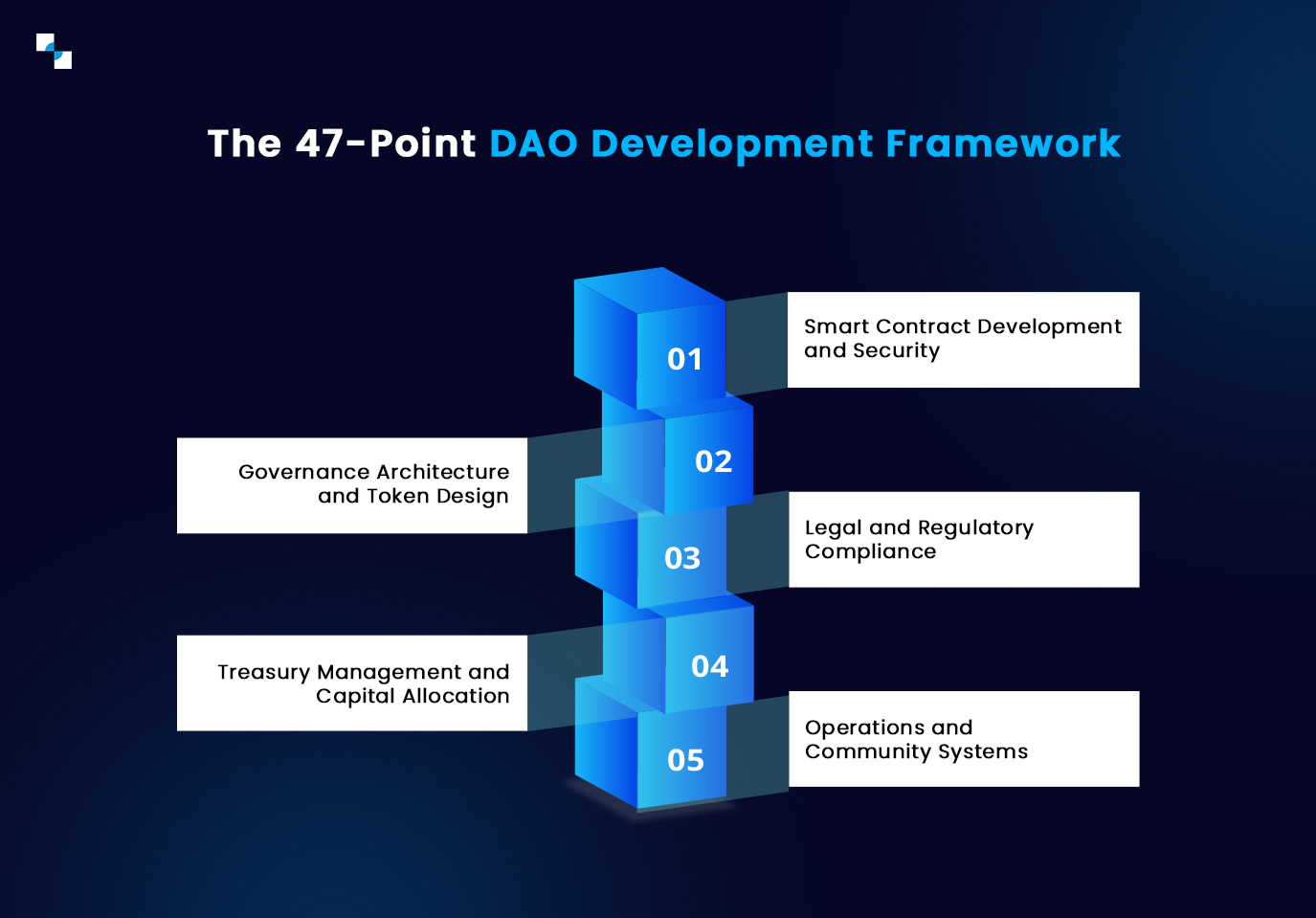
This structured DAO implementation framework ensures that every critical component is addressed before launch, reducing risks and improving long-term sustainability.
Pillar 1: Smart Contracts and Security
Smart contracts form the backbone of any DAO, and secure development begins with writing robust, audit-ready code.
Audit Requirements
Before deploying your DAO smart contracts:
- Conduct third-party smart contract audits
- Implement multi-signature approval systems
- Use formal verification for critical logic
- Launch a bug bounty program
Any experienced firm will prioritize audits as a non-negotiable step to prevent multi-million dollar vulnerabilities.
Code Best Practices
Modern DAO smart contract development relies on proven frameworks and patterns:
- Reentrancy protection mechanisms
- Role-based access control
- Upgradeable contract architecture
- Secure fallback functions
Using standardized libraries reduces risk and accelerates development timelines.
Testing and Deployment
Professional DAO development services always include:
- Testnet deployment cycles
- Stress testing under peak conditions
- Gradual rollout strategies
- Real-time monitoring systems
Skipping this phase is one of the most common mistakes in DAO deployment.
Blockchain Selection
Selecting the right blockchain for DAO development directly impacts scalability and cost efficiency.
| Blockchain | Strength | Best For |
|---|---|---|
| Ethereum | High security | Enterprise DAOs |
| Polygon | Low fees | Scalable governance |
| Arbitrum | Balanced performance | DeFi DAOs |
| BNB Chain | High throughput | Mass adoption |
A strategic blockchain selection framework is critical for long-term DAO success.
Pillar 2: Governance Architecture and Token Design
A strong governance framework is what separates successful DAOs from failed experiments.
Governance Models
When designing a DAO governance system, three models dominate:
- Direct Governance: Suitable for small communities, but often lacks engagement
- Delegated Governance: Improves efficiency but risks centralization
- Liquid Governance: Combines flexibility with scalability
Choosing the right DAO governance model is essential for maintaining a balance between decentralization and efficiency.
Token Economics
Tokenomics is central to any DAO token development strategy.
Key factors include:
- Token supply structure
- Distribution mechanisms
- Vesting schedules
- Incentive alignment
Poorly designed DAO token models often result in governance attacks and community imbalance.
Voting Mechanisms
A scalable DAO governance platform requires:
- Defined quorum thresholds
- Transparent voting timelines
- Token locking systems
- Advanced voting models
These mechanisms ensure that governance decisions are meaningful and enforceable.
Multisig and Safeguards
Security layers in DAO governance include:
- Multi-signature wallets
- Time-lock execution
- Emergency pause systems
These safeguards are essential for protecting DAO treasury assets.
Pillar 3: Legal and Regulatory Compliance
Legal clarity is becoming a core requirement in DAO development services, especially for enterprise-grade projects.
Entity Formation
The Wyoming DAO LLC model has emerged as a preferred legal structure for decentralized organizations due to its clarity and flexibility.
This structure offers:
- Limited liability protection
- Defined governance rules
- Regulatory recognition
Alternative jurisdictions exist, but they often add complexity.
Token Classification
Understanding whether your governance token qualifies as a security is critical.
Regulatory frameworks similar to the Howey Test determine classification, and misclassification can lead to significant compliance risks.
KYC and AML Requirements
Modern DAO platforms must integrate:
- Identity verification systems
- AML compliance tools
- Transaction monitoring
Compliance-driven DAO development is now essential for long-term sustainability.
Tax Implications
DAO taxation frameworks vary globally, but key considerations include:
- Capital gains taxation
- Transaction-based tax events
- Cross-border reporting
Early tax planning prevents costly legal complications later.
Pillar 4: Treasury Management and Capital
DAO treasury management is one of the most critical aspects of long-term sustainability.
Core Treasury Principles
A strong DAO treasury framework includes:
- Multi-signature wallets like Gnosis Safe
- Asset diversification strategies
- Controlled spending systems
- Reserve management
Professional DAO development solutions always include treasury architecture design.
Capital Allocation Strategy
A balanced DAO treasury allocation typically includes:
- Stable assets for risk mitigation
- Native tokens for growth
This approach ensures both stability and scalability.
Financial Transparency
High-performing DAOs maintain transparency through:
- Regular treasury reports
- Governance disclosures
- Spending audits
Transparency builds trust and improves participation.
Pillar 5: Operations and Community
A DAO is only as strong as its community and operational systems.
Operational Systems
Efficient DAO operations include:
- Structured onboarding processes
- Defined contributor roles
- Working groups
- Governance documentation
These systems ensure smooth execution.
Communication Stack
Most DAO ecosystems rely on tools like:
- Discord
- Snapshot
These tools enable communication and governance coordination.
Conflict Resolution
Without structured dispute resolution, DAO communities fragment quickly.
Define clear processes for:
- Governance disputes
- Proposal escalation
- Emergency decisions
DAO Market Size and Future Growth
The DAO ecosystem in 2026 has entered a strong growth phase, driven by rising enterprise adoption and demand for scalable DAO development solutions.
Current Market Size (2026)
- The DAO-as-a-Service market is estimated at $145–150 million in 2026, growing steadily from 2023 levels.
- The broader DAO market has crossed $190 million, reflecting increased demand for governance and infrastructure solutions.
Future Growth
- The DAOaaS market is projected to reach $680 million by 2033, growing at 18.6% CAGR.
- The DAO market is expected to hit $330+ million by 2031 at a 9.3% CAGR.
What does this mean?
DAO development is rapidly becoming a core layer of Web3 infrastructure. Businesses entering early gain a significant advantage in governance, scalability, and ecosystem positioning.
Real DAO Case Insights
Case 1: Grant-Based DAO
Objective: Fund ecosystem projects at scale
Solution: Delegated governance combined with quadratic voting to balance influence
Result: More efficient capital allocation and consistently higher-quality proposals
Case 2: Enterprise DAO
Objective: Enable coordination across multiple organizations
Solution: Permissioned governance model with built-in compliance layers
Result: Greater transparency and significantly reduced operational delays
Case 3: DeFi Treasury DAO
Objective: Manage and grow a large decentralized treasury
Solution: Multi-layer governance supported by multisig controls
Result: Stable treasury growth with minimized governance attack risks
Get everything you need to plan, build, and launch your DAO
8 Critical Mistakes That Destroy DAOs
These account for the majority of DAO failures, and in most cases, they are not technical issues but strategic oversights during DAO development and governance planning.
- Deploying without audits exposes the DAO to critical smart contract vulnerabilities, often leading to irreversible financial losses that could have been prevented with proper security reviews.
- Weak governance design results in unclear decision-making processes, low participation, and internal conflicts that eventually break the system.
- Ignoring legal structure increases regulatory risk and liability exposure, making the DAO vulnerable to compliance issues and operational shutdowns.
- Whale dominance emerges when token distribution is poorly planned, allowing a few large holders to control governance and discourage broader community involvement.
- Poor treasury planning leads to inefficient fund allocation, a lack of runway visibility, and, in many cases, complete financial mismanagement.
- Broken token economics create misaligned incentives, inflationary pressure, and long-term value erosion within the ecosystem.
- Low community engagement reduces participation in governance, weakens the DAO’s foundation, and ultimately leads to inactivity.
- Lack of compliance with KYC, AML, and evolving regulations can result in sanctions, restricted access, or forced restructuring.
Each of these mistakes is preventable with a well-structured DAO development strategy, proper planning, and expert execution.
DAO Development Roadmap
A successful DAO is not built overnight. It requires a structured, phase-wise approach that balances speed with precision and long-term sustainability.
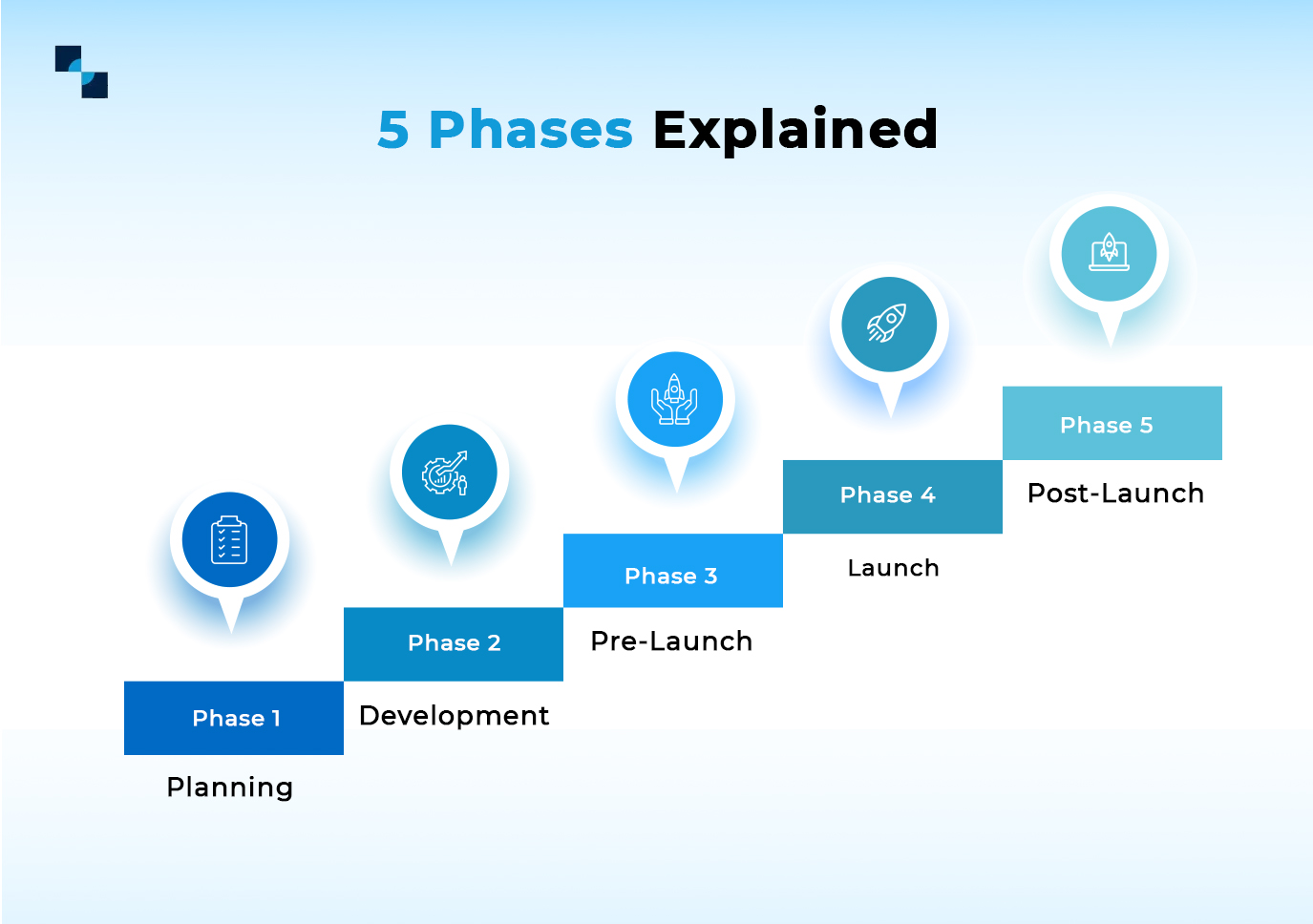
Phase 1: Planning
This stage defines the foundation of your DAO. It includes selecting the right governance model based on your use case, designing tokenomics that align incentives, and establishing a clear legal structure to ensure compliance and risk mitigation from day one.
Phase 2: Development
Here, the technical backbone is built. Smart contracts are developed to automate governance and treasury operations, followed by rigorous internal testing to identify vulnerabilities. A third-party audit process is essential to validate security before moving forward.
Phase 3: Pre-Launch
Before going live, the focus shifts to readiness. This includes onboarding early community members, finalizing governance frameworks and proposal systems, and integrating compliance mechanisms such as KYC and AML where required.
Phase 4: Launch
This is the execution phase where the DAO goes live. It involves deploying smart contracts on the mainnet, distributing tokens according to the defined allocation, and initiating the first governance vote to activate decentralized decision-making.
Phase 5: Post-Launch
After launch, continuous optimization becomes critical. This includes regular treasury reporting, refining governance processes based on participation and outcomes, and scaling the community to ensure long-term growth and sustainability.
Execution speed matters, but precision matters more.
Conclusion: Build It Right From Day One
In 2026, DAO success is no longer about experimentation. It is about precision, security, and scalable execution. The difference between failure and long-term success lies in how well governance frameworks, smart contracts, compliance layers, and treasury systems are designed from the very beginning. A well-structured DAO not only launches successfully, but it sustains, evolves, and scales with its ecosystem.
Execution is what defines outcomes. The right architecture, the right processes, and the right development approach eliminate risks before they become costly mistakes. With Antier, a renowned DAO platform development company, you move from concept to execution with clarity and confidence. From strategy to deployment, we deliver secure, compliant, and scalable DAO development.
Frequently Asked Questions
01. What is DAO development?
DAO development refers to the process of building a decentralized autonomous organization using blockchain technology, smart contracts, and governance frameworks that enable community-driven decision-making without centralized control.
02. Why do most DAOs fail?
Most DAOs fail not due to broken smart contracts, but because of weak governance structures, poor treasury management, and unclear legal frameworks, leading to significant financial losses and damaged community trust.
03. Why are DAOs becoming more important in 2026?
DAOs are gaining importance in 2026 due to their ability to improve operational efficiency, reduce governance friction, and enable transparent decision-making, as more organizations explore DAO development to enhance their operations.