





AI Summary
- In the blog post, it is highlighted that the global financial industry is on the brink of a major transformation in cross-border payments with the rise of stablecoin remittance platforms.
- These platforms promise real-time, transparent, and cost-efficient global transactions, contrasting with traditional systems like SWIFT that are slow and costly.
- Financial institutions are increasingly recognizing the need to upgrade their infrastructure to meet the demands of the digital-first economy.
- By 2026, stablecoins are expected to become the backbone of institutional payment systems, offering significant advantages in terms of cost efficiency, real-time liquidity, and compliance automation.
- Institutions that embrace stablecoin payment rails early on are poised to lead the charge in shaping the future of global remittance, while those who delay risk falling behind.
The way money moves across borders is about to undergo a significant transformation.
By 2026, nearly every major bank and fintech will rely on stablecoin remittance platforms to process real-time global payments. What began as a blockchain experiment is fast becoming the next layer of financial infrastructure, one that eliminates days of waiting, opaque fees, and outdated settlement chains that have defined international transfers for decades.
Traditional systems like SWIFT still take two to five business days to complete a transaction. Each step passes through multiple intermediaries, adding costs and friction that today’s on-demand economy can no longer afford. In contrast, Stablecoin Payment Platforms enable instant, transparent, and cost-efficient value exchange that aligns with the expectations of digital-first finance. From the Bank for International Settlements to JP Morgan’s Onyx network, global institutions are recognizing the same reality: stablecoins are not a disruption to banking; they are its natural evolution. And by the end of 2026, the institutions building these rails today will define how the world moves money tomorrow.
Let’s explore:
Why Legacy Systems Are Forcing Banks Toward Stablecoin Remittance
Traditional banking infrastructure continues to face significant limitations that hinder cross-border remittances, making them slow, fragmented, and prohibitively expensive. Most legacy systems, still running on 1970s–1990s mainframe architectures and COBOL-based code, were built for overnight batch processing and manual reconciliation. They were never designed for the always-on, digital-first demands of the modern global economy.
In practice, remittances can take several days to process. Transfers are queued in settlement windows, and recipients often wait for critical funds like medical payments, tuition fees, or small-business transfers that should move instantly in 2026. Financial institutions are now realizing that the outdated infrastructure they depend on cannot support the transparency or real-time efficiency required by Stablecoin Remittance models emerging across global markets.
“According to World Bank data, banks charge an average of 12.4% in remittance fees, compared to 8.8% from money transfer operators.”
Traditional international transfers frequently involve three or more intermediary banks, each deducting service and exchange charges. Add poor foreign exchange markups, typically 3% to 5% above spot rates, and the total cost of sending money across borders can exceed 15% of the principal. This model not only limits customer satisfaction but also erodes trust in traditional financial systems. To counter these inefficiencies, institutions are exploring stablecoin remittance platform solutions that remove intermediaries and deliver instant, low-cost settlement options suited for both retail and institutional payments.
The Institutional Shift Toward Cross-Border Payment Platform Development
The global financial system is entering a new phase where blockchain technology is becoming the foundation for modern money movement. What was once seen as an experiment is now a strategic shift among financial institutions. Legacy systems cannot support the speed, visibility, or compliance automation required for today’s global markets. This shift is accelerating as banks and payment providers adopt stablecoin remittance solutions to enhance real-time liquidity and transparency across borders.
Institutional Leadership and Key Deployments
| Institution | 2025–2026 Initiative | Key Outcomes |
|---|---|---|
| JPMorgan (Kinexys) | Processed $1.5 trillion in value and expanding to multi-currency FX settlement | Instant fund transfers across five continents |
| Visa | Enabled USDC, PYUSD, USDG, and EURC across Ethereum, Solana, Stellar, and Avalanche | Over $225 million settled via blockchain corridors |
| Mastercard | Partnered with Circle, Paxos, and PayPal for institutional stablecoin settlement | Live deployments across EMEA and North America |
| European Central Bank and 87 Nations | Advancing CBDC readiness | 90% of global GDP is engaged in digital currency pilots |
| Citi & DBS Bank | Built digital asset payment rails using private blockchain networks | Institutional clearing and tokenized cash settlement |
| Societe Generale | Launched a regulated digital asset division (Forge) for blockchain payments | Deployed euro-backed stablecoin (EURCV) for corporate use |
| Standard Chartered & SBI Holdings | Developing cross-border stablecoin corridors in Asia and MENA | Interoperable settlement for trade finance and remittance |
These initiatives prove that blockchain is no longer in trial stages. Financial institutions are upgrading their rails through stablecoin remittance platform development to achieve secure, transparent, and instant value transfers.
Reduce settlement costs and build faster payment rails with our blockchain expertise.
How Institutions Are Building Stablecoin Payment Rails & Why They’re Winning
Banks and fintechs are no longer testing blockchain; they are actively building stablecoin payment rails that combine blockchain efficiency with institutional-grade compliance. Most institutions begin by integrating a blockchain layer, often on networks such as Solana, Stellar, Ripple, or Polygon, into their existing systems, followed by the deployment of smart contracts that automate settlement and fee distribution in real time.
A stablecoin liquidity engine manages fiat on-ramps and off-ramps, while integrated KYC, AML, and KYT tools ensure transparency and regulatory alignment. Through API-based connections, these systems link directly to treasury operations, enabling instant, programmable, and auditable cross-border settlements.
For a complete step-by-step breakdown of the architecture, modules, and deployment strategy, here is the full blog on how to build a white label stablecoin payment platform in detail
Now, let’s come to the next part: why they’re winning this race.
Institutions that have already deployed blockchain settlement systems are outperforming their peers on every measurable metric of efficiency and cost. By using stablecoin remittance platform development frameworks, institutions are unlocking three strategic advantages:
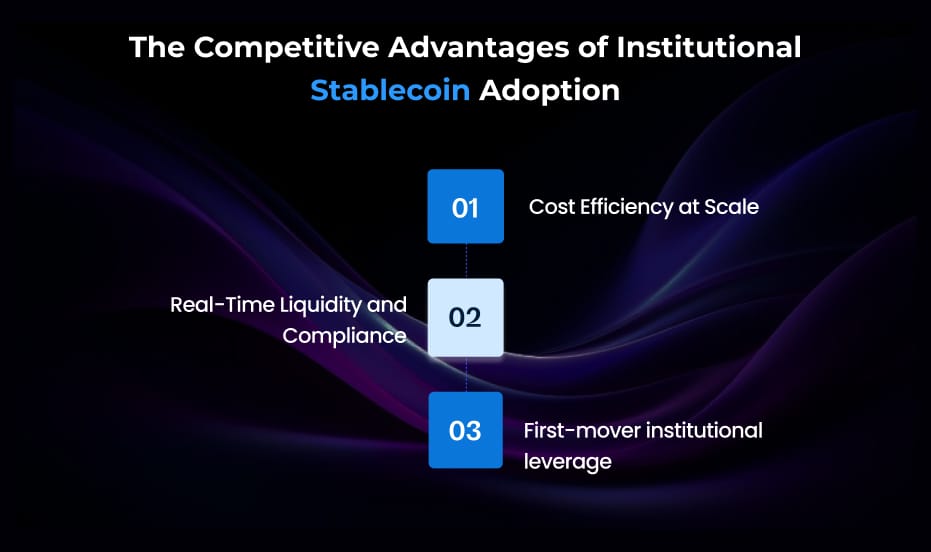
- Cost Efficiency at Scale
Stablecoin-based systems eliminate intermediary charges and FX markups, reducing remittance costs by up to 80%. This not only enhances margins but also enables banks to offer more competitive international transfer rates to customers.
- Real-Time Liquidity and Compliance
Automated reconciliation, on-chain reporting, and real-time liquidity tracking have made treasury operations faster and more transparent. Compliance teams benefit from auditable data that reduces manual oversight and reporting delays.
- First-Mover Institutional Leverage
Banks that invest in blockchain infrastructure today are becoming the settlement hubs of tomorrow. As regulatory clarity grows, late adopters will likely rely on early builders for transaction processing and corridor access, much like how smaller payment processors depend on VisaNet or SWIFT today.
These advantages are not just theoretical; they are already visible in real-world applications across banking, fintech, and cross-border commerce. Institutions are using stablecoins to power everything from interbank settlements to retail payments and on-chain treasury operations.
Here are some detailed use cases of a stablecoin payment rails that illustrate how these benefits translate into measurable business outcomes.
Why 2026 Is the Make-or-Break Year for Stablecoin Remittance
The global financial industry is heading toward a critical turning point. By 2026, stablecoins will evolve from pilot projects into the core infrastructure of institutional payment systems. Banks, fintechs, and regulators worldwide are aligning around blockchain-powered settlements that eliminate the inefficiencies of traditional rails. The next 18 months will determine which institutions lead this transformation and which risk being left behind.
Across major economies, several initiatives are already shaping this transition and proving the scalability of blockchain-based remittance systems:
Key Examples Defining the 2026 Shift
- Operates in 50+ countries and processed $2.3 billion in cross-border transfers in Q1 2025 alone.
- Achieves settlement times of 3–5 seconds, with upgrades underway to reach sub-second transfers by 2026.
2. Great British Tokenised Deposits (GBTD) Pilot:
- A national blockchain initiative involving Barclays, HSBC, Lloyds, NatWest, Nationwide, and Santander.
- Supported by EY, Quant, and Linklaters, this project runs through mid-2026 to build a shared digital ledger for tokenized deposits and cross-border settlements.
- Establishes a strong precedent for Stablecoin Remittance Platform development in regulated financial markets.
3. EY and State Street Global Survey (2025):
- Reveals that 96% of organizations with revenues exceeding $50 billion plan to adopt stablecoins between 2026 and 2027.
- Another 54% of financial institutions not yet active in blockchain payments expect to integrate stablecoin systems within six to twelve months.
4. JPMorgan Research & Forecast:
- Projects that institutional stablecoin adoption will increase U.S. dollar demand by $1.4 trillion by 2027.
- Confirms the growing liquidity and settlement confidence in blockchain-based rails among global banks and corporates.
Schedule a free strategy session with our blockchain architects.
Why 2026 Is the Decisive Year for Stablecoin Payment Platform Development?
For global banks, 2026 represents the threshold between legacy survival and digital dominance. The rollout of regulatory clarity through the 2025 GENIUS Act in the United States and the MiCA framework across Europe has removed previous barriers to institutional adoption.
Financial institutions now have the green light to scale blockchain-based systems with full compliance assurance. Those who move early will define new stablecoin remittance platform standards, while laggards will find themselves dependent on competitors’ infrastructure.
Strategic Outlook!
By the end of 2026, analysts expect over 90% of financial institutions to connect with blockchain-enabled settlement networks, either as direct operators or participants. Early adopters are already establishing stablecoin payment platform development capabilities to secure first-mover advantages in liquidity control, transaction speed, and cost efficiency. The institutions that act now will own the settlement rails of tomorrow’s financial ecosystem, positioning themselves as the new gatekeepers of global money movement.
In short, 2026 is not just another year in the digital transformation timeline; it is the inflection point that will define the future of global remittance.
Final Words
Stablecoin remittance will evolve from an innovation into the backbone of global financial infrastructure. The institutions that move now will define the standards for instant, transparent, and borderless payments. Those who hesitate will find themselves relying on the technology frameworks built by early movers.
Building a stablecoin payment platform today is not just a technological upgrade; it is a strategic shift toward efficiency, compliance, and global reach. Stablecoin-based systems enable banks and fintechs to process transfers in seconds, maintain full regulatory visibility, and cut operational costs by more than half. Organizations across the world are already partnering with Antier, a global stablecoin remittance payment platform development company, to design and deploy stablecoin remittance platform solutions that deliver speed, security, and long-term scalability.
Take the first step toward a faster, more transparent, and interoperable financial ecosystem that redefines how the world moves money.
Frequently Asked Questions
01. What is the expected transformation in money transfers by 2026?
By 2026, nearly every major bank and fintech is expected to rely on stablecoin remittance platforms for real-time global payments, eliminating delays and high fees associated with traditional systems.
02. How do stablecoins improve the remittance process compared to traditional banking systems?
Stablecoins enable instant, transparent, and cost-efficient value exchange, addressing the limitations of traditional banking systems that often take days to process transactions and involve multiple intermediaries.
03. Why are legacy banking systems inadequate for modern remittance needs?
Legacy systems are built on outdated technology that is not designed for the real-time, digital-first demands of today’s economy, resulting in slow, fragmented, and expensive cross-border remittances.