




✨ AI Summary
- The blog post discusses how Crypto-as-a-Service (CaaS) is transforming the banking industry by offering modular infrastructure components needed for digital asset services.
- CaaS enables enterprises to focus on product and customer experience while leveraging services like custody, trading, payments, compliance, and tokenization through APIs and SDKs.
- Real-world examples show how CaaS is being integrated into neo banking platforms for custody, trading, payments, compliance, and tokenization.
- The post emphasizes the importance of governance, security, and choosing the right CaaS partner for successful implementation.
- The future of CaaS in blockchain banking includes trends like deeper custody convergence, composable financial primitives, and regulatory-tech integration.
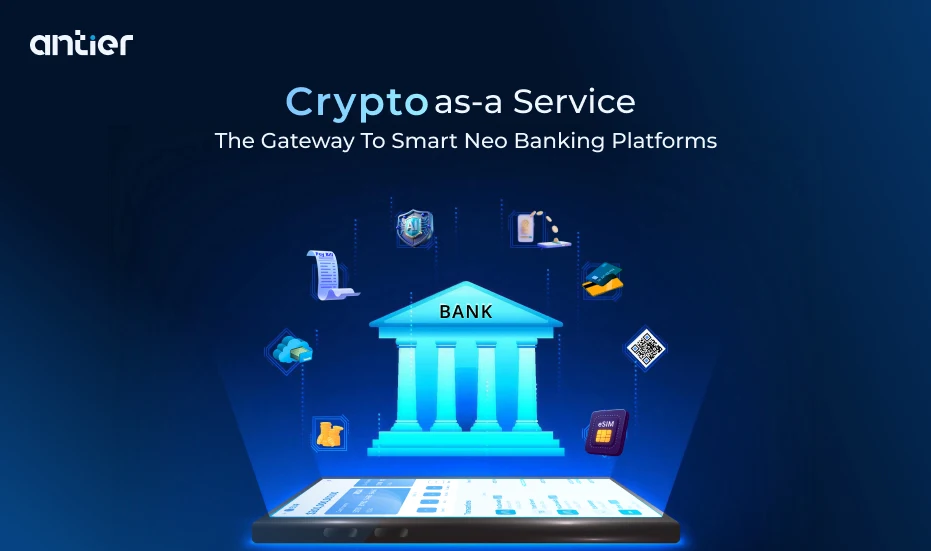
The convergence of regulatory clarity, institutional custody, and turnkey infrastructure has moved crypto from niche to necessary for modern banking experiences. Crypto‑as‑a‑Service (CaaS) removes the heavy lifting, custody, compliance, liquidity, and rails, letting enterprises and fintechs focus on product, brand, and customer experience. For organizations planning a neo banking product, a customized approach accelerates time‑to‑market while preserving enterprise controls and regulatory posture.
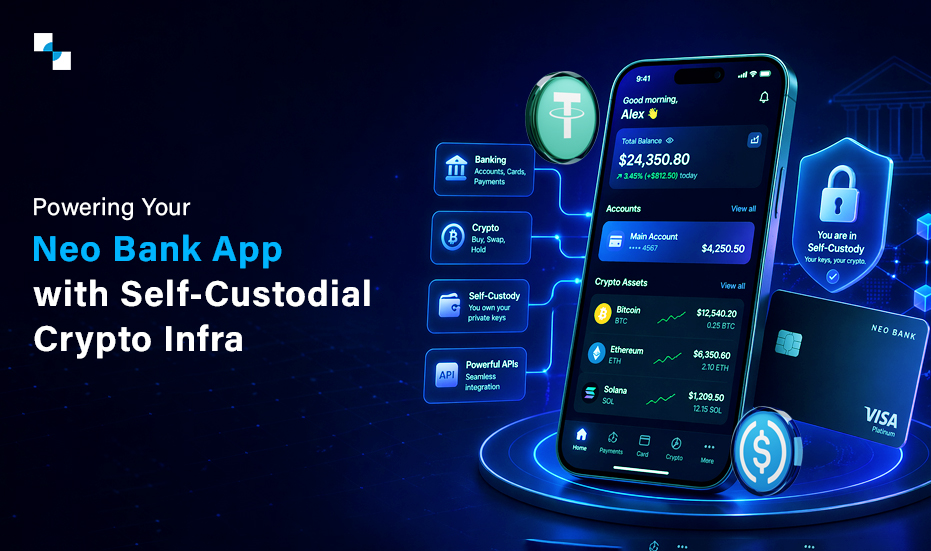
Carefully architected CaaS integrations transform a banking solution into a white label crypto‑friendly neobank that offers trading, programmable payments, and tokenized product rails without building complex blockchain middleware in‑house. This opens opportunities for banks and large enterprises to deploy crypto features in ways that align with corporate governance and risk frameworks, making white label neo bank products a competitive and compliance‑first proposition.
What is Crypto-as-a-Service?
Crypto‑as‑a‑Service (CaaS) is a modular, API‑first offering that packages the critical infrastructure components institutions need to offer digital‑asset services. At its core, CaaS includes custody and key management (often with institutional sub‑custodians), exchange and liquidity access, on‑ramp/off‑ramp fiat rails, programmable payment rails (cards, stablecoins), and compliance toolsets (KYC/AML, transaction monitoring).
CaaS solution providers expose SDKs, REST APIs, and UI components that allow banks and fintechs to embed crypto trading, crypto wallet management, and settlement flows into a white‑label app quickly. That means a NeoBank App Platform Development effort can remain focused on UX, customer journeys, and product differentiation while relying on the CaaS provider for security, fault tolerance, and regulatory controls. For enterprises looking to partner with a BaaS development company for the launch of CaaS in banking apps, it represents the pragmatic bridge between legacy banking rails and the composable world of decentralized crypto banking.
Real‑World Integration of CaaS in Web3 Neo Banking
CaaS is already powering real deployments across three major vectors, thus let us
1. Custody & Institutional Safekeeping – Investors with white‑label neo banking platforms integrate institutional custody services and multi‑party key management to hold customer assets securely while meeting audit and insurance requirements. This combination enables white label crypto neo bank solutions to offer insured custodial wallets without building HSM and governance frameworks from scratch.
2. Embedded Trading & Liquidity – CaaS platforms connect to spot/liquidity pools, OTC desks, and institutional exchanges, so a neo bank app can offer instant buy/sell, limit orders, and programmatic rebalancing. This capability allows traditional banking users to trade crypto in‑app with the trust and UX they expect from mainstream finance.
3. Payments, Cards & Stablecoins – Programmable stablecoins and card settlement rails powered by CaaS let neo banks offer crypto‑funded cards, merchant acceptance, and cross‑border FX routing while preserving compliance controls.
4. Compliance, Reporting & AML– Integrated KYC, transaction monitoring, and audit trails enable enterprises to meet regulatory obligations without custom engineering. White label neo bank services benefit from pre‑built compliance connectors that reduce legal and operational friction.
5. Tokenization & Real‑World Assets (RWAs) – CaaS providers increasingly add tokenization modules enabling neo banks to offer asset‑backed products, synthetic exposures, or loyalty token ecosystems that remain compliant and auditable.
Talk to Our Experts & Get Your CaaS Ready Neo Banking App Launched!
Regulatory, Compliance & Governance Considerations For CaaS Neo Banking
Successful CaaS adoption is as much about governance as technology. Enterprises must assess: which entity holds custody vs. deposits, how KYC/AML flows tie to legacy onboarding, and where consumer protection sits across jurisdictions. MiCA (EU), evolving U.S. stablecoin rules, and regional VASP requirements create a patchwork where a compliant white‑label crypto neo bank solution must include geofencing, consented data flows, and audit‑ready transaction logs. Work with legal, regulatory, and ops teams early, and choose CaaS neo bank app development partners with experience supporting bank audits and regulatory exams.
CaaS Neo Banking Security & Custody Best Practices
Institutional CaaS integrations should assume adversaries will target keys, transaction settlement, and API endpoints. Adopt multi‑party computation (MPC) or hardware security module (HSM) custody, cold‑hot key separation, signed settlement workflows, continuous audit logging, and SOC2/ISO certifications. Penetration testing, red‑team exercises, and third‑party attestations are non‑negotiable when marketing a crypto‑enabled white label neo bank app to enterprise clients and corporate treasury customers.
How to Pick the Right CaaS White Label Neo Banking Partner?
- Evaluate regulatory compliance frameworks and licenses across multiple jurisdictions.
- Verify custody security modelssuch as MPC or HSM, with insurance coverage.
- Assess liquidity partnerships and exchange integrations for seamless trading.
- Check auditability, KYC/AML coverage, and real‑time compliance monitoring tools.
- Ensure modular APIs and SDKs enable faster Neo Banking App Development.
- Compare enterprise‑grade SLAs, uptime guarantees, and scalability performance.
- Look for proven deployments in White label crypto neo bank platform development.
- Prioritize partners offering customizable UX to support Crypto-friendly neobanking solutions.
The Future of CaaS in Blockchain Neo Banking Development Landscape
CaaS neo banking will evolve from a feature provider into a full platform fabric for neo banking. Expect three converging trends: deeper institutional custody convergence (traditional custodians offering on‑chain settlement), composable financial primitives (tokenized deposits, real‑world asset rails, and programmable credit), and tighter regulatory‑tech integration where compliance is enforced at the protocol level.
These shifts will enable white label crypto neo bank platform development to move beyond add‑ons and become core banking product lines for incumbent banks and new challengers alike. As large custodians and exchanges provide bank‑grade APIs, enterprises can launch decentralized crypto neo banking features with lower capital intensity and predictable operational models. Ultimately, the strategic winners will be those CaaS providers that combine regulatory trust, liquidity breadth, and developer ergonomics, enabling enterprises to offer secure, compliant, and high‑performance neo banking apps at scale.
The Final Takeaway
Crypto‑as‑a‑Service demystifies the technical and operational complexity of adding crypto to enterprise banking products. For businesses building a white‑label neo bank, CaaS reduces engineering lift, accelerates regulatory readiness, and unlocks new product lines, from crypto cards and trading to tokenized assets and programmable payments. The strategic decision is no longer whether to offer crypto, but how: choose Baas solution providers who bring institutional custody, audited compliance modules, and modular APIs that map to your product roadmap. When implemented thoughtfully, a crypto-friendly neobanking solution powered by robust CaaS infrastructure becomes a growth engine, enabling faster launches, measurable enterprise trust, and new revenue streams while preserving the controls enterprise stakeholders require. Connect with Antier and its vast team of blockchain experts who are adept at crafting and delivering impactful solutions. Our team not only designs business tailored banking platforms but also ensures that all the solutions are fully regulated an compliant.
Frequently Asked Questions
01. What is Crypto-as-a-Service (CaaS)?
Crypto-as-a-Service (CaaS) is a modular, API-first offering that provides the essential infrastructure for institutions to offer digital-asset services, including custody, liquidity access, and compliance tools.
02. How does CaaS benefit neo banking products?
CaaS allows organizations to quickly integrate crypto features into their neo banking products without building complex blockchain systems, enabling a focus on customer experience and regulatory compliance.
03. What are the key components of a CaaS solution?
A CaaS solution typically includes custody and key management, exchange and liquidity access, fiat on-ramp/off-ramp, programmable payment rails, and compliance toolsets like KYC/AML and transaction monitoring.