



✨ AI Summary
- Discover how Tokenized Real Estate Platforms are revolutionizing the real estate market by enabling digital fractional ownership, automating compliance, and inviting global participation.
- With forecasts predicting a $4 trillion market by 2035, early adopters gain a competitive advantage by simplifying capital raising and accelerating liquidity.
- The blog delves into the core features that investors seek, the necessary technology architecture, and estimated development costs.
- Real-world examples like AspenCoin showcase the success of compliance-first issuance and liquidity mechanisms.
- The comprehensive tech stack blueprint outlines the necessary components for building a secure and scalable platform.
The real estate market is enormous, but inaccessible. Large down payments, prolonged deal cycles, and limited liquidity have historically restricted real estate to well-funded investors. A well-designed Tokenized Real Estate Platform transforms this model. It enables digital fractional ownership, accelerates capital flows, automates compliance, and invites global participation.
Designed for real estate firms, proptech leaders, and fintech innovators, this deep dive unpacks why tokenized property investment matters now, details the core features that investors look for to buy Tokenized Real Estate, the technology architecture, and estimates development costs. It emphasizes real estate-specific infrastructure and avoids generic asset commentary.

Why Tokenized Real Estate Platforms Matter in 2025?
- In 2024, tokenized real estate accounted for under $300B. Forecasts by Deloitte project a total of $4T by 2035, driven by a 27% compound annual growth rate.
- The Real Estate Tokens for Sale will represent 15% of global real estate under management ($3T) by 2030.
- About 55% of firms are already piloting or live with Real Estate Tokenization Software Development services, with 12% operational as of mid-2024.
Why it matters: This shift transforms property ownership, simplifies capital raising, and accelerates liquidity. Early adopters gain a structural advantage; laggards risk obsolescence.
1. Fractional Ownership & Liquidity
Tokenization enables properties to be divided into tradable digital shares. Buyers can acquire fractions, and secondary trading enables rapid exit. This creates trust and flexibility, vital for attracting capital and boosting return velocity for those offering Real Estate Tokens for Sale.
2. Compliance Embedded by Design
Smart contracts enforce conditions around investor accreditation, geography, and tax status. Platforms built through a Real Estate Tokenization Software Development Company can automate KYC/AML, allow global onboarding while minimize legal risk.
3. Reduced Operational Overhead
Distributing rental income, managing ownership records, and executing cap table changes become automated. Human workflows diminish, saving legal, administrative, and brokerage costs through Real Estate Tokenization Software Development Services.
4. Broader Audience Reach
By lowering entry thresholds and enabling digital onboarding, platforms open access to retail, accredited, and international investors without conventional gatekeeping.
5. Transparency & Control
On-chain recordings of ownership, transactions, and payouts ensure investors, auditors, and regulators have real-time visibility, minimizing disputes and boosting trust.
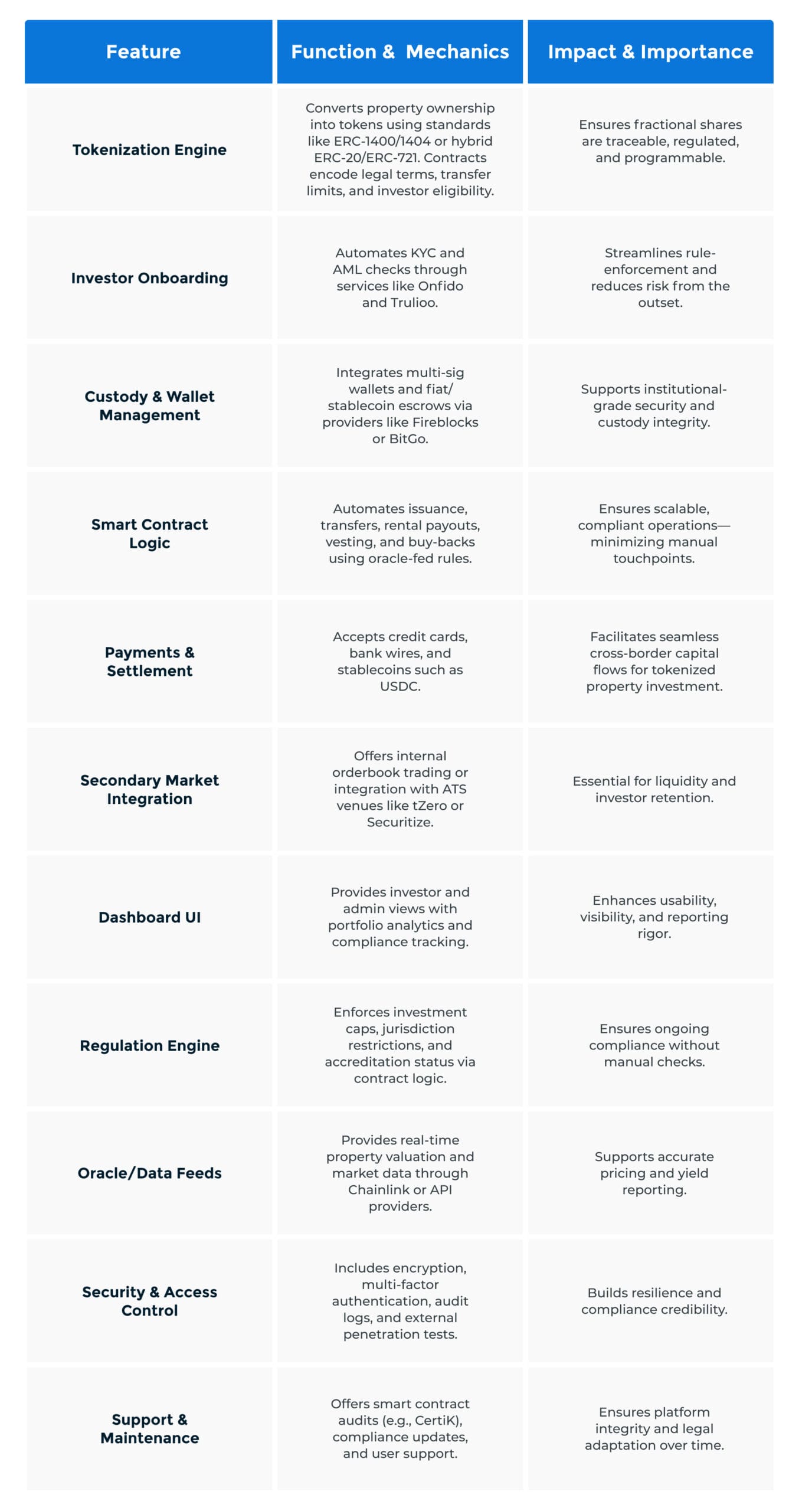
Core Tokenized Real Estate Platform Modules: What They Are and How They Work
Institutional Example: AspenCoin and Elevated Returns
- Elevated Returns tokenized 19% of Aspen’s St. Regis Resort, raising US$18M in 2018 via AspenCoin, a Reg D token on Ethereum. The offering, developed by a Real Estate Tokenization Software Development Company, saw investor holdings triple by 2024 due to liquidity and fractionalization.
- Tokens migrated to Tezos and were listed on tZERO by 2020. Investor holdings appreciated about 30% within 18 months and tripled by 2024. Its success stemmed from embedded compliance, fractional issuance, and secondary trading availability.
This case underscores critical design principles: Compliance-first issuance, liquidity mechanisms, and investor-aligned economics.
Real Estate Tokenization Platform: Tech Stack Blueprint for 2025
The technical framework for building a Tokenized Real Estate Platform includes:
- Blockchain Layer: Ethereum and Polygon for liquidity; Quorum or Hyperledger for regulated enterprise needs.
- Backend: Node.js (Express), Python (Django), or Go; PostgreSQL or MongoDB; document storage via IPFS or AWS S3.
- Frontend & Mobile: React.js or Vue.js for web portals; Flutter or React Native for mobile access.
- Cloud & DevOps: AWS/Azure/GCP with Docker/Kubernetes orchestration; CI/CD via GitHub Actions or Jenkins; monitoring via Datadog or Splunk.
- Integrations: Payment rails (Stripe, Circle), compliance services (Onfido, Trulioo), Oracle feeds (Chainlink or proprietary APIs).
- Security Infrastructure: External audits (CertiK), MFA, encrypted communication, and cold storage custody.
This architecture supports a scalable, modular, secure environment ideal for enterprise-grade Real Estate Tokenization Platforms.
Cost Estimates: Development Budget for building Tokenized Real-Estate Platforms
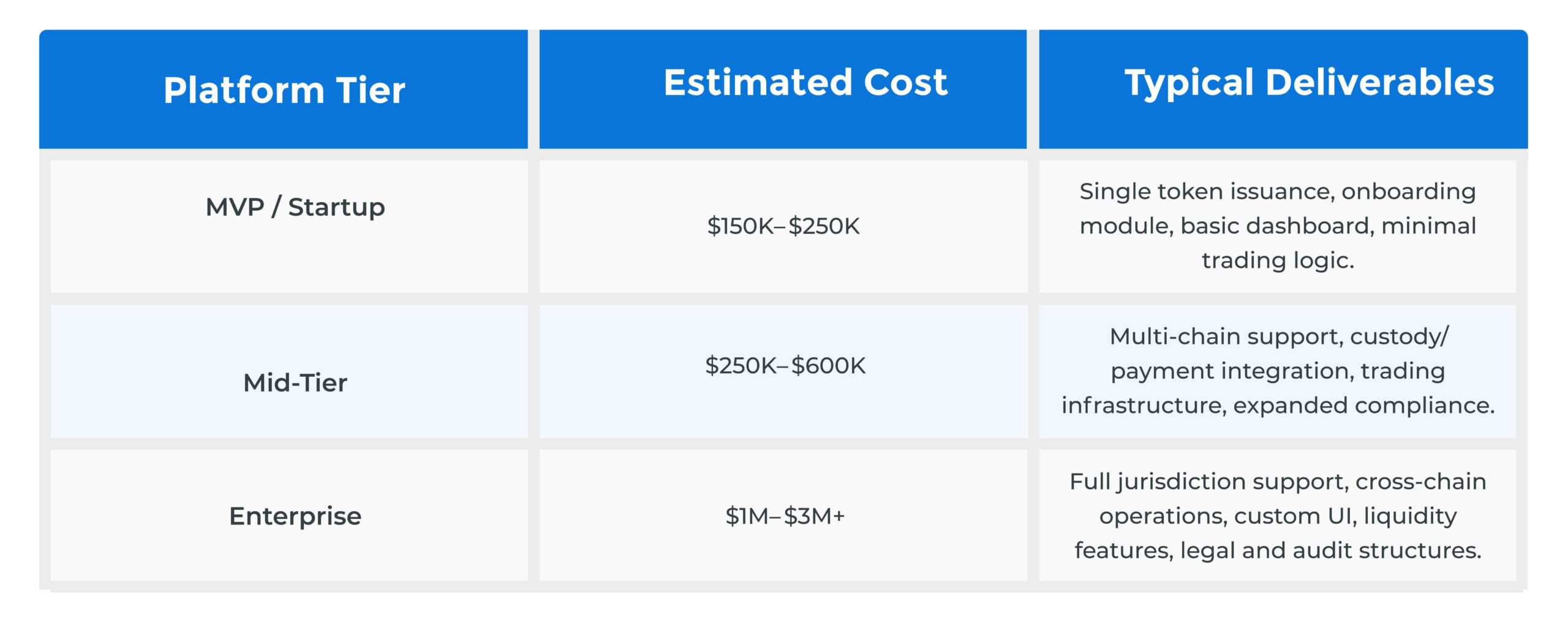
Most mid-tier deployments fall between $200K–US500K, depending on smart contract complexity, compliance layering, and trading engine design.
Compliance Strategy: Regulations Built In
- Smart contracts enforce legal limits by jurisdiction (Reg D, MiCA, MAS). Real Estate Tokenization Software Development practices now prioritize embedded legal logic to reduce dependency on manual review.
- Investor eligibility, geofence restrictions, and investment ceilings operate via embedded validation layers.
- Compliance modules ensure adaptability to evolving legal landscapes.
Liquidity Architecture for Tokenization Platform
Liquidity is driven by exchange links, token portability, and embedded buy-back logic. These mechanisms allow developers to offer Real Estate Tokens for Sale that are attractive to both retail and institutional buyers.
- Supports ATS integration (tZERO, Securitize), internal exchanges, or DEX connectivity.
- Enables cross-chain portability via interoperability protocols like Chainlink CIPs.
- Incorporates features such as token buy-back, structured exit windows, and automated market maker logic.
- A liquidity-first design is foundational; no exit means no investor trust.
Differentiators That Deliver Competitive Advantage
- Automated income payouts: Instant rent or dividend handling via smart contracts.
- Debt tokenization capabilities: Converts mortgages or loans into tradable token instruments.
- AI-backed valuation tools: AVMs and yield forecasting for investor dashboards.
- Compliance-as-a-service modules: Jurisdiction plug-ins that scale effortlessly.
- Token portability: Enables cross-chain migration for enhanced liquidity access.
These features distinguish a platform as product-led, investor-aligned, and regulation-ready.

Launch Strategy for Platform Builders
- Pilot with one or two assets to validate token logic, onboarding, and trading workflows.
- Incorporate user feedback to refine UX, payout behavior, and compliance flows.
- Scale architecture modularly, expand to multiple assets, jurisdictions, chains, and analytics layers.
- Involve legal counsel early to navigate global regulatory standards.
- Develop licensing or SaaS models to monetize the platform beyond single-asset usage.
Takeaway
Tokenized real estate is rapidly transitioning from novelty to mainstream infrastructure. With forecasts estimating a $4 trillion market by 2035 and growing demand to Buy Tokenized Real Estate, it is crucial to work on platform development that meets the global standards.
Ready for Real Estate Tokenization Software Development? Get in touch with Antier to build a custom solution.
Frequently Asked Questions
01. What is a Tokenized Real Estate Platform?
A Tokenized Real Estate Platform enables digital fractional ownership of properties, allowing investors to buy tradable digital shares, which increases liquidity and simplifies capital raising.
02. Why is tokenized real estate expected to grow significantly by 2035?
Tokenized real estate is projected to grow to $4T by 2035 due to a 27% compound annual growth rate, driven by increased participation and the advantages of fractional ownership and automated compliance.
03. How does tokenization reduce operational overhead in real estate?
Tokenization automates processes like distributing rental income and managing ownership records, which reduces the need for human workflows and lowers legal, administrative, and brokerage costs.