




✨ AI Summary
- The blog post discusses the significant growth in the altcoin market cap and the increasing demand for purpose-driven tokens that offer real utility and solve industry-specific problems.
- It emphasizes that 2025 is the perfect year to launch an altcoin due to favorable conditions such as regulatory clarity, optimized blockchain infrastructure, and institutional adoption.
- The post provides a step-by-step breakdown of altcoin development, including defining the use case, choosing the right blockchain, designing tokenomics, developing smart contracts, integrating wallets and platforms, launching and distributing the altcoin, and post-launch support.
- It also touches on the cost of altcoin development, highlighting the importance of strategic planning and professional expertise.
- The blog encourages readers to take advantage of the current market environment and launch their altcoin in 2025 to tap into the growing opportunities in the digital finance space.
The altcoin market cap has grown by approximately 42% over the past year, reflecting a strong shift toward token-driven innovation and decentralized solutions. This surge in momentum highlights the rising demand for altcoin development that delivers real utility, solves industry-specific problems, and supports scalable digital ecosystems.
As the global economy leans into blockchain adoption, altcoins are emerging as a vital layer in both consumer and enterprise use cases. If you are considering launching an altcoin, 2025 presents the most strategic environment for doing so. The technology is stable, the use cases are proven, and the market is looking for well-built, purpose-driven tokens. This blog will walk you through everything you need to know to build your own altcoin this year.

Why 2025 Is the Perfect Year to Launch Your Own Altcoin?
If you’ve been on the fence about launching your own altcoin, 2025 is the year that should change your mind. The conditions are more favorable than ever. Regulatory clarity is finally maturing across key regions. Layer-1s and Layer-2s are being optimized for scale, and institutional adoption is no longer a prospect; it’s already happening. The total market capitalization of all altcoins (excluding Bitcoin) in 2025 is approximately USD 1.79 trillion, a clear signal that altcoins are not just speculative assets, but foundational elements in the next phase of digital finance.
Key players are already demonstrating how tokens are moving from pilot to production. Across industries, businesses are leveraging altcoins for payments, rewards, governance, and asset tokenization, backed by real use cases and scalable infrastructure. For enterprises planning altcoin development, this is a rare window. The tools are mature, regulatory pilots are live, and blockchain ecosystems are interoperable and enterprise ready.
If you want your altcoin to serve a real-world purpose in an on-chain economy, 2025 is your launchpad year. Infrastructure is in place, adoption is accelerating, and early movers are already setting the standards.
Now is the time to turn strategy into action—and your idea into a trusted token.
Altcoin Development: A Step-by-Step Breakdown
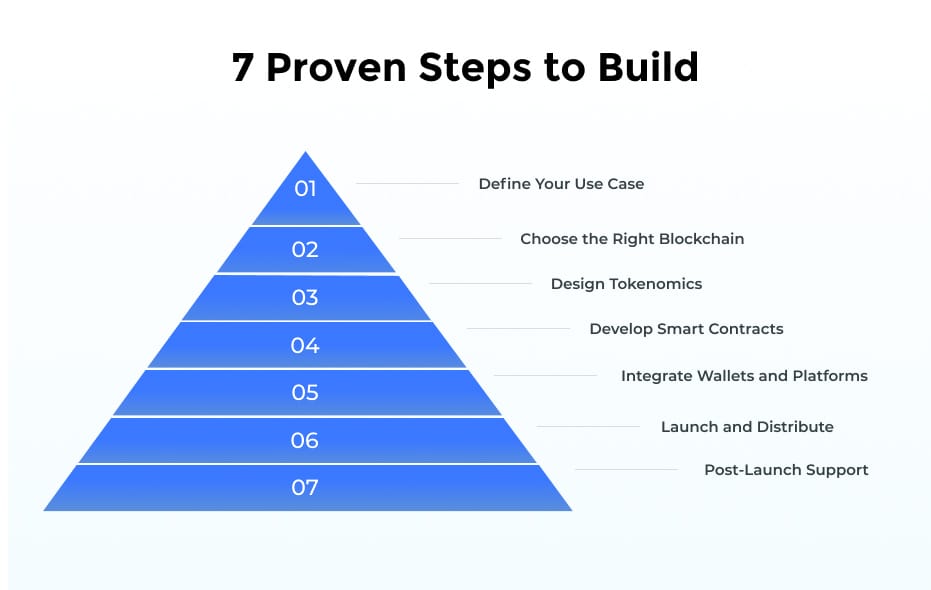
Understanding how to build your own altcoin in 2025 requires a structured, technically sound, and purpose-driven approach. Here you go:
1. Define Your Use Case
Start with clarity. Is your altcoin meant for payments, loyalty, governance, staking, cross-border settlements, or tokenizing assets? A well-defined use case will shape every technical and economic layer of your token.
2. Choose the Right Blockchain
Not all chains are equal. Ethereum offers wide adoption and composability, but newer options like Avalanche, Cosmos SDK, or Polygon CDK may provide better speed, scalability, and customization. Your choice should align with your industry, user base, and regulatory requirements.
3. Design Tokenomics
Tokenomics drives utility and trust. Decide on supply models, user incentives, emission schedules, and governance frameworks. Institutions often partner with an altcoin creation service to design economically viable and regulatory-compliant token models.
4. Develop Smart Contracts
Smart contracts bring automation and security. This step includes coding the logic for minting, transfers, vesting, staking, or governance. Prioritize audits to eliminate vulnerabilities before launch.
5. Integrate Wallets and Platforms
Your altcoin should be easy to use and access. Integrate popular wallets, such as MetaMask or Trust Wallet, or use custom mobile apps. Ensure your token appears on block explorers and supports seamless DApp interactions.
6. Launch and Distribute
Choose your launch model: IDO, exchange listing, community airdrop, or enterprise deployment. Use launchpads or liquidity providers to create initial traction and accessibility.
7. Post-Launch Support
Altcoin development doesn’t end at launch. Maintain community engagement, roll out updates, monitor analytics, and ensure protocol-level upgrades through governance or forks.
How Much Does Altcoin Development Cost?
That’s probably one of the first questions on your mind, and it should be. But the truth is, there’s no one-size-fits-all answer. The cost of altcoin development depends entirely on what you’re building, why you’re building it, and how far you want it to go. If you’re creating a simple utility token with fixed supply, that’s a very different project compared to launching a custom programmable asset with staking logic, on-chain governance, and multi-chain compatibility. The deeper your altcoin’s functionality, the more engineering, security, and planning it demands. Your choice of blockchain also plays a role. Some chains offer faster deployment and lower operating costs, while others provide enterprise-grade performance and regulatory alignment. Then there’s the architecture: are you using standard smart contracts, or will you need custom-built modules, native bridges, or oracle integrations?
And let’s not forget compliance. If your altcoin is part of a regulated use case or targeting institutional users, you’ll need legal advisory, KYC integration, and possibly audit-ready infrastructure. That’s were working with a professional altcoin development company, or a trusted altcoin creation service can change the game. They bring not just technical expertise but also strategic foresight. At the end of the day, the cost reflects how ambitious your project is. So, if you’re thinking about how to build your own altcoin, remember: you’re not just buying development hours. You’re investing in trust, functionality, and long-term adoption. And when done right, that investment pays off in more ways than one.
This Is Your Sign to Launch That Altcoin in 2025
You have watched the momentum build all year. The infrastructure is ready, the regulations are lining up, and real‑world pilots are crossing the finish line. Whether you lead a fintech, a global enterprise, or a nimble startup, the path to launching an altcoin has never been clearer. Pick the chain that fits, harden your smart contracts, lock in user‑friendly integrations, and watch your token open revenue streams your balance sheet has never seen. 2025 is not just the right time; it is the optimal time. If you have been waiting for a sign, this is it. Partner with Antier, a trusted altcoin development company, and let our experienced blockchain team bring your vision to life with a market-ready altcoin built for real-world adoption.
Frequently Asked Questions
01. Why has the altcoin market cap grown significantly over the past year?
The altcoin market cap has grown by approximately 42% due to a strong shift towards token-driven innovation and decentralized solutions, reflecting rising demand for altcoins that deliver real utility and solve industry-specific problems.
02. Why is 2025 considered the ideal year to launch an altcoin?
2025 is seen as the perfect year to launch an altcoin because of favorable conditions such as regulatory clarity, optimized blockchain technology, and increasing institutional adoption, with the total market capitalization of altcoins projected to reach approximately USD 1.79 trillion.
03. What are the key steps to building an altcoin in 2025?
Key steps to building an altcoin in 2025 include defining your use case, ensuring a structured and technically sound approach, and focusing on creating a purpose-driven token that serves a real-world function in the on-chain economy.