




AI Summary
- The blog post delves into the rise of decentralized finance (DeFi) and its potential impact on the financial industry.
- It discusses how DeFi platforms operate on blockchains, enabling peer-to-peer transactions by eliminating intermediaries.
- The post highlights the increasing adoption of DeFi by hobbyists, innovators, and institutions, emphasizing the need for broader institutional adoption to achieve a truly borderless market.
- Institutional DeFi involves businesses, financial companies, FinTech firms, and entrepreneurs leveraging cryptocurrencies and NFTs to enhance their portfolios and market offerings.
- The article also outlines key elements necessary for developing an institutional DeFi platform, such as NFTs, confidentiality solutions, AEAs, and dPrime brokerages.
A decentralized finance platform runs on a blockchain (like Ethereum) to facilitate peer-to-peer transactions by removing intermediaries. DeFi is being widely adopted in current times, not only by hobbyists and innovators but also by institutions.
Though DeFi is not completely risk-free, the results so far have outweighed the risks. Cryptocurrencies and NFTs are being used as the lines between the traditional and crypto market are slowly blurring.
For DeFi to become a global phenomenon, it needs to be extensively adopted by institutions (not limited to FinTech companies). Creating a true borderless market is possible only when DeFi is implemented on a large scale.
What is Institutional DeFi?
Institutional DeFi can be defined as-
● Businesses that rely heavily on crypto and are not a part of traditional banking or financial services
● Medium to large financial companies and their investors looking at crypto as a way to bring more sophistication and diversity to the portfolio and exchanges
● FinTech companies that offer financial products for B2B and B2C clients to create a simplified environment for buyers and sellers to interact and negotiate
● And finally, entrepreneurs looking to capture the market by investing in the latest technology as well as small enterprises and the gambling industry
Institutional decentralized finance development follows a sequential process of adoption. We can assume that wider adoption will be seen in crypto native businesses rather than SMEs. The simple reason for this is that the crypto companies have a better chance and reason to upgrade and invest in something that’ll add more value to the business.
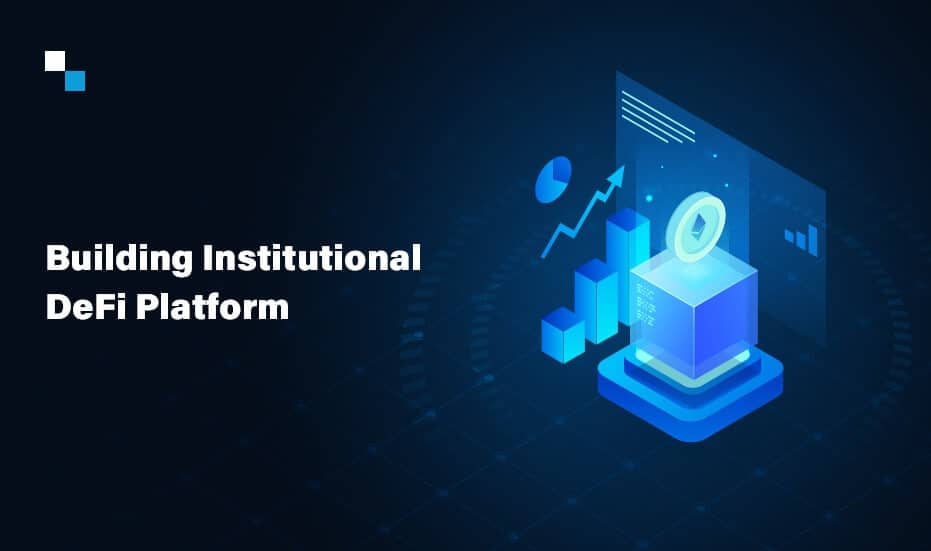
How to Develop an Institutional DeFi Platform?
Developing an institutional DeFi platform requires certain elements that will help investors and businesses alike. We can say that the following are necessary for an institutional DeFi platform-
● NFTs (Non-Fungible Tokens)
A non-fungible token is an asset that cannot be interchanged with another asset. The NFTs are unique digital files and represent assets that stand on their own (such as a car, house, photo, video, etc.). Ethereum is typically used to create NFTs.
For institutional DeFi, an NFT is more of a digital representation of a unique asset. Security of NFTs is one important aspect to consider for institutional DeFi.
● Confidentiality Solutions
DeFi, by nature, emphasizes transparency, leading to the data being left open for public access. But the same cannot be done for institutional DeFi. To maintain transparency and provide adequate security in DeFi platforms, concepts like ZKP (Zero-Knowledge Proof) are being implemented. Layer 2 scaling is another way to increase data security on the platform.
● AEAs (Autonomous Economic Agents)
DeFi platform development includes building an automated agent that acts on the owner’s behalf but without having any ownership rights of its own. The main aim of using AEAs is to increase economic value for the traders/ investors on the platform.
The DeFi protocols complement Ethereum by enhancing the user experience through automation, reusing complex machine learning capabilities off-chain and on-chain, and encouraging proactive behavior/ trading on the platform.
However, it is to be noted that as more features are introduced in DeFi, it’ll resemble CeFi (Centralized Finance) a lot more.
● (Demand) dPrime Brokerages & ETFs
Oxygen, built by Goldman Sachs, is an excellent example of an on-chain prime brokerage that makes borrowing and lending a democratic process for users of the DeFi platform.
Institutional DeFi is the way to increase the digital economy and operational efficiency. Being an open-source protocol makes DeFi easier to copy, recreate, and adopt on any scale. Of course, it’s up to the regulators to decide how much of this adoption will be accepted.
If you are planning for decentralized finance development, Antier Solutions can help. We offer comprehensive DeFi development solutions to help start-ups and established organizations tap into the billion-dollar DeFi world. Our technology-agnostic solutions and coherent roadmap accelerate the development process.
Schedule a free demo of one of our DeFi applications or connect with our subject matter experts to share your business needs.