




AI Summary
- Solana's rise in the crypto world has led to a surge in demand for hot wallets, offering instant access to trading, NFTs, DeFi, and on-chain services without the hassle of exchanges.
- Self-custody has become mainstream, with users seeking control over their assets.
- Decentralized hot wallets are bridging the gap, providing online accessibility along with the security of non-custodial systems.
- The Solana wallet market has seen significant growth, with Phantom leading the way.
- These wallets offer a range of features like seedless authentication, social recovery, and built-in fiat rails to enhance user experience and integration within the Solana ecosystem.
Solana’s low fees and high throughput have made it the backbone for a new generation of consumer-facing crypto experiences. Demand for Solana hot wallets is surging because users want instant access to trading, NFTs, DeFi, and on‑chain services without the friction of exchanges. At the same time, self-custody—where users hold their own private keys—has become mainstream as people trade convenience for control. Decentralized hot wallets combine both: online access for everyday use plus the transparency and users‑first model of non‑custodial systems. Enterprises and builders are shipping wallet features such as seedless authentication, account abstraction, social recovery, transaction batching, and built-in fiat rails to reduce onboarding friction. The result is a fast‑growing market that favors wallets that are secure, user-friendly, and integrable with the broader Solana ecosystem.
Market Snapshot & Why Decentralized Self‑Custody Wallets Are Booming?
Solana’s cryptocurrency wallet ecosystem has expanded rapidly as consumer apps, NFTs, and DeFi activity attracted mainstream users. Phantom led the way with an estimated 15+ million users, while Solflare had 3–4 million. In 2025, Solana’s wallet market boasted over 2.2 million daily active wallets and experienced strong user growth. The overall market was characterized by high transaction volume and activity, particularly from Q4 2024 through Q1 2025, driven by meme coins, DeFi, and NFTs. At its peak in 2025, Phantom, the industry leader, reported about 17 million monthly active users, indicating consumer-grade demand for straightforward, on-chain financial experiences.
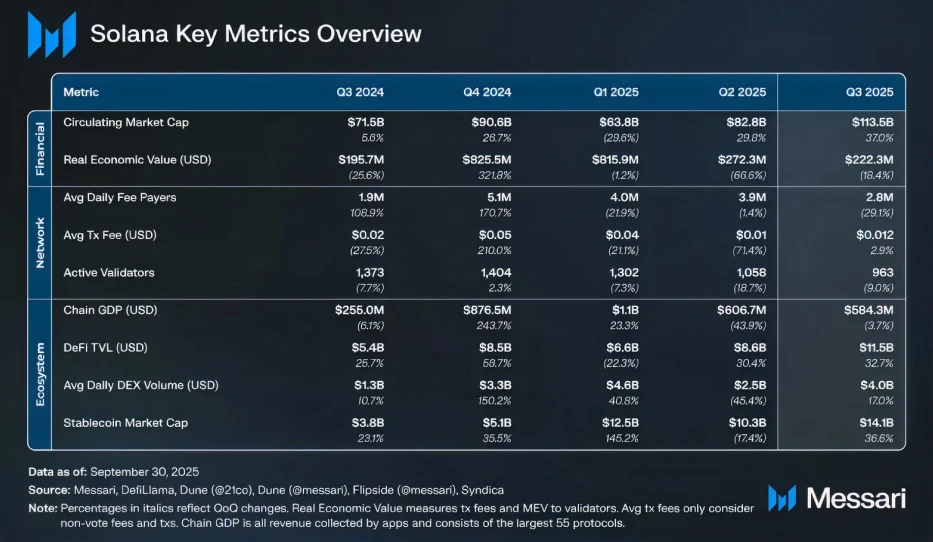
Source link: https://messari.io/report/state-of-solana-q3-2025
These metrics show that users expect instant, low‑cost interactions; they choose hot cryptocurrency wallet apps for everyday access and trading while demanding self‑custody to retain control over assets. For visionary investors, decentralized self‑custody wallets represent both a defensive and strategic play: they remove custodial counterparty risk while positioning products to capture new revenue streams such as swap fees, tokenized loyalty, and embedded finance. Additionally, modern wallet features like seedless authentication, social recovery, and account abstraction lower onboarding friction, making self-custody viable for broader audiences and attractive to enterprises seeking to own direct customer relationships on-chain.
Solana Hot Wallet vs. Solana Cold Wallet
Let us understand the difference between Solana hot crypto wallets and cold wallets so that every business and enterprise makes an informed decision.
| Aspect | Solana Hot Wallet | Solana Cold Wallet |
|---|---|---|
| Connectivity | Always connected to the internet for instant transactions | Offline, disconnected from networks |
| Use Case | Daily trading, DeFi, NFTs, fast transfers | Long‑term storage and safeguarding high‑value assets |
| Security Model | Higher convenience but requires strict security hardening | Highly secure due to offline key storage |
| Accessibility | Immediate access through mobile/web apps | Requires hardware devices or offline setups |
| Private Key Management | Stored in encrypted local storage or secure enclave | Stored in hardware devices or offline media |
| Ideal Users | Active traders, dApp users, businesses with real‑time operations | Institutions, long‑term holders, treasury managers |
Benefits of Decentralized Self‑Custody Solana Hot Wallet Development
- Full user control: users retain private keys, reducing counterparty risk.
- Faster transactions: Solana’s throughput enables instant UX for payments and swaps.
- Lower fees: Solana’s low transaction costs enable micro‑transactions and frequent interactions.
- Rich ecosystem integrations: easy connection to Solana dApps, NFT markets, and on‑chain programs.
- Custom branding and enterprise features: private label wallets that integrate KYC pipes or fiat rails without custodial custody.
- Modern UX patterns: seedless auth, social recovery and account abstraction improve adoption.
- Monetization options: swap fees, premium features, staking rewards aggregation and tokenized loyalty.
- Compliance and auditability: on‑chain transparency combined with server‑side controls for enterprise needs.
Must-Have Features IN Your Self-Custody Solana Hot Wallet
Features aren’t just a checklist; they shape how users trust, use, and stick with your crypto DeFi wallet. The right capabilities reduce friction, protect assets, and unlock integrations that turn a simple wallet into a platform. Thinking about features early keeps onboarding smooth, prevents costly rewrites, and helps your product scale from hobbyists to business customers.
| Feature | Functionality |
|---|---|
| Seedless authentication & WebAuthn | Modern login without seed phrase or biometric/FIDO-based authentication |
| Social recovery patterns | Advanced account recovery features for non-custodial wallets |
| Multisig & threshold key management | Enterprise-grade security and shared signing features |
| Fiat on-ramps & regulatory guardrails | Payment integrations and compliance-ready workflows |
| UX patterns to reduce failed transactions | Smart transaction simulation, batching and pre-validation |
| Hardware wallet & secure element support | High-security signing methods and hardware integration |
| Tokenization use cases | Built-in tools for enterprise token issuance and management |
| Monitoring & fraud detection | Real-time threat monitoring, anomaly detection and alerts |
If you want this built right, partner with a seasoned Web3 crypto wallet development company that understands both security and UX. The right partner will help you turn a wallet into a strategic, revenue-generating product.
How to Build a Decentralized Self‑Custody Solana Hot Crypto Wallet?
Step 1: Define product scope and security model
Decide whether you will support purely self‑custody seed phrases, seedless login, or hybrid models and outline recovery options. Define threat models and compliance requirements for target users and enterprises.
Step 2: Choose the technology stack
Select Solana SDKs such as @solana/web3.js, Solana Wallet Adapter, Anchor (for programs), and a frontend framework like React or Next.js. Pick a secure backend for optional telemetry or fiat onramps.
Step 3: Implement key management and wallet generation
Build deterministic key generation (BIP39 or Solana keypair derivation), secure in‑browser storage using encrypted local storage or IndexedDB, and optional hardware wallet integration using WebHID or Ledger transport.
Step 4: Integrate Wallet Adapter and connection flows
Use the Solana Wallet Adapter to support popular wallets (Phantom, Solflare) and to create a smooth connect/disconnect UX. Provide deep linking and mobile SDKs for seamless onboarding.
Step 5: Implement transaction signing and batching
Create secure signing flows using ephemeral sessions, transaction previews, and optional transaction batching and simulation to reduce failed transactions and improve UX.
Step 6: Add recovery and account abstraction features
Support social recovery, multisig, or delegated guardians to improve account recoverability without compromising self‑custody principles. Consider key‑split or threshold schemes for higher security.
Step 7: Harden security and audit the code
Run static analysis, dependency audits, and third‑party security audits. Implement anti‑phishing measures, a strict Content Security Policy, runtime integrity checks, and secure update channels.
Step 8: Launch, monitor, and iterate
Launch a controlled beta, instrument analytics for wallet flows, monitor on‑chain activity, respond to incidents, and iterate on usability and performance based on user feedback.
How Much Does Decentralized Self-Custody Solana Hot Crypto Wallet Development Cost?
Solana crypto wallet development cost is driven primarily by scope and complexity rather than fixed price points. Core determinants include feature set (seedless auth, social recovery, multisig, hardware wallet support), platform targets (mobile apps, browser extensions, web), and integrations such as fiat on‑ramps, KYC providers, and third‑party swap/DEX SDKs. Security requirements, threat modeling, penetration testing, and formal audits significantly increase effort and vendor costs. Infrastructure needs (dedicated RPC nodes, indexers, monitoring, and availability SLAs), ongoing maintenance, and support contracts add recurring expenses.
Design and UX investment to reduce friction and failed transactions matters for adoption and affects timelines. Team composition and location (in‑house vs agency), compliance/regulatory work, and time‑to‑market pressure also influence budgets. Finally, costs rise with the need for certifications, legal reviews, and enterprise SLAs required by institutional customers. Thus, it is always recommended and suggested that you opt for a white label cryptocurrency wallet solution so that you enter the market faster and smarter with minimal risk.
Conclusion
Building a decentralized self-custody Solana crypto hot wallet is a strong strategic move for businesses aiming to deliver secure, high-performance on-chain experiences. As users demand more control, transparency, and instant access, Solana’s speed and low-cost infrastructure make it ideal for real-time transactions, dApp interactions, and scalable Web3 products. A well-designed wallet not only enhances user trust but also positions enterprises to innovate with tokenization, embedded finance, and next-gen digital services.
Choosing the right blockchain wallet development company is crucial, and this is where Antier stands apart. With deep expertise in Solana, security-first engineering, and enterprise-grade Web3 architectures, we build wallets that balance usability, compliance, and performance. Our end-to-end approach ensures seamless delivery, faster time-to-market, and solutions tailored to your business vision. Partner with us to transform your idea into a powerful, future-ready self-custody wallet.
Frequently Asked Questions
01. What are the main advantages of using Solana hot wallets?
Solana hot wallets offer low fees, high throughput, and instant access to trading, NFTs, DeFi, and on-chain services, allowing users to maintain control over their assets through self-custody.
02. How has the demand for decentralized self-custody wallets changed recently?
The demand for decentralized self-custody wallets has surged as users prioritize convenience and control, with features like seedless authentication and social recovery making them more accessible to mainstream audiences.
03. What factors contributed to the growth of Solana's wallet ecosystem?
The growth of Solana's wallet ecosystem is driven by increased consumer interest in apps, NFTs, and DeFi, leading to high transaction volumes and a significant rise in daily active wallets, particularly from late 2024 to early 2025.