




AI Summary
- In the rapidly evolving landscape of global real estate, blockchain technology, particularly the XRP Ledger, is revolutionizing how property assets are tokenized and managed.
- By 2025, XRPL has emerged as a leading choice for real estate tokenization platforms, offering unparalleled transaction speed, cost efficiency, compliance features, and liquidity support through Automated Market Makers.
- Key developments, such as Dubai's government-backed tokenization platform and RealFI's retail-focused launch, highlight XRPL's growing prominence in the industry.
- With forecasts predicting a trillion-dollar tokenized real estate market by 2030, businesses are urged to leverage XRPL's capabilities for developing robust tokenization platforms.
- By integrating AI for asset valuation, enabling cross-chain connectivity, and tokenizing sustainable assets, XRPL is expanding opportunities for investors and developers alike.
The global real estate sector is entering a new phase as blockchain technology reshapes how property assets are issued, traded, and managed. In 2025, the XRP Ledger has become a preferred choice for real estate tokenization platform development, supported by significant milestones such as Dubai’s government-backed tokenization platform and RealFi’s retail-focused launch.
Industry forecasts estimate that the tokenized real estate market could surpass $16 trillion by 2030. As institutions and private platforms accelerate adoption, the demand for efficient, secure, and compliant blockchain solutions is increasing. This guide explores why XRPL is the best choice for businesses aiming to develop an estate tokenization platform in 2025.
Why XRPL is Leading Real Estate Tokenization in 2025
XRPL offers a strong combination of speed, cost efficiency, and built-in compliance tools. Here is why XRPL is the most prominent choice for Real Estate Tokenization Platform Development in 2025:
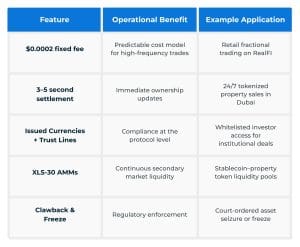
- Transaction Speed and Cost Efficiency: XRPL processes transactions within 3–5 seconds at costs as low as $0.0002 per transaction. This ensures scalability for high-volume property trades without the operational burden of high network fees.
- Native Asset Issuance and Compliance Features: XRPL supports token issuance through its Issued Currencies function, avoiding complex external smart contracts. Features such as Authorized Trust Lines, Clawback, and Freeze functions enable issuers to meet jurisdictional compliance requirements.
- Liquidity Support through AMMs: The introduction of the XLS-30 amendment brought native Automated Market Makers to XRPL, allowing tokenized properties to be integrated into liquidity pools alongside its built-in decentralized exchange (DEX).
These capabilities make XRPL an effective blockchain for both retail-focused platforms and institutional XRPL property investment initiatives.
Global Developments Strengthening XRPL’s Position
1. Dubai Land Department- Government-Backed Tokenization (May 2025)
Dubai launched the MENA region’s first licensed real estate tokenization platform on XRPL in collaboration with Prypco Mint. This initiative, backed by regulatory approval, uses RICH tokens to represent fractional property ownership and has recorded a 44% year-over-year increase in tokenized property sales. Ripple later partnered with Ctrl Alt to tokenize $325 million in Dubai real estate, with title deeds stored securely on XRPL.
2. RealFI- Retail Market Expansion (August 2025)
RealFI introduced an XRPL-based platform enabling retail users to tokenize and trade real estate assets directly. It supports fractional ownership starting at accessible entry points and integrates with XRPL’s DEX for immediate trading. Within hours of launch, over 2,900 users joined the platform, indicating strong retail interest.
3. Institutional Engagement- MUFG
Japan’s largest bank, MUFG, announced plans to tokenize a ¥100 billion Osaka skyscraper. While global institutions explore blockchain real estate solutions, XRPL’s compliance tools and transaction efficiency position it as a viable infrastructure layer for large-scale tokenized real estate projects.

Key Trends in XRPL Real Estate Development for 2025
- AI Integration for Asset Valuation: Platforms are using AI-driven models linked to blockchain oracles for real-time property appraisals and risk scoring.
- Cross-Chain Connectivity: Bridges between XRPL and Ethereum are enabling hybrid tokenized real estate platforms that leverage both ecosystems.
- Sustainable Asset Tokenization: Properties meeting environmental, social, and governance (ESG) criteria are being tokenized to align with sustainability goals, particularly in the UAE and Europe.
These trends expand the market potential for XRPL blockchain real estate solutions beyond traditional investment channels.
Technical Framework for Building a Tokenization Platform on XRPL
Developing a tokenization platform for XRPL involves a structured approach to ensure scalability, compliance, and security:
- Asset Issuance: Use XRPL’s Issued Currencies to mint tokens representing fractional property ownership. Configure Authorized Trust Lines to restrict access to verified investors and implement Clawback or Freeze functions if required by law.
- Compliance Automation: Leverage XRPL Hooks or integrated sidechain functionality to automate KYC/AML checks, dividend distributions, and jurisdiction-based restrictions in line with frameworks such as MiCA or the SEC.
- Liquidity and Trading Infrastructure: Integrate XRPL’s DEX and XLS-30 AMMs to support active trading and continuous liquidity for tokenized properties.
- Security Architecture: Utilize multi-signature permissions, hardware-secured key management, and XRPL’s proven ledger history for resilience against cyber threats.
- Scalability Considerations: With the ability to process up to 1,500 transactions per second, XRPL can handle growing user volumes without congestion, reducing settlement timeframes from weeks to seconds.
XRPL Tokenization Features Mapped to Real Estate Applications
Opportunities for Businesses and Investors
The demand for real estate tokenization platform development has increased significantly, signaling a growing market. Partnering with an experienced real estate tokenization platform development company offers advantages such as:
- Access to pre-built white-label frameworks for faster deployment.
- Modular API integrations for payment, compliance, and analytics.
- Global regulatory expertise to ensure adherence to multiple jurisdictional requirements.
- AI-enabled investor dashboards and reporting tools for better engagement.
With institutional adoption increasing and governments piloting XRPL-based solutions, the current market window offers first-mover advantages for platform operators.
Takeaway
In 2025, XRPL has moved from being an alternative blockchain option to a leading infrastructure for XRPL real estate development. With government-backed pilots, institutional-scale custody solutions, and retail adoption, the foundation is in place for sustainable growth in tokenized real estate platforms.
Its low fees, rapid settlement, native asset issuance, and built-in liquidity mechanisms make XRPL well-suited for both large-scale institutional projects and retail-focused applications. For businesses, investing in real estate tokenization platform development now can secure a competitive position in a market projected to reach trillions in value over the coming years.
To build a secure, compliant, and scalable XRPL-powered real estate tokenization platform, partner with Antier, a trusted real estate tokenization platform development company. With expertise in blockchain architecture, regulatory alignment, and liquidity integration, our experts can help to launch an institutional and retail-grade platform that transforms property assets into tradeable digital tokens, ensuring speed, cost efficiency, and long-term market competitiveness.