




AI Summary
- Cryptocurrency wallets are evolving from mere storage solutions to the operational core of on-chain finance, integrating DeFi derivatives for trading, risk management, and liquidity.
- In 2025, the crypto derivatives market hit $85.70 trillion in trading volume, emphasizing the rapid growth of this segment.
- A white-label crypto wallet with DeFi derivatives can cater to a wide range of users, from professional traders to enterprises, fintech platforms, and Web3 communities.
- These integrated wallets provide leverage, hedging, and advanced trading capabilities within a familiar user experience, enhancing retention and usability.
- The market trend towards wallets as on-chain gateways is driven by the convergence of derivatives, payments, compliance, and stablecoins in a unified financial stack.
There is a quiet but unmistakable shift underway in digital finance: cryptocurrency wallet solutions are no longer just a vault; they are becoming the operating layer of on-chain finance. As crypto markets mature, derivatives are moving from the edge of speculation into the center of liquidity, risk management, and price discovery, while wallets are evolving into the user’s primary command panel for trading, payments, and decentralized access. In 2025, the crypto derivatives market reached approximately $85.70 trillion in total trading volume, and Perp DEX monthly volume crossed $1.2 trillion for the first time, underscoring how rapidly this segment has accelerated. At the same time, regulators and policy bodies are paying closer attention to crypto’s integration with mainstream finance, which makes compliant, enterprise-grade Web3 wallet infrastructure even more strategic.
Why Do DeFi Derivatives Matter in a White Label Crypto Wallet?
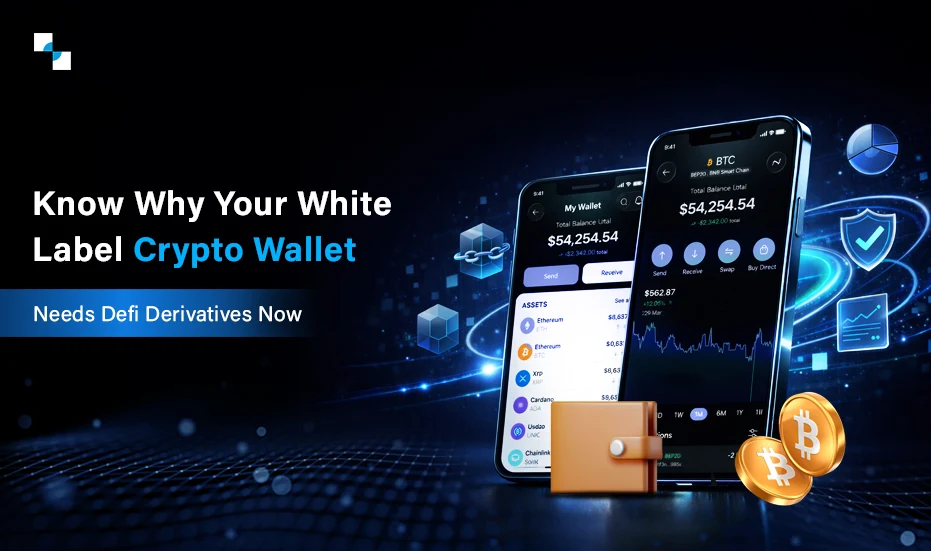
A white label crypto wallet app that stops at storage and swaps is already behind the curve. DeFi derivatives add the depth, utility, and stickiness that modern users expect. This integration allows a wallet to become a venue for leveraged exposure, hedging, market-neutral strategies, and advanced trading behavior without forcing users to leave the experience they already trust. That matters because derivatives are now described as a primary venue for price formation and risk management, not a fringe trading lane. The same market reality is visible in the rise of decentralized perpetuals, where 2025 activity became a multi-trillion-dollar on-chain derivatives story.
For businesses and visionary enterprises, this is not just a feature upgrade. It is a positioning upgrade. A cryptocurrency wallet development solution with DeFi derivatives can serve power traders, treasury teams, fintech platforms, and Web3-native communities with one integrated experience. It also creates stronger retention, because sophisticated financial activity is harder to move once it lives inside a familiar wallet environment. That is the logic behind the broader industry shift toward wallets as on-chain traffic gateways rather than simple key stores.
Who Needs Crypto Wallets With DeFi Derivatives Integrated?
White label crypto wallet with Defi derivative is no longer only for professional traders. It is for any business that wants to capture serious on-chain activity while keeping the experience smooth.
- Enterprise exchanges need it to compete with on-chain perp venues.
- Fintechs need it to expand beyond basic custody and payments.
- Web3 platforms need it to offer more than token holding.
- Market makers and treasury operators need it for hedging.
- High-volume retail users need it for leverage, advanced positioning, and capital efficiency.
- Even custodians and institutions need wallet infrastructure that can manage dapp access, smart contract access, and extended sessions more intelligently.
In short, if your audience includes users who trade, hedge, rotate capital, or pay from crypto balances, DeFi derivatives integration in blockchain wallets is no longer optional. They are a differentiator. That is especially true in a market where wallets are also being pushed toward payment, compliance, and multi-network experiences at the same time.
Market News: Why Is This Fusion Gaining Momentum?
The strongest market signal is simple: the ecosystem is converging. Derivatives, wallets, payments, stablecoins, and compliance are no longer separate silos. They are blending into one financial stack. In 2025, CoinGlass described crypto derivatives as increasingly shaped by institutional capital, compliant infrastructure, and decentralized technology. PwC also noted that global crypto regulation is evolving across jurisdictions, with businesses needing to adapt to changing compliance requirements as the ecosystem matures.
At the wallet layer, Wallet Connect now documents wallet integrations for payments with SDK, standalone, and API-first paths, while also covering compliance, settlement, and gas handling. That is a strong sign that mobile crypto wallets are expanding from “asset holders” to “financial experience hubs.” It also means wallets that can connect to derivatives workflows are aligning with where infrastructure is already heading.
There is also a visible market split between centralized and decentralized derivatives activity, with DeFi protocols and perp DEXs gaining meaningful scale. DeFiLlama tracks perpetual DEX rankings and volume across 50+ protocols, while CoinGlass reported explosive growth in on-chain derivatives activity in 2025. That combination suggests a durable category, not a passing cycle.
Upgrade Your Web3 Crypto Wallet. Unlock Derivatives!
How Does a White Label Crypto Wallet With DeFi Derivatives Look Like?
At the core, the crypto wallet solution should feel elegant to the user and powerful to the business. The best version of this product is not noisy or overbuilt. It is clean, modular, and institution-ready. Let us scroll through the blog to check the primary features that are non-negotiable
- Non-custodial or hybrid custody architecture
- Multi-chain asset support
- DeFi derivatives dashboard
- Perpetuals, options, or structured exposure modules
- Collateral management and margin visibility
- Real-time pricing and Oracle connectivity
- Position tracking and risk alerts
- Smart contract interaction layer
- KYC/AML and compliance controls, where needed
- Admin console for wallet operators
- SDK/API layer for fast enterprise deployment
- Payment and settlement rails for broader utility
A well-designed white label cryptocurrency wallet should also present derivatives in a way that does not intimidate less technical users. That means clean labels, guided flows, explainers for leverage and liquidation, and configurable risk controls. The goal is not to overload the interface. The goal is to make advanced finance feel navigable. This is consistent with the broader wallet evolution the market is already moving toward.
How Does a Cryptocurrency Wallet With DeFi Derivatives Function?
The functioning begins when the wallet becomes the user’s access layer to a derivatives protocol or protocol stack. The user connects the wallet, funds collateral, chooses a market, and the wallet helps route the transaction to the underlying smart contract. From there, the protocol calculates margin, opens the position, tracks unrealized P&L, and updates liquidation thresholds in real time. In a mature implementation, the wallet also shows exposure, fees, funding rates, and risk changes without requiring the user to manually decode contract data. That is the practical bridge between wallet UX and derivatives logic.
The user never experiences this as raw blockchain mechanics. They experience it as a guided financial action: deposit, trade, monitor, adjust, and close. Behind the scenes, the wallet is coordinating signing, contract access, network compatibility, compliance prompts, and settlement flows. This is exactly why blockchain wallets are increasingly being treated as infrastructure, not just interfaces.
Steps of Cryptocurrency Wallet Development With DeFi Derivatives
- Define the product scope- Decide whether the wallet will support perpetuals, options, hedging tools, or a full derivatives suite. This also determines whether the wallet will be retail-first, enterprise-first, or hybrid.
- Choose the custody and security model- Select non-custodial, custodial, or hybrid architecture. At this stage, security, key management, transaction approvals, and recovery logic must be designed carefully.
- Design the derivatives architecture- Map the wallet to the relevant protocol layer, oracle layer, liquidity layer, and margin engine. This is where the business model and trading experience are shaped.
- Build the UX for advanced trading- Create a clear interface for collateral, leverage, positions, liquidation risk, and performance tracking. Simplicity matters here more than flashy design.
- Add compliance and policy controls- If the product will serve regulated markets or institutional users, integrate the necessary compliance flows early. Global regulation is changing, and wallet infrastructure needs to be designed around that reality.
- Integrate multi-chain and dapp connectivity- Ensure the wallet can interact with multiple networks and contract environments. Wallet Connect’s current wallet and institutional documentation shows how important broad connectivity has become.
- Test risk, load, and execution behavior- Stress-test the product under volatility, liquidity fragmentation, and rapid transaction conditions. Derivatives platforms live or die on execution quality.
- Launch with admin tooling and observability- Give the business control dashboards, analytics, alerting, and customer support tooling so the product can scale cleanly after launch.
Final Take
A white label crypto wallet development solution that does not evolve toward DeFi derivatives risks becoming a static product in a dynamic market. Derivatives are now a core part of how crypto markets discover price, manage risk, and attract institutional attention. Wallets, meanwhile, are becoming the main doorway into that activity. The combination is not theoretical anymore; it is the direction the market is already taking.
That is where Antier becomes a serious partner. With legal expertise, certified specialists, and strong capabilities across AI and blockchain, this crypto wallet development company is built to help businesses move confidently in the Web3 market. They do not just help you participate in Web3; they help you scale seamlessly and faster with no risk, using white label modules tailored to each solution. We also customize the product around your business needs, so the wallet you launch is not generic but strategically aligned with your market.
Frequently Asked Questions
01. What is the role of cryptocurrency wallets in the evolving digital finance landscape?
Cryptocurrency wallets are transitioning from mere storage solutions to becoming the primary interface for trading, payments, and decentralized access, reflecting their importance in on-chain finance.
02. Why are DeFi derivatives important for white-label crypto wallets?
DeFi derivatives enhance the functionality of white-label crypto wallets by providing users with leveraged exposure, hedging options, and advanced trading capabilities, making the wallet experience more comprehensive and engaging.
03. Who can benefit from crypto wallets that integrate DeFi derivatives?
Any business looking to engage in significant on-chain activity can benefit from integrated DeFi derivatives in crypto wallets, not just professional traders, as it allows for a seamless user experience.