





AI Summary
- The blog post discusses the significant shift of traditional financial institutions towards embracing blockchain and cryptocurrency.
- Key players like NASDAQ, NYSE, and BNY are making strategic moves towards integrating crypto infrastructure, driven by factors such as institutional demand for new asset classes and the need for efficient collateral management.
- The post highlights how the traditional finance sector is pivoting towards blockchain due to its benefits of 24/7 markets, efficiency, and global reach.
- It also emphasizes the importance of building institutional-grade compliance and multi-asset collateral management for crypto exchange development.
- The narrative paints a picture of a future where all asset classes trade on blockchain rails, signaling a transformative era in the financial industry.
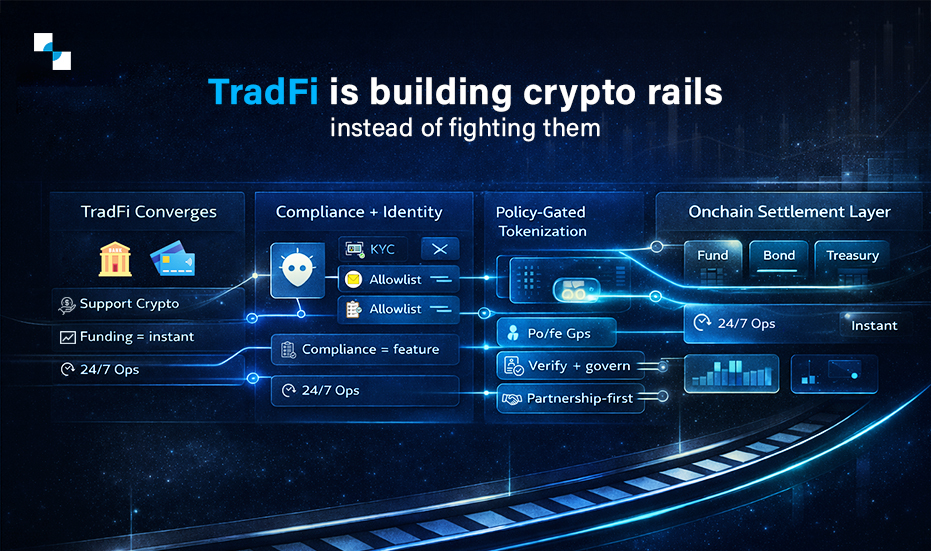
For years, traditional finance has treated blockchain as a curiosity, a fad, or a threat, but the era is now over. The world’s most powerful financial institutions are no longer fighting crypto rails; they are building on top of them.
The reason? Bleeding collateral and the need for never sleeping markets. Crypto has the rails they need.
In the past few weeks of March 2026, Wall Street has moved faster on crypto infrastructure than it did over the entire previous decade.
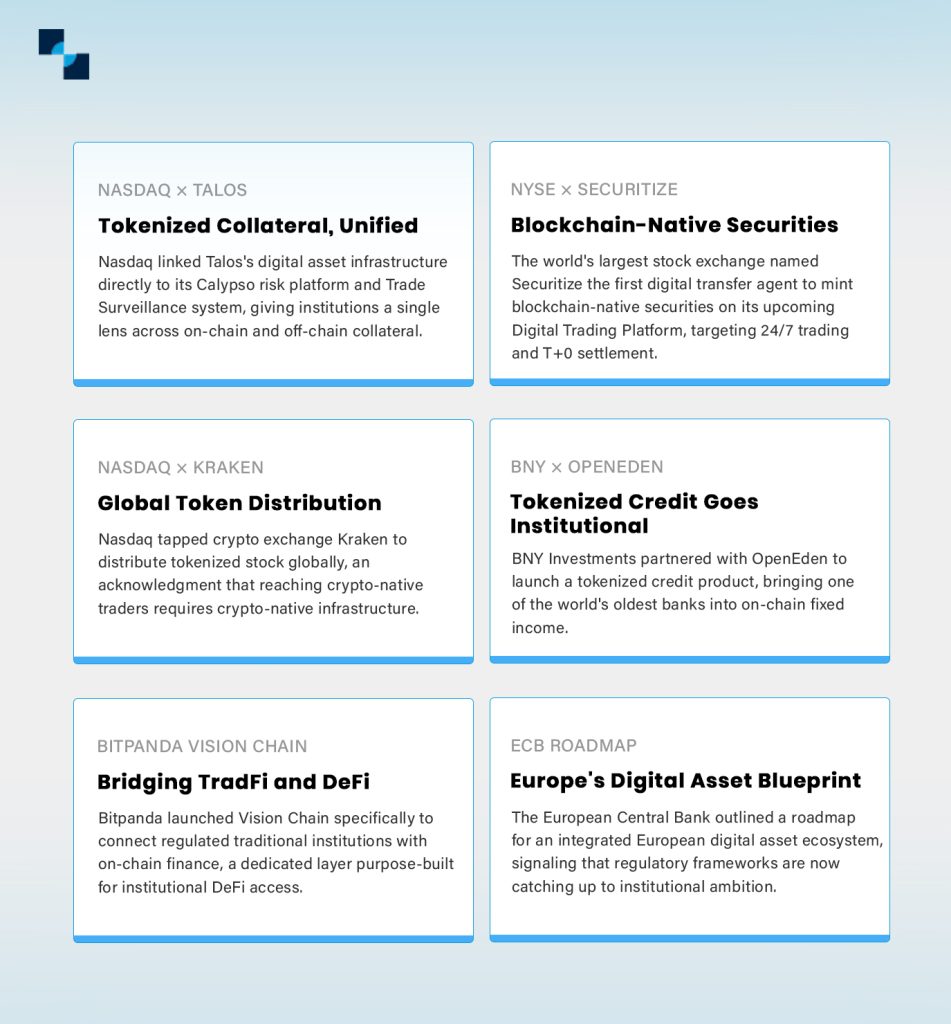
- NASDAQ obtained SEC approval to enable trading for tokenized securities.
- The NYSE partnered with BlackRock-based Securitize to build its blockchain-native digital trading platform.
- Nasdaq also partnered with digital asset firm Talos to unify tokenized collateral management across traditional and on-chain markets.
- BNY Investments collaborated with OpenEden to launch a blockchain-based credit and investment product for its institutional clients.
“For a very long time, it was just crypto people pushing the narrative that traditional finance and crypto would merge. Now we see the major exchanges moving. That’s a realization that eventually all assets will settle on blockchain rails.”
— Antoine Scalia, CEO, Cryptio
A Series of Institutional Moves
NASDAQ, NYSE, and BNY weren’t the only players that pivoted towards crypto and blockchain. As the SEC clarified in Jan 2026 that tokenized equities carry the same legal weight as traditional securities, Wall Street acquired the regulatory cover it needed to jump into the market. Meanwhile, the DTCC’s clearing subsidiary received three-year relief to tokenize DTC-custodied assets, including Russell 1000 stocks, major ETFs, and US treasuries on approved chains.
The pace and breadth of announcements in Q1 2026 signal something systemic. It wasn’t a handful of pilot programs, but a coordinated industry-wide pivot including major moves from renowned crypto exchange software, brokerages, banks, and more. Here’s what else has happened in March 2026, and why each move matters:
It’s not just the US and Europe; the pattern repeats globally. Nedbank and Crypto.com also recently partnered to build African payment rails. Apart from that, Oobit launched real-time wallet-to-bank transfers, bridging stablecoins and local banking. Every geography and financial institution category is treading on the same trajectory.
What is Driving TradFi’s Shift Towards Crypto and Blockchain?
A skeptic’s opinion may be that institutions are taking advantage of clearer and more favorable rules. But this is partly true. One cannot overlook the structural forces triggering this transformation.
1. Institutional demand for new asset classes
“As per the leading crypto exchange software’s crypto market sizing report, the crypto owners across the world rose by 12.4% from 659 million in 2024 to 741 million in 2025.”
Not just cryptocurrency, but the demand for blockchain versions of RWAs has also been increasing. This puts pressure on the tradFi institutions to include tokenized assets and crypto on their future roadmap.
2. Collateral Inefficiency is Costing a Fortune
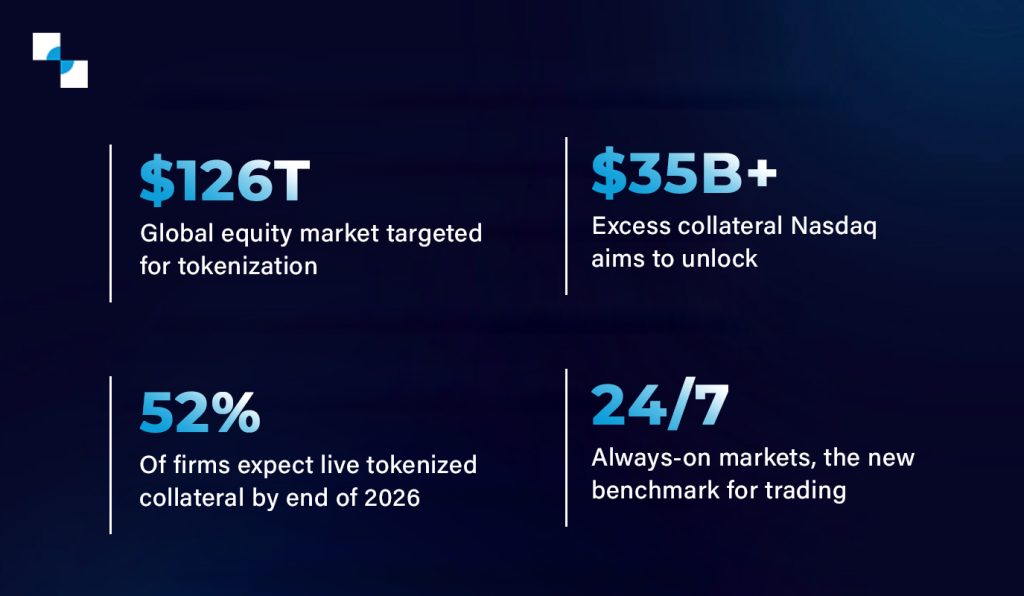
Nasdaq’s own research found that 25% of all collateral (around $35 billion) was currently tied up in non-interest-bearing buffers, corrections, and idle positions. Tokenization onboards the assets on the chain and makes collateral programmable. It can move instantly and rebalance across positions without friction. For the institutions managing trillions, that becomes a competitive necessity.
3. 24/7 Markets are the New Baseline:
Crypto never closes, but traditional equity markets do. When Israel struck Iran, the NYSE and Nasdaq were closed, so Bloomberg turned to real-time on-chain prices of oil and gas perpetuals on Hyperliquid, a leading decentralized crypto exchange software. It intensified the need for “always-on markets”. Many TradFi towards crypto/blockchain moves were triggered or accelerated by the same event.
4. Efficiency of blockchain infrastructure:
The events stated above also prove that blockchain rails are the only credible path to round-the-clock settlement. Also, it doesn’t require rebuilding decades of existing infrastructure from scratch. Tokenization expands the exposure and access of traditional assets, enabling faster settlement and better liquidity.
Bloomberg just used on-chain oil prices as the reference for their iran risk coverage.
Not CME. Not NYMEX. But Hyperliquid.
Price discovery doesn’t wait for Monday open anymore. https://t.co/r7x2ZLncQC
— Magnus.hype (@0xmagnus) March 2, 2026
5. Competitive pressure across global markets
Traditional exchanges want exposure to the hundreds of millions of crypto users globally. Crypto-native platforms want the credibility, regulatory legitimacy and larger chunk of audience that comes with NYSE or Nasdaq branding or integrations. The partnerships emerging are not charity but mutually beneficial distribution deals.
“Traditional exchanges want exposure to the crypto trading population. At the same time, crypto-native firms benefit from the reach of these traditional players to bring more people into crypto markets.”
— Antoine Scalia, CEO, Cryptio
What This Means for Crypto Exchange Development
If you are building crypto exchange infrastructure today, the TradFi and RWA pivot is not a mere trend but a necessity. It is shaping the product requirements, compliance expectations, and competitive landscape you will face in the next 18 months.
- Institutional-grade compliance is now table stakes: NYSE and Nasdaq are embedding trade surveillance, cross-market abuse detection, and regulatory reporting into their blockchain infrastructure from day one. Exchanges that cannot meet these standards will be locked out of institutional liquidity.
- Multi-asset, unified collateral management is the next frontier: The Nasdaq–Talos model, which introduces one risk lens across on-chain and off-chain assets, sets the architectural expectation for institutional platforms. If you’re planning your cryptocurrency exchange development, build for cross-asset from the start. Bolt-ons won’t work.
- Tokenized RWAs are inbound liquidity: As NYSE and Nasdaq bring tokenized equities, ETFs, and Treasuries onto blockchain rails, exchanges that can list and settle these instruments alongside native crypto assets will capture the institutional flow.
- Stablecoin-native settlement is the bridge: NYSE’s Digital Trading Platform explicitly targets “stablecoin-funded markets.” Exchanges that integrate stablecoin settlement rails and not just crypto-to-crypto will be positioned as the connection point between TradFi and on-chain finance.
- Global reach through local rails matters: Nedbank in Africa, Oobit’s wallet-to-bank bridges, ECB’s European roadmap prove that the tokenization wave is not exclusively a US story. Exchanges with multi-jurisdiction compliance and local rail integrations will win the distribution game.
The “Everything Exchange” Is Coming
Bitget, a leading crypto trading platform, already promotes itself as Universal Exchange. Antoine Scalia of Cryptio also introduces “everything exchange,” which is a marketplace where all asset classes trade on the same infrastructure. Everyone is moving towards an infrastructure where stocks, bonds, commodities, crypto, and real estate are all represented as tokens, settling on the same rails and are accessible around the clock.
That vision is no longer aspirational. It is the stated objective of Nasdaq, NYSE, BNY, the ECB, and dozens of other institutions simultaneously. The question is no longer whether the Everything Exchange gets built. The question is who builds it and defines it.
Traditional exchanges are bringing legitimacy, liquidity, and regulatory cover. Crypto exchange software development aspirants are bringing the infrastructure, the users, and the technical architecture. The exchanges that will dominate the next decade are the ones being built right now at the intersection of both TradFi and digital finance.
For crypto exchange developers, this is the most consequential moment since the launch of spot Bitcoin ETFs. The rails are being built. The institutions are at the table. The regulatory framework is, for the first time, clear enough to build on.
Frequently Asked Questions
01. What recent developments indicate a shift in traditional finance towards blockchain and crypto?
Major financial institutions like NASDAQ and NYSE have made significant moves, such as NASDAQ obtaining SEC approval for trading tokenized securities and NYSE partnering with BlackRock to build a blockchain-native trading platform.
02. How has regulatory clarity influenced Wall Street's adoption of crypto?
The SEC's clarification in January 2026 that tokenized equities have the same legal weight as traditional securities provided Wall Street with the regulatory cover needed to enter the crypto market more aggressively.
03. Are these changes in traditional finance towards crypto happening globally?
Yes, the trend is global, with institutions like Nedbank and Crypto.com partnering to build payment rails in Africa, indicating that financial institutions worldwide are embracing blockchain technology.