




✨ AI Summary
- The blog post delves into the rising popularity of tokenizing real-world assets on the Stellar blockchain.
- It highlights key features of Stellar that make it ideal for asset tokenization, such as low transaction costs, built-in asset controls, decentralized exchange integration, regulatory friendliness, and scalability.
- The post emphasizes the importance of factors like security, legal compliance, user experience, and ecosystem partnerships when building a successful asset tokenization platform on Stellar.
- Real-world examples, strategic considerations, and best practices for platform development are also discussed.
- Ultimately, the post suggests that Stellar provides a strong foundation for asset tokenization platforms, but success requires a holistic approach encompassing technology, regulatory compliance, infrastructure, and user experience.
The hype around tokenizing real-world assets has been constant, but most discussions recycle the same promises: “liquidity, fractionalization, transparency.” Meanwhile, what platform builders actually need is clarity on which blockchain can handle real-world constraints, such as investor onboarding, regulatory restrictions, liquidity fragmentation, and custody risks.
Stellar, long overshadowed by Ethereum in headlines, is gaining traction precisely because its design aligns with what an actual asset platform operator faces in the field.
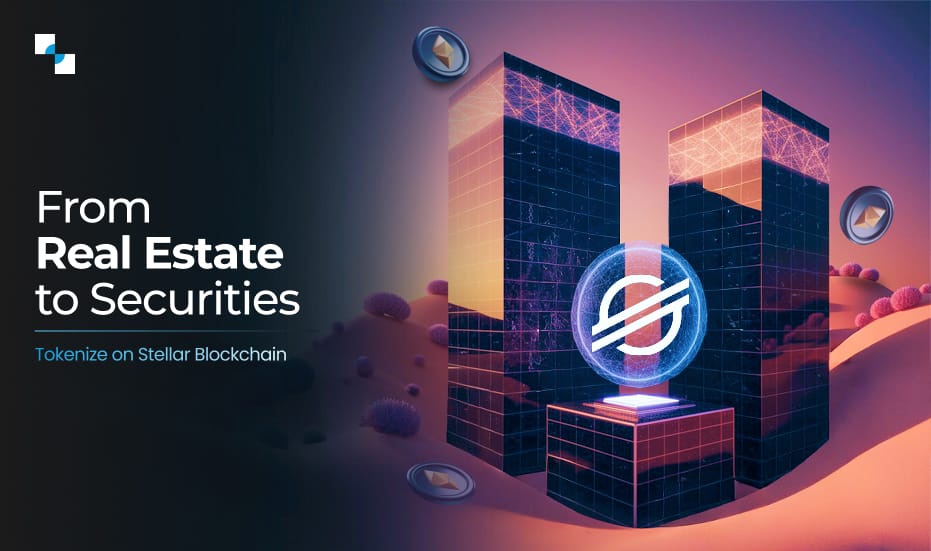
Let’s strip out the marketing clichés and analyze why Stellar blockchain tokenization is becoming the choice for platforms.
Stellar Blockchain: A Technical Overview
Stellar was launched in 2014 by Jed McCaleb and others. Its original mandate is to enable fast, low-cost cross-border payments and asset transfers. Over time, Stellar evolved to include support for issuing custom assets, anchors, a built-in decentralized exchange, etc.
It uses the Stellar Consensus Protocol, which is a federated consensus model rather than proof-of-work or typical proof-of-stake. SCP enables fast finality, low energy consumption, and predictable performance.
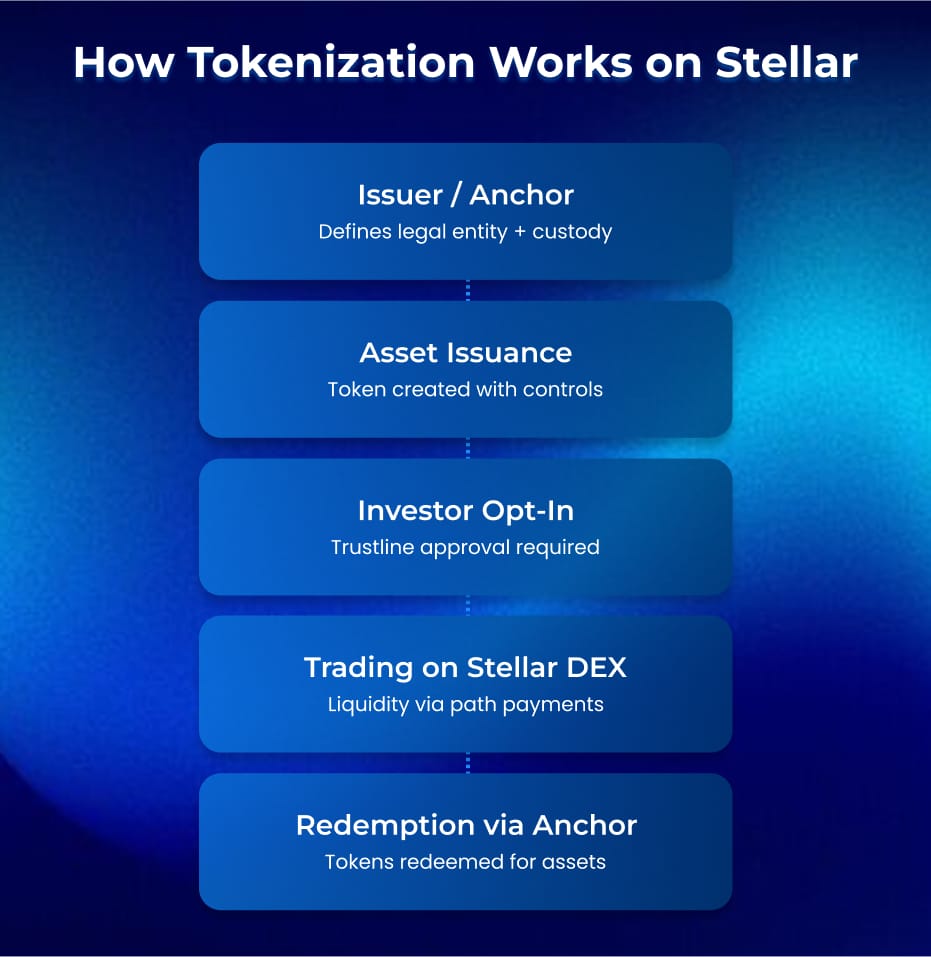
Why Is Stellar Blockchain Ideal for Real-World Asset Tokenization?
Stellar’s architecture is tailored for tokenization, starting with its Stellar Consensus Protocol, a federated model that delivers fast finality, low energy use, and predictable performance. On top of this, Stellar supports native asset issuance, allowing anchors to tokenize fiat, securities, commodities, or stablecoins with built-in controls such as freezing, revocation, and allowlisting. More complex use cases are enabled by Soroban smart contracts, which add programmable logic for compliance and governance.
Assets can also be traded through Stellar’s integrated DEX, while anchors, ramps, and trustlines ensure custody, KYC/AML compliance, and investor consent are embedded into the process.
Benefits Of Building an Asset Tokenization Platform on Stellar Blockchain
For a company seeking to build an asset tokenization platform, especially, Stellar offers numerous advantages.
- Low Transaction Cost + High Speed: Stellar is optimized for fast settlements with very low fees. For platforms issuing tokens often, fractionalizing assets, or supporting many small investors, minimizing gas/transaction costs is essential.
- Built-in Asset Controls: Platform owners can issue assets with features like freezing, clawback, allowlist/blocklist, revocation, etc. For regulated securities or real-world assets, Stellar’s built-in digital assets support such control unlocks the ability to prevent transfers, suspend tokens, and enforce investor eligibility.
- Decentralized Exchange Integration: Token liquidity is very important for real-world assets platforms. Stellar’s DEX enables on-chain trading paths among assets, reducing dependence on external exchanges. Also, path payments help in converting among different assets/facilitating trade flows.
- Regulatory Friendliness / Anchors: Stellar anchors allow off-chain asset custodians (banks, regulated firms) to issue the on-chain equivalent. That provides a bridge between traditional finance and blockchain, which helps compliance, custody, and trust. Also, Stellar has published policies for asset tokenization.
- Global, Compliant Access & Market Momentum: Stellar is being used in real projects. For example, Mercado Bitcoin announced issuance of US$200 million in tokenized financial instruments on Stellar. Such real use gives credibility, helps ecosystem maturity, and investor confidence.
- Interoperability & Transparency: The open design, with trustiness, anchors, etc., gives transparency over asset holdings and flows. Stellar also supports stablecoins and connectivity with other networks through cross-chain protocols. This helps with investor trust, audits, etc.
- Scalability for Institutional Use: Given its consensus model, Stellar can scale to large volumes without the bottlenecks of gas surges seen in some smart-contract heavy blockchains. For tokenization platforms handling many token issuances, frequent trades, and investor interactions, scalability matters.
Develop your Stellar-based Tokenization Platform!
Key Features of Stellar for Tokenized Assets, And What Platform Owners Must Get Right
Here are the key features that come with the Stellar blockchain for Real-World Asset Tokenization Platform Development:
- Native Asset Issuance
Stellar allows issuers to create tokens that represent anything from equities to property shares or commodities. It gives the ability to build in controls like freezing, claw back, and allowlists tools that regulators expect for real-world assets.
For a platform owner, the responsibility goes far beyond pressing “issue.” The legal entity behind the token must be defined, custody roles made explicit, and investor rights aligned across both contracts and code.
- Trustlines
Trustlines require investors to actively opt in before holding a token. This prevents accidental or fraudulent ownership, but it also adds friction.
The platform owner needs to simplify the process, automate where possible, and provide clear investor education. A clunky trustline process will discourage participation, no matter how good the underlying asset is.
- Soroban Smart Contracts
Many assets demand rules beyond basic issuance. Soroban brings that flexibility to Stellar. But programmability introduces risk.
Platform owners should treat this with the seriousness of financial software: audits are non-negotiable, testing must be rigorous, and only mature development practices will suffice. Tokenized assets tied to real-world value cannot afford contract exploits.
- Anchors and Ramps
Anchors act as custodians who hold the real-world asset and issue its on-chain equivalent, while ramps provide the fiat on- and off-boarding investors expect.
For a platform owner, the credibility of these partners will define the credibility of the tokens themselves. Choose anchors with regulatory track records and audited processes and make redemption terms transparent.
- Built-in DEX and Path Payments
Stellar’s native exchange and liquidity routing solve fragmented market issues. Path payments allow trades to route automatically through other assets if direct liquidity is missing.
Platform owners should provide user-friendly trading interfaces, support market makers, and monitor order book depth to maintain trust.
- Security and Audits
Investors will not tolerate weak custody, unreliable oracles, or vulnerable contracts. Stellar provides the framework, but it is the operator’s duty to secure it. External audits, strong operational security, patch management, and reputable Oracle partners are minimum standards.
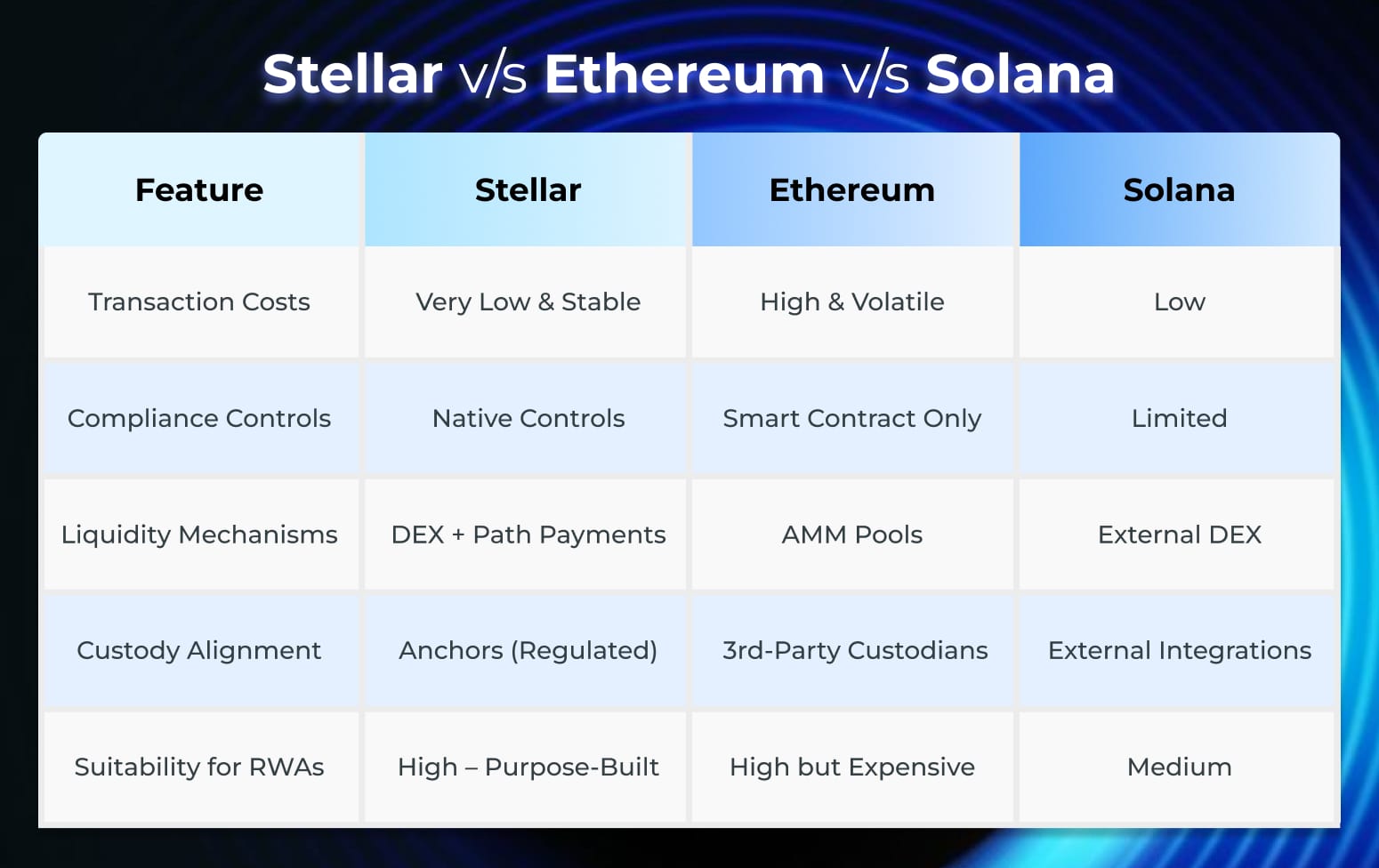
To decide whether to build on Stellar, platform builders need to contrast it with other blockchains in this domain.
- Ethereum: Very mature smart-contract ecosystem, plethora of tools and standards (ERC-20, ERC-721, ERC-1400, etc.). But gas fees can be volatile and high. For smaller fractional investors, high cost and congestion are drawbacks.
- Solana: Offers higher transaction throughput and sometimes lower fees, but tools, regulatory track record, and compliance features vary. Smart contract ecosystems are more mature than Stellar for some complex DeFi functionality, but also riskier or less standardized in regulatory terms.
- Stellar: Less gas fee volatility, simpler asset issuance; built-in compliance controls; easier path to integrating with traditional finance via anchors. But smart contract flexibility (via Soroban) is catching up, and certain complex use cases may still find limitations.
For detailed analysis, read this blog.
Use Cases and Real-World Examples
- Mercado Bitcoin: As mentioned, issuing US$200 million in tokenized financial instruments (equity & fixed income) on Stellar. Shows Stellar being used for regulated financial products in regions beyond the US/EU.
- Stellar’s own Use Cases: Stellar.org describes several use cases, including asset issuances of fiat, securities, etc., and anchor-based systems.
Tips To Build a Successful RWA Tokenization Platform on Stellar Blockchain
For companies building asset tokenization platforms, here are strategic considerations & best practices if choosing Stellar.
- Architecture Design: Split off-chain and on-chain components: custody & legal contracts off-chain; token issuance & ledger on-chain. Build modular services: issuance, KYC/AML, wallet/identity, token trading/liquidity, investor interface. Plan for smart contract support (Soroban) for future features, even if starting simple.
- Legal & Regulatory Integration: Work with legal teams in target jurisdictions early. Decide which regulations apply (securities, property, investment contracts, etc.). Incorporate the legal rights of token holders into documentation, token code (when possible), and issuer responsibilities.
- Security Audits & Risk Management: Use third-party audits for any contract code. Ensure proper custody (if physical assets), data protection, and privacy across jurisdictions. If using oracles: multiple sources, redundancy, verification. Plan for revocation/freeze in emergencies.
- Liquidity Strategy: Plan for how token holders can trade their tokens. Will the platform support secondary market trading? Use Stellar’s built-in DEX? Partner exchanges? Provide market makers or incentive schemes. Also, investor education to attract users who trade.
- User Experience & Trust Building: Provide intuitive interfaces for trustlines, asset browsing, transparency of terms, legal documentation, and reporting. Transparency about fees, custody, redemption, etc.
- Scalability & Cost Management: Even though Stellar is low-cost, as the user base grows, infrastructure, monitoring, storage, audit, and compliance overhead will grow. Build with scalability, monitoring, and observability in mind.
- Ecosystem Partnerships: Stellar’s network is richer if the ecosystem is strong. Platform builders should tap into existing anchors & protocols in Stellar to reduce duplication.
Build your Stellar-powered Tokenization Platform Today!
Takeaway
For companies aiming to build platforms where their customers or investors can tokenize real-world assets, Stellar offers a compelling base: performant, cost-efficient, and regulation-friendly features, and a growing ecosystem. But success doesn’t rest on technology alone. Regulatory clarity, market infrastructure (liquidity, exchanges), legal frameworks, secure off-chain infrastructure, and excellent user experience are equally essential. Stellar is already a go-to for many; with the right strategy, it can become your go-to.
Partner with Antier and work with a team that has delivered end-to-end RWA tokenization platforms on Stellar. Our RWA Tokenization Platform Development Company will help you integrate everything from compliant asset issuance to liquidity solutions. With proven expertise in blockchain, custody, and investor onboarding, our team can help you launch infrastructure that regulators trust and investors use.
Frequently Asked Questions
01. What are the main advantages of using Stellar blockchain for real-world asset tokenization?
Stellar offers low transaction costs, high speed for fast settlements, built-in asset controls like freezing and allowlisting, and supports complex use cases through Soroban smart contracts, making it ideal for asset tokenization platforms.
02. How does Stellar's Consensus Protocol differ from other blockchain consensus models?
Stellar uses a federated consensus model known as the Stellar Consensus Protocol (SCP), which provides fast finality, low energy consumption, and predictable performance, unlike proof-of-work or typical proof-of-stake models.
03. What features does Stellar provide to ensure compliance and investor protection in asset tokenization?
Stellar includes built-in controls for asset issuance, such as freezing and revocation, and integrates custody, KYC/AML compliance, and investor consent through anchors, ramps, and trustlines, ensuring a secure tokenization process.