




AI Summary
- Discover why CIOs and investors are turning to Hyperledger for enterprise blockchain solutions.
- Public chains like Ethereum pose challenges such as fee volatility and data exposure, making Hyperledger Fabric a preferred choice for predictable costs, stringent data governance, and confident ROI.
- Hyperledger's channel-based privacy ensures data is shared only with authorized parties, crucial for sectors like healthcare and finance.
- The framework's design also enables faster project deployment and compliance approvals, reducing time-to-market and enhancing returns.
- Regulators and policymakers favor Hyperledger for its verified identities, permissioned access, auditability, and on-chain governance.
CIOs and investors recognize the transformative potential of blockchain in driving trust, automation, and security across industries. Yet, when evaluating blockchain strategies, enterprises often encounter a core dilemma, i.e., whether to build on public chains like Ethereum, Solana, or Polygon, or to adopt a permissioned framework like Hyperledger Fabric.
Public blockchains often raise red flags such as uncontrolled access, uncertain compliance, volatile fees, and unpredictable governance. For enterprises handling financial transactions, health data, or supply chain records, these gaps are deal-breakers. This is where blockchain development with Hyperledger provides clarity and control.
Why do Executives and Investors back Hyperledger for Enterprise ROI?
Enterprise leaders and investors prioritize measurable outcomes and risk control. Their decision to support Hyperledger blockchain development is driven by three clear advantages.
Predictable Costs
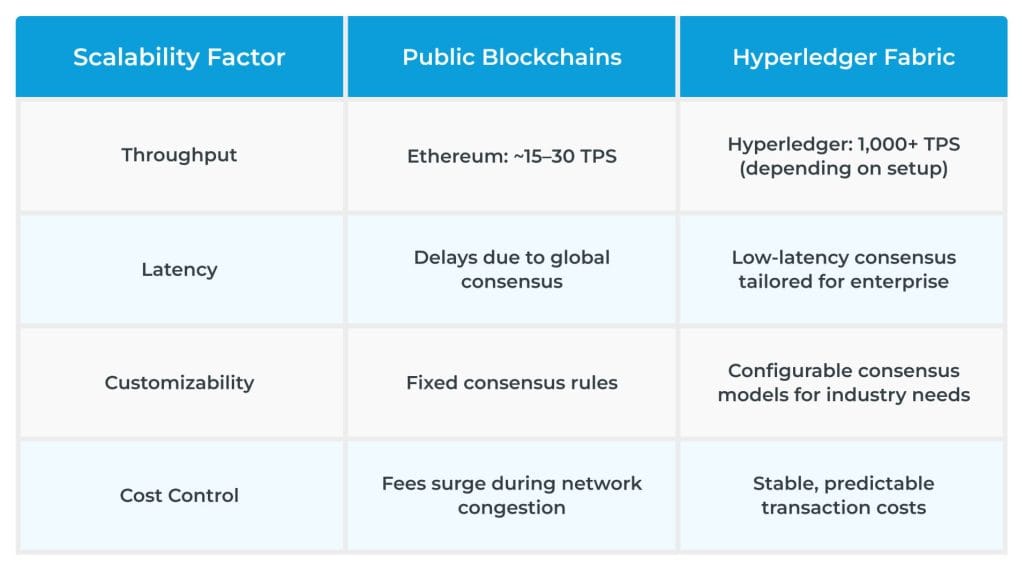
- Public blockchains like Ethereum or Polygon often suffer from fee volatility. During periods of congestion, transaction costs can rise by 200%–300%, making financial forecasting unreliable.
- For enterprises running thousands of daily transactions, such volatility can quickly erode margins.
- With the Hyperledger Fabric blockchain framework, enterprises operate within permissioned networks where transaction costs remain stable. This predictability enables CFOs and investors to create accurate financial models and allocate capital with confidence.
Data Governance
- Investors increasingly demand systems that meet compliance-grade security requirements.
- Hyperledger Fabric addresses this through channel-based privacy. Data is shared only with the parties that need access.
- This design prevents sensitive information from being exposed to the entire network, a key concern in industries like healthcare, banking, and defense.
- For investors, this governance model demonstrates maturity and reduces the risk of data-related penalties or reputational damage.
ROI Confidence
- According to Deloitte’s global blockchain survey, 81% of executives view blockchain as a strategic priority for the future.
- Projects deployed on a Hyperledger blockchain platform move faster from proof-of-concept to production because governance and accountability are built into the architecture.
- This means shorter time-to-market, faster compliance approvals, and accelerated returns.
Ready to deploy enterprise-grade blockchain with Hyperledger?
How does Hyperledger meet Enterprise Compliance and Scalability Needs?
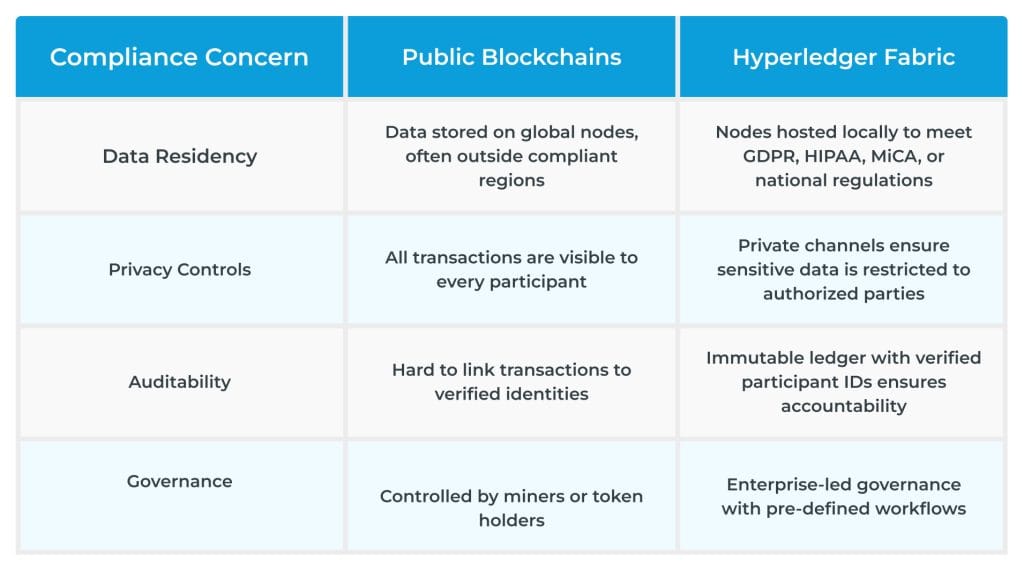
Enterprises operate under strict regulatory frameworks while managing large transaction volumes. Public blockchains often complicate both, creating risks around data residency, privacy, and throughput. The Hyperledger Fabric blockchain framework is designed to bridge this gap.
Compliance: Built for Regulatory Assurance
Hyperledger provides enterprises with control over who sees what and where data is stored. This makes it easier to satisfy sector-specific frameworks.
Scalability: Designed for High-Volume Use Cases
Hyperledger also addresses enterprise growth needs by enabling performance at scale.
Reasons why Regulators and Policymakers prefer Hyperledger Models
- Verified Identities: Every participant must be authenticated. Unlike public chains, where anonymous actors can validate transactions, Hyperledger ensures traceability.
- Permissioned Access: Only authorized organizations can join the network. This enables compliance with laws requiring controlled data sharing, such as GDPR in Europe or HIPAA in the U.S.
- Auditability: Hyperledger provides an immutable ledger where every action can be traced back to a verified identity. This supports mandates like the GENIUS Act in the U.S. that emphasize tamper-evident systems.
- On-Chain Governance: Regulators value the ability to pre-define rules and workflows. Hyperledger supports governance through smart contracts, ensuring policies are enforced automatically.
Case Examples: Hyperledger in Action
Real-world adoption showcases why enterprises consistently prefer Hyperledger over public blockchains. Several well-known organizations have already deployed Hyperledger Fabric to solve industry challenges at scale.
Maersk & IBM: TradeLens for Global Shipping
- Challenge: Global shipping involved fragmented records, paperwork delays, and disputes across ports.
- Solution: Maersk and IBM built TradeLens on Hyperledger Fabric. The platform connected more than 150 participants, including port authorities, customs offices, and logistics firms.
- Impact: Reduced shipping document processing time by up to 40%, and accelerated dispute resolution by 65%. Every container movement became traceable and tamper-proof.
Walmart: Food Safety Tracking
- Challenge: Food recalls were slow and expensive, often taking weeks to trace contaminated products back to their source.
- Solution: Walmart worked with IBM to build a Hyperledger blockchain platform for supply chain tracking.
- Impact: Reduced product traceability time from 7 days to 2.2 seconds. This allowed Walmart to pull unsafe products off shelves quickly, protecting consumers and reducing liability.
Change Healthcare: Healthcare Claims
- Challenge: U.S. healthcare claims suffered from long settlement cycles and fraud risks.
- Solution: Change Healthcare adopted Hyperledger Fabric to manage claims processing and detect anomalies.
- Impact: Improved claim settlement speed and reduced administrative overhead, saving millions in processing costs annually.
Work with Antier to build trusted blockchain ecosystems using Hyperledger Fabric
Conclusion
Enterprises evaluating blockchain today are no longer experimenting. They are searching for production-ready systems that deliver compliance, scalability, and measurable ROI. Blockchain adoption is no longer about “if” but “how.” And for enterprises, the answer is clear. Hyperledger provides the trust, control, and performance they need.
Global leaders like Maersk, Walmart, and Change Healthcare have already demonstrated Hyperledger’s impact. With Antier as a partner, organizations can move confidently from concept to production and lead the future of enterprise blockchain. By delivering Hyperledger blockchain development services, Antier bridges technical expertise with strategic advisory.