




AI Summary
- The blog post delves into the evolution of tokenization solutions, emphasizing the shift towards cross-chain tokenization platforms that connect isolated token markets into a unified monetary mesh.
- It addresses the limitations of single-chain tokenization platforms and highlights the benefits of cross-chain architecture, such as unified asset representation, verified state synchronization, compliance continuity, and cross-chain settlement and yield execution.
- The post also discusses the infrastructure enablers like bridges, native cross-chain protocols, mesh and relay networks, and outlines the revenue opportunities and risk control considerations associated with cross-chain tokenization.
- It provides an implementation framework for businesses looking to launch interoperable asset tokenization platforms and emphasizes the importance of interoperability in defining market leadership in institutional digital finance.
- The message is clear: the future lies in a cross-chain monetary mesh for seamless asset tokenization.
Tokenization Solutions are digitizing the real-world assets, but cross-chain is mobilizing them!
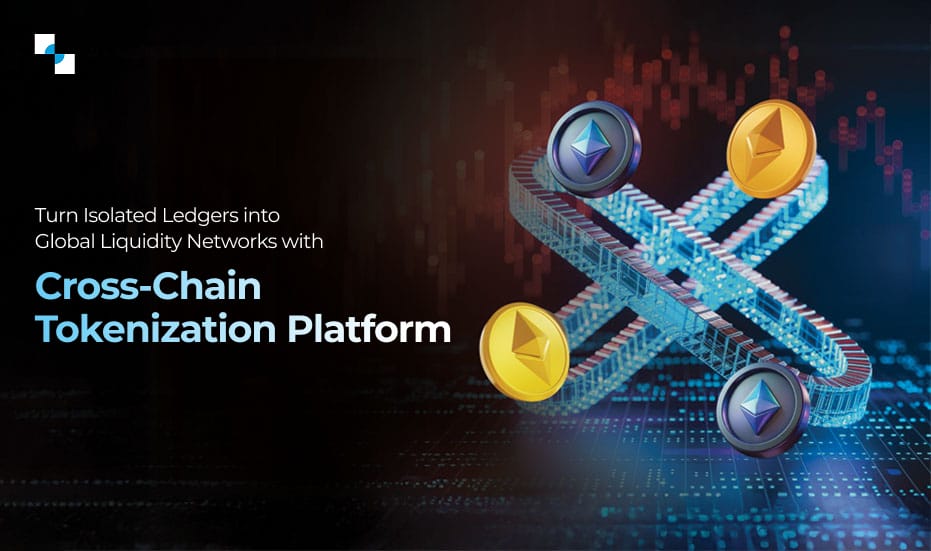
Tokenization gave the world a way to represent real-world assets on blockchain rails. But those assets, once tokenized, still live inside isolated chains, each with its own liquidity, settlement logic, and compliance rules. For institutional finance, that’s a closed economy. Cross-chain tokenization platforms are changing that. It connects isolated token markets into a monetary mesh, where assets, collateral, yield, and liquidity flow across multiple blockchains, which are verifiable, auditable, and programmable.
This article breaks down how interoperability will define the next generation of asset tokenization platforms. It covers the protocols, architecture, governance, and business rationale that make it work, and what enterprises need to get right before the industry standardizes around the new model.
Core Problem: Why the Single-Chain Tokenization Platforms Are Obsolete in 2025
The first generation of tokenization platforms followed a predictable template:
- Tokenize an asset (e.g., real estate, treasury, private equity)
- Record ownership on one blockchain
- Settle in a native stablecoin or fiat-pegged token
- Maintain liquidity within that chain’s ecosystem
This model worked well for pilots and proofs of concept; however, it was not scaled for institutional money, multi-jurisdictional participation, and cross-asset settlement. The root cause is obsolete infrastructure.
Each blockchain is a closed ledger with its own liquidity pool and consensus logic. Assets locked on Ethereum can’t seamlessly transact on Polygon or Avalanche without workarounds. Compliance, KYC, and pricing data have to be duplicated chain by chain.
For asset tokenization platforms aiming to support multiple investor classes or operate in multiple jurisdictions, this is a structural dead end. Liquidity becomes fragmented, capital efficiency collapses, and cross-asset settlement becomes manual again.
Cross-chain tokenization platform solves this by creating a unified solution where multiple chains are connected by verifiable messaging and shared liquidity infrastructure.

Cross-Chain Tokenization as an Architectural Solution to Asset Isolation
Cross-chain tokenization establishes a synchronized infrastructure for asset issuance, settlement, and governance across heterogeneous blockchain networks. It addresses the structural inefficiencies of isolated tokenization frameworks by introducing verifiable state continuity, liquidity mobility, and compliance portability within a unified operational layer. Here is what it delivers:
- Unified Asset Representation: Each tokenized asset maintains a single canonical record across multiple networks. Interoperable token standards (ERC-7201, IBC-based packets, CCIP metadata) define the same asset parameters across participating blockchains. This framework removes duplication, enables deterministic reconciliation, and ensures that asset identity and valuation remain consistent across ecosystems.
- Verified State Synchronization: Cross-chain tokenization relies on proof-driven message validation rather than custodial bridging. State transitions are verified through cryptographic proofs, light-client validation, or relay-based consensus that confirm events directly from the source network. This mechanism eliminates wrapped asset dependencies, ensures deterministic settlement finality, and preserves data integrity without centralized intermediaries.
- Compliance Continuity: Regulatory credentials, KYC attributes, and whitelisting logic are embedded as verifiable attestations within asset metadata. These attestations remain enforceable across all connected networks without exposing sensitive identity data. Regulatory alignment persists at every transaction layer, maintaining institutional-grade compliance irrespective of jurisdictional fragmentation.
- Cross-Chain Settlement and Yield Execution: Settlement and yield operations are executed through coordinated smart contract interactions across networks. Stablecoin-denominated transactions enable value transfer and income distribution under a consistent monetary reference. This model allows assets to be issued on one chain, collateralized on another, and yield-distributed on a third, all under cryptographically verified state synchronization.
- Continuous Auditability: Each cross-chain event produces a verifiable cryptographic proof anchored across connected ledgers. These proofs form an immutable audit trail accessible to regulators, custodians, and platform operators. Audit processes transition from periodic assessment to continuous verification, aligning transparency with institutional control standards.
The Infrastructure Enablers: Protocols Powering Interoperable Tokenization
Cross-chain tokenization depends on how messages, assets, and proofs move between chains. Here’s what’s actually working, and what’s coming next.
1. Bridges and Wrapped Assets- The First Wave
Bridges lock an asset on Chain A and mint a wrapped version on Chain B. They introduced custodial risk, oracle dependency, and fragmented liquidity. Each wrapped asset becomes a separate pool, splitting capital across chains.
For RWA tokenization, where collateral and legal claims must remain traceable, bridge models fail institutional audit standards.
2. Native Cross-Chain Protocols- The Second Wave
Protocols like IBC (Inter-Blockchain Communication) and CCIP (Chainlink Cross-Chain Interoperability Protocol) represent a shift from token transfer to message passing.
- IBC lets sovereign chains (like those in the Cosmos ecosystem) send verified messages and assets natively, without custodial bridges.
- CCIP supports arbitrary messaging and asset movements between major blockchains using decentralized oracles and off-chain computation.
- LayerZero, Axelar, and Wormhole further generalize the model by enabling lightweight verification through relayers and on-chain proofs.
For tokenization platforms, these protocols make it possible to:
- Issue an asset on one chain
- Collateralize or trade it on another.
- Distribute yield on a third, all under verified state synchronization.
That’s not a workaround; that’s cross-chain architecture.
3. Mesh and Relay Networks- The Third Wave
The next generation goes beyond “pair-wise” bridging. Mesh networks create a shared relay layer that connects multiple chains simultaneously by validating and relaying proofs across ecosystems using light clients or zk-proof systems.
For enterprises, that means:
- Compliance and KYC once, not per chain.
- Unified liquidity routing.
- A single audit trail across multi-chain operations.
Build Cross-Chain Asset Tokenization Platform
How Cross – Chain Tokenization Platform Unlocks Higher Revenue Opportunities for Businesses?
Cross-chain architecture directly addresses institutional constraints of liquidity fragmentation, jurisdictional barriers, and operational inefficiency. It is a structural multiplier for value creation, not a technical upgrade.
- Liquidity Efficiency
Assets gain access to liquidity pools across multiple networks without reissuance or duplication. Stablecoin settlements and collateral movements route automatically to the network with the most favorable liquidity-to-cost ratio. This ensures continuous capital utilization and minimizes idle reserves.
- Global Settlement Arbitrage
Institutions can execute cross-jurisdictional settlement using differentiated networks for issuance, trading, and redemption. For example:
- Tokenized debt instruments issued on an EVM-compatible chain.
- Coupon settlements executed in stablecoins on a high-throughput network.
Redemption events recorded on a compliance-governed sidechain.
This configuration achieves deterministic settlement while maintaining full regulatory conformance.
- Stablecoin as the Monetary Constant
Stablecoins operate as the settlement denominator across chains by enabling standardized accounting, valuation consistency, and frictionless liquidity transfer. They anchor the monetary layer of cross-chain tokenization and unify yield distribution under one reference currency.
- Yield Distribution and Collateral Mobility
Programmable smart contracts direct income flows to investors on different networks in real time. Collateral assets can be dynamically reallocated to optimize leverage and liquidity without manual intervention.
- Institutional Accessibility
Compliance-integrated interoperability allows verified investors across jurisdictions to participate within a unified operational framework. This transforms tokenization from an experimental ecosystem into an institutional-grade infrastructure for regulated capital markets.
Navigating The Risk Domains and Control Architecture
Cross-chain deployment increases systemic exposure; therefore, risk control must be engineered within the protocol’s core. The principal vectors and mitigation frameworks are outlined below:
- Verification Risk: Custodial or multi-signature bridges are vulnerable to compromise. Employ light-client or zk-proof validation to establish deterministic authenticity.
- Oracle Risk: Cross-chain data must be sourced from redundant, tamper-resistant networks. Implement cryptographic attestation through decentralized oracle frameworks such as Chainlink or DIA.
- Compliance Risk: Regulatory and KYC data must remain encrypted and non-transferable across chains. Use zero-knowledge credentials to maintain privacy and compliance simultaneously.
- Liquidity Fragmentation: Liquidity dispersion across wrapped asset pools reduces efficiency. Adopt unified liquidity routing logic under a shared settlement layer.
- Governance Complexity: Distributed ecosystems require programmable control systems. Implement verifiable multi-party governance with role-based authorization and on-chain audit capabilities.
For institutional deployment, formal verification, programmable governance, and continuous attestation mechanisms must be directly integrated directly into the interoperability layer of the tokenization platform.
Implementation Framework to Launch an Interoperable Asset Tokenization Platforms
The cross-chain tokenization architecture must be developed under deterministic design principles by emphasizing verifiability, compliance, and operational continuity. Here is what businesses needs to do:
- Define the Asset Stack: Classify eligible assets (equities, debt instruments, commodities) and regulatory constraints within target jurisdictions.
- Establish the Monetary Layer: Determine the settlement medium and define yield distribution logic aligned with treasury operations.
- Integrate Cross-Chain Middleware: Deploy IBC, CCIP, or Axelar connectors to validate cross-network communication using authenticated message channels.
- Build State-Synchronized Smart Contracts: Deploy interoperable contracts on each network that maintain mirrored states and enforce cross-chain mint/burn parity.
- Implement Unified Compliance and Identity Infrastructure: Adopt identity modules issuing verifiable credentials that are consumable across multiple blockchains without revealing sensitive data.
- Engineer Liquidity and Yield Routing Algorithms: Develop treasury logic capable of reallocating capital and yield across chains based on transaction throughput, gas economics, and yield efficiency.
- Embed Continuous Governance and Audit Controls: Automate compliance attestation, proof-of-reserve validation, and transaction-level auditability through cryptographically linked governance modules.
This blueprint establishes a cross-chain operational core, converting traditional tokenization platforms into compliant, verifiable, and liquidity-optimized financial systems.
Why Interoperability Defines Market Leadership
Cross-chain tokenization constitutes the defining infrastructure shift of institutional digital finance. Platforms adopting interoperability as a foundation will:
- Access global liquidity networks rather than isolated market pools.
- Enable deterministic settlement and yield execution across regulated ecosystems.
- Integrate stablecoin-based monetary uniformity for consistent value measurement.
- Maintain transparent, continuous auditability across multiple blockchains.
Institutions that neglect interoperability will incur higher operating costs, constrained liquidity, and obsolescence as capital migrates toward interoperable ecosystems.
Launch a Multi-Chain Asset Tokenization Platform
Takeaway
The Web3 journey has started from single-chain tokenization and moving towards cross-chain tokenization for digital mobility. This delivers a clear message that the future requires an interoperable economy rather than isolated ecosystems.
Because when the dust settles, every asset, every yield, every settlement will flow through one thing – The Cross-Chain Monetary Mesh.
Build Cross-Chain Tokenization Economy with Antier’s Interoperable Tokenization Platform
Antier designs tokenization platforms where interoperability is embedded at the architectural layer. The framework integrates:
- Stablecoin-denominated cross-chain settlement infrastructure.
- Regulatory-compliant token mobility and jurisdiction-aware identity.
- On-chain reserve attestation and governance transparency.
- Inter-protocol liquidity routing built on CCIP, IBC, and Axelar standards.
Our Tokenization Platform Development company built an interoperability architecture that ensures asset, liquidity, and compliance synchronization across chains, which forms an operational base for global value mobility.
If you want to launch an interoperability native, cross chain tokenization platform, partner with our experts for assistance.
Frequently Asked Questions
01. What is tokenization in the context of blockchain?
Tokenization refers to the process of representing real-world assets on blockchain technology, allowing for digital ownership and transfer of these assets.
02. Why are single-chain tokenization platforms considered obsolete by 2025?
Single-chain tokenization platforms are deemed obsolete because they operate within isolated ecosystems, leading to fragmented liquidity and inefficiencies in compliance and cross-asset settlement, which are not suitable for institutional finance.
03. How do cross-chain tokenization platforms improve asset liquidity?
Cross-chain tokenization platforms enhance asset liquidity by connecting multiple blockchain networks, enabling seamless transactions and shared liquidity infrastructure, thus allowing assets to flow freely across different chains.