




AI Summary
- In the blog post, the importance of stablecoin payment rails as the foundation of the agentic web is highlighted.
- These payment rails bridge the gap between decentralized systems and real-world financial needs by providing quick, predictable, and programmable transactions.
- They enable autonomous agents to operate efficiently, facilitating tasks like automatic payments, participation in decentralized marketplaces, and micropayments without human intervention.
- Stablecoin payment rails minimize volatility risks associated with traditional cryptocurrencies, ensuring reliable and predictable transactions.
- They also enhance cross-platform interoperability, facilitate programmable money through smart contracts, and enhance security and compliance by incorporating regulatory frameworks.
Every technological breakthrough needs a foundation. For the agentic web, that foundation isn’t 5G or cloud—it’s stablecoin payment rails. They bridge the gap between decentralized systems and real-world financial needs by ensuring transactions are not only quick but also predictable. Unlike volatile cryptocurrencies or outdated banking rails, stablecoins make automation practical on a large scale. Whether it’s AI agents coordinating global trade or microtransactions powering digital ecosystems, stablecoin payment rails provide the reliability that transforms possibility into reality. Without them, the agentic web remains a bold idea; with them, it becomes the next frontier of digital commerce.
In this blog, we will unpack why stablecoin payment rails are more than a financial tool. If you are exploring the future of AI-driven systems or building scalable decentralized solutions, understanding this foundation could be your biggest competitive advantage.
What Is Agentic Web Infrastructure?
The Agentic Web is more than just an AI-driven internet. It represents a fundamental shift in how digital systems operate:
- Autonomous agents can execute tasks with minimal human intervention.
- Smart contracts facilitate self-enforcing agreements between agents.
- Interoperability across dApps enables seamless cross-platform operations.
For these agents to function efficiently, they need instant, predictable, and programmable payments. Traditional banking rails are insufficient; they are often slow, geographically limited, and lack the transparency required for decentralized ecosystems. Modern payment solutions, such as a stablecoin remittance platform, provide the speed, reliability, and programmability that the agentic web demands. It acts as the highway for digital money, ensuring transactions are instant, secure, and programmable.

Source: PaymentsCMI
Core attributes of stablecoin payment rails include:
- Speed and Efficiency: Transactions settle in seconds, regardless of geographical boundaries.
- Predictable Value: Eliminates risks associated with cryptocurrency volatility.
- Programmability: Integrates with smart contracts to automate payments and enforce rules.
- Interoperability: Functions across multiple blockchains and dApps, enabling seamless value transfer.
Why Stablecoin Payment Rails Are the Backbone of the Agentic Web
- Enabling Autonomous Financial Transactions
In the agentic web, autonomous agents interact with decentralized services to execute complex workflows. They need payment systems that are fast, reliable, and predictable to operate efficiently. Agents can pay for services automatically, participate in decentralized marketplaces, and execute micropayments without human intervention.
Example: A fleet of AI-driven delivery drones can autonomously pay for charging stations or maintenance services using digital currencies. Without proper infrastructure, agents may encounter delays and operational inefficiencies that reduce effectiveness.
These transactions are made possible by stablecoin payment rails, which provide the backbone for autonomous financial activity while ensuring instant and reliable transfers across ecosystems.
- Minimizing Volatility Risk
Traditional cryptocurrencies fluctuate dramatically in value, making them unsuitable for automated operations. Stablecoins offer predictable value, enabling agents to transact confidently without concern for sudden swings.
Predictable payments encourage wider adoption of AI-driven services. Smart contracts can execute automatically without constant recalibration. Enterprises can also plan operations and investments efficiently, knowing that autonomous workflows will not be disrupted by currency volatility.
A strong, stablecoin remittance platform development company can design and implement these systems, allowing businesses to integrate stablecoins effectively into autonomous agentic processes.
Discover How Stablecoin Payments Can Streamline Your Workflows
- Enabling Cross-Platform Interoperability
Agents frequently operate across multiple blockchains and dApps. Seamless value transfer across these networks is essential for maintaining autonomous operations. Agents need a currency layer that works universally, ensuring interoperability and liquidity.
Example: A supply chain agent may pay a supplier on Ethereum, a logistics provider on Solana, and a storage facility on Polygon, all using stablecoins. Cross-chain transactions become manageable and reliable with the right infrastructure in place.
By implementing a stablecoin development strategy, enterprises can ensure that stablecoins function efficiently across networks, enabling agents to interact smoothly in decentralized ecosystems.
- Facilitating Programmable Money
Stablecoins can be integrated with smart contracts to enable automated and conditional payments, which is critical in agentic web systems. Conditional payments allow agents to pay only upon task completion, subscription models enable continuous computerized payments, and collaborative payments facilitate revenue sharing among multiple agents.
This integration ensures that autonomous financial decision-making becomes scalable, predictable, and reliable. With professional guidance, a Stablecoin Remittance Platform can provide secure infrastructure for executing these programmable transactions efficiently.
- Enhancing Security and Compliance
Many stablecoins are issued under regulatory compliance frameworks, incorporating KYC and AML rules. Using regulated stablecoin payment rails allows agents to transact safely while bridging the gap between traditional finance and decentralized systems.
Benefits:
- Enterprises can maintain compliance while automating payments.
- Risk of fraud and unauthorized transactions is reduced.
- Banking and enterprise financial systems can integrate seamlessly.
A robust stablecoin development approach ensures that organizations can achieve automation, regulatory compliance, and operational efficiency simultaneously.
How Can You Integrate Stablecoin Payment Rails into Agentic Web Infrastructure?
Integrating stablecoin payment rails into agentic web infrastructure ensures autonomous agents can transact efficiently, securely, and predictably. Here are five key steps to implement them:
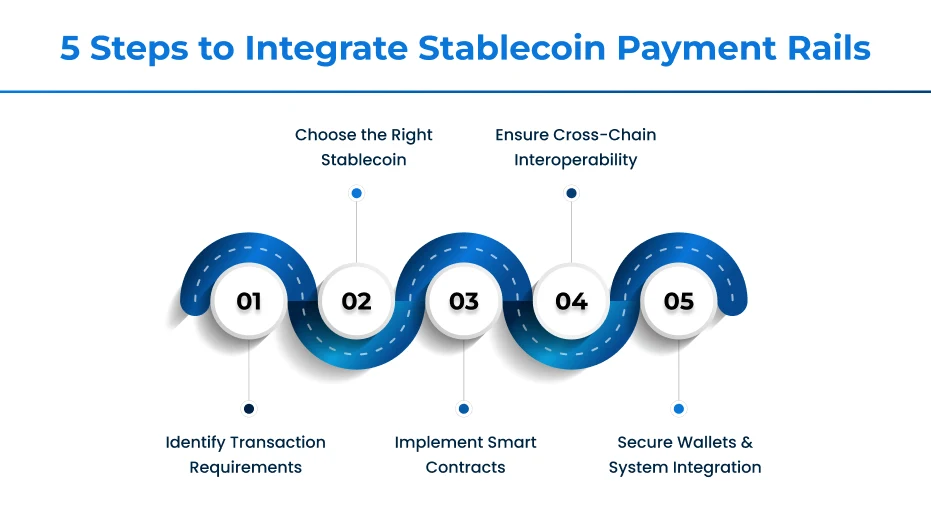
- Identify Transaction Requirements: Understand the types of payments your autonomous agents will perform, including micropayments, subscriptions, or conditional transfers. Define transaction volume, frequency, and speed requirements to maintain operational efficiency.
- Choose the Right Stablecoin: Select a stablecoin compatible with your ecosystem, considering regulatory compliance, network support, and liquidity. Popular options include USDC and USDT, or custom tokens tailored for enterprise applications.
- Implement Smart Contracts: Deploy smart contracts that automate payments and enforce agreements. These contracts trigger conditional transfers automatically, enabling agents to perform financial operations without manual intervention.
- Ensure Cross-Chain Interoperability: Autonomous agents often interact across multiple blockchains. Integrate bridges or cross-chain platforms to allow seamless stablecoin transactions across networks, supporting global decentralized operations.
- Secure Wallets & System Integration: Provide autonomous agents with secure wallets, using multi-signature or hardware-based solutions. Integrate stablecoin rails with enterprise systems for transparency, auditability, and compliance with regulations.
Following these five steps allows organizations to leverage stablecoin remittance effectively, creating a robust, programmable, and decentralized foundation for the agentic web. Autonomous agents can then operate reliably, scale efficiently, and interact seamlessly across decentralized ecosystems.
Lead The Market With Stablecoin-Powered Operations.
Challenges and Considerations
While stablecoin payments are critical for agentic web infrastructure, implementing them comes with practical challenges.
- Liquidity Management: Autonomous agents need sufficient stablecoin reserves to execute transactions without delays, ensuring smooth operations and continuous workflows.
- Network Scalability: Payment rails must support growing transaction volumes efficiently to prevent bottlenecks in autonomous systems.
- Cross-Chain Interoperability: Agents often interact across multiple blockchains, so seamless standards are necessary for smooth and reliable transactions.
- Regulatory Compliance: Rules vary across jurisdictions, requiring enterprises to align operations with local financial regulations.
Proactively addressing these challenges allows organizations to fully leverage stablecoin payment rails, supporting reliable, autonomous, and decentralized workflows across the agentic web.
Strategic Takeaway
Stablecoin payment rails are essential as the backbone of the agentic web. They enable autonomous, programmable, and cross-chain payments, allowing enterprises to streamline operations, reduce delays, and scale efficiently. Organizations that adopt stablecoin payments gain seamless interoperability, predictable transactions, and regulatory-aligned automation, providing a strategic advantage in a decentralized digital ecosystem.
To bring these capabilities to life, partnering with the right stablecoin payment platform development provider is crucial. Antier, the best stablecoin development company, can help implement robust stablecoin payment rails, ensuring secure, scalable, and compliant integration for your enterprise.
Frequently Asked Questions
01. What are stablecoin payment rails and why are they important for the agentic web?
Stablecoin payment rails are financial systems that facilitate quick, predictable, and programmable transactions, bridging decentralized systems with real-world financial needs. They are essential for enabling autonomous agents and smart contracts to operate efficiently in the agentic web.
02. How do stablecoin payment rails differ from traditional banking systems?
Unlike traditional banking systems, which are often slow and geographically limited, stablecoin payment rails offer instant transaction settlement, predictable value, and programmability, making them more suitable for decentralized ecosystems.
03. What core attributes make stablecoin payment rails effective for digital commerce?
The core attributes of stablecoin payment rails include speed and efficiency, predictable value, programmability, and interoperability, allowing seamless value transfer across multiple blockchains and decentralized applications (dApps).