




AI Summary
- The blog post delves into the rise of self-custodial crypto cards in the evolving landscape of crypto neo banking.
- Highlighting the importance of control, security, and seamless integration with daily spending habits, the post emphasizes how self-custodial cards offer users autonomy over their assets while maintaining usability.
- These cards, connected to user-controlled wallets, provide a secure spending layer without surrendering ownership.
- The post discusses the advantages of self-custodial cards in white-label neo banking apps, including enhanced user trust, retention, and differentiation.
- It also touches on the features and development considerations involved in creating such an app, stressing the significance of legal and compliance requirements.
The next wave of crypto neo banking will not be defined by how fast money moves alone. It will be defined by who controls it, how securely it travels, and how elegantly it fits into daily spending. That is exactly why self-custodial crypto cards are moving from a niche idea to a serious product expectation. In a market where tokenization is now a central security layer in digital payments and where major networks continue to push secure token-based experiences at scale, the combination of self-custody and card usability is becoming far more than a trend. It is becoming a structural advantage.
For users, this model promises control without friction. For enterprises and investors, it opens a cleaner path to trust, retention, and product differentiation. A self-custodial cryptocurrency wallet means the user holds the private keys and does not rely on a third party to secure the assets. At the same time, tokenized payment layers help keep sensitive card details out of direct exposure. That mix is exactly why self-custodial cards fit so naturally into a white-label neo-banking app.
What Are Self-Custodial Cards?
Self-custodial cards are payment cards connected to a wallet or account structure where the user retains direct control over the underlying assets or access keys. The crypto virtual card becomes the spending layer, while custody remains with the user. In simple terms, the card is the interface, not the owner. That distinction matters because it gives users more control over their funds while still letting them spend in familiar card rails.
In a white-label neo banking app, this model can be built as part of a branded financial experience where the platform handles the journey, the issuer and network handle card acceptance, and the user keeps ownership of the wallet layer. It is a cleaner answer to modern users who expect both autonomy and convenience.
Self-Custodial Card Vs. Crypto Virtual Cards
| Aspect | Self Custodial Cards | Crypto Virtual Cards |
|---|---|---|
| Control layer | User keeps control of the wallet or keys | The platform often manages the card layer and funding flow |
| Core idea | Spend while keeping custody | Spend from a digital card representation |
| Security model | User ownership plus tokenized payment flow | Usually issuer-led or platform-led security model |
| Best for | Users who want control and transparency | Users who want quick digital spending access |
| Product position | More advanced, trust-led neo banking layer | Simpler entry-level spending product |
The real difference is not only technical but also philosophical. A virtual crypto card gives access to spending, while a self-custodial card gives access to spending without surrendering ownership.
How Does a Self-Custodial Card Work?
A self-custodial card connects a user-controlled wallet to the card payment system without handing over ownership of the underlying assets. In a self-hosted wallet model, the user controls the private keys, while the card program provides the wallet with a usable spending layer.
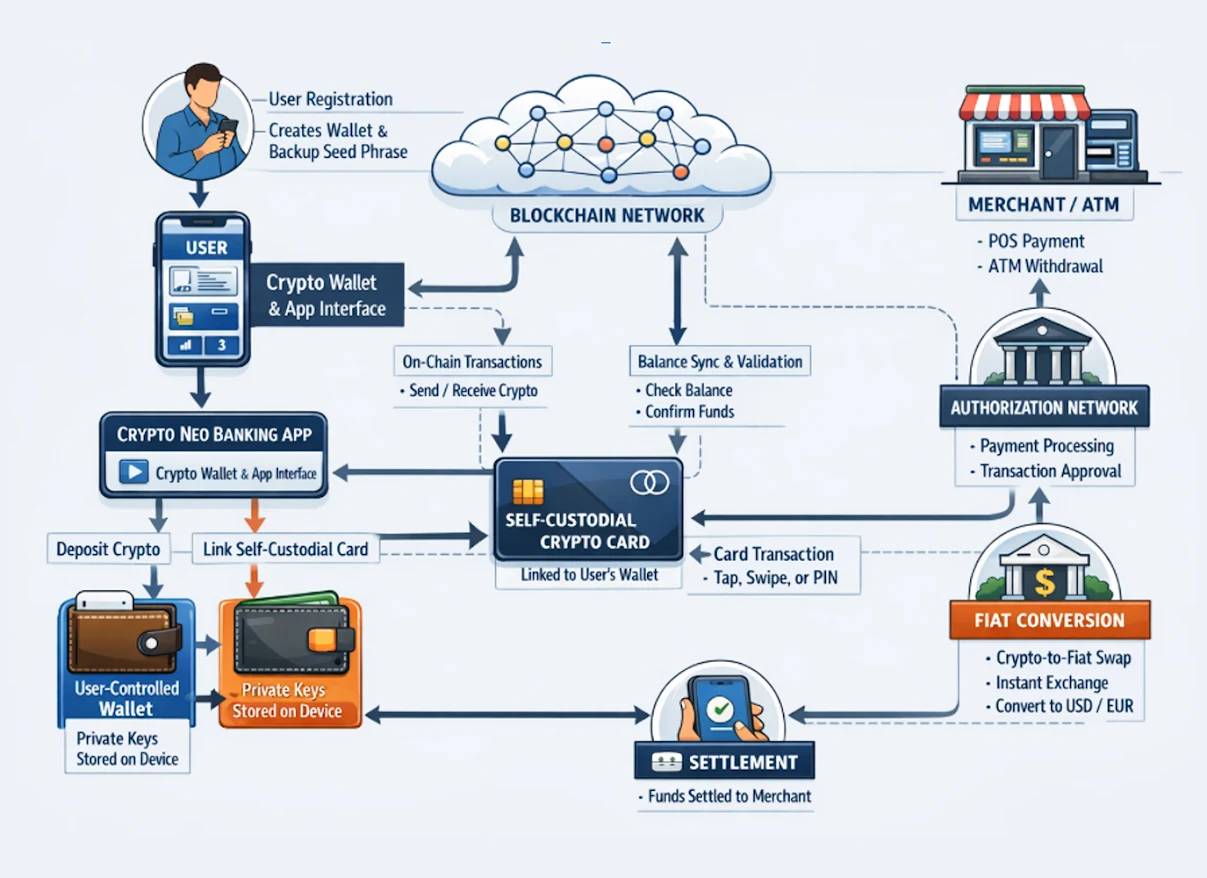
When a purchase is made, the app or wallet initiates the payment, tokenizes the card credentials, and the merchant receives a token instead of the card number. That token is then routed through the payment network to the issuer or token service provider for approval, with fraud, authorization, and policy checks applied along the way. The result is a card experience that feels familiar at checkout, while the custody layer stays with the user.
Advantages of Self-Custodial Cards In a White Label Neo Bank Platform?
An informed investor and an enterprise must assess all the advantages of what they are investing in.
- Greater user trust because customers feel they retain real control over their funds and financial activity.
- Stronger user confidence since ownership is not fully dependent on a central platform.
- Higher appeal to crypto-native and Web3 users who already expect control, transparency, and direct asset access.
- Better customer retention because users who manage funds through a self-custodial model are more likely to stay engaged with the platform.
- Improved brand positioning by offering a more advanced and future-ready financial experience than standard card products.
- Stronger market differentiation, as the platform can stand out in a crowded neo-banking development space with a more meaningful value proposition.
- More investor-friendly product perception because the model reflects a modern, scalable, and ownership-driven financial structure.
- Enhanced user loyalty, as customers value platforms that respect autonomy and financial control.
- Reduced friction in trust-building for audiences that are cautious about custodial dependence.
- Better fit for global digital finance trends where ownership, portability, and control are becoming central expectations.
Higher long-term product relevance because the model aligns with the shift toward decentralized and user-controlled financial services. - Stronger acquisition potential for serious users who actively look for self-managed financial tools rather than traditional account-based products.
- Improved perceived value of the banking app, as the offering feels more premium, modern, and strategically designed.
- Greater readiness for future financial ecosystems where self-custody and programmable money models are likely to matter more.
- More credibility with tech-savvy audiences who want a product that reflects innovation without sacrificing practicality.
Move Beyond Traditional Cards Today!
Features of a white-label neo banking app with self-custodial cards
A serious self-custodial, card-based, crypto-friendly neo-banking solution should include features that are modern yet practical. And this can only be achieved by partnering with a reliable and accredited white label BaaS service provider that promises to design and deliver
- Wallet-based card issuance and management
- Tokenized card credentials for safer transactions
- Instant card freeze and unfreeze controls
- Multi-asset or multi-wallet funding options
- Spending limits by category, merchant, or time
- Real-time transaction notifications
- KYC and risk screening flow
- Device binding and authentication layers
- Recovery and backup logic for wallet access
- Admin dashboard for compliance, monitoring, and program control
The strongest products do not overload the user. They simplify control. That is what makes the experience feel premium rather than complicated. And this level can be only achieved by hiring the industry’s most talented and certified blockchain experts who are adept at building solutions leveraging their blockchain and AI expertise.
How Much Time Does the Self-Custodial Card Neo Banking App Take?
The customized neo bank app development timeline depends on how custom the solution is. A basic branded setup with limited customization moves faster than a full enterprise-grade platform with deep wallet logic, advanced controls, multiple jurisdictions, and compliance-heavy integrations. The more unique the custody model, card rules, and payment routing need to be, the more time the build will require. In practice, the real timeline is shaped by product complexity, integration depth, security review, and regulatory readiness, not by the app shell alone.
How Much Does Self-Custodial Card-Based Neo Banking App Development Cost?
The cost depends on the scope, not on the label. A simple solution with standard white label neo bank app modules, limited customization, and a narrow launch geography will be priced very differently from a multi-region platform with custom wallet architecture, tokenization logic, KYC layers, admin controls, and ongoing compliance work. Factors such as card program setup, security requirements, issuer relationships, wallet design, UI depth, audit expectations, and support infrastructure all influence pricing. For this kind of product, the most honest answer is that cost is driven by architecture, risk profile, and custom build depth.
What Legal & Compliance Requirements Do You Need To Know?
- KYC and AML checks for user onboarding and ongoing monitoring
- Screening for sanctions and suspicious activity
- PCI DSS alignment for any cardholder data environment
- Tokenization and credential protection controls
- Data privacy requirements based on the launch jurisdiction
- Strong authentication and access management
- Clear recordkeeping and audit trails
- Risk-based controls for wallet activity and card usage
- Jurisdiction-specific payment, e-money, or virtual asset rules
These are not optional details. The FATF has long emphasized the need for risk-based AML and CTF controls in the virtual asset sector, and PCI DSS remains the main security framework for organizations that process, store, or transmit cardholder data. Any serious self-custodial card product should be built with those realities in mind from day one. Thus, it is important to connect with a firm that has a legal team that guides the enterprises and businesses from the start to the end.
Conclusion
Self-custodial cards in crypto neo bank platforms are not just another feature idea. They are a more mature answer to how users now expect to hold, control, and spend digital value. They combine ownership, usability, and security in a way that feels natural for the next generation of neo banking. For enterprises and investors, that makes them a strong strategic layer, not a passing product experiment.
For businesses looking to move from Web2 into Web3 without losing speed, structure, or trust or enhance their position in the existing Web3 market, Antier stands out as a strong partner for the journey. With a legal expertise team, certified specialists, and deep strength across blockchain and AI, our teams help businesses move from concept to launch with more confidence. Our white-label banking modules make it easier to customize each solution around real business needs while keeping the build faster, cleaner, and more scalable. They do not just help you enter the market; they help you shape a sharper product presence in it.
Frequently Asked Questions
01. What are self-custodial cards?
Self-custodial cards are payment cards linked to a wallet where the user retains control over their assets and private keys, allowing them to spend while maintaining ownership of their funds.
02. How do self-custodial cards differ from crypto virtual cards?
Self-custodial cards allow users to keep control of their wallet and keys, while crypto virtual cards are typically managed by the platform, which handles the card layer and funding flow.
03. What advantages do self-custodial cards offer to users?
Self-custodial cards provide users with greater control and transparency over their funds, enabling them to spend securely while maintaining ownership of their assets.