



AI Summary
- In the evolving landscape of travel and hospitality, the movement of money across borders is becoming increasingly crucial.
- Cryptocurrency payment gateways are revolutionizing the industry, offering speed, certainty, and flexibility to businesses and guests.
- Countries like Bhutan are leading the way by accepting crypto for tourism services, while platforms like Travala report significant crypto-based bookings.
- The adoption of cryptocurrency payments is not limited to specific regions, with various countries embracing this trend.
- These payment gateways address key industry challenges such as cross-border payments, chargebacks, refunds, and payment failures.
Travel is no longer only about destinations; it is about the speed, certainty, and flexibility with which money moves across borders. In the hospitality and travel industries, that matters more than ever, because guests book from one country, pay from another, and expect instant confirmation in a third. We are already seeing this shift in action. Bhutan now lets travelers pay for visas, flights, accommodation, and even local goods in crypto across its tourism ecosystem, while Travala says close to 80% of its bookings are paid with cryptocurrency. That is not a fringe signal. It is a strong market cue that payment choice has become part of the guest experience, and for enterprises, it is now part of the competitive edge. So let us decode how cryptocurrency payment gateways are going to solve the biggest problems of the travel and hospitality industry and let enterprises outshine in the highly competitive market.
The Market Scenario Around Hospitality & Travel, Adopting Crypto as Payment
The strongest adoption signals are coming from markets where cross-border spending, tourism intensity, and digital payment maturity overlap. Chainalysis’s 2024 Geography of Crypto report shows seven of the top 20 countries in its Global Adoption Index are in Central and Southern Asia and Oceania, including India, Indonesia, Vietnam, the Philippines, Pakistan, Thailand, and Cambodia. Its 2025 report also highlights Nigeria, the United States, India, Vietnam, and Ukraine among the top crypto-adopting countries, which shows that adoption is not confined to one region or one customer type. The report also notes the growing role of stablecoins in remittances, commerce, and inflation hedging.
That matters directly to hospitality and travel. Tourists are often dealing with currency conversion, card declines, hidden fees, and delayed settlement, so crypto and stablecoin rails become attractive where visitors want quicker, cleaner checkout. Bhutan is the clearest tourism-specific example right now, because it has turned crypto into a nationwide tourism payment layer. Travala adds a commercial proof point, since its 2024 gross revenue rose to $103.3 million, driven by nearly 80% growth in crypto-paid bookings, and crypto travelers were shown to spend more, book more spontaneously, and return more often.
Current Challenges of the Hospitality and Travel Industry
There are certain pain points that still exist in the industry, and which should be talked about so that one knows what solutions can be brought to overcome the challenges ahead:
- Cross-border card payments can create friction at checkout, especially when guests pay in one currency and the merchant settles in another. That friction often leads to hesitation and abandoned bookings.
- Chargebacks remain expensive in travel and hospitality. Mastercard says the sector has the highest average chargeback value, at $120, and global chargeback volume is expected to rise 24% from 2025 to 2028.
- Refunds and reversals can be slow, especially for multi-party bookings involving airlines, hotels, OTAs, and activity vendors.
- International guests often face payment failures because of bank blocks, card restrictions, or weak acceptance across regions.
- Currency volatility and inconsistent settlement timing make revenue forecasting harder for businesses that operate across markets.
- Compliance pressure is rising, and firms need better controls for AML, CFT, and transaction monitoring before they can scale globally with confidence.
How Does Crypto Payment Gateway Development Solve the Pain Points?
- Cryptocurrency payment gateway solutions reduce payment friction by giving travelers a faster checkout path with broader payment choices, especially for international bookings.
- It lowers dispute pain by shifting more of the transaction flow toward transparent on-chain or stablecoin-based settlement models, which can reduce reliance on traditional chargeback-heavy rails.
- It supports faster cross-border money movement, which helps hotels, OTAs, and travel platforms improve settlement speed and cash flow.
- This solution improves reach into crypto-native and digitally active traveler segments, whose Travala data suggests can be higher-value and more loyal than traditional customers.
- It creates a cleaner foundation for global expansion, especially when the payment layer is designed to support stablecoins, instant conversion, and multi-jurisdiction compliance.
- It opens the door to lower-lift international acceptance because crypto rails can be designed for real-time routing and programmable settlement rather than legacy card dependence.
Crypto Payment Gateways vs Traditional Systems
| Comparison point | Traditional payment rails | Crypto payment gateway | Why it matters for hospitality and travel |
|---|---|---|---|
| Settlement speed | Usually takes 1 to 3 business days for cross-border settlement. | Can settle in minutes in many stablecoin and blockchain-based models. | Faster access to funds improves cash flow and reduces waiting time after bookings. |
| Availability | Often depends on banking hours, weekends, and holidays. | Designed for 24/7 operation. | Better for global guests who book across time zones. |
| Cross-border flow | Involves more intermediaries and slower routing. | Can reduce dependence on correspondent banking and speed up transfer paths. | Makes international checkout smoother and more efficient. |
| Treasury impact | Funds may remain locked longer in transit. | Faster movement of value supports quicker settlement and better liquidity control. | Helps hotels, OTAs, and travel firms manage working capital more effectively. |
| Operational value | Slower reconciliation and more payment friction. | Cleaner digital payment flow with programmable settlement options. | Creates a more modern, scalable payment experience. |
How to Design a Crypto Payment Gateway Solution for This Industry Specifically?
- A renowned crypto payment gateway development company builds a multi-currency checkout so travelers can pay in major cryptocurrencies and stablecoins without confusing the booking flow.
- Add automatic fiat conversion, so the merchant can receive local currency while the traveler pays in crypto.
- Integrate directly with booking engines, hotel PMS platforms, OTAs, and tour management systems.
- Include refund orchestration to handle cancellations, partial refunds, and rescheduling cleanly.
- Make sure you design a risk and compliance layer with KYC, AML, sanctions screening, wallet screening, and transaction monitoring.
- Offer smart routing so that the gateway can choose the best rail based on jurisdiction, fee, speed, and settlement rules.
- Create a real-time reconciliation dashboard for finance teams, so every booking, refund, and payout is traceable.
- Support QR checkout, mobile wallet payments, and guest-facing links for in-property and on-trip purchases.
- Keep the user experience simple, because the best gateway feels native to the booking flow rather than bolted on.
Is This a Temporary Trend or a Long-Term Shift?
Cryptocurrency payment gateway development is shaping up as a long-term shift, not a passing experiment. The reason is simple: hospitality and travel are built on cross-border commerce, and the payment layer in that sector has long suffered from slow settlement, fragmented systems, and weekend or holiday cutoffs. Visa’s stablecoin work and its recent settlement initiatives show that major payment infrastructure players are treating stablecoin rails as a real payments upgrade, not a side project. At the same time, Skift’s recent reporting on Bhutan and broader travel payments points to a move away from fragmented legacy systems toward unified, scalable payment models. That is usually what a durable shift looks like: the market, the infrastructure, and the use case all start moving in the same direction.
Last but not the least! Crypto payments in travel are not being adopted because they sound innovative. They are being adopted because they solve real business pain. Stablecoins in particular are becoming more attractive because they can settle much faster than traditional rails, operate 24/7, and reduce dependency on banking-hour constraints. In other words, this is a payments modernization story, and that is why the trend has staying power.
How Does a Crypto Payment Gateway Work From Booking to Settlement?
A well-designed crypto payment gateway in travel and hospitality usually starts at checkout, where the guest selects crypto or stablecoin as the payment method. The gateway then displays the payable amount, quotes the exchange rate, and routes the transaction through the selected network or liquidity path. Once the payment is confirmed on-chain, the gateway can either settle the merchant in crypto or auto-convert into fiat, depending on the business model and jurisdiction. Visa’s stablecoin materials and current industry infrastructure show that the real advantage is not just acceptance but the ability to move from consumer payment to business settlement with far less friction than legacy rails.
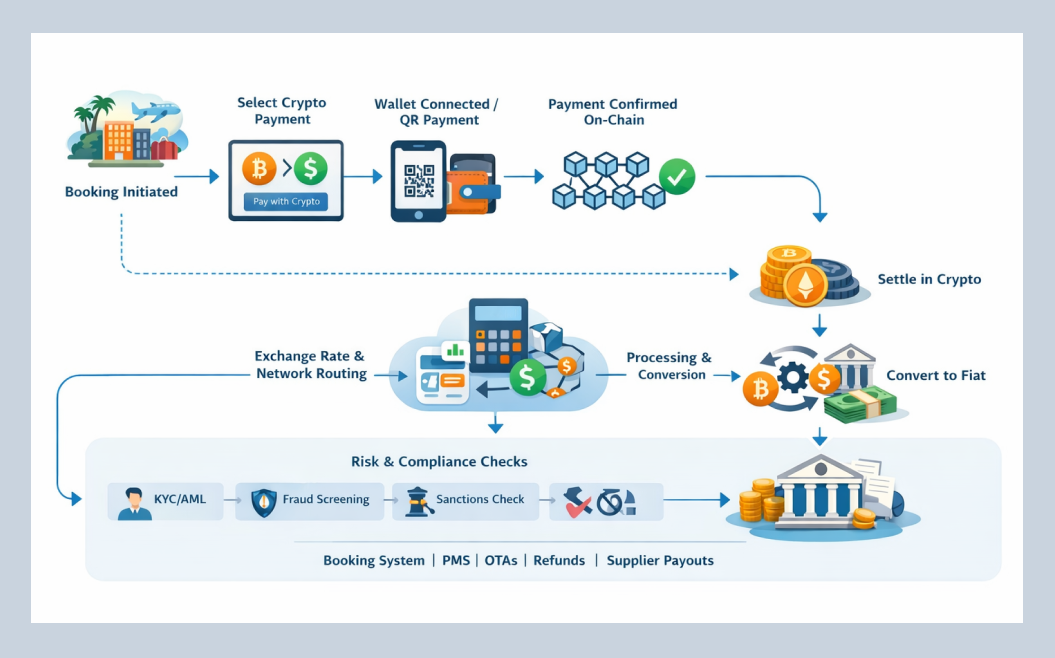
In practice, the flow is usually booking-initiated, payment option selected, wallet connected or QR paid, confirmation received, risk checks applied, and then settlement posted into the merchant’s treasury or operating account. For hospitality and travel, this is especially useful because the payment has to work across booking engines, PMS systems, OTAs, refunds, and supplier payouts. That is why modern merchant payment gateways are increasingly being designed as orchestration layers, not just checkout tools.
Why Choose a White-Label Gateway Instead of Building From The Scratch?
Yes, for most enterprises, a white-label payment gateway solution is the fastest route, because it shortens the path from idea to launch without forcing you to build every payment rail, compliance layer, and settlement workflow from zero. Visa’s stablecoin materials explicitly frame the opportunity around launching faster, with less lift, through a global partner network, chain integrations, and compliance support. That is exactly why white-label makes sense in hospitality and travel, where speed matters, brands still need their own identity, and the payment experience must feel native to the booking journey. The real win is not just speed, though. It is speed with control, meaning you can launch quickly, customize deeply, and scale across regions without rebuilding the core each time.
What Compliance Features Must The Gateway Include From Day One?
From day one, the crypto payment gateway should be built with compliance as part of the core architecture, not as an afterthought. FATF has made clear that virtual asset service providers are expected to apply AML/CFT controls, and its guidance specifically points to licensing or registration, supervision, transaction monitoring, and targeted financial sanctions compliance. FATF also continues to push Travel Rule implementation, which means sender and beneficiary information handling is not optional in serious deployments.
The most important compliance capabilities to include are KYC/KYB onboarding, sanctions screening, wallet screening, transaction monitoring, Travel Rule support, risk scoring, audit logs, and reporting workflows. In India, the FIU guidelines also emphasize customer identification, sanctions screening, record keeping, transaction processing review, and employee training, which is a useful reminder that compliance needs both software and process discipline. In a travel context, a crypto payment gateway solution becomes even more important because guest payments, supplier payouts, and cross-border flows all sit in the same transaction environment.
The Final Verdict
Crypto payments are no longer a future-facing experiment for hospitality and travel. They are becoming a practical response to cross-border friction, high chargeback costs, and the demand for faster, cleaner settlement. The market is already showing where the momentum is strongest, and the businesses that move early will be better placed to serve global travelers with less friction and more trust. Bhutan, Travala, and the wider APAC crypto adoption story all point in the same direction.
Antier can be a strong partner for the crypto payment gateway development shift because it brings legal expertise, certified specialists, and deep experience across blockchain and AI. Its team helps enterprises move from web2 to web3 with white-label modules that can be adapted to different business models and markets. That makes the transition faster, cleaner, and easier to scale. For brands that want a solution built around business needs, operational reality, and long-term growth, that kind of partnership matters. Connect with our experts to share your requirements and business planning for your project.
Frequently Asked Questions
01. How is cryptocurrency changing the travel and hospitality industry?
Cryptocurrency is enhancing the travel experience by providing faster, more flexible payment options, allowing guests to book and pay from different countries seamlessly, and reducing issues like currency conversion and hidden fees.
02. Which countries are leading in cryptocurrency adoption for travel and hospitality?
Countries such as India, Indonesia, Vietnam, the Philippines, Pakistan, Thailand, Cambodia, Nigeria, the United States, and Ukraine are among the top adopters of cryptocurrency in the travel and hospitality sectors.
03. What benefits do travelers experience when using cryptocurrency for bookings?
Travelers using cryptocurrency enjoy quicker checkouts, fewer transaction issues, and often spend more on bookings, leading to a more spontaneous and satisfying travel experience.