





AI Summary
- Discover how global payment systems are evolving to address the challenges of slow, expensive, and fragmented cross-border transactions.
- Stablecoins are emerging as a practical solution, with reports showing trillions of dollars in transaction volumes annually.
- The key lies in building stablecoin payment infrastructure, which encompasses wallet management, transaction orchestration, blockchain settlement, liquidity access, and compliance mechanisms.
- This infrastructure enables faster settlement, reduced dependency on intermediaries, improved visibility, and continuous transaction availability.
- By understanding the core architecture of stablecoin payment infrastructure and how stablecoin payment rails work, businesses can optimize operational efficiency, enhance treasury management, and drive global financial operations.
Global payment systems are being pushed to evolve. Cross-border transactions remain slow, expensive, and fragmented. According to the World Bank, remittance costs still average around 6 percent globally, with settlement timelines often ranging from 1 to 5 business days depending on intermediaries and corridors. At the same time, the scale of global payments continues to expand. Industry estimates suggest that cross-border payment flows exceed hundreds of trillions of dollars annually, placing increasing pressure on legacy systems to improve speed, cost efficiency, and transparency.
Stablecoins are emerging as a practical solution to these challenges. Recent reports from firms like McKinsey & Company and Visa indicate that stablecoin transaction volumes have reached trillions of dollars annually, with growing adoption across payments, settlements, and treasury operations. However, the real transformation is not just about using stablecoins. It is about building the systems that enable them. This is where stablecoin payment infrastructure becomes critical.
What Is Stablecoin Payment Infrastructure
Stablecoin payment infrastructure refers to the backend systems, integrations, and operational layers that enable businesses to send, receive, process, and settle payments using stablecoins across global networks. It is not a single tool or application. It is a coordinated system that includes wallet management, transaction orchestration, blockchain settlement, liquidity access, and compliance mechanisms.
This infrastructure allows organizations to move beyond traditional payment networks and adopt a model where value can be transferred directly, quickly, and with greater transparency. For fintech platforms and payment providers, this represents a shift from relying on external networks to building controlled, programmable payment systems.
Stablecoin Payment Infrastructure vs Traditional Systems
Traditional payment systems rely on complex networks and delayed settlement processes.
Stablecoin-based systems offer a different model.
| Factor | Traditional Systems | Stablecoin Systems |
|---|---|---|
| Settlement Time | Multiple days | Minutes or seconds |
| Cost | High due to intermediaries | Lower and more predictable |
| Transparency | Limited visibility | On-chain tracking |
| Availability | Limited to banking hours | Continuous |
| Accessibility | Region dependent | Global |
This comparison highlights why businesses are exploring alternative payment systems.
Create payment rails built for global transactions.
Why Stablecoin Payment Infrastructure Matters for Businesses
Businesses that operate across borders face recurring challenges. Settlement delays can disrupt cash flow. High transaction fees reduce profitability. Currency conversions introduce unpredictability. Limited visibility into transaction status creates operational friction.
Stablecoin-based systems address these issues by enabling faster and more predictable transactions. However, without a proper infrastructure layer, these benefits cannot be realized. Businesses need systems that integrate stablecoins into their existing operations while maintaining compliance and control.
Stablecoin payment infrastructure enables:
- Faster settlement across regions
- Reduced dependency on intermediaries
- Improved visibility and tracking
- Continuous transaction availability
- Greater control over liquidity and treasury
For high-volume payment environments, even small improvements in efficiency can translate into significant cost savings.
Core Architecture of Stablecoin Payment Infrastructure
To understand how these systems function, it is useful to examine the architecture in layers. Each layer plays a specific role in enabling seamless payment execution.
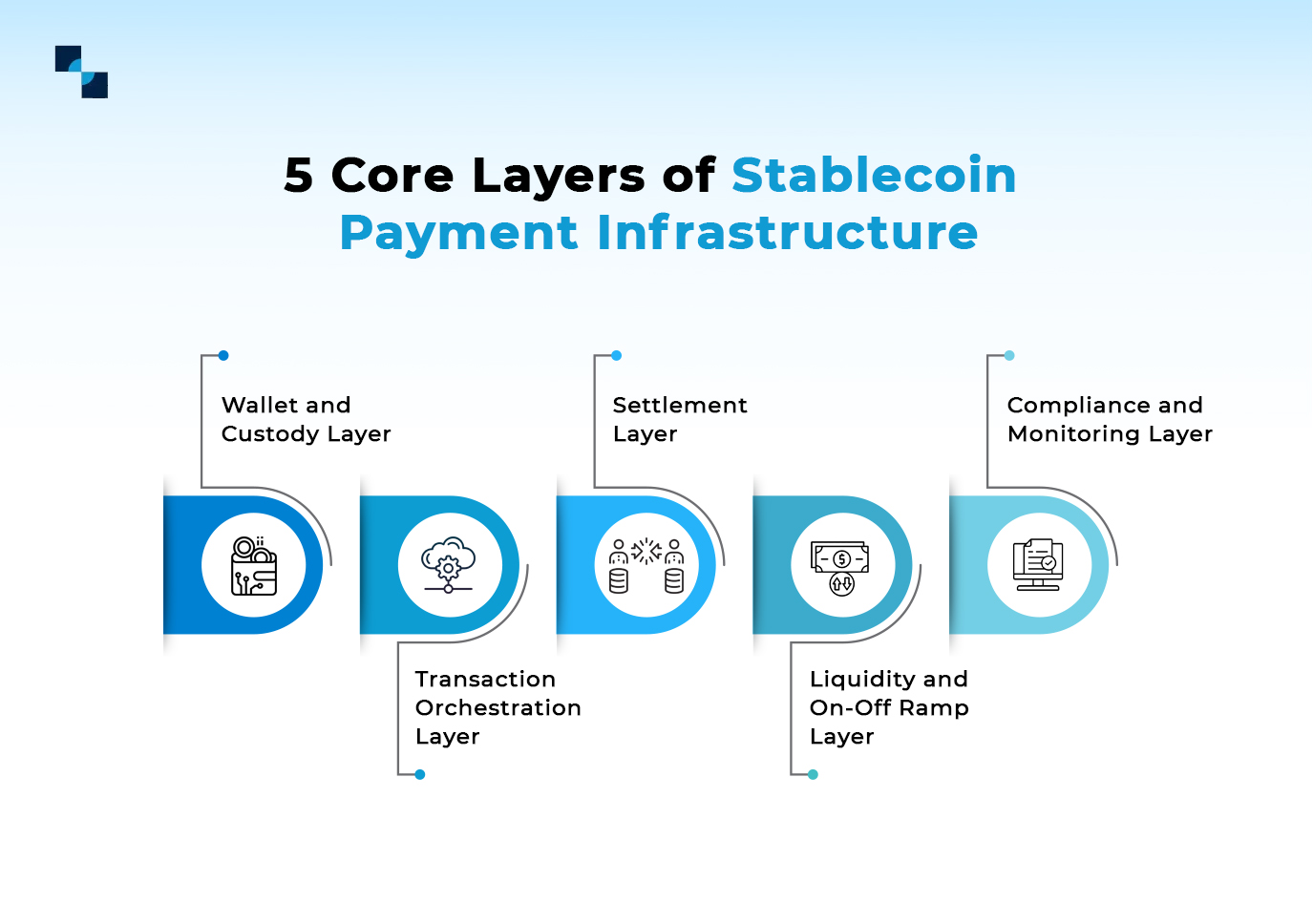
1. Wallet and Custody Layer
This layer manages digital wallets for users and businesses. It handles secure storage of stablecoins and enables transaction authorization. Organizations can choose between custodial models, where assets are managed by a provider, or non-custodial models, where users retain control of their funds.
Security is a critical consideration at this level, as it directly impacts asset protection.
2. Transaction Orchestration Layer
This layer is responsible for managing how payments are initiated, routed, and executed. It integrates with applications and platforms through APIs. It ensures that transactions follow defined rules and are processed efficiently.
For businesses, this layer acts as the control center for payment operations.
3. Settlement Layer
The settlement layer operates on blockchain networks. Transactions are recorded and confirmed on the chain, enabling faster and more transparent settlement compared to traditional systems. Different blockchain networks offer varying levels of speed, cost, and scalability. Selecting the right network is an important decision for system design.
4. Liquidity and On-Off Ramp Layer
This layer connects stablecoin systems with fiat currency. It enables conversion between fiat and stablecoins through partnerships with exchanges, liquidity providers, and financial institutions. Reliable liquidity is essential for ensuring smooth transaction flows, especially in high-volume environments.
5. Compliance and Monitoring Layer
Regulatory compliance is a key requirement for payment systems. This layer includes identity verification, transaction monitoring, and reporting capabilities. It ensures that systems meet legal and regulatory standards across jurisdictions.
For enterprises and financial institutions, this layer is critical for building trust and enabling adoption.
How Stablecoin Payment Rails Work?
Stablecoin payment rails define how transactions move across the network from initiation to settlement. Unlike traditional systems, these rails operate without multiple intermediaries. Transactions are executed directly on blockchain networks.
Step 1: Payment Initiation
A user, enterprise system, or payment platform initiates a transaction through an application, dashboard, or API. This step includes defining the transaction amount, recipient details, and payment conditions.
Step 2: Conversion
If the sender is operating in fiat, the amount is converted into stablecoins through an on-ramp provider. This ensures that the value entering the system is digitized and ready for blockchain-based transfer.
Step 3: Transaction Execution
The transaction is submitted to the blockchain network. At this stage, the system validates the transaction, signs it using wallet credentials, and broadcasts it for processing.
Step 4: Settlement
Once processed, the transaction is confirmed on the chain. Depending on the network, settlement can occur within seconds or minutes. This eliminates delays associated with traditional clearing and settlement cycles.
Step 5: Off Ramp
If the recipient requires fiat currency, stablecoins are converted back through an off-ramp provider. Alternatively, the recipient can retain stablecoins for further transactions or treasury management.
Step 6: Reconciliation and Reporting
The system records transaction details, updates balances, and generates reports for accounting and compliance purposes. This step ensures full traceability and audit readiness.
Why Stablecoin Payment Rails Matter?
Stablecoin payment rails introduce structural improvements to how payments are processed:
- Direct settlement without multiple intermediaries
- Faster transaction processing across borders
- Lower and more predictable transaction costs
- Continuous availability without dependency on banking hours
- Enhanced transparency through on-chain tracking
For payment providers, fintech platforms, and enterprises, these rails form the foundation for building scalable and modern financial systems.
Use Cases Driving Adoption
Stablecoin payment systems are being adopted across multiple industries as businesses look for faster, more efficient ways to move value globally. These systems are not limited to crypto-native use cases. They are increasingly being integrated into real-world financial operations.
- Cross-Border Business Payments
Companies can settle invoices globally without delays or excessive fees. Stablecoin-based systems remove the need for multiple intermediaries, allowing direct settlement between parties. This improves cash flow visibility and reduces dependency on traditional banking networks. For businesses handling high transaction volumes, this can significantly optimize operational efficiency.
- Remittance Services
Money transfer providers can offer faster and more cost-effective services to users. Stablecoin rails enable near real-time delivery of funds across borders, improving user experience. They also reduce operational costs by minimizing intermediary fees, allowing providers to offer more competitive pricing while maintaining margins.
- Merchant Payments
Businesses can accept payments from global customers without relying on traditional card networks. Stablecoins enable direct transactions with lower processing fees and faster settlement. This is particularly valuable for e-commerce platforms and global marketplaces that operate across multiple currencies and regions.
- Enterprise Treasury Management
Organizations can move funds across subsidiaries and regions efficiently. Stablecoin systems allow real-time liquidity management and faster capital allocation. This helps enterprises optimize working capital, reduce foreign exchange exposure, and maintain better control over global financial operations.
Launch a Stablecoin Payment Platform built for real-world use.
These use cases demonstrate the practical value of stablecoin-based systems. As adoption continues to grow, businesses are increasingly viewing stablecoin payment infrastructure as a strategic component of modern financial operations.
Challenges and Considerations
While the benefits are significant, implementing these systems requires careful planning.
- Regulatory Compliance: Different regions have varying rules related to digital assets and payments. Businesses must ensure compliance across jurisdictions.
- Liquidity Management: Ensuring consistent access to liquidity can be complex, especially across multiple regions.
- Integration Complexity: Building and integrating multiple system components requires technical expertise.
- Security and Custody: Protecting digital assets and ensuring secure transactions is a critical requirement.
Addressing these challenges is essential for building reliable and scalable systems.
How Businesses Can Build Stablecoin Payment Infrastructure
A structured approach helps organizations successfully implement these systems.
- Define the Use Case: Identify the primary objective, such as remittance, B2B payments, or merchant solutions.
- Select Blockchain Networks: Choose networks based on speed, cost, and ecosystem support.
- Integrate Core Systems: Implement wallets, APIs, and transaction management tools.
- Establish Liquidity Channels: Connect with providers that enable smooth conversion between fiat and stablecoins.
- Implement Compliance Systems: Ensure identity verification and transaction monitoring are in place.
- Deploy and Scale: Launch with a focused approach and expand based on demand and usage patterns.
This approach ensures that systems are aligned with business requirements and capable of scaling.
The Future of Stablecoin Payment Systems
Stablecoins are moving from experimentation to real-world adoption. Fintech platforms are integrating them into payment products. Enterprises are exploring their use for treasury and settlement. Financial institutions are evaluating how to incorporate them into existing systems. As adoption grows, infrastructure will play a central role in enabling reliable and scalable systems. Stablecoin payment systems are expected to become a key component of global financial operations.
Wrapping Up
Stablecoin payments are redefining how value moves across borders. The real advantage lies in building the systems behind them. Businesses that invest in stablecoin payment infrastructure, deploy a scalable payment platform, and utilize efficient rails can achieve faster settlements, lower costs, and greater operational control.
For fintechs, payment providers, and enterprises, this is where strategy turns into execution. With Antier, you can design, build, and deploy stablecoin payment infrastructure tailored to your use case. Launch a payment platform that integrates seamlessly, and implement stablecoin payment rails built for real-world scale.
Frequently Asked Questions
01. What are the main challenges of traditional global payment systems?
Traditional global payment systems face challenges such as slow transaction speeds, high costs averaging around 6% for remittances, and limited transparency, often taking 1 to 5 business days for settlement.
02. How do stablecoins improve global payment transactions?
Stablecoins improve global payment transactions by offering faster settlement times (minutes or seconds), lower and more predictable costs, enhanced transparency through on-chain tracking, and continuous availability regardless of banking hours.
03. What is stablecoin payment infrastructure?
Stablecoin payment infrastructure refers to the backend systems and integrations that enable businesses to send, receive, process, and settle payments using stablecoins, allowing for direct and efficient value transfer across global networks.