




AI Summary
- In this engaging blog post, readers are taken on a journey to explore Manus AI – a powerful AI tool with a focus on development process, pricing, and practical use cases.
- In Part 2 of the blog, the comparison between Manus AI, ChatGPT, and Deepseek is detailed, highlighting core capabilities, architecture, performance benchmarks, user focus, parent company, and autonomy level.
- The step-by-step guide for AI agent development like Manus AI is outlined, covering defining purpose, selecting the right platform, designing architecture, integrating knowledge sources, building a role system, implementing control layers, testing, and deployment.
- The diverse use cases of Manus AI across industries such as enterprise research, financial services, healthcare, legal, education, media, technology, and human resources are explored, showcasing its versatility.
- Finally, the flexible pricing structure of Manus AI is discussed, catering to different usage needs with various subscription plans.
Many professionals exploring AI tools are curious not only about what Manus AI offers but also about how it functions behind the scenes. After going through the Manus AI benchmarks, working, and key features in Part 1 of this blog post, questions may naturally arise about its development process, pricing model, and practical use cases. This part of the blog covers all these aspects in detail to give you a clearer understanding of how Manus AI operates and where it fits within the broader AI agent development space.
But before we explore the Manus AI Agent use cases, cost, and development structure, it’s important to see how it compares with other well-known tools in the space. Let’s begin with a quick comparison: Manus AI vs ChatGPT vs Deepseek.
Read Part 1: What is Manus AI: From Concept to Capabilities
Manus AI vs ChatGPT vs DeepSeek: The Difference
Though there are many basic parameters available to evaluate AI systems, only the most primary have been chosen for this comparison, given the growing interest in understanding how these platforms differ. With increasing searches around Manus AI vs ChatGPT vs Deepseek, a clear, unbiased comparison becomes essential to navigate the capabilities and limitations of each.
Tabular view
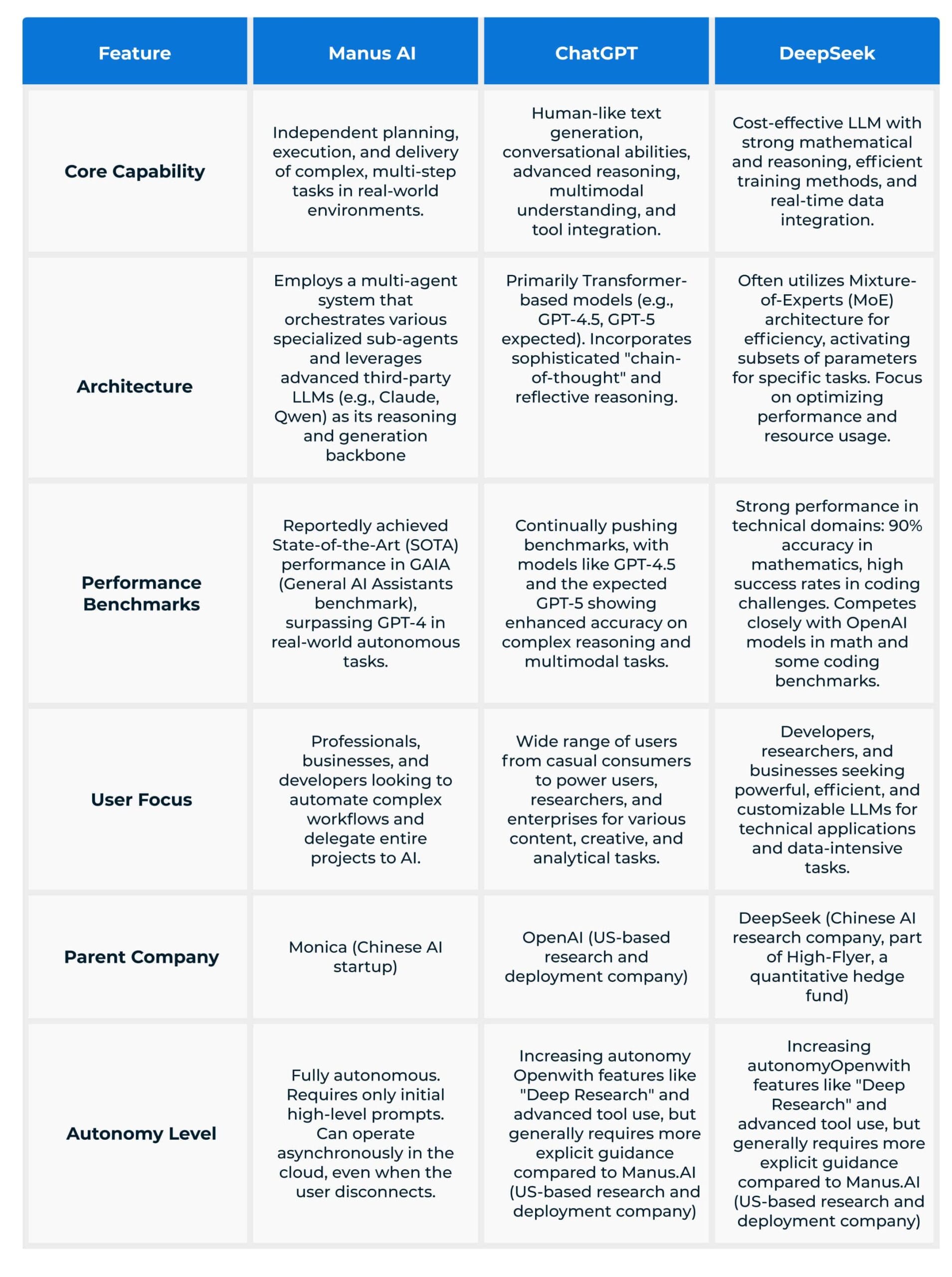
Core capability highlights the main function each platform is designed to perform, while architecture explains the structural design that determines flexibility and integration potential. Performance benchmarks focus on measurable outcomes like speed, stability, and consistency.
User focus defines the intended audience, revealing whether a solution targets general users, developers, researchers, or enterprises. The Parent company offers insight into ecosystem maturity, data security, and ongoing support. Lastly, autonomy level measures how independently each platform can perform tasks, a key factor in assessing automation readiness.
Together, these six pillars provide a practical and concise framework for a detailed Manus AI comparison with ChatGPT and Deepseek, without overwhelming with unnecessary technicalities.
Manus AI Agent Development: A Step-by-Step Process
Here’s a step-by-step approach for developing an AI agent like Manus AI, tailored for technical and business teams evaluating AI agent development for internal operations, SaaS offerings, or client solutions.
Step 1: Define the Agent’s Purpose and User Persona
Start by identifying the specific tasks the AI agent will handle. Will it support customer operations? Automate internal workflows? Act as a research assistant? The Manus AI Agent, for instance, is engineered to perform structured, high-context tasks like business research, market summarization, or internal knowledge retrieval across teams.
Define:
- Who will use the AI agent (technical/non-technical staff, customers, analysts)
- The end goals (e.g., faster decision-making, query resolution, content generation)
- The data sources it should connect with (CRM, knowledge bases, proprietary datasets)
This foundational clarity will shape architectural decisions in later stages.
Step 2: Select the Right AI Agent Development Platform
Choosing the right AI agent development platform is pivotal. Manus AI is built on a structured framework that combines multiple models (LLMs, RAG, vector DBs) into an orchestrated pipeline. The platform you select must support:
- Large Language Model integration (e.g., OpenAI, Claude, Gemini)
- Retrieval-Augmented Generation for Knowledge-Rich Responses
- API extensibility for external tool calling
- Contextual memory to sustain ongoing user sessions
Evaluate platforms such as LangChain, AutoGen, or custom agent stacks with vector database support and orchestration logic.
Step 3: Design the Agent Architecture
To build an enterprise-grade AI agent like the Manus AI Agent, a modular architecture must be mapped out. This includes
- LLM Layer: Choose your foundational model (GPT-4o, Claude 3 Opus, etc.)
- Task Parser: Responsible for breaking down prompts into actionable flows
- RAG Layer: Retrieves relevant context from internal data before LLM invocation
- Execution Layer: Executes function calls or tool actions (e.g., fetching data, sending messages)
- Memory Layer: Preserves context over sessions or per user ID
- Interface Layer: Enables usage across Slack, web dashboards, or internal APIs
Agents like Manus AI are effective because they combine these components through task-specific pipelines designed for reliability and reproducibility.
Step 4: Integrate Knowledge Sources and APIs
A Manus AI Agent doesn’t operate in isolation; it pulls knowledge dynamically. You’ll need to connect the AI agent to:
- Private documents (PDFs, Notion, Confluence, Word docs)
- Structured databases (SQL, Airtable, MongoDB)
- Internal APIs (CRM, ERP, analytics dashboards)
- External tools (search engines, news aggregators, CMS)
RAG pipelines must be optimized using chunking strategies, embedding models, and fine-tuned retrieval methods to ensure context relevance. API calling logic must be robust and monitored for latency and error handling.
Step 5: Build a Role System and Task Routing Engine
Manus AI assigns roles or personas based on the input type. Replicating this capability means building:
- A task classifier to determine user intent
- A routing mechanism to assign tasks to agent roles
- Prompt templates specific to each function
This segmentation avoids generic responses and creates high-value outputs, tailored to user goals.
Step 6: Implement Guardrails, Permissions, and Monitoring
No enterprise AI agent is complete without control layers. Following the Manus AI model, integrate:
- Prompt filters to block sensitive queries
- Access control layers for department-level usage
- Token limiters and logging for performance and cost tracking
- Feedback mechanisms for users to rate or refine outputs
Enterprise teams expect reliability and safety. Ensure all data usage and LLM outputs are observable and auditable.
Step 7: Test with Internal Teams and Iterate Fast
Once your AI agent is in a deployable state, test it in sandbox environments with real business tasks. Start with a few internal use cases, such as:
- Drafting reports or meeting notes
- Summarizing competitor data
- Internal document search and Q&A
Just as the Manus AI Agent was refined through internal usage cycles, use feedback to fine-tune prompts, API logic, and retrieval quality. This stage is key to ensuring consistent performance across departments.
Step 8: Deploy Across Interfaces
An AI agent is most valuable when embedded where users already work. This could mean:
- Slack integrations for internal teams
- Browser plugins for knowledge workers
- CRM embed for sales reps
- Custom web dashboards for client interaction
Manus AI enables multi-interface access, allowing businesses to scale AI-driven productivity across roles and workflows. Ensure your agent supports WebSocket, REST, or GraphQL APIs for seamless frontend integration.
Manus AI Use Cases: Applications in Various Industries
Manus AI is designed to solve real-world challenges by automating research, execution, and decision-making tasks across sectors. As AI agent development gains traction, enterprises are exploring tools like Manus AI to reduce repetitive work, improve accuracy in insights, and accelerate internal workflows. Below is a detailed view of Manus AI use cases across various industries, showing how the Manus AI Agent adapts to different operational needs.
Enterprise Research and Market Intelligence
The Manus AI Agent is widely used for structured business research. Teams use it to summarize competitor strategies, generate market reports, and compile news highlights without manual searching. By connecting to internal documents and public data sources, the agent acts as an on-demand analyst, supporting decision-makers across sales, strategy, and executive roles.
Financial Services
In finance, speed and precision are non-negotiable. The Manus AI Agent helps in drafting investment briefs, scanning regulatory changes, analyzing macroeconomic updates, and generating financial memos. Traders, analysts, and client advisors use Manus AI to accelerate research-heavy tasks while reducing manual workload.
Consulting and Professional Services
Consulting teams often rely on AI agent development platforms to streamline project delivery. With Manus AI, consultants can automate background research, create slide decks, and respond to RFPs faster. This reduces time spent on repetitive work and allows more focus on insights and strategy.
Healthcare and Life Sciences
The Manus AI Agent supports medical researchers and pharmaceutical teams by extracting critical information from journals, regulatory updates, and clinical trial data. This improves documentation accuracy and shortens the turnaround time for literature reviews and regulatory submissions.
Legal and Compliance
Legal teams use Manus AI to review contracts, summarize case laws, and keep track of changing compliance rules. The agent can be trained on internal legal templates and documentation, making it a reliable assistant for routine legal work.
Education and Training
In academic settings, the Manus AI Agent helps educators and administrators generate course content, quiz questions, and reading summaries. For L&D teams in corporations, it accelerates curriculum design, SOP drafting, and internal knowledge capture.
Media and Publishing
Writers, editors, and content teams use Manus AI for summarizing articles, drafting story outlines, generating image or video content ideas, and even producing slides. The ability to pull from exclusive data sources and generate creative formats gives content creators more bandwidth to focus on storytelling.
Technology and Product Teams
Engineering and product teams often rely on AI agent development services to automate documentation, technical research, and user feedback summaries. Manus AI Agent supports these workflows by drafting PRDs, compiling tech stack comparisons, and reviewing changelogs or issue trackers.
Human Resources
HR departments use the Manus AI Agent to automate policy documentation, generate role-based onboarding flows, and even summarize employee engagement reports. This improves internal communication and helps teams stay aligned.

Manus AI Pricing
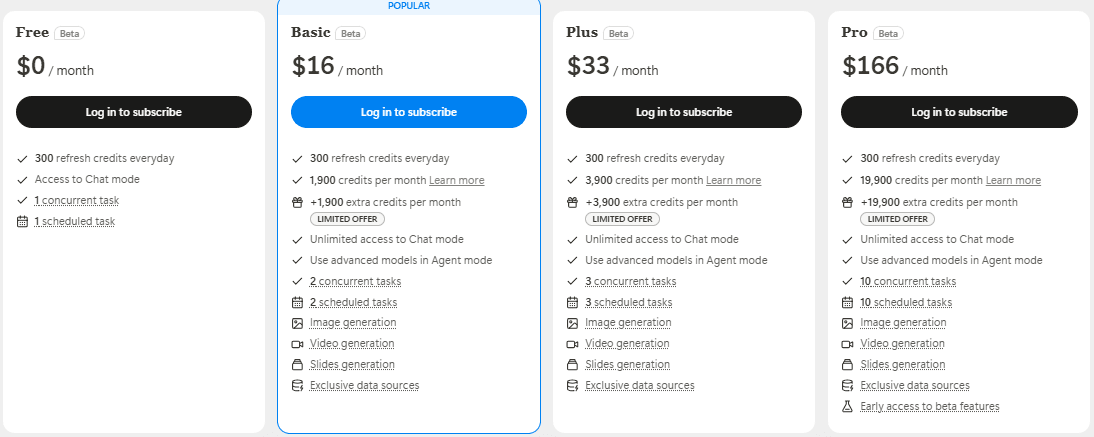
Many professionals exploring AI automation are curious about how Manus AI Pricing is structured, given the advanced capabilities of the Manus AI Agent. Whether the goal is to experiment during the Beta phase or scale access across teams, the platform offers flexible options based on usage needs.
The Manus AI Agent Cost varies across different plans, each tailored for a specific level of interaction, credits, and task concurrency. From those testing the waters with a free plan to teams running complex workflows through Pro Access, the subscription models are designed to support both exploration and scale.
Features like chat mode, advanced model usage in Agent mode, scheduled tasks, and content generation tools are distributed across tiers based on access requirements. Log in is required to subscribe, and each plan includes daily refresh credits.
The pricing is structured around monthly access and credit allowances, making it easy for teams to estimate costs against usage. For businesses evaluating the Manus AI Agent as part of their broader AI agent development roadmap, these structured tiers help manage expectations and budget planning.
For full details on each option, the complete Manus AI pricing table is shared below.
Conclusion
Manus AI stands as a compelling example of how AI agents can be built, deployed, and scaled across industries using structured development practices and modular capabilities. Across part 1 and part 2, we’ve offered a comprehensive view, starting from Manus AI’s benchmarks, functionality, and key differentiators to its development process, use cases, and pricing structure. Together, these insights provide a clearer picture of where Manus AI fits in the broader AI agent development ecosystem. If your organization is ready to move forward or needs expert guidance, feel free to share your business requirements with an experienced AI agent development company like Antier.