




AI Summary
- The blog post discusses the importance of secure rails and white label crypto wallets for institutional investors in Georgia.
- It highlights Georgia's significant capital inflow from remittances, the country's growing fintech hub status in Eastern Europe, and the benefits a crypto wallet can offer in terms of financial resilience, remittance optimization, tourism and commerce enablement, compliance, and programmable public goods.
- The post emphasizes the need for a compliant and technically robust wallet solution tailored to Georgia's market challenges.
- It provides insights on how a white label crypto wallet can address pain points, enhance security, ensure compliance, facilitate payments and settlement, offer a seamless user experience, enable integrations, and provide analytics for monetization.
- The blog also recommends engaging a reputable development partner like Antier for end-to-end support in launching a customized crypto wallet in Georgia.
Secure rails create sovereign value. For institutional investors sizing a white label crypto wallet for Georgia, the opportunity is not speculative theatre; it is infrastructure finance with measurable macro leverage. Georgia received roughly $3.1–3.5 billion in personal transfers and workers’ remittances in 2023, a material capital inflow that underwrites a clear payments use case for cheaper, programmable settlement. At the same time, Eastern Europe has emerged as one of the world’s most crypto-active regions on-chain, signaling strong product-market fit for wallet-led rails and DeFi-enabled services. Georgia’s National Bank has published a fintech strategy that privileges sandboxing, open APIs, and compliance-first innovation, creating a permissive regulatory runway for an enterprise-grade wallet that pairs MPC custody, HSM-backed keys, deterministic settlement, and embedded AML orchestration.
“Build the rails, capture the flow” This white paper begins with that premise and maps the technical blueprint investors should demand.
Why Is A Crypto Wallet A Strategic Tool for Georgia?
1. Financial resilience:a trusted onshore wallet provides a domestic rail that reduces reliance on correspondent banking and mitigates payment friction.
2. Remittance optimization: a purpose-built cryptocurrency wallet solution can reduce costs and settlement times for inward remittances, increasing net receipts to households and SMEs.
3. Tourism and commerce enablement:integrated stablecoin or multi-asset support lets merchants accept near-instant digital payments while avoiding FX and settlement delays.
4. Onshore compliance and transparency:a wallet operated under local licensure aligns customer protection, AML/CFT, and tax transparency with Georgian policy objectives.
5. Platform for programmable public goods: wallet-level APIs enable government and private sector pilots (digital identity, programmable social benefits, payroll rails) that require secure custody and traceability.
Where Does Georgia Stand Today on Web3?
Georgia is emerging as an active regional fintech hub, with rapid growth in its fintech community and constructive policy documents that explicitly recognize blockchain as infrastructure. The National Bank of Georgia has published supervisory and fintech strategy materials that prioritize innovation, regulatory alignment with international standards, and supervisory modernization. These documents indicate a government approach that favors measured integration of crypto into regulated financial plumbing rather than blanket prohibition.
Data-driven adoption signals show outsized crypto activity in several Eastern European countries, and independent industry studies repeatedly cite the region for elevated on-chain activity relative to population size. Practical evidence on the ground includes local fintech adoption, startup acceleration in Tbilisi, and merchant pilots accepting digital assets. At the macro level, remittances remain a meaningful part of Georgia’s foreign receipts, creating a clear use case for cheaper, faster rails.
Key takeaway for investors: The institutional environment is shifting from ambiguous to operational. Regulators are engaging, the fintech ecosystem is growing, and real-world commercial pilots are in motion. This makes a compliance-first, technically robust white label blockchain wallet app an investable infrastructure play rather than a speculative product.
Top Pain Points for Georgia Without a Trusted Web3 Crypto Wallet
1. Fragmented rails. Citizens and businesses juggle multiple foreign exchanges and offshore intermediaries, adding cost and settlement latency.
2. High remittance friction.Traditional remittances are relatively slow and expensive compared with blockchain-native settlement options, reducing household and SME liquidity.
3. Limited merchant integration.Local merchants lack a secure, standards-compliant way to accept and settle crypto receipts in local currency.
4. Regulatory uncertainty for service providers. Without a clear onshore VASP framework, market entrants face licensure risk, AML gaps, and enforcement ambiguity.
5. Custody and security exposure.Non-custodial and offshore solutions often shift operational and legal risk onto end users and local businesses.
6. Interoperability gaps between public sector services. (payments, benefits) and private fintech solutions.
However, these problems have a core solution, i.e, a customized mobile crypto wallet solution designed and deployed keeping the Georgia market challenges in mind.
How Does a White-Label Crypto Wallet Solve These Challenges?
- Licensed onshore hosting and KYC/KYB. White label cryptocurrency wallets can be deployed under local VASP regimes, bringing market access and regulatory predictability.
- Integrated remittance corridors. Native support for stablecoins and custody of fiat bridges reduces fee leakage and settlement time for cross-border receipts.
- Merchant SDKs and POS integrations. Turnkey merchant acceptance (web, POS, QR) converts tourist and retail flows into measurable, auditable revenue streams.
- Modular compliance stack. Built-in AML transaction monitoring, sanctions screening, and auditable audit trails make the product investable from day one.
- Custody options that match risk appetite: multi-party computation (MPC), hardware security modules (HSM), and optional self-custody flows give institutional-grade security and liquidity.
- Interoperability and APIs. Wallets that expose secure APIs allow government and enterprise integrations for payroll, benefits, and tax collection pilots.
What Should a White Label Crypto Wallet Designed for Georgia Look Like?
“Trust is not added to a wallet later. It is engineered into every line of code from the beginning.“
Every serious investor approaches infrastructure with a mental blueprint, not a blank canvas. When evaluating a Web3 crypto wallet development solution, the real question is not whether it works, but whether it is engineered to endure scale, scrutiny, and regulation. The most successful wallets are not built as products; they are built as financial infrastructure.
a) Security and Custody
- Cold wallet architecture with automated secure signing queues for large-value movements.
- Enterprise MPC-based key management, HSM-backed root keys, and threshold signing for operational resilience.
b) Compliance and Legal Readiness
- Native support for robust KYC/KYB flows, ongoing transaction monitoring, automated SAR/STR workflows, and sanctions lists.
- Audit logging and immutable reporting endpoints for regulator requests.
c) Payments and Settlement
- Multi-asset rails: native support for major stablecoins, Bitcoin, Ether, and fiat on/off ramps via licensed local liquidity partners.
- Merchant SDKs for web, native, and POS, and automatic settlement to local currency to minimize merchant FX risk.
d) Product and UX
- Tiered wallet models: basic consumer, custodial business, and institutional custody with separate controls and SLAs.
- Intuitive UX with explicit risk prompts, insurance disclosures, and one-tap merchant payment flows to drive adoption.
e) Integrations and Extensibility
- REST and gRPC APIs, Webhooks, and an SDK library for easy integration with banks, exchanges, and government systems.
- Smart contract wallet support for programmable payments, streaming payroll, and tokenized instruments.
f) Operational Excellence
- 24/7 SOC and incident response, high-availability cloud footprint with regional fallbacks, and DR plans.
- SLAs for uptime, settlement latency, and support response for enterprise customers.
g) Analytics and Monetization
- Real-time dashboards with AUM, flows by corridor, merchant volume, and cohort retention metrics to make the business investable.
- Built-in revenue features: interchange-style fees, settlement spreads, subscription tiers, and B2B integration fees.
Move From Concept to Launch-Ready & Customized Wallet Faster
Recommended White Label Cryptocurrency Wallet Design Choices
- Hybrid custody model: non-custodial options for privacy-conscious users + custodial (tiered KYC) accounts for public programs.
- Multi-asset (fiat + stablecoins + local CBDC readiness): support fast settlement and low volatility channels.
- Integrated fiat on/off ramps with regulated partners (VASPs) so users can move between GEL and crypto seamlessly.
- Verifiable credentials / eID integration: tie wallets to government digital ID to simplify KYC and service access.
- Auditable transaction logs & privacy layers: transparent where required (public programs) and private where needed (personal payments), with selective disclosure.
- Smart-contract modules for conditional disbursements (e.g., social benefits released on verified criteria).
- Low-fee micropayment support & batching to reduce on-chain costs.
- Offline/QR code transfer and agent networks for rural inclusion.
- Open APIs for third-party services (utilities, remittance providers, merchants).
To achieve this level of resilience and institutional readiness, you do not need a wish list. You need a proven, end-to-end crypto wallet service provider that translates financial controls, security primitives, and regulatory requirements into production-grade engineering. Engaging an expert development and compliance team converts technical complexity into a predictable, auditable infrastructure that earns regulatory signoff, merchant adoption, and investor confidence.
Antier’s A-Z Wallet Development Support to Launch Smartly in Georgia
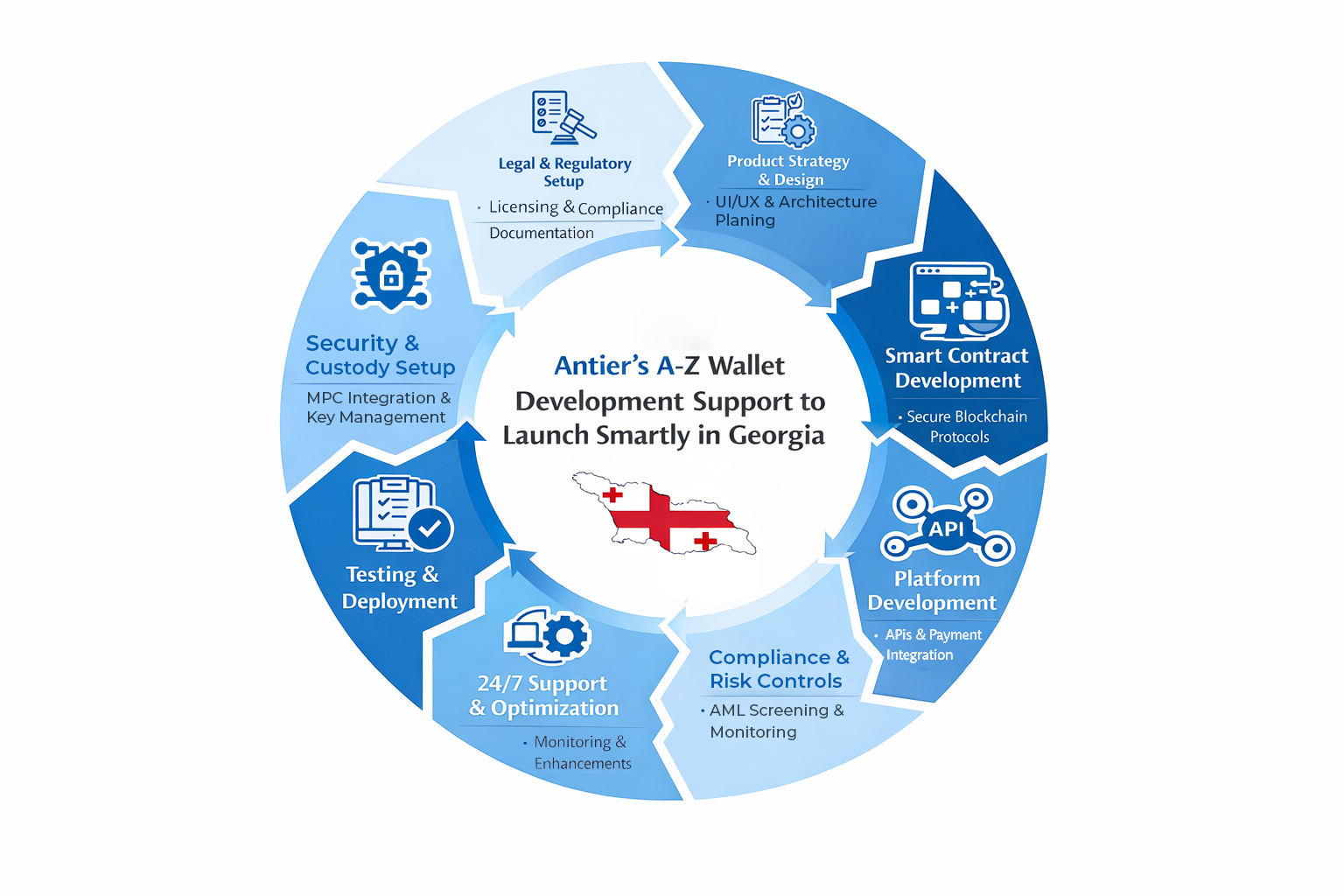
There are numerous reasons why Antier is an ideal cryptocurrency wallet development company you would hire. The most important reason is that it offers end-to-end services right from the start to the end.
- End-to-end product delivery: Antier takes a turnkey approach from scoping and compliance design to engineering and post-launch operations. The offer includes product strategy, UI/UX, smart contract engineering, backend custody architecture, and API design. Antier designs the compliance layer to local licensure specifications and implements AML/KYC workflows that can be adapted as regulation evolves.
Regulatory liaison and legal scaffolding:Antier’s legal operations team maps local VASP requirements and prepares licensing-ready documentation, AML policies, and technical controls that regulators expect. This removes friction and accelerates time-to-market for an onshore operation.
Security and operations:Antier implements MPC custody, HSM integrations, and layered monitoring. Post-launch, Antier offers 24/7 SOC, SRE-led uptime guarantees, and incident playbooks so investors do not inherit operational gaps.
Commercialization and integrations:Antier provides merchant SDKs, POS integrations, and stablecoin corridor negotiations so the wallet starts with revenue-generating flows. Antier can also support pilot programs for remittances, tourism payments, and enterprise payroll to demonstrate traction rapidly.
Investor-friendly deliverables:A clear product roadmap, investor dashboards with KPIs, compliance attestations, and a tested incident response process make the wallet a defensible infrastructure asset for institutional portfolios.
Hire To Achieve a Production-Ready Wallet Today!
For serious investors, white label cryptocurrency wallet development in Georgia is a capital-efficient infrastructure play that aligns with national fintech priorities, remittance economics, and merchant modernization. The market signals are clear: regulators are preparing frameworks that reward compliance-first entrants, the fintech ecosystem is capable of driving adoption, and on-the-ground commercial pilots prove the product-market fit. The right technical architecture, combined with a proven compliance and operations partner, turns regulatory and operational risk into a sustainable moat.
Connect with our team today. Being one of the leading blockchain wallet development companies, we bring the legal expertise, technical depth, and operational discipline necessary to deploy an enterprise-grade wallet in Georgia. We design custody that institutional investors accept, compliance that local regulators approve, and product features that drive merchant and consumer adoption. If you are evaluating infrastructure plays in Web3, a licensed, secure, and commercially integrated Web3 wallet built to these specifications should be at the top of your diligence pipeline. m
Frequently Asked Questions
01. Why is a crypto wallet considered a strategic tool for Georgia?
A crypto wallet enhances financial resilience, optimizes remittances, enables tourism and commerce, ensures onshore compliance, and serves as a platform for programmable public goods.
02. How does Georgia's fintech strategy support the development of crypto wallets?
Georgia's fintech strategy promotes sandboxing, open APIs, and compliance-first innovation, creating a favorable regulatory environment for enterprise-grade crypto wallets.
03. What is the significance of Georgia's position in the Web3 landscape?
Georgia is emerging as a regional fintech hub with a growing community and supportive policies that recognize blockchain as essential infrastructure, fostering innovation and regulatory alignment.