



AI Summary
- The gaming industry is evolving with play-to-earn (P2E) game development, where players earn real-world value for in-game achievements.
- P2E games utilize blockchain technology, offering ownership of assets like NFTs and rewarding players with tokens.
- Casino games feature NFT slot machines and crypto-powered poker, while strategy games involve tokenized land ownership and resource trading.
- RPG games offer character NFTs and quest-based earnings.
- The future of P2E gaming includes AI-driven personalized rewards, Metaverse integration, and cross-genre interoperability.
The global gaming industry is undergoing a massive transformation as digital ownership and blockchain-powered economies change the way players interact with games. Central to this transformation is p2e game development, where players can be rewarded with real-world value for their in-game accomplishments. Play-to-earn is different from, but builds on, both free-to-play and premium traditional gaming models. Play-to-Earn aligns and builds on decentralized technology to create player economies, and means players will earn from their time spent playing—and not just play.
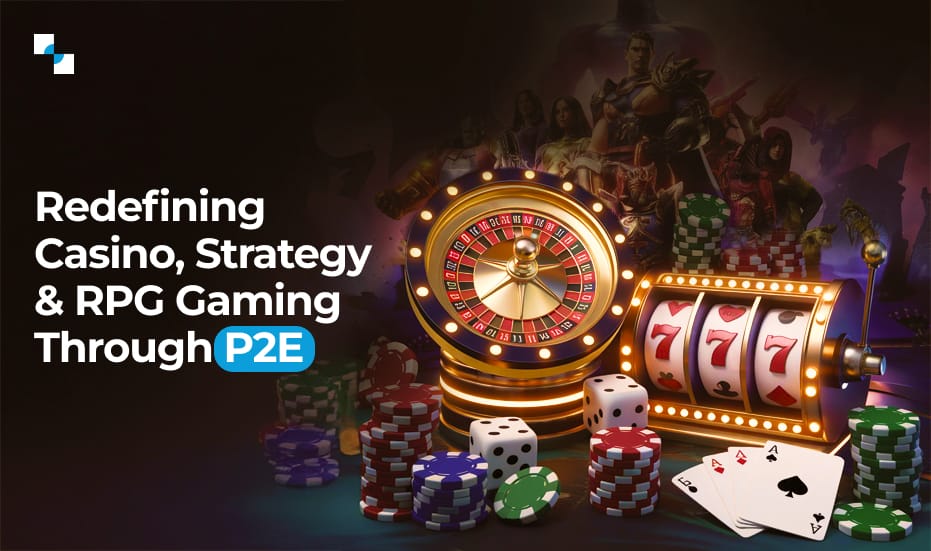
P2E games have the maximum potential in Casino, Strategy, and RPG games. These areas are an ideal fit for innovation with blockchain, developing immersive experiences where players can unlock, own, and trade digital assets. Let’s cover the use cases that will make them groundbreaking.
What Makes P2E Game Development Different?
In conventional gaming, players pour many hours of their time and other monetary commitments to play and progress in a game, but will never have veritable ownership of their efforts and merits in-game. P2E games enter the frame by challenging the direct players’ disadvantage from traditional gaming, which does not allow players ownership because of the model they use, which has proven to be unsustainable for developers and content creators. The fundamental components include:
- Tokenomics: Players earn tokens or cryptocurrency for in-game actions.
- NFTs: Characters, weapons, or items as NFTs that are tradable, ownable, or sellable.
- Smart Contracts: Each transaction is fully transparent with the use of smart contracts.
- In-Game Economies: Fully functional and self-providing.
Not only does this paradigm shift allow players to have ownership, but it also provides financial sustainability for developers and studios.
As of 2025, blockchain games account for 35% of all dApp activity – driven primarily by the play-to-earn model. This statistic is a testament to the growing popularity and success of P2E games in the gaming industry.
Common Use Cases of P2E Game Development
Casino Games
Casino titles thrive on luck, engagement, and repeat play, making them natural candidates for P2E NFT game development. Key use cases include:
- NFT Slot Machines – Players can actually own unique slot machines as NFTs instead of just spinning reels. Those machines could have unique themes, payout percentages that are above or below others, or unique jackpot pools specific to that machine. Those players could use their NFT slot machine or rent it to other players, meaning monetization beyond gaming.
- Crypto-Powered Poker & Blackjack – Since the inception of online gambling, transparency has always been a central concern. Blockchain-powered poker and blackjack have provable fairness by using smart contracts and verifiable outcomes related to intimidation. Players earn tokens from gameplay and staking their assets to play in tournaments with decentralized prize pools.
- Cross Chain Rewards – Most Casino P2E ecosystems span multiple cryptocurrencies, so players get multiple rewards, but it can be to requesters to manage or divest distant assets. A single jackpot could pay to any user in BTC, ETH, and project currency at once, making multi-asset earnings.
- Reward Pools & Shared Earnings – Players can put tokens in community token reward pools, and any winnings come back based on the proportion value of every player’s contributions. Having additional weight with the community share and stake of those tokens makes for easier work and engagement.

Strategy Games
Strategy games revolve around resources, planning, and collaboration, aligning seamlessly with P2E game development mechanics. Examples include:
- Tokenized Land Ownership – Virtual Land can be sold as NFTs, offering players ownership rights. The land can provide passive income in the form of resource production, taxes on other players, or resale in open markets. This imitates real-world land ownership and can fuel engagement for the long term.
- Resource Trading – Strategy games often revolve around resources like food, minerals, or energy. Since many resources can be tokenized, they become tradeable digital assets. Players mine, harvest, or craft resources in the games and trade them for cryptocurrency. This allows for a measurable in-game economy.
- DAO Governance – Many P2E strategy games allow players to vote on game-related policy decisions and strategies through mechanisms like Decentralized Autonomous Organizations (DAOs). This empowers players to vote on things such as battle policies and taxation systems, or who gets what land. It creates enhanced immersion and ownership.
- Guild Economies – Cooperation and social engagement have always existed in the social ecology of strategy games. In a P2E game, guilds become worlds of earning potential through collaboration that shares strategies, creates a communal economy, and shares earnings from invested labor for every player. This allows players to gain economic benefit from player-won control over in-game spaces.
- Seasonal Campaign Rewards – Competitive campaigns can reward participants with NFT or token drops as seasonal rewards. These NFT or token drops become limited edition assets that grow in value over time. As the value increases, players are incentivized to continue to engage with new game offerings with limited time frames across game cycles.
RPG Games
Role-playing games already immerse players in character-building and exploration, making them ideal for P2E NFT game development. Notable use cases include:
- Character NFTs – Every avatar could have the power to exist as an NFT, including changing skills, levels, and abilities. As players progress and level up, their character(s) gain rarity and market value. This allows for avatars to be sold or traded, making the fact that progression is not just a milestone in the game, but also makes it a real monetizable asset.
- Weapon &Gear Tokenization – Rare weapons, magical artifacts, and legendary gear could all be minted as NFTs. Rarities from the game have long-term value.” These items can be auctioned or rented out, creating new ways of income for players.
- Quest-Based Earnings – Typically, in traditional RPGs, quests will reward players with in-game coins or gear. Whereas in P2E, quests can output rewards in cryptocurrency or offer exclusive NFTs. For example, when one completes a particularly difficult quest to get to the bottom of some esoteric dungeon, one might find a rare NFT sword that could be worth significant value in a secondary market.
- Marketplace Trading – Both character trading, item trading, and trading collectible items should happen within a decentralized marketplace as part of systematic P2E-enabled RPGs. Those types of transactions create peer-to-peer economies, which allow the player/buyer to determine the value based on supply, demand, and rarity, contingent on the unique characteristics of that asset.
- Cross-Game Identity – Some P2E-enabled RPGs exist within an ecosystem that would allow players to move an NFT (whether it’s a character or item) across other games and experiences. This creates continuance, thus allowing for value and vast versatility of each asset across the greater Web3 ecosystem.
What’s Next for P2E Game Development?
Moving forward, P2E game development will partner with AI to provide personalized rewards, transition into the Metaverse with cross-genre interoperability, and develop assets that are not unique to any one title. These mechanics will extend beyond gaming and be used in education, healthcare, and fitness – tokenizing rewards for achievements.
From casino slots and tokenized strategy resources to RPG quests offering crypto rewards, P2E games include new ways to both design and monetize games while playing games differently. Think of different use cases, and identify just 1 where developers and businesses can create value through investigations while providing players ownership and financial empowerment.
If you are a business, studio, or entrepreneur looking to transform your gaming vision into a thriving blockchain-powered ecosystem, now is the time to explore P2E NFT game development. Partner with expert developers to create next-gen games that engage, reward, and scale globally.
Frequently Asked Questions
01. What is play-to-earn (P2E) game development?
Play-to-earn (P2E) game development allows players to earn real-world value for their in-game accomplishments, utilizing decentralized technology to create player economies and enabling ownership of digital assets.
02. How does P2E game development differ from traditional gaming models?
Unlike traditional gaming, where players do not have ownership of their in-game efforts, P2E games provide players with ownership through tokenomics, NFTs, and smart contracts, ensuring transparency and financial sustainability for developers.
03. What types of games are most suitable for P2E development?
P2E games have the highest potential in Casino, Strategy, and RPG genres, where players can unlock, own, and trade digital assets, creating immersive and engaging experiences.