




AI Summary
- Discover how Artificial Intelligence is evolving from experimental to essential in driving enterprise innovation and competitive edge.
- Dive into the 7-layer AI tech stack, decoding how each layer contributes to building enterprise-ready AI systems, from infrastructure to governance.
- Uncover the critical importance of a structured AI stack in overcoming operationalization hurdles and unleashing the full potential of AI at scale.
- Learn how a well-designed AI stack empowers enterprises to efficiently scale AI solutions, mitigate risks, ensure compliance, and align technology with strategic business objectives.
- Explore the pivotal role of AI consulting and development services in guiding organizations towards successful AI integration.
Artificial Intelligence is no longer experimental; it has become a core driver of enterprise innovation, operational efficiency, and competitive advantage. As organizations move from isolated AI pilots to production-grade deployments, understanding the underlying AI technology stack becomes critical. A structured AI stack helps enterprises design scalable, secure, and high-performing AI solutions that integrate seamlessly with existing systems.
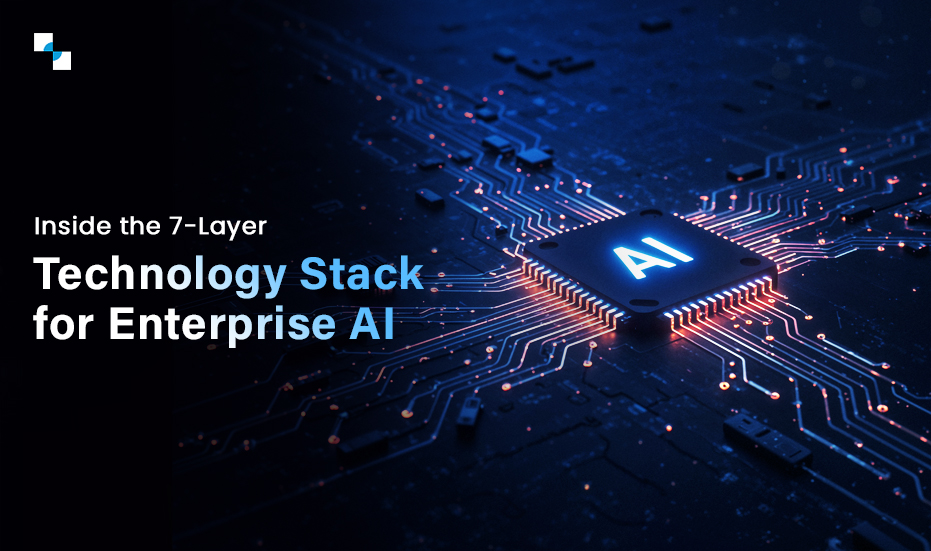
This blog explores the 7-layer AI tech stack, breaking down how each layer contributes to building enterprise-ready AI systems from infrastructure and data pipelines to model deployment and governance. Whether you’re evaluating enterprise AI development services or planning custom AI solutions, this guide provides a clear framework to build and scale AI with confidence.
Why Enterprises Need a Clear AI Tech Stack
Today’s enterprise landscape is witnessing rapid investments in AI. Global demand for AI consulting and development continues strong, with enterprise AI markets forecast to surge significantly in the coming decade. According to research, the global enterprise AI market, driven by automation, analytics, and intelligent decision-making, is projected to reach hundreds of billions by the early 2030s, with rapid adoption across industries.
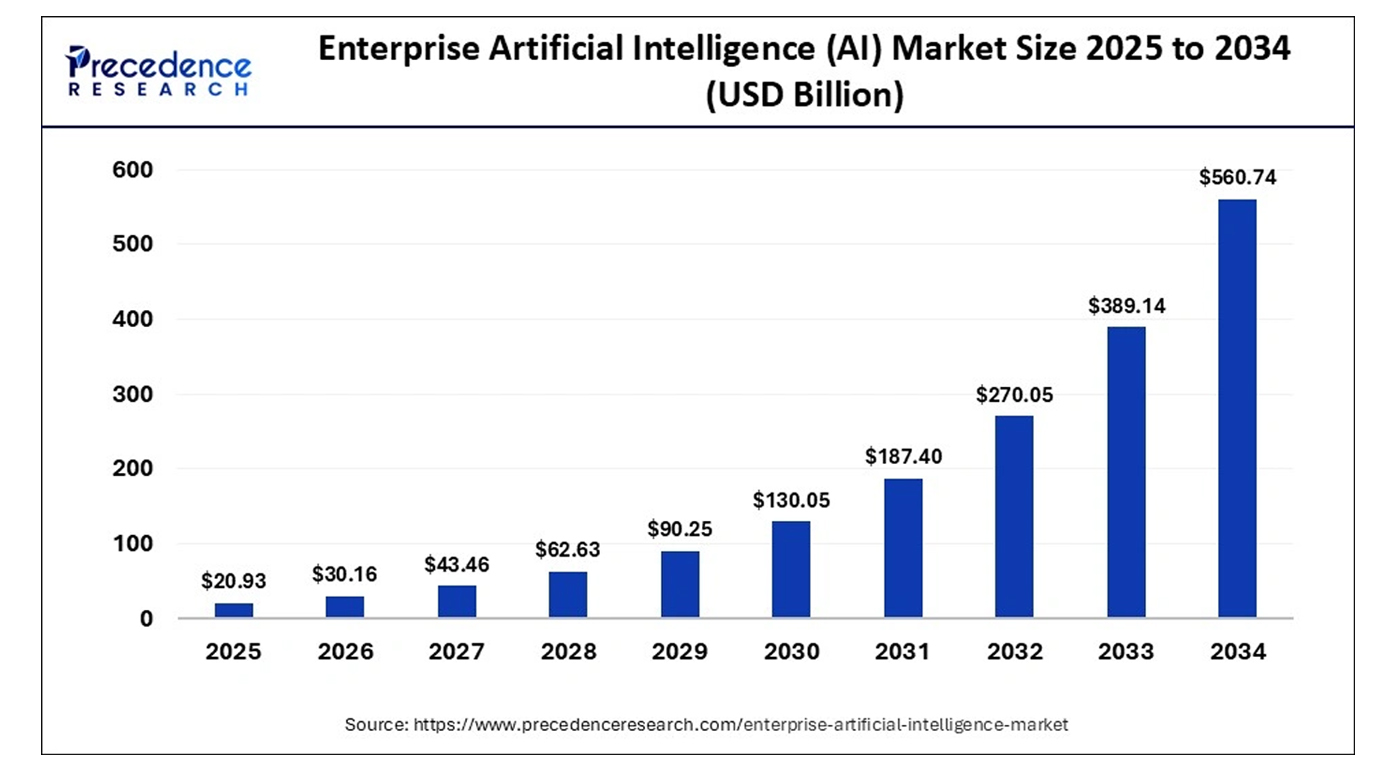
Source: https://www.precedenceresearch.com/enterprise-artificial-intelligence-market
Yet many organizations struggle to operationalize AI at scale. Industry reports show that while companies are eager to deploy AI, many initiatives stall in pilot phases due to a lack of infrastructure, tooling, or strategy.
This is where a well-designed AI development stack becomes indispensable; it provides a clear blueprint for assembling technologies and services that power AI products, from raw data ingestion to production-ready deployment.
What is an AI Tech Stack?
An AI tech stack is the layered combination of compute, data, frameworks, tools, and services that together support the full lifecycle of AI solutions from experimentation to deployment and ongoing operations. It’s similar to a traditional software tech stack but tailored for AI workloads, including machine learning, deep learning, inference, orchestration, and business applications.
By organizing components into layers, businesses can better allocate resources, reduce technical debt, and build robust solutions that support scalable artificial intelligence.
Understanding the 7 Layers of the AI Tech Stack
Below is a detailed breakdown of each layer in the 7-layer AI tech stack, explaining purpose, components, and enterprise value.
1. Infrastructure & Hardware Layer
At the base of the stack lies the AI infrastructure stack – the computational foundation that powers everything above it. This layer includes physical and virtual hardware resources that provide processing power, storage, and networking needed to build and run AI workloads.
Key Components:
- GPUs, TPUs, and specialized AI chips for training and inference.
- Cloud compute platforms (AWS, Azure, Google Cloud) for elastic scalability.
- High-speed networking and storage systems.
Why It Matters:
AI models, especially large language models and deep learning systems, require massive compute resources. Without the right infrastructure, enterprises can’t train models efficiently or serve real-time predictions at scale.
This layer is critical for enterprises seeking AI software development services that are both powerful and cost-efficient.
2. Data Structure & Processing Layer
Data is the lifeblood of AI. This layer focuses on preparing data into formats that AI models can learn from, collecting it, cleaning it, transforming it, and storing it in optimized databases.
Key Functions:
- Data pipelines (ETL/ELT) that extract data from sources.
- Data lakes and warehouses.
- Vector databases and feature stores for machine learning.
- Data governance, privacy, and compliance frameworks.
Enterprise Relevance:
High-quality data with proper governance ensures that AI models make accurate and unbiased decisions – a requirement for scalable enterprise AI. This layer supports the objectives of an AI development company in harnessing clean and compliant data.
3. Model Development & Training Layer
This is where AI models are designed, trained, and fine-tuned. It includes frameworks, libraries, and workflows that allow data scientists and engineers to build solutions efficiently.
Key Tools & Frameworks:
- Machine learning frameworks like TensorFlow and PyTorch
- Model experimentation and versioning tools
- Hyperparameter tuning systems
By standardizing on reliable model development tools, enterprises can reduce risks and shorten time to market when building custom AI solutions.
4. Orchestration & Deployment Layer
Once models are trained, this layer handles their packaging, deployment, and ongoing updates. It ensures models run efficiently in production environments.
Key Features:
- Containerization (Docker, Kubernetes)
- CI/CD pipelines for AI (MLOps)
- API gateways and microservices for model inference
This layer bridges technology and business applications, enabling enterprises to embed AI capabilities within core systems and products.
5. Tooling & Development Environment
This layer empowers developers and data scientists with interactive tools to build, test, and ship AI applications.
Examples Include:
- Integrated development environments (IDEs)
- Code generation tools, prompt builders, and agent developers
- Notebook environments and collaborative platforms
Tooling accelerates innovation and is a core component of AI consulting and development services provided by expert teams.
6. Inference & Runtime Layer
Inference is where trained models produce real-time predictions or insights. This layer ensures AI services respond to user requests with minimal latency and high throughput.
Components:
- Inference engines and APIs
- Load balancing and auto-scaling systems
- Real-time data streaming support
This layer supports intelligent business applications that power user-facing features, automation, and decision support across enterprise systems.
7. Monitoring, Maintenance & Governance Layer
The topmost layer ensures that once AI applications are live, they remain reliable, compliant, and continuously improved.
Key Functions:
- Performance monitoring (accuracy, latency, drift).
- Logging and compliance tracking.
- Model retraining workflows.
This layer is vital for enterprise AI development services that deliver long-term value rather than one-off projects, ensuring each deployed model adapts to evolving data and business needs.
How Enterprises Benefit from a Structured AI Stack
A well-defined AI stack enables enterprises to:
1. Scale AI Solutions Efficiently
Rather than ad-hoc experimentation, a layered stack provides a repeatable structure that accelerates deployment across departments and functions.
2. Reduce Risk & Improve Compliance
With dedicated layers for governance and data processing, enterprises can build responsible AI systems that adhere to regulations and ethical standards.
3. Align Business Needs with Technology
By integrating tooling, deployment, and monitoring layers with business workflows, the stack ensures technology supports strategic goals from customer service automation to predictive analytics.
The Role of AI Consulting and Development Services
Most enterprises lack internal expertise to build a comprehensive AI stack from scratch. This is why many turn to external AI solution providers and AI consulting and development experts to guide strategy, build capabilities, and manage implementation.
The global AI consulting market, encompassing strategy, deployment, and managed services, is rapidly expanding, with projected strong growth through the next decade.
By partnering with experienced firms offering enterprise AI development services, organizations can jump-start their AI journey with tailored solutions, optimized infrastructure, and sustainable support models.
Get a Custom AI Stack Architecture
Key Considerations for Choosing an AI Development Partner
When selecting an AI development company or AI solution provider, enterprises must look beyond tools and technologies. The right partner should combine technical depth, strategic insight, and long-term operational support to ensure sustainable AI success.
1. Proven Technical Competence
A capable AI partner should demonstrate hands-on experience across layered AI technology stacks. This includes expertise in cloud infrastructure, data engineering pipelines, AI model training, MLOps, and production-grade deployment. Strong technical competence ensures AI solutions are scalable, secure, and enterprise-ready from day one.
2. Ability to Deliver Custom AI Solutions
Every enterprise has unique data, workflows, and business objectives. An effective AI partner should be able to design and deploy custom AI solutions tailored to specific use cases while ensuring seamless integration with existing systems. Support for scalable AI solutions allows businesses to expand AI capabilities as needs evolve.
3. Strategic AI Consulting Expertise
Beyond implementation, enterprises need guidance on how AI aligns with broader business goals. A strong AI consulting and development partner provides strategic roadmaps, use-case prioritization, and governance frameworks that help organizations move from experimentation to measurable business outcomes.
4. End-to-End Lifecycle Support
AI initiatives do not end at deployment. Enterprises should look for partners offering full lifecycle support, including monitoring, performance optimization, compliance management, and model retraining. Continuous oversight ensures AI systems remain accurate, reliable, and compliant as data and market conditions change.
Building Enterprise AI with a Layered Technology Stack
Understanding the 7-layer AI tech stack is essential for enterprises looking to move beyond isolated AI experiments and achieve scalable, production-ready intelligence. Each layer, from infrastructure and data pipelines to model deployment and governance, plays a critical role in transforming AI into a reliable, enterprise-grade capability.
As demand for secure and scalable AI solutions continues to grow, organizations must adopt a modular, future-ready AI development stack that supports long-term innovation. Antier, a leading AI development company, helps enterprises design and implement end-to-end AI solutions aligned with business goals, enabling sustainable growth, operational efficiency, and competitive advantage in the AI-driven enterprise era.