



AI Summary
- Revolutionizing traditional real estate markets, tokenized real estate is transforming property investment models by making properties digital, tradable, and divisible.
- This innovative approach allows for fractional ownership, enhanced liquidity, automated income distribution, and transparent on-chain records.
- Market forces like institutional demand, technology maturity, and regulatory evolution are driving the shift towards tokenized assets, providing benefits such as diversified investment opportunities and improved market efficiency.
- Real estate tokenization development companies play a crucial role in developing platforms with smart contracts and AI capabilities to support these advancements.
- The rise of fractional ownership models, institutional adoption, smart contract-driven income distribution, AI-driven analytics, and cross-border investment opportunities are among the key trends shaping the real estate tokenization landscape in 2026.
Traditional real estate markets have faced issues like low liquidity, complicated transactions, and limited investor participation, which are now being resolved with the help of tokenized real estate, wherein the process of effortless transfer of real estate is facilitated using blockchain technology. With the help of property tokenization, organizations are now able to overcome the issues faced in traditional real estate, thereby fueling the need for effective real estate tokenization development Company solutions.
How Tokenization Is Redefining Property Investment Models
Tokenization is revolutionizing the field of property investment by making properties digital, tradable, and divisible. Property tokenization allows for the division of high-value properties into smaller units, making it possible for investors to own a stake in them even without large amounts of capital.
A real estate tokenization development company is essential in ensuring the tokenization of properties. This is because they develop platforms that incorporate smart contracts and other relevant technologies. This ensures that investors can have a dynamic platform for investing in properties.
- Fractional ownership lowers entry barriers and enables portfolio diversification
- Enhanced liquidity allows investors to trade property-backed tokens more efficiently
- Smart contracts automate rental income and dividend distribution
- Transparent, on-chain records ensure trust and auditability
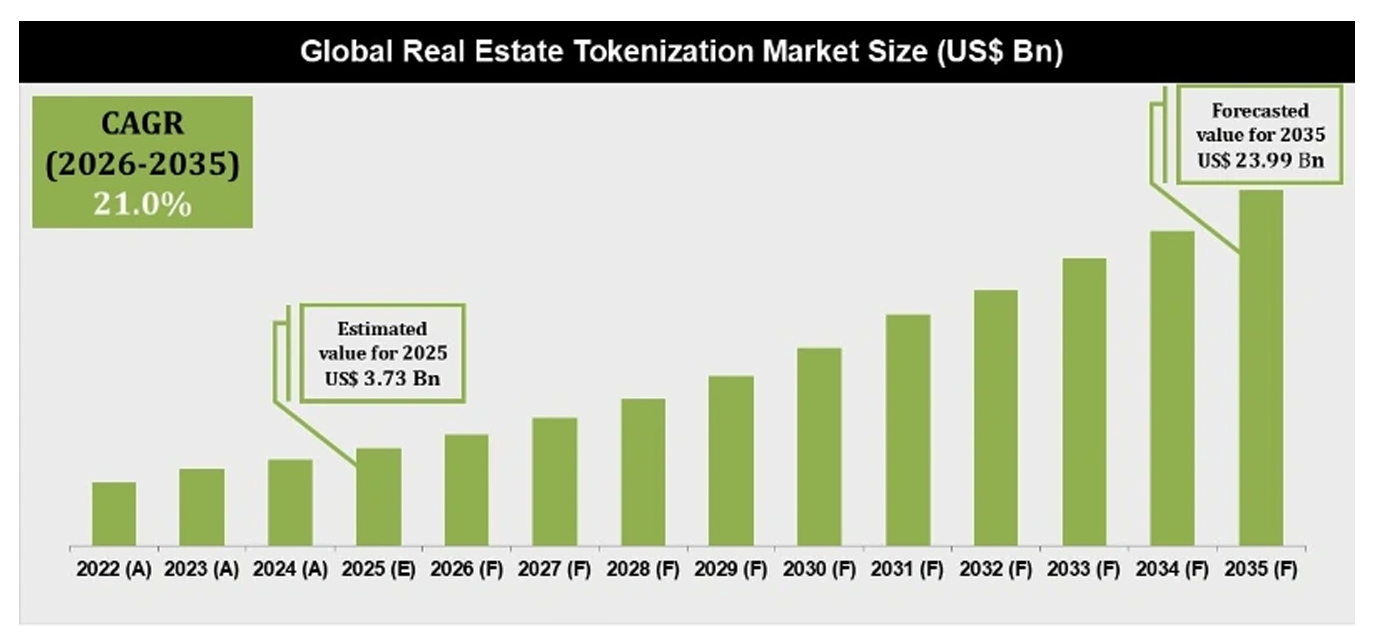
Source: https://www.insightaceanalytic.com/report/real-estate-tokenization-market/2782
Market Forces Driving the Shift Toward Tokenized Assets
The rapid growth in the trends for real estate tokenization in 2026 is attributed to the convergence of institutional demand, technology maturity, and regulatory evolution. As the global market becomes more interconnected, traditional real estate markets face challenges in meeting the need for liquidity, speed, and accessibility.
1. Institutional Capital Entering the RWA Ecosystem
Institutional investors are allocating capital toward tokenized real estate to diversify portfolios and access stable, yield-generating assets.
- Growing participation from asset managers, hedge funds, and private equity firms
- Preference for compliant platforms developed by a real estate tokenization development Company
- Increased standardization in asset structuring and reporting
- Rising demand for stable, income-generating digital assets
2. Demand for Liquidity in Traditionally Illiquid Markets
Tokenization addresses one of real estate’s biggest challenges—illiquidity—by enabling faster and more flexible asset trading.
- Partial ownership enables investors to liquidate fractions of assets
- Faster exit opportunities through secondary marketplaces
- Improved price discovery through increased trading activity
- Unlocking of capital for developers and property owners
3. Maturation of Blockchain Infrastructure
Advancements in blockchain technology are making property tokenization scalable and secure for enterprise use.
- High-performance networks enabling faster transactions
- Lower transaction costs compared to traditional systems
- Interoperability across blockchain ecosystems
- Robust smart contract frameworks ensuring reliability
4. Regulatory Clarity and Compliance Frameworks
Evolving regulatory frameworks are providing the clarity needed to scale tokenized real estate globally.
- Introduction of digital asset and security token regulations
- Integration of KYC/AML compliance within token ecosystems
- Reduced legal uncertainty for enterprises and investors
- Support for cross-border investment participation
5. Rise of Global, Borderless Investment Demand
Tokenization is enabling investors to access international property markets without geographical constraints.
- Simplified cross-border investment processes
- Reduced dependency on intermediaries
- Faster transactions with lower fees
- Expansion of global investor networks
6. Convergence of AI and Data-Driven Decision Making
AI is enhancing the efficiency and intelligence of real estate tokenization development services.
- Predictive analytics for property valuation and market trends
- Real-time monitoring of asset performance
- Automated portfolio management
- Improved risk assessment frameworks
7. Shift Toward Digital-First Asset Management
Enterprises are adopting digital-first platforms to streamline operations and improve scalability.
- End-to-end digitization of asset lifecycle management
- Integration of investor dashboards and analytics tools
- Automation of manual workflows
- Enhanced user experience and investor engagement
8. Emergence of Secondary Markets and Trading Infrastructure
Secondary marketplaces are transforming tokenized real estate into a liquid and tradeable asset class.
- 24/7 trading capabilities for property tokens
- Increased liquidity attracting diverse investors
- Real-time price discovery mechanisms
- Development of regulated trading platforms
9. Growing Trust in Blockchain-Based Ownership Models
Blockchain is strengthening trust in digital ownership through transparency and immutability.
- Tamper-proof ownership records
- Reduced risk of fraud and disputes
- Transparent audit trails
- Increased adoption among institutional players
10. Enterprise Demand for New Revenue and Business Models
Enterprises are leveraging tokenization to unlock new growth opportunities.
- Monetization of underutilized real estate assets
- Creation of innovative investment products
- Expansion into global markets
- Competitive differentiation through digital transformation
Discover the Right Tokenization Strategy for Your Property Assets!
Top Real Estate Tokenization Trends 2026
With the increasing adoption of blockchain in the property industry, the concept of tokenized real estate is gradually shifting from an emerging trend to an integral part of the industry. Many businesses, investors, and governments are keenly exploring the concept of property tokenization. With the integration of various technologies and regulatory advancements, the property industry is shifting towards a new wave of real estate tokenization development services.
1. Fractional Ownership Models
Fractional ownership is redefining how real estate assets are accessed and funded by breaking down high-value properties into smaller, tradable digital units. Within tokenized real estate, this model enables investors to purchase fractional shares of premium assets—ranging from commercial buildings to luxury residential properties—without the need for large upfront capital. As property tokenization platforms mature, fractionalization is becoming more structured, compliant, and accessible across global markets.
This shift is not only democratizing investment but also improving capital efficiency for asset owners, who can unlock liquidity without divesting full ownership. Enterprises leveraging real estate tokenization development services are increasingly designing fractional ownership frameworks that support multi-asset portfolios and cross-border participation.
- Enables broader investor participation, including retail and international investors
- Allows asset owners to unlock capital while retaining partial ownership
- Enhances liquidity through divisible and tradable ownership units
- Supports diversified investment strategies across multiple properties
2. Institutional Adoption of Tokenized Real Estate
Institutional adoption is shaping up as a key driver of real estate tokenization trends 2026. Large financial institutions, asset managers, and private equity players are actively investigating tokenized real estate as a solution to revamp portfolio management and leverage new liquidity routes.
The real estate tokenization development company plays a significant role in facilitating institutional-grade infrastructure development, which is compliant, secure, and scalable by design. With institutional players tokenizing large-scale real estate portfolios and launching blockchain-based real estate funds, the real estate tokenization market is moving from a testing and experimental phase to a financial product paradigm.
- Growth of institutional-grade tokenized real estate funds and investment vehicles
- Increased standardization in asset structuring and reporting
- Enhanced trust and credibility in blockchain-based property investments
- Acceleration of mainstream adoption driven by large capital inflows
3. Programmable Rental Income Distribution
One of the most significant contributions that property tokenization has seen is the ability to automate the distribution of rental income through smart contracts. The traditional way of distributing rental income is through various intermediaries, which is not very efficient. On the other hand, tokenized real estate platforms provide a real-time rule-based system that allows investors to receive rental income according to their share.
The programmability of this system not only makes it more efficient but also increases trust among investors by being transparent. Enterprises that are using real estate tokenization development services are using advanced smart contract mechanisms to handle complex revenue models.
- Real-time and automated distribution of rental income and dividends
- Elimination of intermediaries, reducing operational costs
- Transparent and auditable payout mechanisms
- Increased investor confidence through predictable cash flows
4. On-Chain Property Data Integration
The incorporation of property data from the real world into blockchain has greatly enhanced the efficiency and accuracy of tokenized real estate platforms. This has ensured that investors get real-time information regarding their properties based on their performance.
This has emerged as an essential part of sophisticated real estate tokenization development services. This has ensured that investors make more informed decisions and that there is no asymmetry of information.
- Real-time tracking of asset performance metrics
- Improved transparency through verifiable data integration
- Data-driven decision-making for investors and asset managers
- Reduced risk of discrepancies and data manipulation
5. AI-Driven Property Valuation & Risk Analytics
Artificial intelligence is playing an important role in augmenting the intelligence of tokenized real estate markets. With the ability to process large amounts of market data, trends, and macro-economic factors, artificial intelligence can provide accurate valuations and project future performance.
Artificial intelligence, in conjunction with real estate tokenization development services, is providing investors with critical insights and allowing them to make more informed and strategic decisions in property investments.
- Dynamic and data-driven property valuation models
- Predictive analytics for identifying high-growth opportunities
- Enhanced risk management through real-time insights
- Improved investment decision-making across portfolios
6. Expansion into Non-Traditional Property Assets
The scope of property tokenization is increasing and is no longer limited to traditional property types such as residential and commercial properties. Instead, other forms of assets are emerging, such as land plots, co-working properties, storage properties, parking properties, and energy-related properties. This is providing new opportunities and allowing asset owners to monetize their resources that were previously not utilized effectively. Businesses that are using real estate tokenization development services are coming up with platforms that are able to support different types of properties.
- Creation of new tokenized asset categories beyond conventional real estate
- Increased opportunities for niche and alternative investments
- Enhanced revenue potential for asset owners
- Broader participation across diverse investor segments
7. Cross-Border Real Estate Investment
The tokenization of assets is breaking geographical barriers, thereby facilitating smooth international investment in tokenized real estate. One can now explore global property markets without facing the complications associated with conventional international transactions, such as currency exchange, legal hurdles, etc.
By using real estate tokenization development services, one can easily add features that facilitate international investment in property. This is a growing phenomenon that is broadening the investor community.
- Access to international property markets without physical presence
- Faster and more efficient cross-border transactions
- Reduced costs associated with intermediaries and legal processes
- Expansion of global investor networks and opportunities
8. Embedded On-Chain Compliance (KYC/AML)
Compliance is increasingly becoming an essential feature of tokenized real estate platforms, with the KYC/AML process integrated as an inherent feature of the tokens. This ensures that only eligible investors are allowed to participate in the market, reducing the regulatory risks.
A real estate tokenization development company helps in the integration of compliance mechanisms that adhere to international regulatory norms, which is crucial in the context of institutional investors, as they need to comply with the regulations.
- Automated investor verification and onboarding processes
- Reduced compliance costs and operational complexity
- Alignment with global regulatory standards
- Increased trust among institutional and retail investors
9. Secondary Markets for Property Tokens
The creation of secondary markets is changing tokenized property into a liquid and tradable asset class. Investors are able to trade property-backed tokens on regulated markets.
The creation of secondary markets is one of the leading drivers of real estate tokenization trends 2026. Liquidity is crucial in attracting both retail and institutional investors. Trading is being added to platforms developed using real estate tokenization development services.
- 24/7 trading of tokenized property assets
- Improved liquidity and faster exit opportunities
- Real-time price discovery mechanisms
- Attraction of a broader and more diverse investor base
10. Government & Land Registry Tokenization Initiatives
Different governments and public entities are seeking blockchain technology-based solutions to revamp the existing systems of land registries and property ownership. These efforts are further solidifying the legitimacy and scaling of property tokenization.
By partnering with a real estate tokenization development company, governments can establish transparent and tamper-proof systems that can help them eliminate inefficiency and reduce fraudulent activities. This trend is likely to contribute significantly to the global adoption of tokenized real estate.
- Development of blockchain-based land registry systems
- Increased transparency and reduction in ownership disputes
- Faster and more efficient property registration processes
- Stronger alignment between public infrastructure and digital asset ecosystems
Final Thoughts
As the real estate tokenization trends 2026 continue to gain traction, the move towards tokenized real estate is becoming a strategic imperative, not an emerging opportunity. Businesses that are embracing tokenization in the real estate industry today are not only providing liquidity and transparency in their businesses; they are also leading the way in an emerging digital asset economy.
With the use of advanced real estate tokenization development services and a trusted real estate tokenization development company, businesses are able to create scalable and future-proof platforms that provide new revenue streams and global investment opportunities.