





AI Summary
- In 2025, blockchain trends are moving towards real-world adoption and practical applications.
- From enterprise stablecoin payments to on-chain government bonds, the year ahead will see significant progress in blockchain development.
- Understanding these trends is crucial for businesses to make informed technology investments, reduce risks, strengthen competitive advantage, lower operational costs, ensure regulatory readiness, and enhance long-term product design.
- Key trends for 2025 include enterprise adoption of stablecoins, government bonds moving onchain, legal recognition for DAOs, reuse of blockchain infrastructure, improved app discovery through crypto app stores, converting crypto owners into users, and abstraction layers hiding blockchain complexity for a seamless user experience.
- By staying ahead of these trends, businesses can navigate the evolving digital economy successfully.
As blockchain continues to mature, 2025 is shaping up to be a year of measurable progress, real-world adoption, and architectural consolidation. While previous cycles emphasized hype and theoretical use cases, the latest blockchain trends reflect a more grounded direction. From enterprise stablecoin payments to on-chain bond experimentation, the year ahead will push blockchain development closer to mainstream infrastructure. Here’s a detailed overview of the top blockchain trends that will matter for enterprises, builders, and solution providers in 2025. But before moving further, it’s important to understand the factors that make blockchain trends in 2025 crucial for businesses.
Reasons Why Businesses Should Pay Attention to Blockchain Trends in 2025
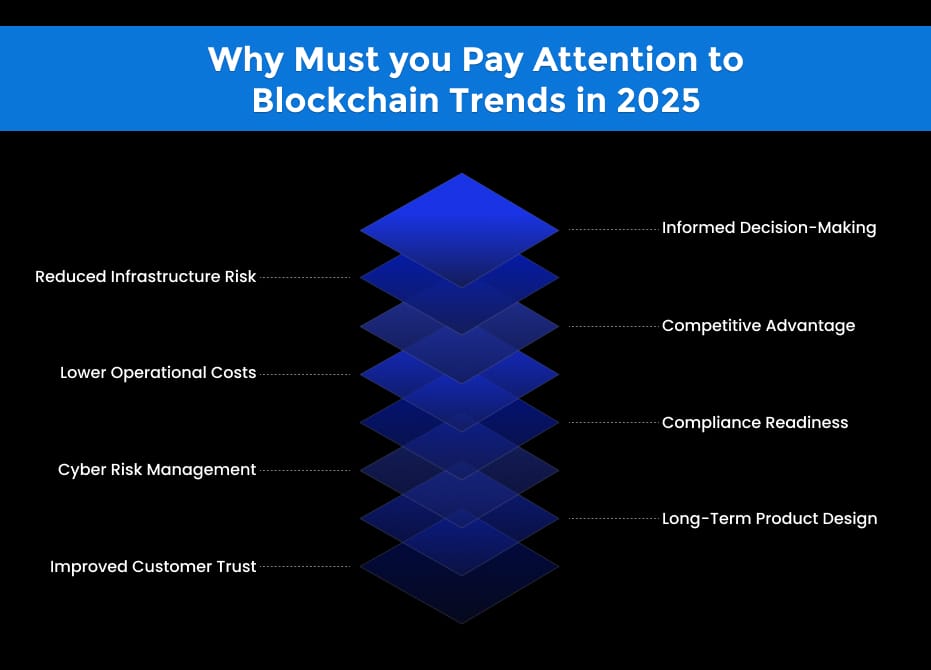
Informed Decision-Making for Technology Investment
Understanding the latest blockchain trends allows businesses to make grounded choices about where and how to allocate resources. Whether building in-house capabilities or choosing third-party vendors, knowing which technologies are gaining real traction helps avoid waste and improve long-term ROI.
Reducing Vendor and Infrastructure Risk
B2B companies often rely on long-term contracts and integrations. Staying updated on blockchain future trends 2025 ensures that systems selected today won’t become obsolete tomorrow. It also helps avoid the risk of depending on providers or standards that may not last.
Strengthening Competitive Advantage
Being early to adopt a trend doesn’t guarantee success, but being late often comes at a cost. Businesses that recognize which top blockchain trends are commercially viable can launch better products, offer faster services, or improve internal processes, while others are still evaluating options.
Lowering Operational Costs
Blockchain-based systems, especially across layer 2 blockchain market trends, are opening up more cost-effective ways to handle transactions, settlement, data sharing, and contract execution. Understanding which models are scaling helps companies cut costs while maintaining control.
Ensuring Regulatory and Compliance Readiness
Legal frameworks are evolving in parallel with blockchain adoption. Businesses that understand blockchain technology trends 2025 can align their operations with emerging standards, reducing exposure to fines, audits, or rework due to non-compliant practices.
Building Security from the Ground Up
Cyber risk increases as more data and value move on-chain. Awareness of blockchain security trends 2025 equips companies to design their systems with better access control, fraud protection, and real-time monitoring, critical for business continuity and client trust.
Supporting Long-Term Product and Service Design
When internal teams know where blockchain is heading, they can plan product roadmaps with more clarity. Engineering decisions made with trend foresight can avoid future rewrites or pivots. This improves delivery timelines and customer satisfaction.
Enhancing Partner and Customer Trust
Clients and partners expect B2B firms to stay updated. A company that understands the evolving blockchain space can advise, adapt, and co-build with partners more confidently. This adds to credibility and long-term relationship value.
Top Blockchain Trends 2025
1. Enterprise Adoption of Stablecoins for Payments
Stablecoins have already proven their utility in peer-to-peer transactions, but 2025 will mark a new phase, i.e., enterprise adoption. Their ability to move dollars globally at low cost, without intermediaries, makes them an appealing alternative to traditional payment rails. Retailers, food chains, and service providers, particularly those sensitive to transaction fees, are beginning to experiment with stablecoin-based payments.
A coffee shop losing $0.30 per sale to credit card fees is watching its margins erode. With stablecoins, that friction is removed. Larger enterprises are also taking notice. There’s growing recognition that stablecoin adoption could eliminate significant layers of cost, fraud overhead, and settlement delays.
As regulatory clarity improves, expect a marked increase in trials, stablecoin acceptance at checkout, and B2B payment arrangements settled directly onchain.
2. Government Bonds Move Onchain
A new form of digital asset is emerging: interest-bearing, government-backed instruments issued directly on blockchain networks. These onchain government bonds promise transparency, accessibility, and programmability, without tying citizens into central bank digital currencies.
Countries like the UK are already exploring this model through sandbox frameworks. For the U.S., 2025 will be a critical year, as regulatory agencies assess whether blockchains can simplify treasury clearing processes.
These products are not only appealing to governments and financial institutions. DeFi platforms may also use them as collateral for lending and derivatives markets. If adopted at scale, on-chain bonds could drive demand for public chain infrastructure from institutional actors previously hesitant to engage.
3. DAOs Get Legal Muscle with the DUNA Model
The DUNA (Decentralized Unincorporated Nonprofit Association) model is fast becoming the legal framework of choice for U.S.-based DAOs. Originating in Wyoming, this structure recognizes DAOs as legitimate legal entities while limiting liability and clarifying tax obligations.
In 2025, more states may adopt similar laws, making the DUNA model the standard for U.S. projects looking to scale in compliance with federal and state laws. Legal clarity enables decentralized networks to function more like formal businesses, entering into contracts, hiring teams, managing revenue, and solving disputes.
With DUNA-backed DAOs, token communities are better equipped to drive sustained development, launch compliant products, and expand economic activity without structural ambiguity.
4. Teams Will Reuse, Not Rebuild, Blockchain Infrastructure
Over the past few years, many blockchain projects have created proprietary stacks, new validator sets, consensus mechanisms, and programming languages. In 2025, this reinvention trend will slow down.
Instead, expect more reuse of proven tools. Builders are likely to tap into existing infrastructure such as established consensus protocols, modular proof systems, and widely used development frameworks.
This shift allows project teams to focus on their core offering, whether it’s a payment solution, a gaming experience, or a tokenized data network, instead of spending months recreating primitives. The result will be shorter development cycles, greater interoperability, and broader compatibility across ecosystems.
5. Discovery Improves: Crypto’s Own App Stores Gain Traction
One of the long-standing challenges for web3 products has been app discovery. Traditional distribution channels such as Apple’s App Store or Google Play are often restrictive, sometimes blocking apps over compliance or monetization concerns.
In 2025, dedicated crypto app stores are finally reaching meaningful scale. World App’s mini-app ecosystem and Solana’s dApp Store on mobile are early examples. These platforms offer users frictionless access to DeFi apps, games, identity tools, and more, often without requiring traditional downloads or permissions.
With better app discovery, crypto adoption becomes less reliant on niche communities and more about native distribution channels. Expect more web3-ready phones and portals to appear throughout the year, enabling developers to onboard users directly.
6. Crypto Owners Become Crypto Users
While hundreds of millions of people now own digital assets, only a small percentage actively use them. In 2025, the focus will shift toward converting these holders into daily participants.
As transaction costs fall and user interfaces improve, applications spanning stablecoin remittances, NFT ticketing, decentralized social platforms, and onchain gaming will attract new users from this pool. Simpler wallets, fewer steps, and better support will play key roles.
DePIN networks, prediction markets, and governance protocols will also benefit. Developers and product teams are working to reduce friction, enabling more people to interact with smart contracts, not just hold tokens.
7. Abstraction Layers Will Hide Blockchain Complexity
2025 is also likely to mark the arrival of consumer-facing products where blockchain’s complexity is invisible. Just as users don’t think about email’s SMTP protocol or how their browser handles SSL, blockchain-based apps will increasingly keep the technical details in the background.
The real growth will come from platforms that prioritize simple experiences, where terms like “wallet,” “gas,” or “zkRollup” aren’t part of the user journey. In many cases, applications will handle these steps in the backend.
These changes will help bring blockchain into everyday experiences. Whether it’s a loyalty program, a concert ticket, or an in-game item, users will care about utility and value, not the backend. The blockchain technology trends of 2025 will be marked not by flash but by utility hidden beneath an intuitive design.

Conclusion
Understanding blockchain trends 2025 isn’t just about technical foresight; it’s a practical step for B2B businesses to reduce costs, improve resilience, and stay relevant in a shifting digital economy. By observing and adapting to these latest blockchain trends, businesses can better prepare for a digital economy that is programmable, composable, and increasingly decentralized. Moreover, those looking to understand in detail about the blockchain trends must get in touch with experts at a renowned blockchain development company like Antier.