




AI Summary
- The blog post discusses the significant impact of the metaverse platform on education, highlighting trends shaping the future of learning in 2025.
- It emphasizes the shift towards immersive, personalized, and gamified learning experiences enabled by technologies like AI, blockchain, and XR.
- The metaverse offers higher engagement levels, enhanced collaboration, experiential learning opportunities, inclusivity, global classroom experiences, and data-driven insights.
- Key trends include personalized AI-driven learning environments, blockchain-based credentialing, gamified learning models, XR-driven simulations, and inclusive global experiences.
- By embracing the metaverse, educational institutions can provide interactive, engaging, and tailored learning experiences that prepare students for the digital-first world.
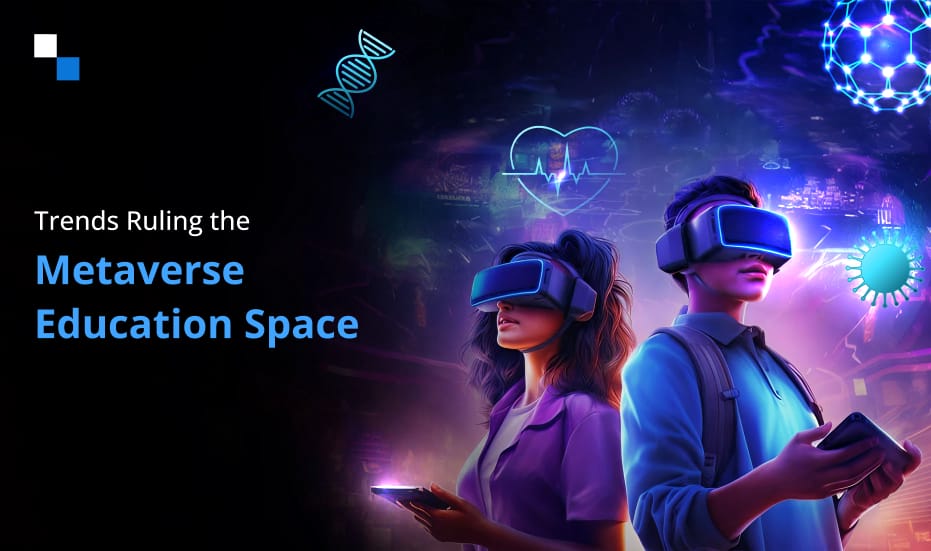
The pace of change in education is unprecedented, with advances in technology altering the ways that knowledge is delivered, grappled with, and enacted. At the core of this change is the metaverse platform for education—a digital universe that combines virtual reality, artificial intelligence, blockchain, and spatial computing to manifest a deeply immersive and interactive learning environment. Traditional classroom models are becoming increasingly antiquated by the primary offer, and even basic eLearning platforms are being displaced by alternatives that are more dynamic and engaging while offering each learner a virtual experience that replicates their ‘real world’ experience.
With 2025 in full swing, the trend of metaverse education platform development is gaining speed. Educational institutions, edtech startups, and corporate learning departments are each currently seeking to employ immersive technology that solves spatial, geographical, linguistic, and economic barriers. These platforms offer students and educators not only a more engaging method of collaboration and learning than flat video conferencing, but the examples continue: educators with students can see each other as avatars interact in 3D classrooms, while performing in-game simulations that replicate real-world situations. So, while the term metaverse often conjures up hype that outpaces analysis, it is not a trend but rather an emerging technology that is quickly becoming a no-brainer in terms of learning structure and delivery.
Why Metaverse in Education Matters Now More Than Ever
In the digital-first world we all occupy, it is clear that passive learning methods alone are not enough to keep students excited about their learning or prepare them for the real world any longer. The metaverse platform for education is about to shift that paradigm by transitioning to a virtual world that is still tactile and where learning is based on experience, collaboration, and personalization.
Here’s why the metaverse will become essential in education:
- Higher Levels of Engagement: Game-based learning environments, interactive simulations, and immersive storytelling have been shown to increase attention spans and lead to deeper retention.
- Enhanced Collaboration: Students can work together in real-time and space on collaborative group projects, lab simulations, and problem-solving activities even if they are apart.
- Learning to develop skills through experience: In the metaverse, students can simulate every hands-on practice, from a medical procedure to architectural design and planning, so they can learn risk-free and without fear of judgement.
- Inclusivity and Accessibility: Students with physical, sensory or learning disabilities can experience personalized learning experiences that are based on their individual needs.
- Global Learning Ecosystem: The metaverse eliminates geographical barriers so that students have access to global educators, peer groups, and cross-border academic programs.
- Data-Driven Insights: Integrated AI systems measure progress, levels of engagement, and emotions to provide educators with real-time updates.
With the escalating need for personalized, scalable, and tech-enabled education systems, investing in metaverse education platform development is no longer a choice but a necessity.
Top 5 Metaverse Trends for Education in 2025
The education industry is undergoing a significant transition from passive content consumption to immersive, gamified, and student-centric learning models as digital innovation reimagines what is possible in classrooms. As a transformational force that bridges virtual and physical learning environments, the metaverse platform for education is opening up new pedagogical experiences that are inclusive, scalable, and data-driven. Here are the top five trends in metaverse education platform development that all educators, policymakers, and institutions need to be aware of as 2025 unfolds as a crucial chapter in immersive learning.
1. Personalized Learning Environments Driven by AI
The use of artificial intelligence (AI) to develop tailored, responsive learning experiences is one of the most innovative developments in the metaverse platform for education. AI in the metaverse enables each learner to pursue a route customized to their pace, strengths, and preferences, in contrast to traditional classrooms where a one-size-fits-all approach is typical.
Imagine walking into a virtual classroom where your AI-powered avatar mentor is already familiar with your learning preferences, problem areas, and results from your most recent test. It instantly modifies the level of complexity of your assignments, suggests additional reading, and even provides tests at the optimal times for your cognitive abilities.
Key innovations include:
- AI avatars and tutors that offer real-time academic support
- Emotion recognition and sentiment analysis to detect student frustration or disengagement
- Predictive analytics that adapt lesson plans based on performance trends
- Gamified nudges that keep learners motivated through real-time insights
This level of personalization is now a fundamental component of metaverse education platform development, driving deeper engagement and better learning outcomes across all age groups.
2. Blockchain-Based Credentialing and NFT Certification
The legitimacy and transferability of online credentials are increasingly important as digital learning expands. Blockchain technology is being used more and more in metaverse platform for education solutions to provide tamper-proof degrees, certifications, and academic records in the form of NFTs (Non-Fungible Tokens).
In addition to being safe and verifiable, these digital assets can be transferred between universities and countries, resolving issues with lost transcripts, phony degrees, and inconsistent grading schemes. Academic credentials are now owned by students and can be used for future learning opportunities or shown in professional networks.
Highlights of this trend include:
- NFT diplomas and skill badges are stored securely on the blockchain
- Instant verification by employers, universities, and credentialing bodies
- Portfolios that evolve in real-time with skill progression
- Smart contracts for credit transfer and scholarship disbursement
This decentralized model is redefining academic transparency and scalability, becoming a core feature in the roadmap of every modern metaverse education platform development strategy.

3. Gamified and Play-to-Learn Models
Gamification has always been a source of engagement, but the metaverse builds on that concept. Inside a metaverse platform for education, learning becomes an interactive game space where students can earn points, complete missions, and obtain virtual recognition for academic progress.
For example, in a science module, students could enter into a quest where they explored a 3D jungle and identified plant species, collected digital specimens, and answered questions to level up. In these kinds of experiences, students not only improve knowledge retention but also practice critical thinking, teamwork, and problem solving.
Core elements of this trend:
- XP points, level-based progression, and achievement badges
- Interactive quests replacing traditional assessments
- Team-based learning challenges and tournaments
- Tokenized incentives, sometimes integrating real-world rewards
As gamified learning becomes mainstream, it’s being structurally embedded into metaverse education platform development to meet the cognitive preferences of Gen Z and Gen Alpha learners.
4. XR-Driven Realistic Simulations for Practical Learning
Extended Reality (XR), which includes Virtual Reality (VR), Augmented Reality (AR), and Mixed Reality (MR), has a big impact on experiential learning. A metaverse platform for education allows students to take part in lifelike simulations, giving them hands-on practice in safe virtual settings.
Think about medical students doing surgeries in an immersive VR lab or engineering students creating working prototypes with digital twins. These simulations don’t just teach theory – they help students build real-world skills without needing costly physical equipment.
Core benefits include:
- Immersive science labs for chemistry, biology, and physics
- Virtual field trips to historical sites or planetary systems
- Technical skill development for medical, aviation, and design domains
- Collaborative learning environments for group experimentation
Incorporating XR into metaverse education platform development empowers institutions to offer vocational training, corporate upskilling, and complex subject matter education more effectively than ever before.
5. Inclusive and Global-Classroom Experiences
The metaverse is making education global and culturally adaptive. A student in rural India can now attend a Harvard lecture or debate with peers from Africa, Japan, and the US in a virtual debate hall—all within the same metaverse platform for education.
This borderless model promotes global citizenship, cross-cultural empathy, and more equal access to quality education. Most importantly, it has adaptive features to support differently-abled learners so no one is left behind.
Key components of this trend are:
- Multilingual content and real-time translation tools
- Adaptive user interfaces for neurodiverse and disabled learners
- Cloud-based accessibility from low-end devices
- Unified academic hubs linking global institutions and learners
Metaverse education platform development will be designed with inclusivity as a first principle, so educational institutions can reach every learner regardless of location, language, or physical ability.
Future-Proofing Education Through Virtual Worlds
As the education landscape moves to hybrid and fully digital models, virtual worlds are no longer an experimental frontier—they’re a strategic imperative. From AI-guided learning journeys to blockchain-backed credentials and XR-powered simulations, the metaverse is where learning is not just consumed but experienced. By having a metaverse platform for education, institutions can unlock new dimensions of interactivity, engagement, and personalization, meeting the expectations of modern learners while staying ahead of technological disruption.
To truly future-proof education, schools, universities, and edtech providers must look beyond traditional platforms and invest in scalable, secure, and feature-rich virtual environments. That’s where metaverse education platform development comes in—offering custom-built solutions that align with curriculum goals, technological capabilities, and learner needs.
At Antier, we build metaverse solutions for the education sector. With expertise in immersive design, blockchain integration, and real-time collaboration frameworks, Antier helps institutions transform their learning environments into intelligent, inclusive, and interactive ecosystems. Whether you’re launching a virtual campus or building a fully integrated learning metaverse, our team is here to help you lead the next wave of digital education.
Get in touch with Antier—your partner in the metaverse education platform development journey.