




AI Summary
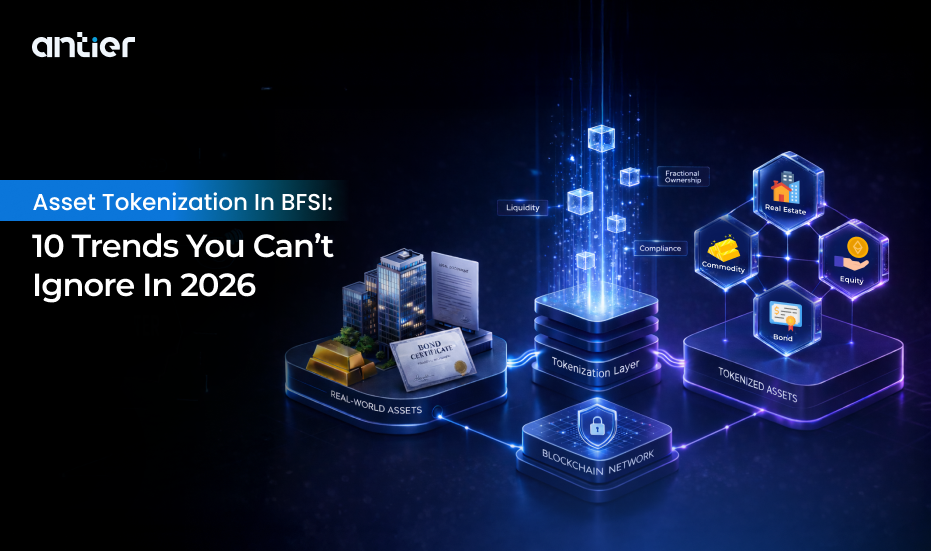
- In 2026, the finance industry is undergoing a significant transformation driven by asset tokenization, a process where ownership rights of real-world assets are converted into digital tokens on the blockchain.
- This innovation is reshaping the BFSI sector by enhancing efficiency, liquidity, and transparency.
- The top asset tokenization trends in 2026 include institutional adoption moving to production, fractional ownership democratizing investment access, convergence of tokenization and DeFi, expansion into multi-asset tokenization, AI-powered intelligence enhancing ecosystems, compliance-driven token standards, integration with legacy financial systems, emergence of secondary markets and liquidity hubs, development of regulated blockchain networks, and the emergence of DAO-based financial models.
- Antier is a leading technology partner offering specialized asset tokenization development services for BFSI enterprises looking to leverage the power of tokenization in their financial systems.
The world of finance finds itself at a pivotal point in its transformation journey, where digital innovation becomes more than just an option; it becomes an essential component. One of the key factors that has contributed immensely to this transformation process is the concept of tokenization. In 2026, Asset tokenization in the BFSI sector will not be in its nascent stages anymore; rather, it will be firmly established within financial institutions.
For financial institutions seeking to adapt their business models in this evolving market, recognizing the top asset tokenization trends in BFSI 2026 is vital.
Asset tokenization involves converting ownership rights of real-world assets into blockchain-based digital tokens. These tokens are programmable, divisible, and transferable making them highly efficient compared to traditional financial instruments.
Asset tokenization in financial services is witnessing accelerated adoption due to:
- Rising demand for fractional investments
- Increased need for liquidity in illiquid markets
- Enhanced transparency through blockchain
- Improved operational efficiency and cost reduction
Financial institutions are now leveraging tokenization not just as a product innovation but as a core infrastructure upgrade.
Top 10 Asset Tokenization Trends Transforming the BFSI Sector in 2026
The financial services landscape is witnessing a transformation that revolves around the concept of blockchain-led innovation in creating, managing, and trading assets. Tokenization is one such innovation that promises to play a vital role in creating the future of financial services. In 2026, Asset tokenization in the BFSI industry is not just confined to experimental projects but is revolutionizing capital markets, investment, and financial products in a big way.
This is due to growing participation from investors, regulatory developments, and changing expectations. The following blog discusses some of the Top asset tokenization trends in the BFSI industry in 2026.
1. Institutional Adoption Moves from Pilot to Production
A defining shift in asset tokenization trends 2026 is the transition from proof-of-concept initiatives to full-scale production deployments. Earlier, financial institutions explored tokenization through sandbox environments or limited pilots. However, in 2026, major banks, asset managers, and custodians are launching live tokenized products.
This evolution is driven by:
- Improved regulatory clarity across key financial hubs
- Maturity of blockchain infrastructure
- Proven ROI in operational efficiency and settlement speed
Institutions are now issuing tokenized bonds, structured products, and funds, reducing settlement cycles from days to near real-time. This significantly lowers counterparty risk and enhances capital efficiency.
As a result, adopting enterprise asset tokenization solutions for BFSI is becoming a core strategic initiative rather than an experimental investment.
2. Fractional Ownership Democratizes Investment Access
Fractional ownership continues to be one of the most transformative aspects of asset tokenization in financial services. Traditionally, high-value assets such as commercial real estate or private equity funds required significant capital investment, limiting access to institutional or high-net-worth investors.
Tokenization breaks this barrier by:
- Dividing assets into smaller digital units
- Allowing micro-investments
- Enabling broader participation across geographies
For BFSI institutions, this creates an opportunity to design innovative financial products tailored for retail investors. It also enhances liquidity, as fractional tokens can be traded more easily than entire asset units.
Moreover, fractionalization enables portfolio diversification for investors while unlocking dormant capital for asset owners—creating a win-win ecosystem.
3. Convergence of Tokenization and DeFi
The integration of decentralized finance (DeFi) with traditional finance is redefining asset tokenization in the BFSI sector. Tokenized assets are increasingly being utilized within DeFi protocols to enable programmable financial services.
Key use cases include:
- Using tokenized assets as collateral for loans
- Generating yield through liquidity pools
- Enabling automated lending and borrowing
This convergence is fostering hybrid financial ecosystems where traditional institutions can leverage DeFi’s efficiency without compromising on compliance.
For a forward-looking asset tokenization development company, building interoperability between DeFi protocols and traditional systems is becoming a key differentiator, enabling clients to unlock new liquidity channels and financial instruments.
Launch Your Asset Tokenization Platform with Our Experts
4. Expansion into Multi-Asset Tokenization
Tokenization is rapidly expanding beyond traditional asset classes. In 2026, BFSI institutions are exploring tokenization across a diverse range of assets, including:
- Commodities like gold, silver, and oil
- Trade finance instruments such as invoices and receivables
- Carbon credits and ESG-linked assets
- Intellectual property and royalties
This multi-asset approach enables financial institutions to create diversified investment platforms, catering to different risk appetites and investment goals.
Additionally, it allows institutions to tap into niche markets and unlock previously inaccessible asset classes, further strengthening the role of asset tokenization in BFSI sector as a growth driver.
5. AI-Powered Intelligence Enhances Tokenized Ecosystems
Artificial intelligence is playing a pivotal role in scaling and optimizing tokenized financial ecosystems. When combined with blockchain, AI introduces a layer of intelligence that enhances decision-making and operational efficiency.
Key applications include:
- Dynamic asset valuation based on real-time market data
- Predictive analytics for credit and risk assessment
- Automated compliance monitoring and fraud detection
These capabilities are critical for ensuring trust and transparency—two essential pillars for institutional adoption.
As a result, advanced Asset tokenization development services are increasingly integrating AI to deliver smarter, more adaptive platforms tailored to enterprise needs.
6. Compliance-Driven Token Standards Take Center Stage
Regulatory compliance is no longer a bottleneck—it is becoming a competitive advantage. In 2026, token standards are evolving to incorporate built-in compliance mechanisms.
Innovations include:
- Identity-linked token ownership
- Smart contracts enforcing jurisdiction-specific regulations
- Automated KYC/AML verification
These compliance-first frameworks enable seamless cross-border transactions while ensuring adherence to local laws.
For BFSI enterprises, leveraging such frameworks through a trusted asset tokenization development company ensures that tokenized offerings are both scalable and legally compliant, reducing risks associated with regulatory violations.
7. Integration with Legacy Financial Systems
A key trend in asset tokenization in financial services is the seamless integration of blockchain with existing financial infrastructure. Rather than replacing legacy systems, institutions are adopting a hybrid approach.
This includes:
- Connecting blockchain layers with core banking systems
- Enabling tokenized settlements alongside traditional clearing systems
- Integrating digital asset custody with existing custodial services
This approach minimizes disruption while allowing institutions to gradually transition to tokenized ecosystems.
Such integration is essential for delivering scalable enterprise asset tokenization solutions for BFSI, ensuring interoperability across systems and stakeholders.
8. Emergence of Secondary Markets and Liquidity Hubs
One of the biggest advantages of tokenization is the ability to create liquid markets for traditionally illiquid assets. In 2026, secondary markets for tokenized assets are gaining significant traction.
These markets enable:
- Continuous trading (24/7 availability)
- Global investor participation
- Faster price discovery
For BFSI institutions, this translates into increased trading volumes and new revenue streams. It also enhances investor confidence, as liquidity is a key factor in investment decisions.
The development of regulated digital exchanges and trading platforms is further accelerating this trend.
9. Development of Regulated Blockchain Networks
Purpose-built blockchain networks designed for financial institutions are becoming increasingly important. These networks address the specific requirements of the BFSI sector, including:
- High security and scalability
- Permissioned access controls
- Built-in compliance and identity management
Such networks provide a secure environment for issuing and managing tokenized assets, making them ideal for institutional use.
These advancements are strengthening the foundation of asset tokenization in the BFSI sector, enabling enterprises to deploy large-scale tokenization initiatives with confidence.
10. Emergence of DAO-Based Financial Models
Decentralized Autonomous Organizations (DAOs) are introducing innovative governance models in asset management. While still in the early stages within BFSI, their potential is significant.
DAO-based models enable:
- Transparent and decentralized decision-making
- Automated fund allocation through smart contracts
- Real-time distribution of profits and dividends
For financial institutions, DAOs offer an opportunity to reimagine fund management and investor engagement.
As tokenization matures, DAO frameworks are expected to complement traditional financial structures, creating hybrid governance models that enhance transparency and efficiency.
Transform Your Financial Assets into Digital Opportunities
Driving Tokenization Innovation with Antier
It is clear from Top asset tokenization trends in BFSI 2026 that asset tokenization has become an integral part of today’s financial systems. The influence of tokenization on the finance industry can be regarded as both powerful and extensive.
In the face of increasing demands for sophisticated enterprise asset tokenization solutions in BFSI, the selection of the right technology partner has become increasingly important.
Antier leads the way in adopting asset tokenization solutions through its specialized asset tokenization development services. The company is equipped with all the skills and experience required to offer world-class blockchain-based platforms to global BFSI enterprises.
With a team proficient in blockchain architecture and platform development, Antier helps businesses to adopt asset tokenization and take advantage of new opportunities.