



AI Summary
- The blog post discusses the rise of tokenized treasuries, where traditional U.S.
- government-backed securities are now digitized on the blockchain.
- This innovation offers increased transparency, automation, accessibility, and liquidity in trading.
- To ensure success, platforms must prioritize security, regulation compliance, speed of settlement, and scalability.
- Recent developments show significant growth in the tokenized treasury market, with milestones like Fidelity's tokenized Treasury fund launch on Ethereum and increased regulatory clarity.
U.S. Treasuries, the gold standard of safe investments, are finally catching up with the digital era. With Tokenized Tokenization Platform Development, these government-backed securities can now live on the blockchain as digital tokens. That means they’re easier to verify, trade, and even split into smaller chunks.
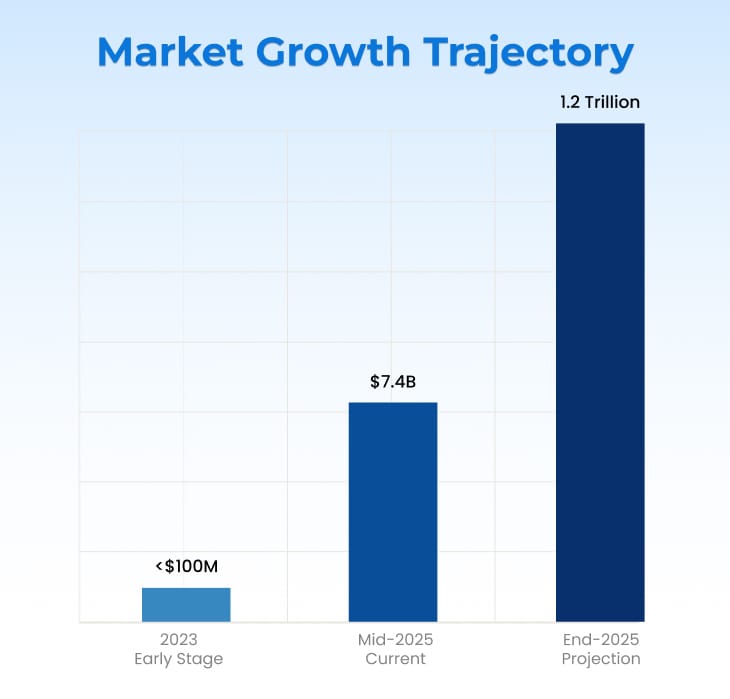
What looked like a niche play just a year ago (with under $100 million in 2023) has turned into a $7.4 billion market by mid-2025. And the projections say that tokenized assets could hit $1.24 trillion this year. Treasuries keep their reputation for safety, while blockchain brings in speed and efficiency; however, for this to scale, platforms must align with the investor’s demand. This guide explores key features that a tokenized treasury platform must support to unlock higher ROI and share the best user experience.
Understanding Tokenized Treasury Platforms
A Tokenization Platform Development takes traditional government securities, such as bills, notes, bonds, or even money market funds, and turns them into digital tokens on a blockchain. Each token represents ownership of the real asset, with smart contracts making sure rights, rules, and transfers are automatically enforced. This platform unlocks:
- Transparency – Every token move is permanently logged on the blockchain.
- Automation – Interest payments, compliance checks, and transfer rules can run on autopilot.
- Accessibility – Investors don’t need millions; they can get exposure to Treasuries with as little as $100.
- Liquidity – Tokens can trade peer-to-peer or be used as collateral in DeFi.
At present, Ethereum leads the space with about 72% market share, but new players are experimenting with permissioned chains (for tighter compliance) and Layer-2 networks (for faster, cheaper transactions).
If tokenized treasuries are going to become a trillion-dollar market, the platforms running them will require tighter security, lightning-fast execution, and the ability to handle massive scale.
Must-Have Features of Tokenized Treasury Platforms
Security: The Non-Negotiable Foundation
Institutions will not risk billions without rock-solid safeguards. While blockchain itself is resilient, vulnerabilities often arise in smart contracts, custody models, and governance.
What investors are looking for in a Tokenized Treasury platform in terms of security:
- Multi-signature wallets access to reduce the risk of insider compromise.
- Hardware Security Modules (HSMs) for military-grade key storage for custodians.
- On-chain KYC/AML to ensure only authorized investors participate, satisfying regulators.
- Zero-knowledge proofs (ZKPs) for private transfers without breaking auditability.
Regulation: Ensuring Legal Enforceability
For tokenized treasuries to be credible, they must operate within regulated frameworks. Without regulation, the ownership of a digital token may not be recognized as a legally enforceable financial claim. This is unacceptable for institutional investors and regulators alike.
Recent regulatory developments highlight this shift:
- The EU’s MiCA framework sets operational and custody standards for tokenized assets.
- The U.S. SEC’s Project Crypto introduces custody and reporting requirements tailored to digital securities.
Platforms are now expected to conduct regular smart contract audits, penetration testing, and continuous monitoring as part of compliance. It ensures that investor rights are protected and that platforms are accountable under the law.
Speed: Eliminating Settlement Friction
Settlement speed is another defining feature. Traditional treasury trades settle on T+1 or T+2 cycles, which creates liquidity bottlenecks and counterparty risks. Tokenized platforms replace this with T+0 atomic settlement, where transactions finalize instantly.
Enabling technologies include:
- Layer-2 scaling solutions (such as Ethereum’s Dencun upgrade) to reduce costs and increase throughput.
- Smart contract automation to handle yield distribution and collateralization in real time.
- Cross-chain protocols to enable secure and efficient asset movement across multiple blockchains.
In 2025, the Canton Network demonstrated repo transactions backed by tokenized Treasuries settling within seconds. This illustrates how instant settlement optimizes intraday liquidity, reduces risk exposure, and enhances composability within DeFi. For institutions managing trillions in cash reserves, speed is a competitive advantage.
Scale: Infrastructure for Trillions
Scale determines whether tokenized treasuries remain a niche innovation or evolve into the backbone of global liquidity markets. Tokenized treasuries will only become core financial infrastructure if platforms can support trillions in value and millions of transactions.
Essential requirements for scale include:
- Cross-chain interoperability to ensure seamless movement between Ethereum, Solana, and enterprise-grade blockchains.
- Modular ERC standards for easier integration with custodians, exchanges, and wallets.
Elastic infrastructure capable of absorbing spikes in transaction volumes without downtime. - Dynamic fee mechanisms to maintain fairness and stability during high network activity.
Fractionalization is also reshaping the market by opening U.S. Treasuries to global retail investors. This creates exponential growth in transaction volumes that only scalable platforms can handle. Looking ahead, the same infrastructure will support tokenization of real estate, carbon credits, and private debt.
Recent Developments in Tokenized Treasuries
Several milestones in 2025 underscore the momentum:
- Fidelity’s tokenized Treasury fund launched on Ethereum, expanding DeFi liquidity.
- BlackRock’s BUIDL fund, valued at $2.8 billion, showed that tokenized money markets can attract institutional capital at scale.
- Market expansion: U.S. Treasury issuance in tokenized form rose to $5.75 billion by April 2025.
- Regulatory frameworks: The EU’s MiCA and updated U.S. digital asset rules have provided long-awaited clarity.
- Stablecoins and treasuries: Stablecoins collateralized by tokenized Treasuries are becoming integral to corporate treasury operations.
These events highlight that tokenized treasuries are not theoretical. They are entering mainstream finance.
Build Your Institutional-Grade Tokenized Treasury Platform
Emerging Opportunities for Platform Owners
Tokenization Platform Development is about seizing the gaps that traditional finance can’t fill. Here’s where the smartest builders can stand out:
1. Use AI to Stay Ahead
Platforms can integrate AI tools that monitor risks in real time, flag unusual activity, and optimize liquidity flows. Instead of reacting to problems after they happen, AI lets platforms prevent them, a feature that will win over cautious institutional investors.
2. Make Treasuries Sustainable
ESG is now a mandate for global capital. By offering tokenized treasuries tied to sustainability goals, platforms can attract investors who are under pressure to align portfolios with green finance standards. Positioning “green treasuries” could set a platform apart in a crowded market.
3. Expand Beyond Treasuries
Once the foundation is secure, platforms don’t have to stop at U.S. government debt. The same infrastructure can tokenize real estate, private credit, or even intellectual property. Builders who design with flexibility in mind today can become tomorrow’s go-to marketplace for all types of real-world assets.
4. Build With Partners, Not Alone
Trust in this market comes from collaboration. Tokenization Platform Development can connect with established custodians, regulated exchanges, or global banks, and can fast-track adoption. For example, a partnership with a bank gives retail investors confidence, while integration with DeFi protocols creates new liquidity channels.
Tokenized Treasury Platforms: What Does the Future Hold?
Tokenized treasuries will not remain a niche DeFi experiment. They are on track to become a standard feature of institutional portfolios. Several themes define the path forward:
- Cross-chain ecosystems will eliminate current liquidity silos.
- Institutional-grade compliance will separate serious platforms from short-lived projects.
- AI-driven governance will provide predictive risk modeling and automated compliance enforcement.
- Sustainability integration will align tokenized platforms with the global push toward ESG investing.
Takeaway
Tokenized treasury platforms are moving from proof-of-concept to critical market infrastructure. Their future will be decided by the above-discussed critical factors. Platforms that deliver on these pillars will attract institutional trust and capture a share of the trillion-dollar tokenization market.
Where Antier Fits In
At Antier, we partner with financial institutions, asset managers, and fintech innovators to design tokenized treasury platforms that meet the highest standards of compliance, security, and scalability. From integrating multi-sig custody and zero-knowledge compliance to enabling cross-chain scalability, our Asset Tokenization Platform Development Company can help to transform ideas into regulated, enterprise-ready platforms built for institutional adoption and long-term growth.
Frequently Asked Questions
01. What are tokenized treasury platforms?
Tokenized treasury platforms convert traditional government securities, like bills and bonds, into digital tokens on a blockchain, allowing for easier verification, trading, and fractional ownership.
02. What advantages do tokenized treasuries offer to investors?
Tokenized treasuries provide benefits such as transparency, automation of processes, accessibility with lower investment amounts, and increased liquidity for trading and collateral use.
03. Why is security important for tokenized treasury platforms?
Security is crucial because institutions need robust safeguards to protect billions in assets, ensuring that vulnerabilities in smart contracts, custody models, and governance are minimized.