





AI Summary
- In 2026, the shift towards sustainability has made carbon credit systems crucial for businesses and governments to offset emissions and comply with climate regulations.
- Traditional platforms face challenges like fraud and lack of transparency, leading to the rise of blockchain-based solutions.
- Blockchain technology offers immutable records, automated compliance, and streamlined trading, revolutionizing the carbon market.
- By leveraging blockchain, businesses enhance operational efficiency, credibility, and market trust, positioning themselves as leaders in sustainable trading.
- This guide provides insights into building a blockchain-based carbon credit platform, covering development processes, key features, costs, and best practices.
Sustainability is no longer a trend; it’s an imperative. In 2026, businesses, governments, and environmental organizations are increasingly turning to carbon credit systems to offset emissions and comply with climate regulations. However, traditional carbon credit platforms often struggle with transparency, security, and efficiency, making blockchain-based solutions a highly desirable alternative.
A Blockchain based carbon credit platform leverages distributed ledger technology to provide immutable transaction records, automated compliance, and streamlined carbon trading. With the rise of eco-conscious investing, blockchain platforms are poised to redefine the carbon market, creating opportunities for investors, project developers, and regulators alike.
This guide offers a comprehensive walkthrough for building a Blockchain based carbon credit platform, covering the development process, essential features, cost considerations, and best practices for successful deployment.
The Role of Blockchain in Enhancing Carbon Credit Platforms
Traditional carbon credit systems, while foundational for global sustainability efforts, face significant operational and structural challenges. These limitations not only hinder efficiency but also reduce stakeholder confidence, making it essential to rethink the carbon credit development process using modern technologies.
- Fraud and Double Counting: In conventional systems, carbon credits can be claimed or sold multiple times, leading to discrepancies and diminishing trust among investors, regulators, and project developers.
- Opaque Processes: Many platforms lack transparent mechanisms for tracking credit issuance, transfer, and retirement, making it difficult to verify authenticity or track historical transactions.
- Manual Verification Bottlenecks: Reliance on human auditors and manual processes slows down approval and trading, increasing operational costs and introducing the risk of human error.
- Limited Scalability: As carbon markets expand, traditional platforms struggle to accommodate a growing number of projects, participants, and cross-border transactions without significant infrastructure upgrades.
Blockchain technology addresses these critical challenges, transforming carbon credit management into a secure, transparent, and scalable ecosystem:
- Immutable Ledger: Each carbon credit transaction is permanently recorded on a distributed ledger, eliminating the risk of fraud or double-counting and ensuring a verifiable audit trail.
- Smart Contracts: Automated protocols streamline the issuance, trading, and retirement of carbon credits, reducing reliance on manual interventions and speeding up market operations.
- Decentralization: By removing single points of failure, blockchain fosters trust among all stakeholders, from project developers to regulators, while enhancing system resilience.
- Real-Time Analytics: Platforms can now offer instantaneous insights into market trends, credit valuation, and project performance, empowering stakeholders to make informed decisions.
- Global Scalability: Blockchain platforms can seamlessly integrate new carbon projects and participants across borders, enabling a truly international and efficient carbon trading network.
By adopting blockchain, businesses not only enhance operational efficiency but also strengthen credibility and market trust, positioning themselves as pioneers in the evolving landscape of sustainable trading. A Blockchain based carbon credit platform transforms traditional systems into transparent, automated, and future-ready solutions, capable of meeting the growing demands of global carbon markets.
Understanding Carbon Credits and Carbon Trading
Before embarking on the development of a Blockchain based carbon credit platform, it is crucial to gain a comprehensive understanding of the carbon credit ecosystem, including the types of credits, their origins, and the mechanisms of trading. A clear understanding of the carbon credit development process helps businesses build efficient and compliant platforms.
What is a Carbon Credit?
A carbon credit is a tradable certificate representing the right to emit one metric ton of carbon dioxide (CO2) or an equivalent amount of other greenhouse gases (GHGs). Each credit essentially serves as a quantifiable measure of emission reduction, allowing businesses and governments to offset their environmental impact. The concept incentivizes companies to reduce emissions while providing a framework for compliance with international climate agreements and national regulations.
Carbon Offset Projects
Carbon credits are generated through carbon offset projects, which actively reduce, capture, or prevent greenhouse gas emissions. Efficient carbon credit project development ensures that these projects are credible, measurable, and aligned with global sustainability standards. Common types of projects include:
- Reforestation and Afforestation: Planting trees to absorb CO2 from the atmosphere.
- Renewable Energy Initiatives: Solar, wind, and hydroelectric projects that replace fossil fuel-based energy sources.
- Industrial Emission Reduction: Upgrading manufacturing processes or installing carbon capture technologies to lower industrial emissions.
- Methane Capture and Waste Management: Preventing methane emissions from landfills or livestock operations.
These projects are rigorously verified and certified by recognized environmental standards such as Verra, Gold Standard, or the Clean Development Mechanism (CDM), ensuring that the credits represent genuine emission reductions.
Carbon Trading Market
Once carbon credits are generated, they enter the carbon trading market, a dynamic ecosystem where credits can be bought, sold, or retired to offset emissions. Modern platforms supported by advanced carbon trading software development enable seamless and efficient transactions within this ecosystem. Participants include corporations aiming to meet sustainability targets, governments regulating emission limits, and investors seeking green financial products. Carbon trading enables:
- Flexibility: Organizations can balance their emissions by purchasing credits instead of investing solely in internal reduction measures.
- Market-Driven Pricing: Credit values fluctuate based on supply, demand, and regulatory policies.
- Transparency and Accountability: Properly managed markets ensure that credits correspond to measurable environmental impact.
The Power of Blockchain in Carbon Trading Systems
In 2026, as carbon markets expand and regulations tighten, blockchain technology is revolutionizing carbon credit trading. By leveraging carbon credit development services, businesses can build platforms that are secure, scalable, and compliant. By tokenizing carbon credits, blockchain enables:
- Seamless Trading: Digital tokens representing carbon credits can be transferred instantly and securely across participants worldwide.
- Automated Verification: Smart contracts verify transactions, validate project authenticity, and prevent double-counting or fraudulent claims.
- Transparent Reporting: Every transaction is recorded on an immutable ledger, allowing stakeholders and regulators to trace the lifecycle of each credit.
- Global Compliance: Blockchain platforms can integrate multiple regulatory frameworks, ensuring adherence to both local and international carbon standards.
By digitizing and automating the carbon credit ecosystem, businesses can not only streamline operations but also demonstrate credibility and environmental responsibility – an increasingly critical factor as global attention on climate action intensifies.
Build a Scalable Blockchain-Based Carbon Credit Platform
Services Provided by a Carbon Credit Platform Development Company
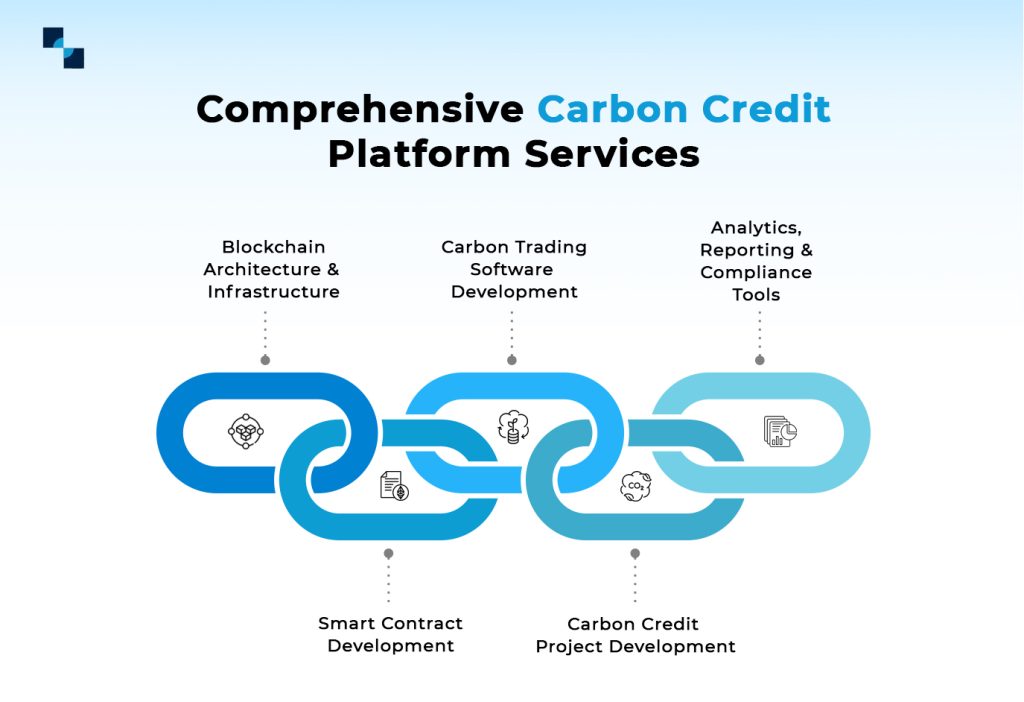
A professional carbon credit platform development company offers end-to-end Carbon credit development services, enabling businesses to build secure, scalable, and compliant carbon trading ecosystems. These services typically include:
1. Blockchain Architecture & Infrastructure
- Design a secure, scalable infrastructure for carbon trading.
- Select the right blockchain type: public, private, or hybrid.
- Ensure high availability and low latency for global users.
2. Smart Contract Development
- Automate issuance, redemption, and trading of carbon credits.
- Define rules for project verification, tokenization, and retirement.
- Enable conditional trading based on regulatory compliance.
3. Carbon Trading Software Development
- Build real-time trading dashboards with market insights.
- Enable multi-currency support, including fiat and cryptocurrencies.
- Provide order book management, transaction history, and reporting tools.
4. Carbon Credit Project Development
- Onboard verified carbon projects (e.g., solar, wind, reforestation).
- Tokenize project outputs into digital carbon credits.
- Implement verification modules to ensure authenticity.
5. Analytics, Reporting & Compliance Tools
- Generate detailed carbon footprint and emission reduction reports.
- Integrate AI-driven analytics for market predictions and trend tracking.
- Ensure regulatory compliance for local and international standards.
These comprehensive Carbon credit development services help organizations streamline operations, ensure transparency, and accelerate the deployment of advanced carbon credit platforms.
Step-by-Step Carbon Credit Platform Development Process
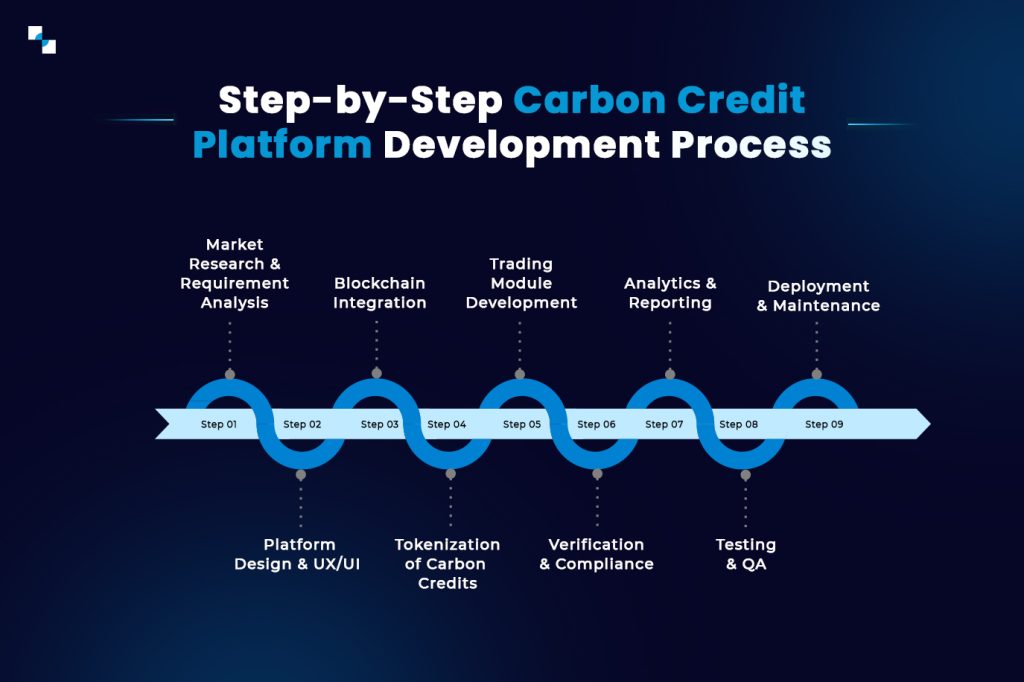
Developing a blockchain based carbon credit platform involves a series of strategic steps:
Step 1: Market Research & Requirement Analysis
- Understand the carbon trading landscape in your target region.
- Identify stakeholders: investors, businesses, government agencies, and NGOs.
- Determine the blockchain framework, trading model, and verification mechanisms.
Engage with environmental consultants to ensure the platform meets global carbon standards.
Step 2: Platform Design & UX/UI
- Create a user-friendly interface for buyers, sellers, and regulators.
- Build MVP prototypes to test core functionalities.
- Ensure responsive design for web and mobile platforms.
A good design simplifies complex carbon trading processes, making the platform accessible to non-technical users.
Step 3: Blockchain Integration
- Choose between public, private, or hybrid blockchain depending on scalability and privacy needs.
- Implement smart contracts for automated issuance, trading, and retirement.
- Ensure data integrity and transparency with cryptographic verification.
Trend Note (2026): Many platforms now integrate layer-2 solutions to reduce blockchain transaction costs and improve performance.
Step 4: Tokenization of Carbon Credits
- Convert verified carbon offsets into digital tokens.
- Define rules for trading, locking, and retiring tokens.
- Ensure project-level transparency for each token.
Tokenization simplifies trading, enabling fractional ownership and cross-border transactions.
Step 5: Trading Module Development
- Build order management systems with real-time market data.
- Enable auction-style trading, direct purchases, and peer-to-peer transactions.
- Integrate payment gateways and crypto wallets for seamless transactions.
This module is critical for attracting traders and investors to the platform.
Step 6: Verification & Compliance
- Integrate AI-powered verification systems to authenticate carbon credits.
- Automate compliance checks against regional and international standards.
- Maintain audit trails for all transactions.
Platforms that reduce manual verification costs gain a competitive edge in carbon markets.
Step 7: Analytics & Reporting
- Offer carbon footprint dashboards for corporate users.
- Provide market trend insights, credit valuations, and emission reduction metrics.
- Enable customized reports for regulators, investors, and NGOs.
Analytics not only help in decision-making but also enhance platform credibility.
Step 8: Testing & QA
- Conduct security testing to prevent hacks or fraud.
- Perform performance testing to ensure smooth trading even under high loads.
- Run user acceptance testing (UAT) to gather stakeholder feedback.
Robust testing ensures trustworthiness, which is critical in financial and environmental applications.
Step 9: Deployment & Maintenance
- Launch the platform on cloud or hybrid infrastructure.
- Offer ongoing support, updates, and feature enhancements.
- Monitor regulatory changes to update compliance modules proactively.
Maintenance ensures the platform remains scalable, secure, and reliable over time.
Essential Features of a Blockchain Carbon Credit Platform
A successful blockchain based carbon credit platform goes beyond basic trading; it must combine security, transparency, automation, and usability. In 2026, businesses and regulators expect platforms that are not only functional but also provide real-time insights, scalability, and compliance assurance. Below is a detailed breakdown of the essential features every platform should have:
1. Immutable and Transparent Ledger
At the heart of every blockchain platform is an immutable ledger, which records all transactions permanently. This ensures:
- Fraud Prevention: Carbon credits cannot be duplicated or double-counted.
- Auditability: Regulators and auditors can trace every transaction back to its source project.
- Stakeholder Trust: Investors, project developers, and corporate buyers gain confidence in the authenticity of credits.
Unlike traditional databases, blockchain eliminates the possibility of tampering, which is a key concern in carbon trading markets.
2. Smart Contract Automation
Smart contracts are programmable protocols that automate the issuance, trading, and retirement of carbon credits. Benefits include:
- Automated Credit Issuance: Verified projects automatically receive tokenized credits once emissions reductions are confirmed.
- Conditional Trading: Trades can only execute if specific compliance or verification criteria are met.
- Retirement Automation: Credits can be automatically retired after use, preventing reuse or fraud.
Smart contracts reduce manual intervention, streamline operations, and make the platform highly efficient for both small businesses and large corporations.
3. Tokenization of Carbon Credits
Tokenization converts carbon credits into digital assets that can be securely traded on the platform. Key advantages:
- Fractional Ownership: Investors can buy smaller portions of credits, enabling participation by small and medium enterprises.
- Cross-Border Trading: Tokenized credits can be traded internationally without reliance on traditional banking systems.
- Integration with DeFi: Innovative financial models like staking or yield farming can be introduced for carbon credits.
Tokenization not only increases liquidity but also opens up the carbon market to a wider audience.
4. Real-Time Trading Module
A robust trading module is critical for a vibrant carbon credit ecosystem. Features should include:
- Order Book Management: Supports limit orders, market orders, and auctions.
- Instant Settlement: Transactions settle in real-time, reducing delays.
- Multi-Currency Support: Accepts fiat currencies, stablecoins, and cryptocurrencies.
- Market Analytics: Shows price trends, demand-supply curves, and credit valuation metrics.
A seamless trading experience attracts more participants, boosting liquidity and market efficiency.
5. Verification and Compliance Tools
Regulatory compliance is non-negotiable in carbon markets. A modern platform should integrate:
- AI-Powered Verification: Uses satellite imagery, IoT sensors, and data analytics to validate carbon offset projects.
- Regulatory Compliance Modules: Tracks international standards like ISO 14064, Verra, Gold Standard, and ensures credits meet local laws.
- Audit Trails: Every credit has a transparent history from issuance to retirement.
By automating compliance, platforms reduce costs, improve reliability, and maintain stakeholder confidence.
6. Carbon Footprint and Sustainability Dashboards
Corporates and investors increasingly demand actionable insights. Features include:
- Emission Tracking: Real-time tracking of emissions and offset progress.
- Impact Reports: Visual dashboards showcasing environmental impact, project performance, and historical credit utilization.
- Customizable Metrics: Users can filter reports based on regions, industries, or project types.
Dashboards turn data into actionable insights, enabling businesses to make strategic sustainability decisions.
7. Multi-Level User Access & Role Management
A carbon credit platform serves various stakeholders: project developers, investors, regulators, and corporate buyers. Essential access features include:
- Role-Based Access Control (RBAC): Defines what actions each user can perform.
- Secure Authentication: Multi-factor authentication (MFA) to protect sensitive data.
- Activity Logs: Tracks all user interactions for accountability and compliance.
Well-defined user access ensures the platform is secure, compliant, and user-friendly.
8. Third-Party Integrations and API Support
Modern platforms must integrate with external services and data sources:
- Carbon Exchanges: Connect to global marketplaces for liquidity and pricing.
- Payment Gateways: Enable seamless fiat and crypto transactions.
- IoT and Remote Sensors: Feed real-time emissions data from offset projects.
- Data Analytics Tools: Support predictive modeling and AI-driven insights.
Integration capabilities ensure the platform remains flexible, scalable, and future-ready.
9. Global Scalability
The platform must be capable of supporting:
- International Projects: Allow projects and investors from different countries to participate.
- High Transaction Volumes: Efficiently handle spikes in trading activity.
- Future Expansion: Add new features, modules, or carbon asset classes without downtime.
Scalability ensures that the platform grows with market demand and remains a trusted global solution.
10. Advanced Analytics and AI Insights
Artificial intelligence and analytics are increasingly embedded in carbon credit platforms to:
- Predict Market Trends: Forecast supply, demand, and pricing fluctuations.
- Assess Project Viability: Identify high-quality projects likely to generate real emission reductions.
- Optimize Trading Strategies: Provide guidance for investors based on historical and predictive data.
AI-powered analytics transform a carbon credit platform from a simple trading hub into a strategic decision-making tool for businesses and regulators alike.
11. Sustainability and ESG Reporting Features
Corporate users often need data for Environmental, Social, and Governance (ESG) compliance:
- Automated ESG Reports: Summarizes emission reductions, project contributions, and sustainability impact.
- Regulatory Submissions: Generates reports in formats compatible with government and international standards.
- Investor Insights: Provides transparency for stakeholders and ESG-focused investors.
Integrating ESG reporting enhances platform credibility and aligns with the rising demand for sustainable business practices.
A fully-featured blockchain carbon credit platform is not just a marketplace; it is a comprehensive ecosystem combining secure trading, automated verification, advanced analytics, and global scalability. By integrating these features, businesses can create a platform that is trustworthy, efficient, and future-proof, capable of meeting the growing demands of carbon-conscious markets in 2026 and beyond.
Carbon Credit Platform Cost Breakdown
Understanding the Carbon credit platform cost is essential before initiating development, as it depends on multiple technical and business factors. Building a blockchain carbon credit platform involves several cost components, including infrastructure, features, integrations, and ongoing maintenance.
| Component | Estimated Cost Range | Notes |
|---|---|---|
| Blockchain Infrastructure | $15,000 – $50,000 | Depends on network type (public/private/hybrid) |
| Smart Contract Development | $10,000 – $40,000 | Complexity and automation level affect cost |
| Carbon Trading Module | $15,000 – $60,000 | Includes dashboards, order book, and payments |
| Verification & Compliance | $5,000 – $25,000 | AI integration and audit modules |
| Analytics & Reporting Tools | $5,000 – $20,000 | Predictive analytics and dashboards |
| UX/UI Design | $5,000 – $15,000 | Mobile and web-friendly design |
| Maintenance & Updates | $2,000 – $10,000 per month | Security patches, scaling, and new features |
Emerging Trends in 2026 Shaping Blockchain Carbon Credit Platforms
The carbon credit ecosystem is undergoing a rapid technological transformation in 2026, driven by the convergence of blockchain, artificial intelligence, and sustainable finance. With the global carbon credit market projected to exceed $785 billion in 2026 and grow significantly in the coming years, innovation is accelerating across trading, verification, and compliance systems. Below are the most impactful trends redefining how blockchain based carbon credit platforms are built and scaled:
1. AI-Powered Carbon Verification and Monitoring
One of the most critical advancements in 2026 is the integration of AI-driven Measurement, Reporting, and Verification (MRV) systems. Traditional verification methods are slow, manual, and prone to inconsistencies.
Today, platforms are leveraging:
- Satellite imagery and remote sensing to monitor forests, land use, and carbon sinks
- IoT sensors for real-time emission tracking from industrial projects
- Machine learning models to validate emission reductions and detect anomalies
This shift significantly improves accuracy, speed, and trust in carbon credit issuance. Research shows that combining AI with blockchain ensures real-time validation and fraud prevention, solving long-standing issues like double-counting and unverifiable claims. Additionally, companies are increasingly adopting AI-powered monitoring to ensure high-integrity carbon credits, which directly impacts pricing and investor confidence.
2. Rise of Tokenized Carbon Marketplaces
Carbon markets are rapidly evolving into fully digital, tokenized ecosystems. Instead of static registries, modern platforms tokenize carbon credits into tradable digital assets.
Leading global exchanges such as:
- Intercontinental Exchange
- Xpansiv
- AirCarbon Exchange
They are already shaping the future of next-generation carbon trading infrastructure.
Key innovations in tokenized marketplaces include:
- Fractional ownership of carbon credits, enabling retail participation
- 24/7 global trading without traditional financial barriers
- Instant settlement and improved liquidity
- Programmable assets via smart contracts
This trend is democratizing carbon markets, allowing SMEs and individual investors to participate alongside large corporations.
3. Integration with ESG and Climate Reporting Systems
Environmental, Social, and Governance (ESG) compliance is no longer optional; it is a core requirement for businesses in 2026. Modern carbon credit platforms are integrating directly with ESG reporting frameworks, enabling:
- Automated sustainability reports aligned with global standards
- Real-time carbon footprint tracking
- Audit-ready compliance data for regulators and investors
This integration allows organizations to move from manual reporting to real-time, verifiable ESG disclosures, significantly improving transparency and accountability. Moreover, enterprises are increasingly using carbon platforms to support net-zero commitments, as stricter regulations and investor expectations continue to rise globally.
4. Expansion of DeFi (Decentralized Finance) in Carbon Markets
The intersection of Decentralized Finance (DeFi) and carbon credits is creating entirely new financial models. In 2026, blockchain platforms will enable:
- Carbon-backed liquidity pools
- Yield farming using tokenized carbon credits
- Decentralized exchanges (DEXs) for carbon trading
- Collateralization of carbon credits in financial products
This transforms carbon credits from static environmental instruments into yield-generating digital assets, attracting crypto-native investors and institutional players alike. DeFi integration also enhances market liquidity, which has historically been a limitation in voluntary carbon markets.
5. Emergence of Carbon Credit NFTs and Digital Assets
Another major trend is the use of Non-Fungible Tokens (NFTs) to represent carbon credits or environmental projects. Unlike fungible tokens, NFTs provide:
- Unique identification of each carbon credit or project
- Proof of ownership and authenticity
- Traceability of environmental impact
Blockchain-based NFT systems are being explored to address greenwashing concerns and ensure that each credit is tied to a verifiable real-world project lifecycle.
This innovation is particularly useful for:
- High-value or premium carbon credits
- Nature-based projects (e.g., rainforest preservation)
- Corporate branding and sustainability storytelling
Streamline your carbon credit development process with a trusted platform partner
Powering transparent and scalable carbon markets with blockchain
Building a Blockchain based carbon credit platform is no longer just a technological upgrade; it’s a strategic move toward sustainability, transparency, and global compliance. As carbon markets evolve in 2026, integrating advanced features, AI-driven verification, and scalable architecture becomes essential for long-term success. Partnering with an experienced Carbon credit platform development company ensures faster deployment, regulatory alignment, and future-ready solutions. Antier is a global technology consulting firm specializing in blockchain, AI, and fintech innovation, delivering end-to-end solutions to help businesses build secure, scalable, and high-performance carbon credit platforms.
Frequently Asked Questions
01. What is the significance of blockchain technology in carbon credit platforms?
Blockchain technology enhances carbon credit platforms by providing immutable transaction records, improving transparency, and streamlining carbon trading, thus addressing issues like fraud, double counting, and operational inefficiencies.
02. What challenges do traditional carbon credit systems face?
Traditional carbon credit systems struggle with fraud and double counting, opaque processes, manual verification bottlenecks, and limited scalability, which can undermine stakeholder confidence and operational efficiency.
03. What does the guide on building a blockchain-based carbon credit platform cover?
The guide provides a comprehensive walkthrough of the development process, essential features, cost considerations, and best practices for successfully deploying a blockchain-based carbon credit platform.