




AI Summary
- In a significant shift within the video game industry, the rise of on-chain games is revolutionizing traditional gameplay dynamics.
- These blockchain-based games offer unparalleled transparency, fair reward systems, and direct asset ownership for players.
- By utilizing smart contracts and decentralized logic, on-chain games eliminate the trust barrier between studios and gamers, providing complete visibility and verifiability of in-game actions.
- The U.S.
- gaming market, driven by a demand for real digital ownership and regulatory scrutiny, is primed for on-chain disruption.
The traditional video game industry, historically powered by centralized servers and opaque economic models, is experiencing a structural change. The driving force behind this change is on-chain games—or games that are mostly or fully played on a blockchain. This does not just mean you have NFT or tokenized assets; rather, games built on fully transparent, decentralized logic, where gameplay, rewards, ownership, and interactions are immutably recorded on-chain.
As trust, fairness, and sustainability take center stage in the U.S. market, the rise of on-chain gaming is prompting serious interest across the spectrum—from gamers and developers to global investors and AAA game development studios.
What Are On-Chain Games?
On-chain games are blockchain-based games where core game mechanics, which could involve battles, item generation, trading, rewards, etc., are executed via smart contracts directly recorded and finalized on the blockchain. This differs from traditional games where a centralized server executes all these mechanics, including body motor movement, trading, monetization, etc.
This development is especially appealing to AAA developers who are attempting to rebuild player trust through disclosure in design. As a result, an increasing number of AAA game development projects are pursuing hybrid models that use on-chain logic to govern the rules/parameters of player rewards, tokenomics, and asset ownership, while the rendering and heavy computing remain off-chain.
Simply put, on-chain games provide you with:
- Complete transparency of every transaction or action
- Immutable gameplay history
- Verifiable fairness through publicly auditable code
- Direct asset ownership for players
This model eliminates the trust barrier that has historically existed between studios and gamers. Every move, every win, and every loss is recorded and verifiable.
Why Transparent Economies Matter in Gaming
Traditional game systems involve you investing an excessive amount of time and money, while publishers allow you to own in-game assets, you still don’t legally own real property.
Publishers can alter game rendering or mechanics, delete a server, ban an account—and poof, all of the virtual wealth you built overnight can mean nothing.
On-chain games are solving this with transparent economies:
- Ownership: Players truly own their items as NFTs or tokens on a wallet they control.
- Tradability: Assets can be freely traded in open marketplaces.
- Fairness: Random number generators (RNGs) and reward systems are executed via smart contracts and are publicly verifiable.
- Community Governance: Many on-chain games allow token holders to vote on game updates, balancing changes, and economic policies.
That kind of assurance gives players visibility and trust, and this represents two key factors to help with retention problems in the U.S. gaming ecosystem.

Why the U.S. Gaming Market Is Geared Up for On-Chain Disruption
The mature user base, high revenue potential, and deep-rooted tradition within the U.S. gaming industry are bringing to the forefront an increasing level of scrutiny vis-a-vis microtransaction mechanisms, loot box regulations, and potential data privacy issues. Either through emerging frameworks, policy development, or the emerging skepticism by players, new factors are emerging, ushering in the potential for alt/disruptive, transparent on-chain alternatives.
Key Market Signals:
- Over 65% of U.S. gamers now express interest in games that offer real digital ownership.
- Regulatory movements (like loot box scrutiny in several U.S. states) are pushing studios to rethink monetization models.
- High-profile hacks and server shutdowns have increased the call for tamper-proof, decentralized systems.
As a result, on-chain gaming is no longer experimental—it is being actively explored by forward-looking developers and venture capitalists.
Role of AAA Game Developers in On-Chain Gaming
Previously, blockchain games had an experimental reputation and were primarily associated with indie studios. However, that narrative is changing quickly. AAA game developers and studios are starting to take interest, and with their large ecosystems, they have the opportunity to explore the possibilities offered by on-chain infrastructure.
Reasons for game Developers to get interested:
- Monetization Re-imagined: On-chain logic opens up a different monetization model utilizing fractional royalties and player-to-player trading economies.
- Player Retention: Studios will be able to create long-term engagement with players if they own the assets and participate in governance.
- Cross-Platform compatibility: on-chain assets will be portable from within the metaverse or other blockchain games, creating a further ecosystem advantage.
Game studios involved in AAA game development are increasingly adopting hybrid models – that involve putting some portion of the game’s logic or economy (marketplace, battle rewards) on-chain to build trust while maintaining the performance of the product.
Learn the top reasons to build AAA games in 2025.
Key Components of On-Chain Game Architecture
1. Smart Contracts
Identify game mechanics, reward schemes, and economy logic. These are deployed on public chains like Ethereum, Avalanche, or Polygon.
2. Decentralized Storage
Platform integrations like IPFS or Arweave are typically integrated to store metadata and dynamic assets (e.g. maps or player states).
3. Wallets
Players access the game with their crypto wallets to sign on, hold in-game assets, and vote in governance.
4. Tokenomics
On-chain economies are built off fungible tokens (for utility and rewards) and non-fungible tokens (for items and other on-chain characters). These tokens often have liquidity in the real world.
Challenges to Adoption—And How They’re Being Solved
While promising, the transition to on-chain gaming is not without friction:
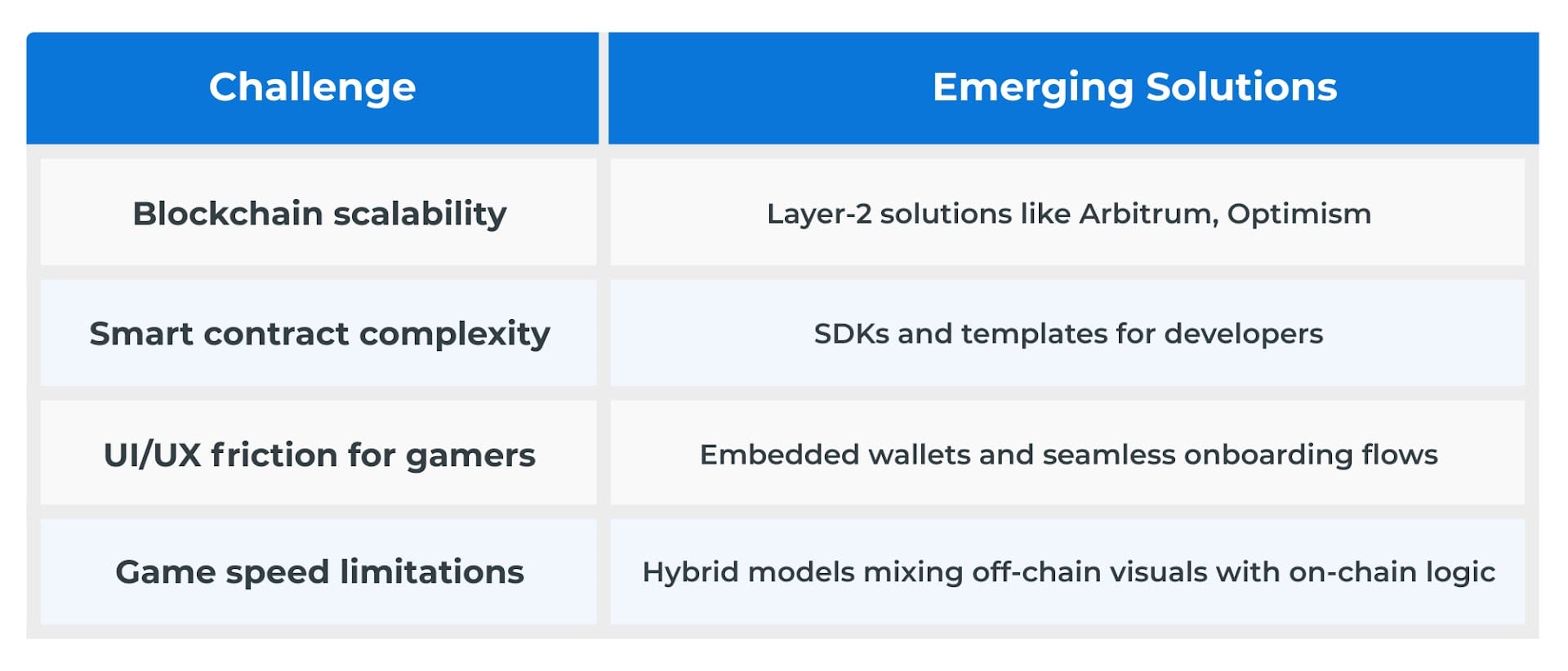
AAA game developers are crucial to solving these problems at scale by integrating blockchain infrastructure with proven gaming engines like Unity and Unreal.
The Future Outlook: Is Full On-Chain the New Normal?
While not every game will be 100% on-chain, the trajectory is clear. Core elements like item ownership, governance, and reward distribution are moving toward decentralization.
As AAA game development integrates these principles, we can expect a hybrid wave where:
- Core economies run transparently on-chain
- Game assets are owned and traded across ecosystems
- Communities participate in both gameplay and policymaking
This evolution not only enhances gameplay but creates an equitable environment for players, developers, and investors alike.
The shift to on-chain games is a culture shift, not just a technology shift. Players want the fairness they expect in other entertainment, investors want transparency, and developers want scalability. On-chain game development aligns with all three. And as we see more AAA game developers implement blockchain-based models, we are that much closer to a world in which code—not corporations—dictates the terms of play.