



AI Summary
- Transforming the U.S.
- workforce, the metaverse is revolutionizing training with engaging simulations and immersive experiences.
- As the U.S.
- leads in metaverse-based reskilling, key drivers include government-enterprise collaborations and innovative adoption.
- Benefits of metaverse platforms for education include increased engagement, personalized feedback, scalability, and gamification.
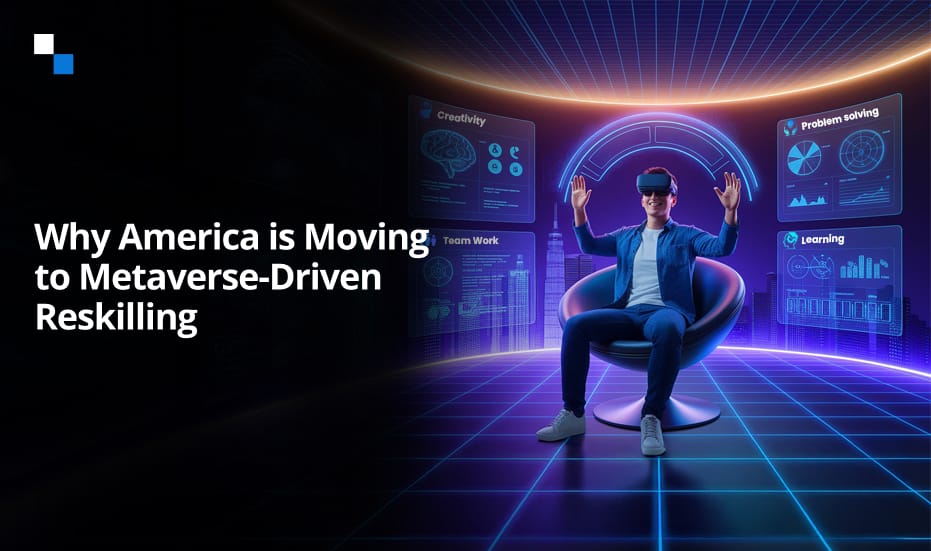
The shift to digital-first operations has fueled an unprecedented demand for agile, technology-enabled workforce training in the United States. Providing immediate interactivity, immersive learning, and collaborative simulations, the metaverse is now trumpeting in a reskilling revolution for a myriad of industries in the U.S.
As projected, the U.S. will be responsible for most of the $1.4 billion metaverse education revenue globally by 2025. The surge is primarily driven by early adopters and their investments in metaverse education platform development that allows companies to train quicker, smarter, and better than ever before.
Why Is the U.S. Leading in Metaverse-Based Workforce Reskilling?
The combination of a future-ready workforce, enterprise-level tech adoption, and an economy built on innovation positions the U.S. as a leader in immersive education.
Key Drivers:
- Government and enterprise collaboration: U.S. governments are working alongside private enterprises to create economic and regulatory incentives that support digital learning activities. Grant types of programs and tax efforts are allowing enterprises to invest in immersive technologies.
- Enterprise innovation: U.S. enterprises have gained a reputation for adopting innovative technologies faster than other organizations. With the Metaverse and associated NFT platforms supporting enterprise LMS platforms, organizations can build personalized training environments at scale.
- A diverse workforce: An increasingly multigenerational and multinational workforce has increasing demands to access training, and training should be flexible, inclusive, and supportive. With a diversified Metaverse platform, employees can have new, dynamic experiences that suit their different learning styles.
From Silicon Valley tech firms to New York’s financial powerhouses, organizations are championing the shift from traditional classrooms to interactive digital campuses.

What Are the Key Benefits of Using a Metaverse Platform for Education?
As the need to digitally upskill the workforce rapidly increases, traditional training methods usually suffer in areas of engagement, personalization, and scalability. Many businesses simply do not have programs that can deliver these elements to learners. Metaverse education platforms are different in that they use fully immersive experiences to fully engage learners and bring education to life. They also provide a way to remove the limitations placed on learning content and instructional delivery in the physical space of a classroom. Education immersed in a simulated real world takes the consumption and dictation out of learning and brings learners together to “learn-by-doing.” Companies in the U.S. (and across every industry) are already beginning to explore metaverse education platform development as a training solution to improve training efficiency, training knowledge retention, and a future-ready workforce. The visual identity of these platforms is not the only benefit they provide. They also provide operational outputs with measurable outcomes, reduced training costs, and enhanced onboarding experiences.
Learn how to build your own virtual space in the metaverse.
Key Benefits include:
1. Increased Engagement
While existing eLearning models and video-based training fail to engage learners, the metaverse provides an exit plan to a realistic scenario for learners to immerse themselves, which is ideal for training. You allow the trainee to engage with virtual tools, avatars, and real-life immersive 3D models that replicate their real working environment. The total involvement of learners during these training events, like using a combination of VR and AR, increased attention during training experiences, will greatly improve learning retention, particularly common to technical and operational roles.
2. Personalized Feedback
By embedding analytics, like with Gamification and AI, the learner receives immediate feedback while going through simulation training. In practical terms, it does not matter if correcting a VPN in healthcare or workflow in manufacturing, which informs instructors, managers, and the learner where a gap exists and quickly understands what content needs changing for further improvement.
3. Scalable Deployment
A core benefit of a metaverse platform for education is its scalability across departments and geographies. Once developed, the training modules can be taken live for employees wherever they are in the world at the same time. That makes for a consistent training experience and minimal downtime.
4. Gamification
The introduction of gaming mechanics such as tracking progress, badges, leaderboards, and rewards morphs a boring training session into an engaging experience. Gamified learning has been found to increase motivation and healthy competition among employees, leading to greater course completion rates.
The ability to scale training deployment and create gamified learning makes metaverse education platform development an invaluable tool in establishing effective, engaging, and future-focused training ecosystems that support the unique adaptation of U.S. enterprises.
Learn How to Build a Scalable Industrial Metaverse from the Ground Up
What Are the Top Industry Use Cases of Metaverse Reskilling in the U.S.?
Across many industries in the U.S., companies are onboarding metaverse platforms in their training ecosystem to create a future-ready workforce. In high-stakes environments like manufacturing and healthcare, and fast-moving worlds such as retail and IT, organizations are creating immersive education that enables them to create real-world environments, to compress training time, and, in turn, empower their employees. Implementation and implementation will look different for each subset of industries, and clearly illustrates metaverse education platform development cannot be one-size-fits-all but customizable and engaging for any industry.
- Healthcare: Virtual avatars and digital twins are being used by medical facilities to imitate surgeries and patient care powered by 3D environments. These 3D environments are used to lower error rates and create safe practices.
- Manufacturing: Workers are taking safety training in virtual factories and learning how to operate manufacturing-type equipment and practice dealing with emergency situations without real-life consequences to help ensure minimal downtime and fewer workplace accidents.
- Retail: Sales and customer service training staff take place through immersive virtual stores and practice simulated interactions with customers, visualizing the shop layout, and using interactive modules to learn product knowledge.
- Technology & IT: Engineering and Software staff are collaborating in 3D agile environments, designing solutions for prototype testing and deployment in the three-dimensional Metaverse spaces in real time and less physically distant collaboration.
Such educational uses will be underpinned by purpose-built metaverse education platform development for industry-related training requirements.

How Can Companies Get Started with Metaverse-Driven Reskilling?
Starting a metaverse-driven reskilling process of any kind begins with a distinct vision and strategic plan that reflects the needs of your workforce. U.S. businesses first should assess the current skill gaps and investigate areas where immersive learning will provide the most benefits—whether it’s onboarding, technical upskilling, or leadership development. After assessment, selecting the right development partner with established capabilities in metaverse education platform development to create rich, immersive, and scalable training solutions is important. One way to encourage adoption is to pilot the platform and corresponding immersive learning in a single department or job role.
After piloting, the workforce is able to collect user feedback, optimize the user experiences, and ultimately expand adoption throughout the organization, and/or other departments. A phased approach to piloting immersive solutions will build acceptance amongst users, limit the disruption of multi-department, simultaneous learning innovation, and define the opportunities for long-term ROI through continuous learning innovation.
- Evaluate Skills Gaps: Use analytics, and employee assessments to determine where reskilling needs to be prioritized—especially in areas that are changing quickly such as AI, cybersecurity, or compliance.
- Establish Training Goals: Develop measurable objectives, for example, decreasing onboarding time and increasing customer interaction scores.
- Select the Right Partner: Choose a vendor with strong subject matter knowledge, instructional design/substance, and immersive UX.
- Implement Proof of Concepts: Use one department or function and gather feedback from learners and instructors to inform how you might roll out future iterations.
- Scale Up: Create internal champions, improving content along the way before scaling once success metrics are achieved.
Why Metaverse Reskilling is the Future of the U.S. Workforce
The workplace in the United States is on its way to a fundamental transformation from traditional training and learning to immersive reskilling. The benefits of quicker implementation, lower costs, and personalized learning, are driving this transition across various industries. Companies are seeking future-proof methods of training and education, and the metaverse platform for education no longer appears to be just a forward-thinking initiative; rather, investing in its use is a viable strategy and economic directive.
Environmental leaders, people strategy leaders, and innovation officers just can’t afford to wait. Give your workforce a fighting chance, develop your talent pipeline, and harness immersive education’s value.
See how Antier helps U.S. companies integrate future-ready training infrastructure. Book a free demo now.