



✨ AI Summary
- In 2025, the global stablecoin market undergoes a transformative shift towards regulated compliance.
- The GENIUS Act and the STABLE Act in the USA establish a comprehensive federal framework for stablecoin issuance, emphasizing accountability and legal clarity.
- Compliance is now a strategic advantage for founders, enhancing market credibility and long-term success.
- The Acts outline strict standards for reserve management, transparency reports, third-party audits, and consumer protections.
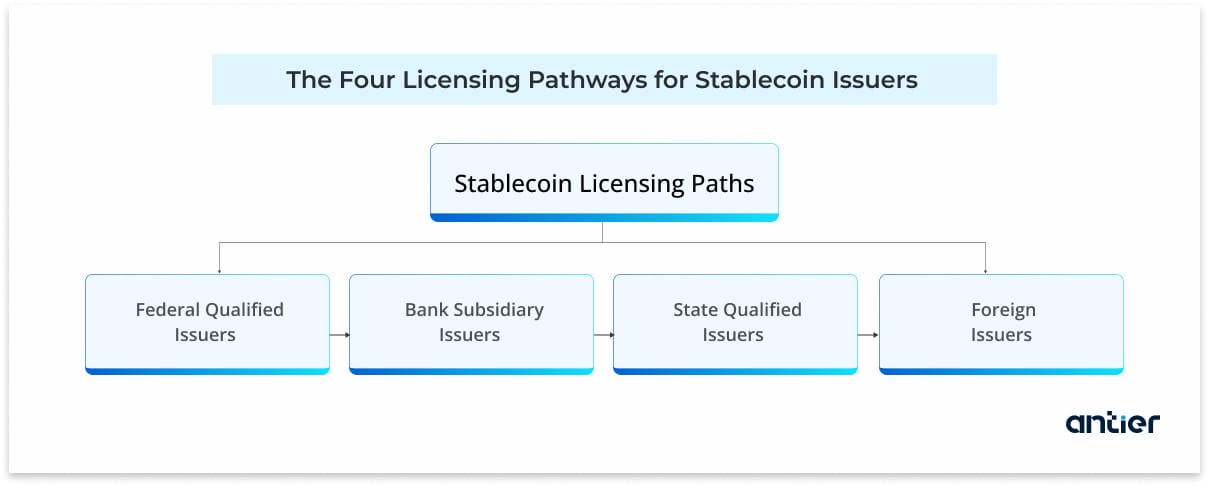
- Different licensing pathways, including federal qualification, bank subsidiaries, state qualification, and foreign issuers, offer founders options for navigating the regulatory landscape.
2025 is a defining moment for the global stablecoin development market. What was once a grey area of experimentation has evolved into a regulated financial frontier with clear legal pathways, institutional-grade compliance, and accountability. The transition from uncertainty to structured compliance has been rapid.
The GENIUS Act and the competing STABLE Act are introducing the first comprehensive federal stablecoin framework in the USA. At the same time, MiCA enforcement in Europe and emerging regulations in Singapore and the UAE are setting globally aligned standards. Founders who treat compliance as a strategic advantage position their projects for wider adoption, strong market credibility, and long-term success. Those who do not adapt risk losing access and relevance.
Let’s explore compliant stablecoin issuance and practical strategies for navigating the global regulatory landscape in our latest blog.
2025: When Stablecoin Issuance Became a Compliance-Driven Industry
On February 4, 2025, the U.S. Congress introduced two parallel bills, the Guiding and Establishing National Innovation for U.S. Stablecoins (GENIUS) Act and the STABLE Act. Together, these created a dual legislative approach that reshaped the regulatory foundations for the issuance of digital currency.
The goal? To define “payment stablecoins” not as speculative crypto assets but as regulated payment instruments, redeemable 1:1 for fiat value. Both Acts also ensure that stablecoins are not treated as securities, removing the SEC’s oversight and instead positioning them under federal and banking supervision.
This dual-track legislative evolution finally answers the industry’s biggest question: Who should regulate stablecoins, and how? The answer now lies in licensing pathways that align with business models, offering founders multiple routes to compliance, from federal-qualified issuers to bank-affiliated issuers, and even foreign entities seeking entry into the U.S. market.
Inside the GENIUS and STABLE Acts: What Founders Must Understand
The GENIUS Act represents a forward-looking attempt to encourage innovation while enforcing a nationally consistent regulatory structure, overseen by the Office of the Comptroller of the Currency (OCC). It aims to give clarity to innovators by creating a standardized path for stablecoin issuance under federal oversight.
The STABLE Act, in contrast, prioritizes financial supervision and consumer protection. It pushes for greater transparency, emphasizing that every circulating stablecoin must be verifiably backed and redeemable at all times. While GENIUS is innovation-driven, STABLE is risk-aware; together, they shape a dual framework that rewards projects combining technical excellence with financial accountability.
Despite their different philosophies, both Acts converge on a set of shared compliance fundamentals that every issuer must now treat as non-negotiable:
- Both the GENIUS and STABLE Acts set uncompromising standards for reserve management. Stablecoins must maintain 1:1 backing in U.S. dollars, Treasury bills with under 93-day maturity, or approved money market funds.
- Monthly transparency reports signed and certified by CEOs and CFOs, offering a clear window into reserve composition and circulation data.
- Mandatory third-party audits for large issuers managing more than $50 billion in stablecoin circulation, ensuring continuous oversight and risk mitigation.
- Strict consumer disclosures and redemption rights, allowing users to redeem at par value and understand the financial and operational structure of the issuer.
For founders, these requirements signal a complete evolution of the stablecoin landscape. Stablecoin issuance is no longer just about deploying smart contracts or maintaining collateral pools. It now mirrors the discipline, documentation, and governance expected from licensed financial institutions.
This shift has elevated the need for strategic collaboration with a stablecoin development company that understands both technology and regulation. With evolving frameworks and compliance dependencies across jurisdictions, technical architecture alone is no longer enough. Founders need partners capable of embedding regulatory alignment, audit readiness, and reserve management systems directly into the stablecoin’s core infrastructure.
See how our architecture aligns with GENIUS, & STABLE frameworks from day one.
The Four Licensing Pathways for Stablecoin Issuers
Understanding each of these four routes ensures your project aligns with legal requirements while positioning for sustainable growth.
- Federal Qualified Issuers (OCC Supervised)
Federal Qualified Issuers operate nationally under the OCC; the same authority supervises national banks. This pathway requires issuers to implement full AML/KYC programs, capital adequacy protocols, cybersecurity frameworks, and real-time reserve reporting systems.
The major advantage of federal qualification is state preemption. Issuers are exempt from individual money transmitter licenses in each state, enabling seamless national operations. This makes it an ideal path for projects aiming at institutional adoption, cross-state payment solutions, or global investor credibility. While compliance requirements are rigorous, partnering with a stablecoin development company ensures your infrastructure meets federal standards from day one.
- Bank Subsidiary Issuers
Traditional banks can issue stablecoins through subsidiaries, leveraging existing regulatory oversight from their primary federal regulator. This model is particularly appealing to legacy financial institutions entering blockchain markets because it builds on already established capital reserves, auditing protocols, and risk management frameworks.
Bank subsidiaries offer instant credibility with institutional clients and regulators, making them attractive for collaborations or co-branded stablecoin projects. However, issuers must still maintain compliance with stablecoin-specific legislation, requiring integration of monitoring systems, transaction reporting, and reserve transparency.
- State Qualified Issuers
Smaller issuers under $10 billion in market cap can utilize state-level licensing frameworks considered “substantially similar” to federal standards. This pathway functions as an on-ramp for startups, allowing compliance while scaling gradually.
State-qualified issuers must adhere to AML/KYC standards, maintain reserve transparency, and provide consumer disclosures. The scaled regulatory intensity supports innovation while enabling the development of operational infrastructure that can later transition to federal qualification. A stablecoin development services provider can help automate reporting, risk management, and reserve monitoring, ensuring smooth scalability across jurisdictions.
- Foreign Issuers
Non-U.S. projects entering the American market must prove comparable regulation in their home jurisdiction and comply with U.S. enforcement conditions. This pathway supports cross-border expansion while ensuring consumer protection parity.
Foreign issuers often benefit from building compliance into their stablecoin architecture early. Strategic partnerships with experienced stableocin development providers ensure adherence to U.S. and international standards, helping projects avoid regulatory pitfalls while capturing global market opportunities.
Each licensing pathway reflects the maturation of the U.S. regulatory landscape, offering scalable access while requiring banking-grade transparency, robust compliance programs, and operational resilience. Selecting the right model is both a strategic and technical decision that can define a project’s long-term success in the regulated stablecoin ecosystem.
Global Regulatory Stablecoin Development Shifts
While the U.S. develops dual legislative routes, the rest of the world is not standing still. Let’s look at how the most influential regions are reshaping stablecoin regulation:

European Union: MiCA Enforcement in Action
- The Markets in Crypto-Assets (MiCA) framework has moved from policy to enforcement. By March 2025, exchanges like Kraken, Crypto.com, and Coinbase delisted non-compliant stablecoins, including USDT and PYUSD.
Circle’s MiCA-compliant EMI license in France has become the gold standard, setting a precedent for how issuers can access all EU member states with a single authorization.
United Arab Emirates: Regulation Meets Innovation
- The UAE emerged as a progressive hub with its Fiat-Referenced Tokens (FRT) framework under the Abu Dhabi Global Market (ADGM) and the Central Bank of the UAE. The launch of AE Coin, the first dirham-pegged stablecoin, reflects the nation’s push to lead the regulated digital asset economy.
This clarity has attracted major players; Tether’s UAE expansion and Circle’s regional partnerships underline the region’s growing dominance in compliant stablecoin ecosystems.
Singapore: Precision and Tiered Compliance
- The Monetary Authority of Singapore (MAS) introduced a tiered structure for stablecoin regulation, classifying issuers by token circulation and licensing them as major payment institutions or digital payment token service providers.
Singapore’s model is globally recognized for its sophistication and balance — enabling innovation while demanding transparent, fully backed reserves.
El Salvador and Latin America: The Competitive Frontier
- El Salvador has gone beyond Bitcoin with the approval of Alloy (aUSDT), a gold-backed stablecoin issued under formal government supervision. With Tether relocating its headquarters there, Latin America is rapidly evolving into a competitive stablecoin innovation hub.
See how we help projects align with U.S., EU, and UAE standards effortlessly.
Stablecoin Compliance Requirements Every Founder Must Address
The new era of stablecoin issuance requires attention to multiple critical areas:
- AML/KYC Programs: Full adherence to the Bank Secrecy Act is mandatory, including comprehensive suspicious activity reporting, sanctions screening, and risk-based monitoring of all transactions.
- Travel Rule Adherence: Founders must ensure collection and transmission of originator and beneficiary information for transactions exceeding $1,000, fully aligning with FATF guidance.
- Consumer Protection: Redemption rights, fees, and terms must be transparently disclosed, providing legal clarity and trust for users.
- Marketing Restrictions: Issuers are prohibited from making claims that imply FDIC insurance, government backing, or equivalence to official currency.
- Interest Prohibition: Stablecoins cannot offer yield or returns to users, ensuring clear differentiation from securities or bank deposits.
Meeting these compliance requirements is essential for legitimacy and operational success. Partnering with a stablecoin development solutions provider allows founders to embed compliance into the token’s architecture, with automated reporting, real-time monitoring, and blockchain-level auditability built into the platform.
Circle’s USDC: Compliance as a Competitive Edge
The Market Challenge
Back in 2018, launching a stablecoin meant navigating an uncertain regulatory environment. Most projects focused solely on blockchain code and collateral, ignoring legal alignment. Circle took a different approach. They asked, How can we build a stablecoin that regulators, institutions, and users all trust?
Circle’s Move:
- Secured 46 state licenses
- Registered with FinCEN
- Implemented AML/KYC programs and transparent reserves
The Result:
Circle achieved early institutional adoption and unmatched market credibility. USDC quickly became the benchmark for compliance and trust in the stablecoin ecosystem.
Lessons for Founders:
- Compliance is infrastructure, not overhead.
- Transparency builds trust with users and investors.
- Legal interoperability enables scaling across jurisdictions.s
Licensing and compliance are the keys to building a perfect stablecoin example, and achieving this level of success is possible with the guidance of a trusted stablecoin development company.
Why a Tech Partner Is Now Your Legal Advantage
Speed alone will not win in stablecoins; strategic thinking does. Founders today need partners that understand both blockchain architecture and financial regulation.
- A trusted stablecoin development company integrates:
- Automated AML frameworks within smart contracts.
- Reserve management dashboards for instant transparency.
- Modular compliance engines adaptable across jurisdictions.
- Scalable token architectures aligned with local regulations.
These innovations allow issuers to transform regulation from a burden into a brand differentiator.
The Road Ahead
2025 has transformed the stablecoin landscape. Stablecoin issuance is no longer a decentralized experiment; it has become an institutional movement backed by global governments and fintech ecosystems. With the GENIUS and STABLE Acts approaching enactment and MiCA enforcement growing stricter, compliant projects are emerging as the new standard-bearers of trust in the digital asset economy.
Founders who seize this opportunity by combining visionary innovation with rigorous compliance will shape the next generation of global payment infrastructure. Those who hesitate risk delisting, restricted access, or becoming obsolete.
Your Next Step
Regulation does not slow progress; it accelerates your path to legitimacy. Partner with Antier, the leading stablecoin development company, with expert legal advisors to ensure full compliance. We build stablecoins with a compliance-first architecture and deliver expert services tailored for the financial ecosystem of tomorrow.
Build your compliant stablecoin today with Antier and turn regulation into your competitive advantage.
Frequently Asked Questions
01. What are the GENIUS Act and STABLE Act?
The GENIUS Act and STABLE Act are two parallel bills introduced in the U.S. Congress that create a comprehensive federal framework for stablecoin regulation, defining them as regulated payment instruments rather than speculative assets.
02. How do the GENIUS and STABLE Acts impact stablecoin issuance?
These Acts provide clear licensing pathways for stablecoin issuers, ensuring compliance with federal and banking supervision, which helps to establish a structured regulatory environment for the stablecoin market.
03. Why is compliance important for stablecoin founders?
Compliance is crucial as it positions projects for wider adoption, enhances market credibility, and ensures long-term success, while non-compliance risks losing access and relevance in the evolving regulatory landscape.