



Artificial intelligence has entered a defining new phase. The competitive conversation is no longer centered solely around model innovation, data volume, or algorithmic breakthroughs. Instead, the question enterprise leaders must now answer is far more foundational:
Is our compute foundation strong enough to scale AI across the business?
In 2026, the AI race has evolved into an infrastructure race – one that demands collaboration with the right AI infrastructure development Company and long-term architectural foresight. Amazon’s $12 billion investment in AI-focused data center campuses in Louisiana reflects a larger global reality: enterprise AI growth now depends on physical and architectural compute capacity.
The message for business leaders is clear: compute strategy defines market leadership.
The Shift from AI Experimentation to AI Industrialization
For years, AI initiatives lived in innovation labs – contained within pilots, proofs of concept, or isolated departmental use cases. Infrastructure requirements were minimal because workloads were temporary and limited in scale.
That reality has fundamentally changed.
AI now operates inside mission-critical systems, powering core operations, customer experience platforms, cybersecurity defenses, supply chain optimization, real-time analytics engines, and generative copilots. These are not experimental environments; they are revenue-generating, risk-sensitive business functions.
This evolution demands a formalized enterprise AI infrastructure strategy.
Deloitte’s 2026 Tech Trends analysis highlights a critical inflection point: the challenge is no longer just training models, but managing the long-term economics and scalability of inference at enterprise scale. As AI becomes operational, compute demand shifts from sporadic experimentation to continuous, production-level execution.
Enterprises must now make deliberate decisions about workload placement, hybrid scaling models, cost governance, and performance optimization.
AI is no longer a tactical deployment.
It is a strategic compute architecture commitment.
Amazon’s $12B Move: A Blueprint for AI-Ready Data Centers
Amazon’s $12 billion investment in new AI-focused data center campuses in Louisiana is more than geographic expansion – it is a signal of where global AI infrastructure economics are heading.
As reported by CNBC and covered in depth by Bloomberg, Amazon is expanding its cloud and AI capacity through purpose-built, next-generation data center campuses engineered for high-density compute workloads. These facilities are designed to support advanced AI applications that demand massive processing power, ultra-fast networking, and scalable energy infrastructure.
This investment reflects:
- Long-term compute capacity expansion
- AI-optimized hardware integration
- Advanced cooling systems built for dense GPU clusters
- Infrastructure tailored for large-scale, real-time AI inference
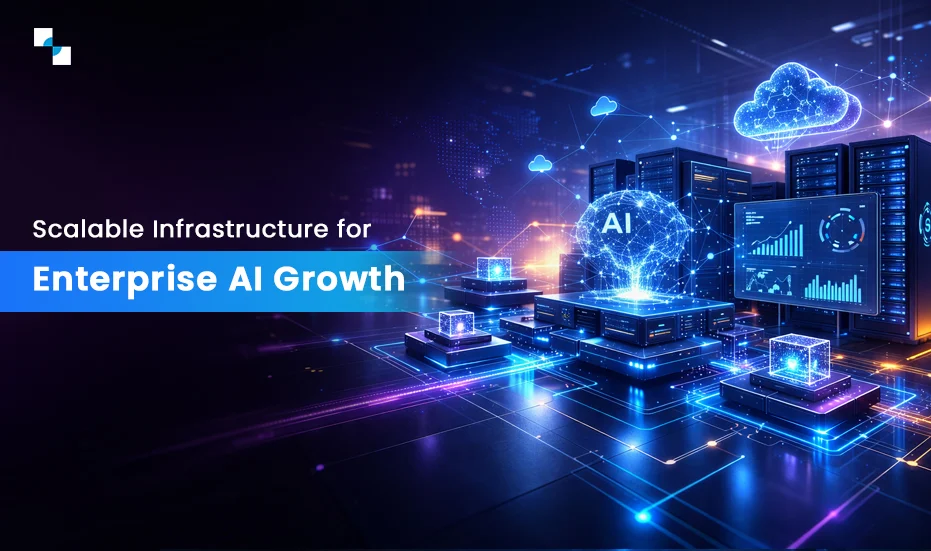
This is what AI-ready data center architecture for enterprises looks like in practice.
Unlike traditional facilities designed for general enterprise IT, AI-optimized data centers are engineered specifically to handle:
- GPU-intensive model training
- High-bandwidth, low-latency interconnects
- Continuous inference workloads
- Distributed real-time data processing environments
Amazon’s strategic expansion reinforces a broader industry truth: AI leadership is no longer defined solely by software innovation – it is secured through physical infrastructure leadership.
Why Compute Architecture Is Now a Strategic Weapon
Modern AI systems, particularly generative AI, real-time analytics engines, and autonomous decision systems, demand far more than virtualized servers. They require a reimagined enterprise compute architecture for AI workloads. Let’s examine why.
1. AI Is Compute-Intensive by Design
Training advanced foundation models can require thousands of GPUs operating simultaneously. Even inference, once considered lightweight, now demands specialized accelerators for high-speed response times.
Organizations that rely on outdated compute environments face:
- Processing bottlenecks
- Latency spikes
- Escalating operational costs
- Infrastructure fragility
AI doesn’t tolerate inefficiency. It exposes it.
2. Real-Time AI Changes Infrastructure Requirements
AI is increasingly embedded in live environments:
- Fraud detection in financial services
- Predictive maintenance in manufacturing
- Personalized product recommendations in e-commerce
- AI copilots in enterprise workflows
These applications require infrastructure for real-time AI, not batch-processing systems designed for overnight analytics.
Real-time AI demands:
- Ultra-low latency networking
- Edge integration capabilities
- Distributed processing
- Seamless scalability
According to TechRepublic’s enterprise AI coverage, many organizations struggle to transition AI from pilot to production because their compute, storage, and networking layers weren’t designed for production-grade workloads, creating bottlenecks that delay or derail deployments.
3. Energy, Cooling, and Sustainability Are Now AI Variables
One often overlooked aspect of AI infrastructure is energy intensity. AI workloads consume significantly more power than traditional enterprise systems.
Modern AI-optimized facilities incorporate:
- Advanced liquid cooling systems
- High-density rack configurations
- Renewable energy integration
- Intelligent power distribution networks
Amazon’s Louisiana campuses are expected to include significant utility and infrastructure upgrades – including new electrical systems funded in partnership with Southwestern Electric Power Company and up to $400 million in water infrastructure improvements to support high-performance operations.
The AI era is also an energy era. Infrastructure planning must integrate sustainability, resilience, and cost efficiency simultaneously.
The Rise of a Formal Enterprise AI Infrastructure Strategy
What separates AI leaders from followers is not experimentation – it is architectural foresight. A strong enterprise AI infrastructure strategy includes:
- Strategic Capacity Planning
Forecasting compute requirements aligned with AI adoption roadmaps.
- Hybrid & Multi-Cloud Alignment
Balancing hyperscale cloud, on-premise systems, and edge environments.
- Cost Governance Models
Monitoring inference economics to prevent uncontrolled compute spend.
- Security by Design
Embedding zero-trust principles into AI workloads and data flows.
Workload Placement Intelligence
Running the right workloads on the right platforms for performance and cost optimization.
Without a structured strategy, enterprises face:
- Siloed AI deployments
- Fragmented compute environments
- Rising operational costs
- Limited scalability
Infrastructure must move from reactive to predictive.
Why Enterprises Are Turning to Specialized Partners
Designing, deploying, and optimizing AI infrastructure is not trivial. It requires deep expertise across hardware, orchestration, networking, and AI deployment pipelines.
This is why organizations increasingly collaborate with experienced:
- AI infrastructure development companies
- Enterprise AI development companies
These partners help enterprises:
- Architect scalable compute frameworks
- Optimize GPU utilization
- Design resilient multi-cloud ecosystems
- Integrate AI seamlessly into enterprise environments
Infrastructure transformation is complex, but strategic partnerships reduce risk and accelerate deployment timelines.
The Economic Implications of AI Data Center Expansion
Large-scale AI infrastructure investments are signaling a structural transformation in the global economy. Compute capacity is becoming a strategic asset influencing energy markets, semiconductor supply chains, regional talent hubs, and capital allocation priorities.
Enterprises are no longer simply purchasing software licenses; they are competing for sustained access to scalable compute ecosystems. As AI adoption accelerates, infrastructure availability, performance efficiency, and cost governance increasingly determine which organizations can innovate reliably at scale.
The deeper shift is this: AI infrastructure is becoming industrial infrastructure.
Just as railroads powered manufacturing growth and broadband enabled digital commerce, AI-ready compute environments now form the backbone of competitive enterprise ecosystems. Organizations that recognize infrastructure as strategic capital, not operational overhead, will define the next decade of market leadership.
What Enterprise Leaders Must Do Now
Infrastructure decisions can no longer be deferred to IT roadmaps. They must sit at the center of enterprise AI strategy. To remain competitive in the Infrastructure Era of AI, leaders should:
1. Conduct a Compute Readiness Assessment
Identify architectural bottlenecks, GPU constraints, latency risks, and cost inefficiencies that could limit AI scale.
2. Formalize an enterprise AI infrastructure strategy
Align infrastructure investment with long-term AI adoption plans, ensuring compute capacity grows alongside business ambition.
3. Redesign enterprise compute architecture for AI workloads
Move beyond retrofitting legacy systems. Build environments purpose-designed for training, inference, and hybrid scaling.
4. Build a dedicated infrastructure for real-time AI
Enable low-latency, production-grade AI systems that operate within mission-critical workflows.
5. Partner with AI Infrastructure Experts
Work with specialists who can design scalable compute environments and ensure your infrastructure supports sustainable AI growth.
The organizations that act decisively will turn infrastructure into a growth multiplier. Those who delay will find their AI ambitions constrained by architectural limits.
The New Definition of AI Leadership
AI leadership in 2026 is no longer measured by isolated model innovation, but by the strength and scalability of enterprise compute foundations. As AI shifts from experimentation to industrialization, competitive advantage depends on a well-defined enterprise AI infrastructure strategy and a purpose-built enterprise compute architecture for AI workloads. Organizations that invest in AI-ready data center architecture for enterprises and build infrastructure for real-time AI position themselves to scale efficiently, control costs, and sustain performance.
In this new era, infrastructure is not operational support – it is strategic capital. Market leaders will be those who align compute capacity with long-term business vision. Aniter, an enterprise AI development company, helps organizations design, deploy, and optimize scalable AI systems that deliver resilient, production-grade performance and measurable business impact.