



AI Summary
- Tokenization is transforming the management of real-world assets by enhancing liquidity and accessibility.
- However, the key to successful tokenized ecosystems lies in robust infrastructure that ensures trust, reliability, and compliance.
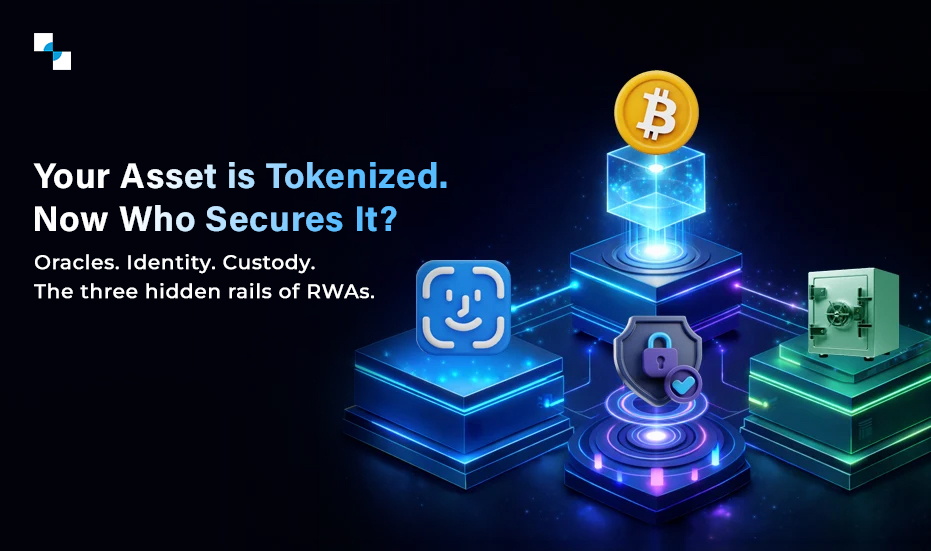
- This involves a layered approach with components such as oracles, identity verification, and custody to maintain data accuracy, participant verification, and asset security.
- Oracles bridge on-chain and off-chain data sources, while identity layers enable compliant participation and programmable access controls.
- Custody layers secure both physical and digital assets, ensuring ownership rights and regulatory compliance.
Tokenization is revolutionizing the world of issuing and managing real-world assets. Tokenizing assets, whether they are real estate and private equity, or debt and commodities, opens up possibilities for greater liquidity and global access. However, the real power of tokenized ecosystems cannot be solely attributed to token issuance; it comes from the system infrastructure that guarantees trust, reliability, and compliance.
At the heart of this transformation is a robust tokenization infrastructure that connects blockchain logic with real-world systems. Without this foundation, tokenized assets risk becoming disconnected from their underlying value, regulatory frameworks, and operational workflows.
With enterprises gradually transitioning into an institutional environment, the focus now turns to implementing digital asset tokenization infrastructure that would allow for scaling and interconnectivity. This is where the invisible rails come into play.
Understanding Tokenization Architecture as a Layered Stack
An effective RWA tokenization architecture is not one solution but rather a series of interconnected layers that perform specific functions. Though smart contracts enable issuing and transferring tokens, they require additional systems to operate efficiently in reality.
These systems comprise the core tokenization ecosystem components, that guarantee accurate data, participant verification, and secure assets. It combines the advantages of the existing traditional financial systems while making use of blockchain.
The properly implemented layer-based framework makes it possible to ensure that:
- Real-world data is consistently reflected on chain
- Only compliant participants can interact with assets
- Ownership and asset security are never compromised
Without this approach, there would be no chance to scale tokenization beyond experiments.
1. Oracle Layer: Bridging On-Chain and Off-Chain Data
The oracle layer is essential for establishing a direct connection between digital assets and their value in the physical world since the blockchain technology itself has no means of retrieving data from outside its environment.
2. Reliable Data Aggregation and Validation
Since tokenized solutions require a certain amount of trust and precision, it would be unwise to have data provided by just one single source of information. Instead, an oracle network should combine inputs about market prices, financial statements, and other information related to the value of the tokenized asset.
Data validation procedures make sure that smart contracts work only with inputs approved by consensus-based methods and thus prevent any manipulation.
3. Real-Time and Event-Driven Synchronization
Tokenized solutions can benefit from oracles using two different approaches based on the kind of the use case. One option involves regular updates of a certain indicator (for instance, price feed). Another requires the update of information once an event occurs (dividends distribution, loan repayment, maturation date).
Depending on the requirements, the oracle layer should be capable of both feeding the smart contract with data constantly and triggering smart contracts’ actions once an event occurs.
4. Security, Redundancy, and Decentralization
The stability of the oracle system plays a major role in the safety of the whole network. It is because centralized or malfunctioning oracles may pose security risks such as tampering with data or making it unavailable.
In order to counter this problem, today’s oracle systems use decentralized models whereby a number of separate nodes provide data sources. In addition, redundancy ensures that even in case some data sources fail, there are backups to keep things running.
A professional RWA tokenization development company prioritizes these design principles to build oracle systems that are resilient, tamper-resistant, and aligned with enterprise-grade requirements.
Build Your Tokenization Infrastructure Today
Identity Layer: Enabling Compliant Participation
This layer provides assurance that tokenized networks will comply with worldwide regulatory standards, as well as ease access for users. Unlike conventional blockchain platforms that prioritize anonymity, tokenized financial systems have to rely on verified identities to work within legal frameworks and security guidelines.
1. Integration of KYC & AML/IV Processes
At the heart of the identity layer lies KYC and AML processes. These include identity verification, risk assessment, and other activities necessary to ensure that users comply with regulatory standards.
In tokenized environments, such verification cannot be applied at once. This process continues during the entire lifetime of users, ensuring that only those who comply with all the requirements can use certain assets or services. For instance, an investor has to be verified as accredited before they gain access to specific resources.
2. Programmable Compliance and Access Controls
One of the main strengths of tokenization involves compliance embedded into smart contracts. By combining identity and wallet information, the system can easily control transactions.
This implies limiting access to:
- Jurisdictional regulations
- Investor type or accreditation status
- Asset-specific compliance requirements
Such programmable compliance eliminates manual oversight and reduces the risk of regulatory violations, making the system more efficient and scalable.
3. Privacy-Preserving and Decentralized Identity Models
With the emergence of new identity systems, there is an increasing concern about achieving a balance between compliance and user privacy. DID protocols help users retain ownership of their credentials without having to give away more than is required to validate their eligibility.
The use of zero-knowledge proofs makes it possible for users to demonstrate their eligibility without revealing any personal information. Besides enhancing privacy, such methods also make the verification process seamless.
This trend is reflected in organizations providing RWA tokenization development services.
Custody Layer: Securing Tokenized Assets and Keys
The function of custody provides for the protection of the assets themselves as well as their digital counterparts. Within a robust RWA tokenization architecture, custody becomes one of the basic aspects.
1. Dual Custody: Asset and Digital Key Management
A dual responsibility arises with tokenization, requiring custody solutions for physical or financial assets in order to ensure proper structure and ownership while also protecting the digital counterpart through its keys.
This dual-layer approach ensures that ownership rights are enforceable both on-chain and off-chain, forming a critical pillar of digital asset tokenization infrastructure.
2. Advanced Security Models in Digital Asset Tokenization Infrastructure
In order to protect digital assets from theft or misuse, various security techniques become applicable. Multi-signature wallets require approval from more than one person prior to carrying out any transactions.
Multi-party computation (MPC) extends this model to a degree, providing security from threats by distributing control over the system among multiple parties. Finally, hardware security modules (HSMs) provide secure storage for keys.
All of these approaches are crucial for meeting security demands of institutional investors.
3. Regulatory Compliance and Institutional Trust
Custody becomes not only desirable but mandatory within certain jurisdictions. Institutional investors will demand custody that includes transparency, insurance, and legal compliance.
Regulated custodians fulfill this role by offering audited processes and secure asset management practices. Their involvement enhances credibility and accelerates adoption of tokenized assets across traditional financial markets.
Designing a Future-Ready Tokenization Infrastructure
1. Modular and Composable Architecture
A system that is prepared for the future needs to be designed in such a way that modularity is at its core. In other words, rather than building a platform that is one-size-fits-all, companies will need to build separate layers such as smart contract layer, oracle integration layer, identity layer, and custody layer.
The benefits of modular architecture include:
- Upgrading certain parts of the system without impacting the rest of the system
- Incorporating new technology developments such as better oracle networks or identity solutions
- Customizing the solution according to asset class or jurisdiction
2. Interoperability Across Chains and Financial Systems
These assets will not function as standalone products. They have to work with several blockchains, financial frameworks, and service providers like custody, exchange, and payment channels.
What does the system need to be ready for the future?
- Cross-chain interaction and transfer capabilities
- Integration with legacy finance infrastructure (banking system, ERP systems, etc.)
- Marketplace liquidity for these assets
Interoperability is not just necessary for easy use but also an essential part of scalability of digital asset tokenization systems.
3. Compliance-by-Design Framework
Regulatory considerations should be incorporated right into the architecture and not considered as an add-on. Compliance by design makes sure that all transactions, users, and movements comply with the law.
This involves:
- Identity verification process (KYC/AML) integrated into onboarding and transaction layering
- Incorporation of jurisdictional laws in smart contracts
- Automation of reporting and audit trails for regulators
This will ensure minimum operational risks and easier scalability of the architecture.
4. Scalable and Secure Oracle Infrastructure
Oracles should be designed to handle increasing volumes of data and transactions without compromising accuracy or speed. As tokenized ecosystems grow, the demand for real-time, reliable data becomes more critical.
A scalable oracle layer should:
- Support high-frequency data updates for dynamic asset classes
- Incorporate redundancy through multiple data providers
- Use decentralized validation mechanisms to prevent manipulation
This ensures that the entire system remains responsive and trustworthy, even under high transaction loads.
5. Institutional-Grade Custody Integration
Custody must meet the expectations of institutional investors, regulators, and asset issuers. This requires integrating secure and compliant custody solutions that protect both underlying assets and digital keys.
A future-ready custody framework should:
- Support advanced security models such as MPC and multi-signature controls
- Provide insurance coverage and regulatory compliance
- Enable seamless interaction with trading platforms and settlement systems
Strong custody integration enhances trust and is a critical enabler for large-scale adoption within the tokenization ecosystem components.
6. Data Privacy and Security Architecture
As tokenization platforms handle sensitive financial and identity data, privacy and security must be foundational. This involves not only protecting data from breaches but also ensuring compliance with global data protection regulations.
Key considerations include:
- Implementing encryption for data at rest and in transit
- Leveraging privacy-enhancing technologies such as zero-knowledge proofs
- Ensuring controlled access through role-based permissions
A well-defined security architecture safeguards user trust and strengthens the overall resilience of the platform.
7. Automation and Smart Contract Orchestration
Automation is one of the biggest advantages of tokenization. A future-ready system should leverage smart contracts to automate complex financial workflows, reducing manual intervention and operational inefficiencies.
This includes:
- Automated dividend or interest distribution
- Real-time compliance enforcement
- Trigger-based execution of financial events
Smart contract orchestration ensures consistency, accuracy, and efficiency across the platform, enabling scalable operations.
8. Scalability and Performance Optimization
As adoption grows, tokenization platforms must handle increased transaction volumes, user activity, and data processing requirements. Scalability should be built into the system from the beginning.
Approaches include:
- Leveraging Layer 2 solutions or sidechains for faster transactions
- Optimizing smart contract design for efficiency
- Implementing load balancing and distributed infrastructure
Performance optimization ensures that the platform can support enterprise-scale operations without compromising user experience.
9. Ecosystem Integration and Liquidity Enablement
A tokenized asset is only as valuable as its accessibility and liquidity. Future-ready infrastructure must integrate with a broader ecosystem of exchanges, marketplaces, and financial services.
This enables:
- Secondary market trading and price discovery
- Integration with DeFi protocols for additional yield opportunities
- Access to global investor pools
By connecting with the wider ecosystem, platforms can unlock the full potential of tokenization and drive sustained growth.
Launch Robust Tokenization Platforms—Faster
Final Thoughts
Tokenization is no longer just about digitizing assets—it is about building systems that can sustain trust, compliance, and scalability over time. The real differentiator lies in the hidden rails that power these ecosystems.
Oracle, identity, and custody layers ensure that tokenized assets remain accurate, secure, and compliant throughout their lifecycle. Together, they form the backbone of modern financial infrastructure.
Enterprises that invest in strong tokenization infrastructure will be better positioned to lead in the evolving digital asset landscape. By leveraging comprehensive RWA tokenization development services, organizations can accelerate their journey toward building resilient, future-ready tokenized ecosystems.
At Antier, we empower enterprises to build secure, compliant, and scalable tokenization platforms backed by deep blockchain expertise. From architecture design to full-stack implementation, our RWA tokenization development company accelerates your journey toward institutional-grade digital asset ecosystems.